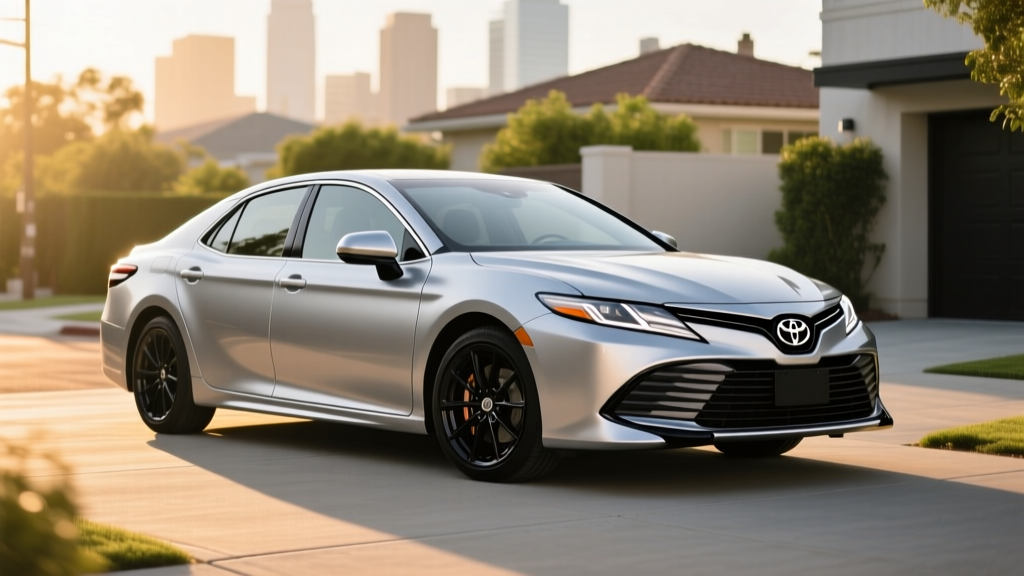
The 2018 Toyota Camry Hybrid remains one of the most fuel-efficient midsize sedans you can buy on the used market in 2026. Built on Toyota's TNGA-K platform and equipped with a fourth-generation hybrid powertrain, it delivers EPA-estimated fuel economy that still rivals or beats many newer hybrids. For buyers searching 2018 Camry Hybrid MPG data before pulling the trigger on a pre-owned example, this guide covers the exact numbers, real-world expectations, battery longevity, and whether this HEV still makes sense against modern PHEVs and full EVs.
2018 Camry Hybrid MPG: EPA Numbers and Real-World Results
The 2018 Camry Hybrid comes in three trims — LE, SE, and XLE — and fuel economy varies slightly depending on the wheel and tire package. The LE trim, equipped with 16-inch wheels and low-rolling-resistance tires, achieves the highest ratings.
| Trim | City MPG | Highway MPG | Combined MPG |
|---|---|---|---|
| LE | 51 | 53 | 52 |
| SE | 44 | 47 | 46 |
| XLE | 44 | 47 | 46 |
Source: EPA fueleconomy.gov
Real-World MPG vs. EPA Sticker
EPA Combined: 52 MPG (LE trim)
Real-World Expectation: 45–55 MPG depending on conditions
Toyota's hybrid system excels in city driving, where regenerative braking and electric-motor assist maximize efficiency. Many owners report exceeding the EPA city estimate in stop-and-go traffic — 54–58 MPG is achievable in warm weather on flat urban routes. Highway driving at 75+ MPH typically yields 43–48 MPG due to increased aerodynamic drag and reduced regenerative opportunities. In cold weather (below 30°F), expect a 5–10% drop as the engine runs more frequently to maintain cabin heat and battery temperature.
Powertrain and Performance Specs
The 2018 Camry Hybrid pairs a 2.5-liter inline-four Atkinson-cycle gasoline engine with two motor-generators and a nickel-metal hydride (NiMH) traction battery. This is a conventional hybrid (HEV), not a plug-in — it charges itself through regenerative braking and engine power. You never plug it in.
| Engine | 2.5L 4-cyl Atkinson-cycle (176 hp, 163 lb-ft) |
| Electric Motor | Permanent-magnet synchronous (118 hp, 149 lb-ft) |
| Net Combined Horsepower | 208 hp |
| Transmission | eCVT (electronically controlled) |
| Traction Battery | NiMH, ~1.6 kWh (sealed, self-charging) |
| 0–60 mph | ~7.6 seconds |
| Drivetrain | Front-wheel drive |
| Curb Weight | ~3,472–3,572 lbs |
The 208 combined horsepower is competitive with the non-hybrid 2018 Camry's 2.5L gas engine (203 hp) while delivering nearly double the fuel economy. The eCVT provides smooth, stepless acceleration without the rubber-band feel that older CVTs exhibited. At highway merging speeds, the Camry Hybrid has adequate passing power, though it won't match the instant torque delivery of a full EV.
HEV vs. PHEV vs. EV: Where Does the 2018 Camry Hybrid Fit?
Conventional Hybrid (HEV) — 2018 Camry Hybrid
- No plug required — the battery self-charges via regen and engine
- No electric-only driving range — the gas engine and motor work together, with brief EV-mode capability under ~25 mph for short distances
- Fuel economy: 46–52 MPG combined
- Total range: ~570–670 miles on a 13.2-gallon tank
- Best for: Drivers without home charging access, high-mileage commuters, ride-share drivers
Plug-In Hybrid (PHEV) — e.g., 2026 Toyota RAV4 Prime
- Plugs in to charge — Level 1 (120V) or Level 2 (240V)
- Electric-only range: typically 35–42 miles
- Fuel economy after battery depletion: 38–40 MPG combined (gas mode)
- Best for: Drivers with home charging and short commutes who want EV-like daily driving with gas backup
Full Battery Electric (BEV) — e.g., 2026 Hyundai Ioniq 6
- 100% electric — no gasoline engine
- EPA range: 300–360 miles depending on trim
- Efficiency: 120–140 MPGe combined
- Best for: Drivers with reliable home/work charging who want minimal operating cost and zero tailpipe emissions
Choose the 2018 Camry Hybrid If:
- You lack access to home or workplace charging (apartment, street parking)
- Your daily commute is long (60+ miles) and you want maximum range without fuel stops
- You want proven reliability with minimal maintenance
- Your budget is under $22,000 for a used hybrid sedan
Choose a PHEV or Full EV Instead If:
- You have a garage or driveway with a 240V outlet for Level 2 charging
- Your commute is under 40 miles round-trip (a PHEV covers this on electricity alone)
- You want to minimize or eliminate gasoline purchases
- You qualify for federal or state EV/PHEV incentives
Battery Warranty, Lifespan, and Replacement Cost
Hybrid battery longevity is the single biggest concern for used Camry Hybrid buyers. Here's what you need to know about the 2018 model's NiMH traction battery.
2018 Camry Hybrid Battery Warranty
Original warranty: 8 years / 100,000 miles (10 years / 150,000 miles in California and states that follow CARB emissions standards)
Current status in 2026: The 8-year/100k warranty has expired for most 2018 models (manufactured in 2017–2018). However, vehicles registered in CARB states (CA, CT, ME, MA, NJ, NY, OR, RI, VT, WA, and others) may still be covered under the 10-year/150k provision if mileage is under 150,000.
Key point: Check the vehicle's original registration state and current odometer reading. A 2018 Camry Hybrid with 80,000 miles in California is likely still covered; one with 110,000 miles in Texas is not.
How Long Do Camry Hybrid Batteries Actually Last?
Toyota's NiMH hybrid batteries have an excellent track record. Based on owner-reported data and industry analysis, the 2018 Camry Hybrid battery typically lasts 150,000–200,000+ miles before significant degradation. Unlike full EV batteries (NMC or LFP), the Camry's NiMH pack is small (~1.6 kWh) and operates within a narrow state-of-charge window (roughly 40–80%), which minimizes stress and extends cycle life.
Warning signs of a degrading hybrid battery include:
- Noticeably reduced fuel economy (dropping below 40 MPG consistently)
- The gasoline engine running more frequently than normal
- A battery-related check-engine light (codes P0A80, P0A7F, or similar)
- Reduced regenerative braking feel
Replacement Cost in 2026
If the battery does fail outside warranty:
- New OEM Toyota battery: $2,500–$4,000 installed at a dealership
- Refurbished/remanufactured battery: $1,200–$2,000 installed at an independent hybrid specialist
- Individual module replacement: $300–$800 if only specific cells have failed (requires a qualified technician to diagnose)
For a used 2018 Camry Hybrid with 80,000–120,000 miles, the battery likely has substantial remaining life. A pre-purchase hybrid battery health check (available at Toyota dealerships and hybrid specialists) can assess state-of-health before you buy.
Pricing and Tax Credit Eligibility in 2026
The 2018 Camry Hybrid is no longer in production and is available only on the used market. Pricing varies by trim, mileage, condition, and region.
| Trim | Mileage Range | Estimated Price |
|---|---|---|
| LE | 60,000–90,000 | $17,000–$21,000 |
| SE | 60,000–90,000 | $18,000–$22,000 |
| XLE | 60,000–90,000 | $19,000–$24,000 |
Does the 2018 Camry Hybrid Qualify for a Tax Credit?
Federal §30D New EV Credit: No. This credit applies only to new plug-in vehicles (BEVs and PHEVs), not conventional hybrids, and not to used vehicle purchases.
Federal Used Clean Vehicle Credit (§25E): No. The §25E credit of up to $4,000 applies only to used plug-in electric vehicles (BEVs and PHEVs) with a battery capacity of at least 7 kWh. The Camry Hybrid is a conventional HEV with a ~1.6 kWh NiMH battery and no plug-in capability, so it does not qualify. See IRS §25E guidelines for eligibility details.
State incentives: Some states offer rebates or HOV lane access for hybrids, but most incentive programs prioritize plug-in vehicles. Check your state's energy office or DMV for current programs.
Reliability, Safety, and Ownership Costs
The 2018 Camry Hybrid benefits from Toyota's reputation for long-term reliability. The hybrid system adds complexity (motor-generators, inverter, battery) but removes other failure points — there's no traditional starter motor, no alternator, and the eCVT has fewer moving parts than a conventional automatic transmission. Brake pad life is often extended to 80,000–100,000 miles thanks to regenerative braking handling much of the deceleration load.
Safety Ratings
The 2018 Camry earned top marks in crash testing:
- NHTSA: 5-Star Overall Safety Rating (NHTSA results)
- IIHS: Top Safety Pick+ (with acceptable-rated headlights on certain trims)
All trims include Toyota Safety Sense-P (TSS-P) as standard: pre-collision system with pedestrian detection, lane departure alert with steering assist, automatic high beams, and full-speed-range dynamic radar cruise control.
Annual Ownership Cost Estimate
At 15,000 miles per year and 52 MPG combined (LE), the 2018 Camry Hybrid uses approximately 288 gallons of gasoline annually. At $3.40/gallon (2026 national average), that's roughly $980/year in fuel. Compare this to the 2018 gas-only Camry (2.5L, 32 MPG combined), which would consume ~469 gallons — about $1,595/year. The hybrid saves approximately $615 per year in fuel costs.
Pros and Cons of the 2018 Camry Hybrid in 2026
Pros
- Excellent real-world fuel economy — 45–55 MPG achievable
- Proven Toyota hybrid reliability with 150k–200k+ mile battery life
- No plug-in charging required — works for apartment dwellers and street parkers
- Strong safety ratings (5-Star NHTSA, IIHS Top Safety Pick+)
- Standard Toyota Safety Sense-P (adaptive cruise, auto-braking, lane assist)
- Low annual fuel cost (~$980/year at 15k miles)
- Spacious midsize sedan interior with 15.1 cu-ft trunk
Cons
- No plug-in capability — cannot drive on electricity alone beyond very low speeds
- SE/XLE trims drop to 46 MPG combined (still excellent, but lower than LE)
- No federal tax credit eligibility (HEV, not PHEV/BEV)
- Original 8-year battery warranty has expired for most examples
- eCVT acceleration feel less engaging than a geared automatic
- Infotainment system dated by 2026 standards (no wireless CarPlay/Android Auto)
Frequently Asked Questions
How many MPG does the 2018 Camry Hybrid get?
The 2018 Camry Hybrid LE achieves an EPA-estimated 51 city / 53 highway / 52 combined MPG. The SE and XLE trims are rated at 44 city / 47 highway / 46 combined. In real-world driving, many owners exceed the EPA city estimate in warm-weather stop-and-go traffic, while highway driving at speeds above 70 MPH typically returns 43–48 MPG.
Is the 2018 Camry Hybrid a plug-in?
No. The 2018 Camry Hybrid is a conventional hybrid electric vehicle (HEV). It charges its battery through regenerative braking and the gasoline engine. You never plug it in. If you want plug-in capability with electric-only driving range, consider a PHEV like the Toyota Prius Prime or RAV4 Prime.
How long will the 2018 Camry Hybrid battery last?
Toyota's NiMH hybrid batteries typically last 150,000–200,000+ miles. The 2018 model's original 8-year/100,000-mile battery warranty has expired for most vehicles, but CARB-state registrations may still be covered under the 10-year/150,000-mile provision. A pre-purchase battery health check is recommended for used buyers.
What does it cost to replace the hybrid battery?
A new OEM Toyota replacement battery costs $2,500–$4,000 installed at a dealership. Refurbished options from independent hybrid specialists run $1,200–$2,000. Individual module replacement is possible for $300–$800 if only specific cells have degraded.
Does the 2018 Camry Hybrid qualify for any tax credit?
No federal tax credit applies. The §30D new-vehicle credit and §25E used-vehicle credit both require a plug-in vehicle (BEV or PHEV) with a battery capacity of at least 7 kWh. The Camry Hybrid is a conventional HEV. Some states may offer minor incentives for hybrids — check your state energy office.
How does the 2018 Camry Hybrid compare to a full EV?
The Camry Hybrid offers 570+ miles of total range and zero charging infrastructure requirements, making it ideal for drivers without home charging access or those who take frequent long road trips. A full EV like the 2026 Hyundai Ioniq 6 offers much lower per-mile energy costs (roughly $0.04–$0.06/mile on home electricity vs. $0.065/mile on gas in the Camry Hybrid) but requires reliable charging access and planning for trips beyond 300 miles.
Is the 2018 Camry Hybrid reliable?
Yes. The 2018 Camry Hybrid carries Toyota's strong reliability reputation. The hybrid system eliminates the starter motor, alternator, and conventional transmission — common failure points in gas-only vehicles. Brake pads last longer due to regenerative braking. The primary long-term risk is hybrid battery degradation beyond 150,000 miles, but replacement costs have decreased as the refurbishment market has matured.