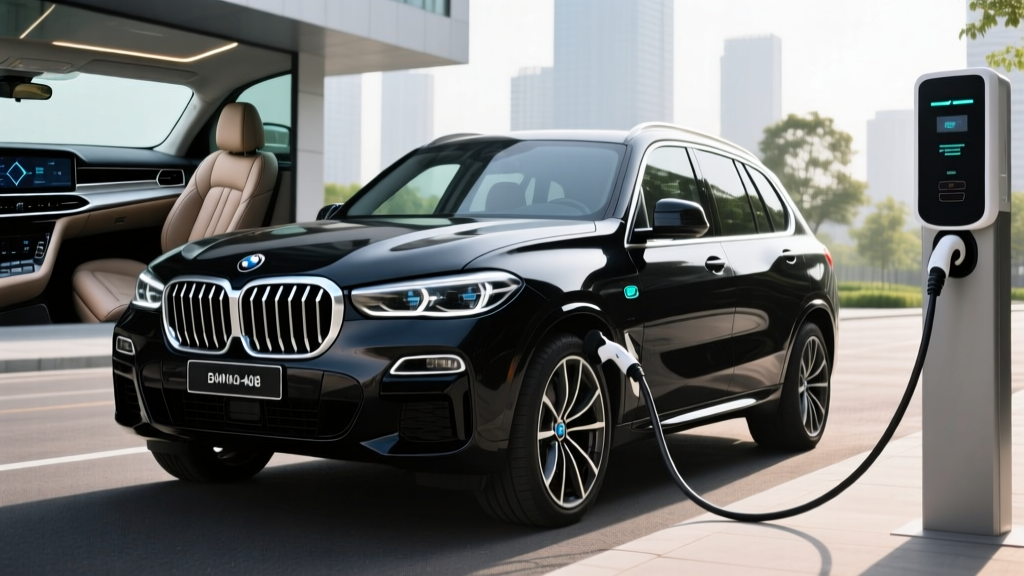
The 2018 BMW X5 xDrive40e was BMW's first plug-in hybrid SUV sold in the United States, blending a turbocharged four-cylinder engine with an electric motor integrated into the 8-speed automatic transmission. For buyers browsing the used market in 2026, this PHEV offers a compelling mix of luxury, all-wheel-drive capability, and short-distance electric commuting — but its modest battery and real-world electric range demand honest expectations. This guide covers everything a prospective used buyer needs to know: EPA figures versus real-world efficiency, battery longevity, replacement costs, and whether this generation X5 hybrid still makes sense against newer PHEVs and full EVs.
HEV vs PHEV: What the 2018 X5 xDrive40e Actually Is
Conventional Hybrid (HEV): A small battery (typically 1–2 kWh) recharged solely by regenerative braking and the engine. No plug. Examples: Toyota RAV4 Hybrid, Honda CR-V Hybrid. You never plug in; you simply refuel with gas.
Plug-in Hybrid (PHEV): A larger battery (the X5 xDrive40e carries 9.2 kWh usable) that can be charged from a wall outlet or Level 2 charger, enabling a limited electric-only driving range before the gasoline engine takes over. You can drive it without ever plugging in, but doing so forfeits its primary efficiency advantage.
The 2018 BMW X5 xDrive40e is strictly a PHEV. BMW did not offer a conventional HEV variant of the F15-generation X5. If you see an "X5 hybrid" listing, confirm it is the xDrive40e — there is no self-charging hybrid equivalent in this model year.
Powertrain Specs: Engine, Motor, and Combined Output
| Specification | 2018 BMW X5 xDrive40e |
|---|---|
| Gasoline Engine | 2.0L turbocharged inline-4 (240 HP / 260 lb-ft) |
| Electric Motor | 111 HP / 184 lb-ft (integrated in ZF 8-speed) |
| Combined System Output | 308 HP / 332 lb-ft |
| Transmission | ZF 8-speed automatic (all-wheel drive standard) |
| Battery (Usable) | 9.2 kWh lithium-ion (NMC chemistry) |
| EPA Electric-Only Range | 14 miles |
| Total EPA Range (EV + Gas) | ~370 miles (18.7-gal tank) |
| 0–60 mph | 6.5 seconds |
| Top Speed (EV-only) | 75 mph |
| Curb Weight | ~5,500 lbs |
The turbo four-cylinder may sound undersized for a 5,500-pound luxury SUV, but the electric motor's instant torque fills the low-RPM gap effectively. In combined driving, the powertrain feels more like a smooth six-cylinder than a strained four. The ZF 8-speed handles transitions between electric and gas power with minimal interruption — one of the better-executed PHEV drivetrains of its era.
Fuel Economy: EPA MPG and Real-World Efficiency
| Mode | City | Highway | Combined |
|---|---|---|---|
| Charge-Sustaining (gas only, battery depleted) | 24 MPG | 27 MPG | 25 MPG |
| Charge-Depleting (full battery, mixed EV/gas) | 56 MPGe combined (EPA) | ||
Real-world expectations: The EPA's 25 MPG combined figure for gas-only operation is reasonably accurate for mixed suburban driving. On highway-only trips at 70+ mph with a depleted battery, expect 24–26 MPG. In stop-and-go city traffic with a depleted battery, regenerative braking pushes the figure closer to 26–28 MPG — hybrids and PHEVs typically outperform their EPA city ratings in dense urban driving because regen recaptures energy that a gas-only vehicle wastes as heat in the brake pads.
The 56 MPGe figure only applies when you start with a full battery and blend electric and gas operation over a short trip. On a 10-mile commute fully on electric power, you burn zero gasoline. On a 300-mile road trip with no charging stops, the xDrive40e operates as a 25 MPG gas vehicle for 95% of the journey. Your real-world MPG depends entirely on how often you plug in and how short your typical trips are.
Electric-Only Range, Charging, and Battery Details
EPA Electric Range: 14 miles
Real-world electric range: Expect 10–12 miles in mixed driving, and as low as 8–9 miles in cold weather (below 35°F) or at sustained highway speeds above 65 mph. Battery degradation on a 2018 model with original battery may further reduce this to 9–11 miles by 2026.
The 9.2 kWh usable battery (12.0 kWh gross) is small by modern PHEV standards — the 2026 BMW X5 xDrive50e carries 25.7 kWh usable and achieves 38 miles of electric range. This generational gap matters if your commute exceeds 14 miles round-trip.
| Charging Method | Power | 0–100% Time | Notes |
|---|---|---|---|
| Level 1 (120V household outlet) | ~1.4 kW | ~7 hours | Trickle charge; adequate for overnight if parked 10+ hours |
| Level 2 (240V, 16A) | ~3.5 kW | ~2.5 hours | Max onboard charger rate; faster Level 2 stations won't speed this up |
| DC Fast Charging | Not supported | N/A | No DC fast-charge capability on this generation |
The xDrive40e's onboard charger is limited to 3.5 kW. Even if you plug into a 7.2 kW or 11.5 kW Level 2 station, the vehicle will only draw 3.5 kW. This is a hard hardware limitation — there is no software update to increase it. Plan for roughly 2.5 hours from empty to full on any 240V source. The J1772 connector is standard (this predates BMW's adoption of NACS).
Battery Longevity, Warranty, and Replacement Cost
Original BMW High-Voltage Battery Warranty: 8 years / 80,000 miles (whichever comes first), covering defects and capacity loss below approximately 70% of original capacity.
For a 2018 model in 2026: The factory battery warranty has expired for nearly all examples on the used market (8 years from the original in-service date). Any battery failure or significant degradation is now an out-of-pocket expense unless an extended warranty or CPO coverage was purchased and remains active.
Is the battery reliable? BMW's NMC lithium-ion packs from this era have proven reasonably durable. Industry data from sources like fueleconomy.gov and owner forums suggest that PHEV batteries of this size and chemistry typically retain 80–88% of original capacity after 8 years of normal use, assuming the vehicle was not repeatedly DC-charged (not applicable here) or routinely stored at 100% state of charge in extreme heat.
Battery replacement cost: A replacement high-voltage battery pack for the F15 X5 xDrive40e runs approximately $8,000–$12,000 for the part alone, with labor adding $1,500–$2,500 at a BMW dealership. Independent EV shops may offer refurbished or reconditioned packs for $5,000–$7,000 installed. Given that a clean 2018 xDrive40e trades for roughly $22,000–$30,000 on the used market in 2026, a full battery replacement represents a significant percentage of the vehicle's value — factor this into your purchase decision and pre-purchase inspection.
12V battery note: Like all BMWs of this era, the X5 xDrive40e also has a conventional 12V auxiliary battery that powers electronics and wakes the high-voltage system. These typically last 4–6 years and cost $250–$400 to replace. A dead 12V battery will prevent the vehicle from starting even if the high-voltage pack is fully charged.
Used Pricing, Tax Credits, and Total Cost of Ownership
2026 used market pricing (approximate):
- 2018 X5 xDrive40e, 60,000–80,000 miles, good condition: $22,000–$26,000
- 2018 X5 xDrive40e, 30,000–50,000 miles, excellent condition / CPO: $27,000–$32,000
Federal tax credit (§30D) for used EVs/PHEVs: Under the current IRS rules, the Used Clean Vehicle Credit provides up to $4,000 (or 30% of the sale price, whichever is lower) on qualifying pre-owned plug-in vehicles purchased from a dealer. Key requirements include:
- Sale price must be $25,000 or less (the vehicle must fall at or below this threshold to qualify)
- Buyer income caps: $75,000 single / $112,500 head of household / $150,000 joint (modified AGI)
- Vehicle must be at least 2 model years old (a 2018 qualifies)
- Must purchase from a licensed dealer (private-party sales do not qualify)
- Vehicle must have a battery capacity of at least 7 kWh (the xDrive40e's 12.0 kWh gross qualifies)
- Credit can be transferred to the dealer as a point-of-sale discount
Practical implication: If you find a 2018 X5 xDrive40e listed at $24,500 from a dealer and your income falls within the caps, you could receive a $4,000 credit, bringing your effective cost to $20,500. However, many well-equipped examples exceed the $25,000 price cap, making them ineligible. Confirm eligibility with a tax professional before relying on this credit. The original $7,500 new-vehicle §30D credit is no longer applicable to a 2018 model.
Who Should Buy the 2018 X5 xDrive40e — and Who Shouldn't
Pros
- Legitimate luxury SUV with premium interior, air suspension (optional), and BMW driving dynamics
- Standard AWD with competent snow/rain traction
- Short commutes (under 12 miles) can be done entirely on electricity, cutting fuel costs significantly
- Smooth powertrain transitions; no range anxiety thanks to 18.7-gallon gas tank
- Used pricing has depreciated steeply — strong value at $22K–$28K
- Towing capacity: 5,000 lbs (when properly equipped)
Cons
- Only 14 miles EPA electric range (real-world often 10–12) — inadequate for most commutes
- 3.5 kW max charge rate means 2.5 hours to refill a tiny battery
- No DC fast charging capability
- Four-cylinder engine sounds coarse under hard acceleration compared to the xDrive35i's inline-six
- Battery warranty has expired on nearly all 2018 examples
- Cargo space reduced vs. gas X5 due to battery placement (loss of under-floor storage)
- Complex powertrain = higher potential repair costs out of warranty
Choose the 2018 X5 xDrive40e if: Your daily round-trip commute is 12 miles or less, you can charge at home overnight (even on a 120V outlet given the small battery), you want a luxury AWD SUV with low running costs on short trips, and you're comfortable with out-of-warranty BMW maintenance costs.
Choose a full EV (e.g., BMW iX, Tesla Model X, Rivian R1S) if: Your commute exceeds 30 miles, you want zero gasoline expenses, you have reliable home Level 2 charging, and you prefer minimal powertrain complexity.
Choose a newer PHEV (e.g., 2026 X5 xDrive50e, Toyota RAV4 Prime) if: You want 35+ miles of electric range, faster charging, modern safety tech, and remaining factory warranty.
Choose a conventional gas X5 (xDrive35i/40i) if: You cannot charge at home, you regularly take long road trips, and you want simpler mechanics with wider independent-shop serviceability.
Hybrid vs PHEV vs EV: Which Fits Your Driving Pattern?
The 2018 X5 lineup illustrates the three paths clearly, since BMW offered the X5 as a gas vehicle (xDrive35i), a PHEV (xDrive40e), and later as a full EV (iX, launched 2022). Here's how the decision breaks down for a used buyer in 2026:
| Factor | Gas (xDrive35i) | PHEV (xDrive40e) | Full EV (BMW iX, used) |
|---|---|---|---|
| Plug in required? | No | Optional (but recommended) | Yes — mandatory |
| Electric range | 0 miles | 10–14 miles | 250–320 miles |
| Fuel cost per mile | ~$0.16–$0.20 | ~$0.05 (EV) / ~$0.17 (gas) | ~$0.04–$0.06 |
| Maintenance complexity | Moderate | High (two powertrains) | Low (no engine, oil, or exhaust) |
| Used price (2026) | $18K–$28K | $22K–$32K | $38K–$55K |
| Best for | No home charging, long trips | Short commutes + home charging | Home charging + daily driving under 250 mi |
The xDrive40e occupies a narrow middle ground: it rewards owners who can charge nightly and drive short distances, but penalizes those who treat it as a gas-only vehicle with mediocre 25 MPG and added weight. According to EPA data on fueleconomy.gov, the xDrive40e's combined gas-only MPG is identical to many non-hybrid luxury SUVs of the era — meaning the plug-in hardware only pays dividends if you actually plug in.
Pre-Purchase Inspection Checklist for the 2018 X5 xDrive40e
Before committing to a used 2018 X5 xDrive40e, prioritize these inspection items specific to the PHEV powertrain:
- High-voltage battery state of health (SoH): Ask the seller or a BMW dealer to pull the battery health report via ISTA (BMW's diagnostic system). A SoH below 80% significantly reduces electric range and may indicate costly replacement within 1–2 years.
- Charging port and cable: Test the J1772 charge port door, latch, and locking mechanism. Inspect the included Level 1 charging cord for damage. Replacement OEM cords run $400–$600.
- Coolant system: The PHEV has separate cooling circuits for the engine, electric motor, and high-voltage battery. Coolant leaks or neglected flushes can damage the battery thermal management system.
- Air suspension (if equipped): Rear air springs were optional and are prone to leaking after 60,000–80,000 miles. Replacement runs $800–$1,200 per corner at independent shops.
- Service history: BMW's turbocharged engines are sensitive to oil-change intervals. Verify records showing 8,000–10,000 mile oil changes (or more frequent if driven hard).
Frequently Asked Questions
How many MPG does the 2018 BMW X5 xDrive40e get?
The EPA rates it at 24 city / 27 highway / 25 combined MPG when operating on gasoline alone (battery depleted). When starting with a full charge and blending electric and gas operation, the EPA rates it at 56 MPGe combined. Real-world gas-only MPG typically falls between 23–27 depending on driving style and conditions.
How far can the 2018 X5 xDrive40e go on electric only?
The EPA rates it at 14 miles of electric-only range. In real-world driving, expect 10–12 miles in moderate temperatures and mixed conditions, and as few as 8–9 miles in cold weather or at highway speeds. This range decreases further if the battery has degraded over 8 years of use.
Does the 2018 X5 xDrive40e qualify for any tax credit in 2026?
It may qualify for the federal Used Clean Vehicle Credit of up to $4,000, but only if the dealer sale price is $25,000 or less and the buyer meets income caps ($75K single / $150K joint). Many well-maintained examples exceed the $25K price cap. The original $7,500 new-vehicle credit no longer applies. Consult a tax professional to verify eligibility for your specific situation.
Is the 2018 X5 xDrive40e reliable, and what does battery replacement cost?
The PHEV powertrain is generally reliable, but it combines two complex systems (turbo engine + electric motor + high-voltage electronics), which means more potential failure points than a gas-only or full-EV alternative. The high-voltage battery typically retains 80–88% capacity after 8 years. A full battery replacement costs approximately $8,000–$12,000 for the part plus $1,500–$2,500 in labor at a BMW dealer. The original 8-year/80,000-mile battery warranty has expired on virtually all 2018 models as of 2026.
Can the 2018 X5 xDrive40e fast-charge?
No. The xDrive40e does not support DC fast charging. Its maximum Level 2 charge rate is 3.5 kW, requiring approximately 2.5 hours for a full charge from empty. This is a hardware limitation of the onboard charger and cannot be upgraded via software.
Should I buy the 2018 X5 xDrive40e or a newer PHEV?
If budget is the primary constraint, the 2018 xDrive40e at $22K–$28K offers luxury PHEV ownership at a fraction of a new vehicle's price. However, the 2024+ BMW X5 xDrive50e provides 38 miles of electric range, a 7.4 kW onboard charger, and full factory warranty — for roughly $67,000 new. The used 2018 model makes sense only if your commute fits within its 10–12 real-world electric miles and you accept out-of-warranty risk.