Quick Verdict: A Used Luxury PHEV That Still Makes Sense
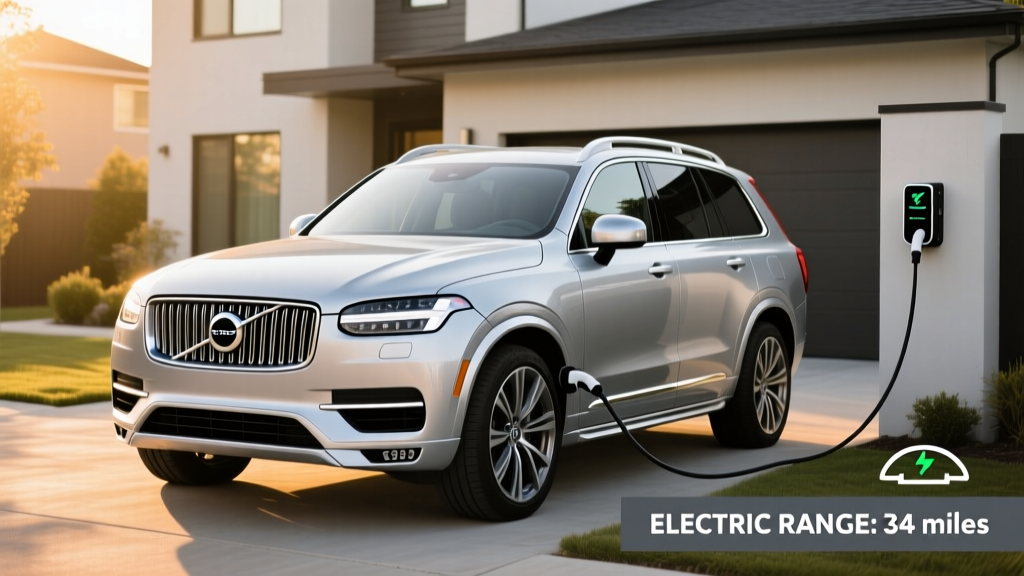
The 2017 Volvo XC90 T8 Twin Engine is a plug-in hybrid (PHEV) luxury SUV that pairs a supercharged and turbocharged 2.0-liter four-cylinder engine with an electric motor on the rear axle. Originally priced from $68,100, used examples in 2026 typically trade between $22,000 and $32,000 depending on mileage and condition. With 400 combined horsepower, 14 miles of EPA-rated electric-only range, and 62 MPGe when the battery is charged, the T8 offers a bridge between full electrification and traditional gas-powered convenience — but only if you understand its limitations as a now-nine-year-old PHEV with a relatively small battery.
| Specification | 2017 Volvo XC90 T8 |
|---|---|
| Powertrain | 2.0L I4 supercharged + turbocharged (316 HP) + rear electric motor (87 HP) |
| Combined Output | 400 HP / 472 lb-ft torque |
| Battery (Gross / Usable) | 11.6 kWh gross / ~9.2 kWh usable (NMC lithium-ion) |
| EPA Electric-Only Range | 14 miles |
| EPA MPGe (gas + electric) | 62 MPGe combined |
| EPA MPG (gas only, battery depleted) | 26 city / 27 highway / 26 combined |
| Total Combined Range | ~330 miles (gas + electric) |
| Level 2 Charging (240V) | ~2.5 hours (3.6 kW onboard charger) |
| DC Fast Charging | Not supported |
| 0-60 mph | 5.3 seconds |
| Drivetrain | AWD (engine drives front wheels, motor drives rear) |
| Seating | 7-passenger (3-row) |
| Cargo (behind 3rd row) | 15.8 cu ft |
| Original MSRP (base Inscription) | $68,100 |
| Typical Used Price (2026) | $22,000–$32,000 |
HEV vs PHEV: Where the XC90 T8 Fits
Before evaluating the T8, it is essential to understand the distinction between a conventional hybrid (HEV) and a plug-in hybrid (PHEV):
- Conventional Hybrid (HEV): Charges its small battery (~1-2 kWh) entirely through regenerative braking and the gas engine. You never plug it in. Examples include the Toyota RAV4 Hybrid. EPA MPG is consistent regardless of whether you "charge" it, because there is nothing to plug in.
- Plug-in Hybrid (PHEV): Has a larger battery (the XC90 T8 carries 11.6 kWh gross) that you charge by plugging into a wall outlet or Level 2 charger. This enables a short electric-only driving range (14 miles EPA for the T8) before the gas engine takes over. Once the battery depletes, it operates like a conventional hybrid. The PHEV advantage only materializes if you charge regularly — otherwise you are hauling dead battery weight and getting MPG worse than a comparable HEV.
The 2017 Volvo XC90 T8 is exclusively a PHEV. Volvo did not offer a conventional HEV version of the XC90 for this model year; the non-electrified models used the T5 (turbo-only, 250 HP) or T6 (supercharged + turbocharged, 316 HP) badges. If you see an XC90 without a charge port, it is not a T8.
Fuel Economy: EPA Numbers and Real-World MPG
The EPA rates the 2017 XC90 T8 at 62 MPGe combined when operating in hybrid mode with a charged battery, and 26 MPG combined (26 city / 27 highway) once the battery is depleted and the vehicle runs on gasoline alone. The fuel tank holds 18.8 gallons, giving a total combined range of approximately 330 miles.
| Mode | City | Highway | Combined |
|---|---|---|---|
| Charge-sustaining (gas only, battery depleted) | 26 MPG | 27 MPG | 26 MPG |
| Blended (gas + electric, battery charged) | 62 MPGe combined | ||
| Electric-only consumption | 58 kWh/100 mi (EPA) | ||
Real-world expectations: The 14-mile EPA electric range was measured on the older, more generous test cycle. In 2026 real-world driving, expect 10 to 12 miles of usable electric range in mild weather, dropping to 8 to 10 miles in cold conditions (below 40°F). The gasoline engine will engage under hard acceleration even in "Pure" electric mode, which further reduces electric-only distance for aggressive drivers.
On the gas-only side, owners consistently report 23 to 25 MPG in mixed driving once the battery is depleted — slightly below the EPA's 26 MPG combined figure. This is typical for a heavy (5,000+ lb) luxury SUV with a relatively small 2.0-liter engine working hard to move mass. Highway cruising at 70+ mph may yield 27 to 28 MPG, but city driving with a depleted battery often drops into the low 20s.
According to fueleconomy.gov, the 2017 XC90 T8's annual fuel cost is estimated at approximately $2,150 assuming 15,000 miles per year, 45% highway driving, and regular premium gasoline — though actual costs depend heavily on how often you charge the battery and your local electricity and fuel prices.
Electric-Only Range, Charging, and Battery Details
The T8's 11.6 kWh gross battery pack (approximately 9.2 kWh usable, as Volvo reserves a buffer to protect longevity) uses NMC (nickel manganese cobalt) lithium-ion chemistry, which offers higher energy density than LFP but is more sensitive to high state-of-charge and temperature extremes over time.
Charging options:
- Level 1 (120V household outlet): Approximately 7 to 8 hours for a full charge using the included portable cord. Suitable for overnight charging if your daily electric-only need is under 14 miles.
- Level 2 (240V): Approximately 2.5 hours using a 240V source. The onboard charger is limited to 3.6 kW, meaning even a 40A Level 2 station will not charge the T8 any faster than a 16A circuit.
- DC fast charging: Not supported. The 2017 XC90 T8 has no DC fast-charge port. This is a significant limitation compared to newer PHEVs like the Toyota RAV4 Prime or the 2023+ XC90 Recharge (which has a larger 18.8 kWh battery and 35 miles of range, though still no DC fast charging).
The charge port is located on the driver's side front fender, using a standard J1772 connector for Level 1 and Level 2 AC charging. There is no CCS or NACS port, as DC fast charging is absent.
Battery Warranty: Volvo covered the 2017 XC90 T8's hybrid battery under its 8-year/100,000-mile hybrid component warranty (whichever came first), with a capacity retention threshold of approximately 70%. For a 2017 model, this factory warranty expired no later than 2025, meaning any used 2017 T8 purchased in 2026 is out of factory battery warranty unless an extended warranty was purchased. Battery replacement cost for the T8's high-voltage pack ranges from $8,000 to $14,000 at a Volvo dealer, depending on labor rates and whether refurbished modules are available. Third-party hybrid battery repair shops may offer module-level repair for $3,000 to $6,000, though availability for Volvo PHEVs is more limited than for Toyota or Ford hybrids.
Powertrain and Performance
The T8's powertrain is one of the most complex Volvo has ever built. The front wheels are driven by a 2.0-liter four-cylinder engine that is both supercharged (for low-end response) and turbocharged (for high-RPM power), producing 316 HP and 295 lb-ft of torque on its own. An 87 HP electric motor drives the rear axle, fed by the 11.6 kWh battery. Combined system output is 400 HP and 472 lb-ft of torque.
This gives the XC90 T8 a 0-60 mph time of 5.3 seconds — genuinely quick for a three-row luxury SUV that weighs over 5,000 pounds. An 8-speed automatic transmission handles gear changes. The AWD system is unconventional: there is no mechanical driveshaft connecting front and rear axles. Instead, the engine drives the front wheels and the electric motor drives the rear wheels, with the vehicle's computer coordinating torque distribution electronically.
Drive modes include Pure (electric-only, limited to ~78 mph), Hybrid (default, blends gas and electric for efficiency), Power (maximum combined output), Off-Road (low-speed AWD traction), and Save (reserves battery charge for later use, such as entering an electric-only urban zone).
The "Save" mode is particularly useful: if you have a highway commute followed by city driving, you can run the gas engine on the highway and save the battery for stop-and-go traffic where electric operation is most efficient.
Reliability, Known Issues, and Ownership Costs
The 2017 XC90 T8's reliability record is mixed. The T8 powertrain's complexity — a supercharged-and-turbocharged engine, a separate electric motor, a high-voltage battery, and an electronically controlled AWD system with no mechanical linkage — creates more potential failure points than a conventional T5 or T6 model. Common issues reported by owners and documented by repair databases include:
- Hybrid system faults: Intermittent "Reduced Performance" or "Service Hybrid System" warnings, sometimes related to the electric motor's power electronics or battery management system sensors.
- Supercharger/turbocharger wear: The dual-forced-induction 2.0L engine is highly stressed. Some owners report supercharger clutch failures or turbo wastegate rattle above 80,000 miles.
- Air suspension: Available on higher trims, the four-corner air suspension is prone to compressor and air spring failures after 60,000 to 80,000 miles. Replacement costs $1,500 to $2,500 per corner.
- Infotainment (Sensus): The vertical touchscreen is slow by 2026 standards and prone to lag. Software updates are no longer being pushed for the 2017 model year.
Insurance costs are above average for the segment due to the vehicle's original MSRP and repair complexity. Expect $1,800 to $2,800 annually depending on your profile and coverage. Maintenance is also premium-priced: Volvo recommends synthetic oil changes every 10,000 miles (~$150-$200 at a dealer), and brake wear is moderate thanks to regenerative braking extending pad life.
Tax Credits and Incentives: What Applies in 2026?
When new, the 2017 XC90 T8 qualified for a $5,002 federal tax credit under the pre-2023 IRS §30D rules (based on its battery capacity). That credit is no longer available for new purchases of this model, as it is discontinued.
For 2026 used buyers, the relevant incentive is the Used Clean Vehicle Credit (§25E), which provides up to $4,000 (or 30% of the sale price, whichever is less) for qualifying pre-owned EVs and PHEVs. To qualify:
- The vehicle must be purchased from a licensed dealer (not a private party).
- The sale price must be $25,000 or less — this is a hard cap. Many 2017 XC90 T8 examples price above this threshold, disqualifying them.
- The buyer's adjusted gross income must not exceed $75,000 (single), $112,500 (head of household), or $150,000 (joint filers).
- The vehicle must have a battery capacity of at least 7 kWh (the T8's 11.6 kWh qualifies).
- The credit is non-refundable and can be transferred to the dealer at point of sale as a price reduction.
If you find a 2017 XC90 T8 at a dealer for $25,000 or under and meet the income requirements, the $4,000 credit could bring your effective cost as low as $21,000 — making it a compelling value for a 400 HP luxury PHEV SUV. Consult IRS.gov's §25E guidance and a tax professional to confirm your eligibility, as rules are subject to change.
Some states offer additional used-EV or PHEV rebates (for example, California, Colorado, and Massachusetts have had programs), but these vary by jurisdiction and funding availability. Check your state's energy or environmental agency for current programs.
Who Should Buy the 2017 XC90 T8 — and Who Shouldn't?
Pros
- 400 HP and 5.3-second 0-60 in a 7-seat luxury SUV
- 14-mile electric range covers short commutes emission-free
- Premium interior materials, quiet cabin, strong safety ratings (IIHS Top Safety Pick+)
- Significant depreciation already absorbed — used value is a fraction of original MSRP
- Eligible for up to $4,000 used-EV credit if priced at $25,000 or below
Cons
- 14-mile EPA electric range is very short by 2026 PHEV standards (RAV4 Prime: 42 mi; new XC90 Recharge: 35 mi)
- No DC fast charging; 3.6 kW Level 2 is slow
- Factory battery warranty has expired; out-of-pocket replacement is $8,000–$14,000
- Complex powertrain = higher repair risk and maintenance cost as the vehicle ages
- Depleted-battery MPG (23-25 real-world) is unimpressive for a hybrid
- Outdated infotainment and no Apple CarPlay on early-build 2017 models
Choose the 2017 XC90 T8 if: You need a three-row luxury SUV, have a short commute (under 15 miles) you can cover on electricity, can charge at home overnight, want AWD and strong acceleration, and find a well-maintained example under $25,000 to capture the used-EV tax credit.
Choose a full BEV instead if: You want zero gas-engine maintenance, longer electric range, DC fast charging for road trips, and can accommodate a vehicle like the used Tesla Model X or Rivian R1S in your budget.
Choose a conventional HEV (like the Toyota Highlander Hybrid) instead if: You cannot charge at home, want simpler mechanics with lower long-term repair risk, and prioritize consistent fuel economy (35+ MPG) over electric-only driving.
Choose a newer PHEV (like the 2024+ Volvo XC90 Recharge or Toyota RAV4 Prime) instead if: You want longer electric range (35-42 miles), a current factory battery warranty, modern infotainment, and are willing to pay new-vehicle prices.
Frequently Asked Questions
How many MPG does the 2017 Volvo XC90 T8 hybrid get?
The EPA rates the 2017 XC90 T8 at 62 MPGe combined when using both gas and a charged battery, and 26 MPG combined (26 city / 27 highway) once the battery is depleted and the vehicle runs on gasoline alone. In real-world driving, owners typically see 23 to 25 MPG in mixed use with a depleted battery, and up to 27-28 MPG on steady highway cruises.
How far can the 2017 XC90 T8 go on electric only?
The EPA rates the T8 at 14 miles of electric-only range. In real-world conditions, expect 10 to 12 miles in mild weather and 8 to 10 miles in cold weather (below 40°F). The electric-only top speed is approximately 78 mph in Pure mode, though hard acceleration will engage the gas engine even in this mode.
Is the 2017 XC90 T8 reliable, and what does battery replacement cost?
Reliability is average to below average for a luxury SUV of this age. The T8's complex dual-forced-induction engine and hybrid system create more failure points than simpler powertrains. The high-voltage battery replacement costs $8,000 to $14,000 at a Volvo dealer. Third-party module-level repair may cost $3,000 to $6,000. The original 8-year/100,000-mile hybrid warranty has expired on all 2017 models as of 2025. Before purchasing, a pre-purchase inspection by a Volvo-certified technician is strongly recommended, with specific attention to hybrid system health and battery state of health (SoH).
Does the 2017 XC90 T8 qualify for any tax credit in 2026?
It is no longer eligible for the new-vehicle §30D credit. However, it may qualify for the Used Clean Vehicle Credit (§25E) of up to $4,000 if: the dealer sale price is $25,000 or less, the buyer meets income caps ($75K single / $150K joint), and the vehicle is purchased from a licensed dealer. Always verify current rules on IRS.gov and consult a tax professional.
Hybrid vs PHEV vs EV — which is right for me?
If you cannot charge at home and want maximum simplicity, a conventional HEV (no plug) like the Toyota Highlander Hybrid delivers consistent 35+ MPG with no behavioral change. If you can charge at home and have a short commute, a PHEV like the XC90 T8 lets you drive most weekdays on electricity while retaining a gas engine for road trips — but its 14-mile range is short by modern standards. If you want zero tailpipe emissions, minimal drivetrain maintenance, and have reliable charging access, a full BEV eliminates gas entirely but requires planning for longer trips around DC fast-charging infrastructure.
Can I charge the XC90 T8 at a public fast charger?
No. The 2017 XC90 T8 does not support DC fast charging. It can only accept AC charging via its J1772 port at up to 3.6 kW (Level 2). Public Level 2 chargers at shopping centers or workplaces will work, but you will not be able to use Electrify America, Tesla Supercharger, or any DC fast-charging network. A full Level 2 charge takes approximately 2.5 hours.
What is the total driving range of the 2017 XC90 T8?
With a full battery and a full 18.8-gallon fuel tank, the total combined range is approximately 330 miles. This is the sum of roughly 14 miles on electricity plus ~316 miles on gasoline (at ~26 MPG combined). This range is adequate for most road trips but falls short of newer PHEVs with larger batteries and more efficient gas engines.