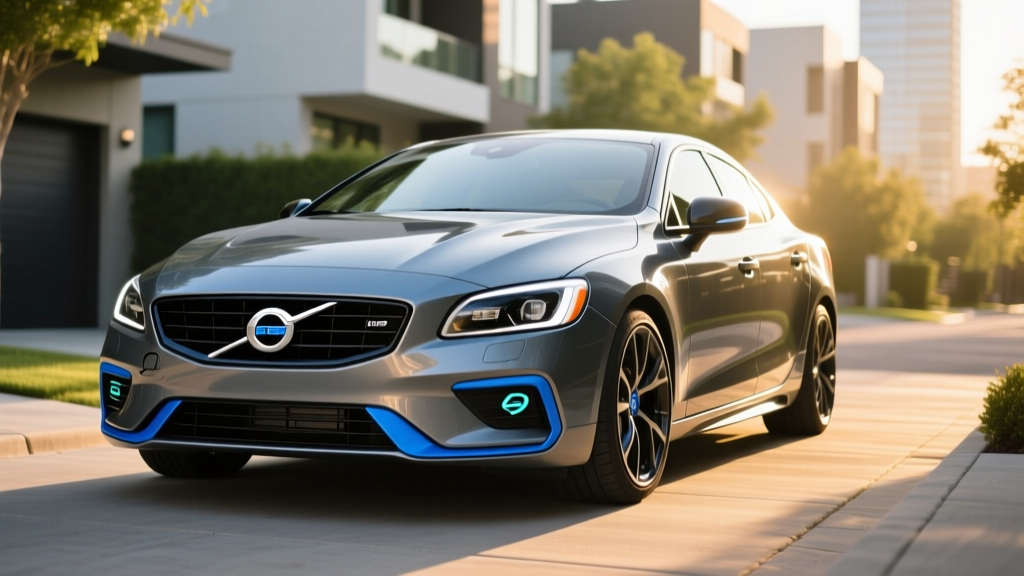
Before Polestar became a standalone electric-vehicle brand with the Polestar 2 and Polestar 3, it was Volvo's in-house performance skunkworks — a tuning division that built limited-run, track-bred variants of Volvo's most popular models. The 2017 Volvo S60 Polestar represents the apex of that era: a turbocharged and supercharged plug-in hybrid sedan wrapped in Rebel Blue paint, Öhlins dampers, and Brembo brakes. For enthusiasts shopping the used market in 2026, this car occupies a fascinating niche — it's one of the last performance-oriented PHEVs built before the industry pivoted hard to pure battery-electric. Here's what you need to know before buying one.
Quick Verdict: A Collector's PHEV With Real Pedigree
The 2017 Volvo S60 Polestar (officially the S60 T8 Polestar or S60 Inscription T8 Polestar in some markets) pairs a 2.0-liter twin-charged four-cylinder engine with an electric motor and an 11.6 kWh lithium-ion battery pack. The result is 367 combined horsepower, a 4.4-second 0-60 mph time, and roughly 22 miles of electric-only range. It's not a compliance car — it's a genuine performance sedan that happens to have a plug. In 2026's used market, well-maintained examples command $28,000–$38,000 depending on mileage and condition.
2017 Volvo S60 Polestar — Key Specifications
| Spec | Value |
|---|---|
| Powertrain | 2.0L turbo+super I4 + rear electric motor (PHEV AWD) |
| Combined Output | 367 hp / 350 lb-ft torque |
| 0-60 mph | 4.4 seconds |
| Battery Capacity | 11.6 kWh gross (NMC chemistry) |
| EPA Electric-Only Range | ~22 miles (estimated; see real-world note) |
| EPA Combined MPG (gas mode) | ~28 MPG combined (non-electric operation) |
| MPGe (combined gas+electric) | ~59 MPGe |
| DC Fast Charging | Not supported (AC only) |
| Level 2 AC Charge Rate | 3.7 kW (240V) |
| Level 2 Full Charge Time | ~3.5 hours (0-100%) |
| Level 1 (120V) Charge Time | ~8-10 hours |
| Drivetrain | AWD (engine drives front, motor drives rear) |
| Cargo Volume | 12.0 cu ft trunk |
| Base MSRP (2017) | $61,295 |
| 2026 Used Market Range | $28,000–$38,000 |
| Federal Tax Credit (new in 2017) | $5,807 (original §30D; no longer available used) |
| Battery/Powertrain Warranty (original) | 8 yr / 100,000 mi hybrid components |
Real-World Range and Efficiency: What the Battery Actually Delivers
The 2017 S60 Polestar's 11.6 kWh battery pack (NMC chemistry, manufactured by LG Chem) was modest even by 2017 standards, and in 2026 it's positively quaint compared to the 60-100 kWh packs in modern BEVs. But for a PHEV of its era, the setup was purposeful: enough electric range for short commutes, with the gas engine ready for everything else.
Range Reality Check
EPA Electric-Only Range: ~22 miles
Real-World Expectation: 15–19 miles in mixed driving; 12–15 miles at sustained highway speeds (65+ mph). In cold weather (below 40°F), expect 10–14 miles of usable electric range due to cabin heating draw and reduced battery efficiency.
Gas-Only Range: ~350 miles on the 15.9-gallon tank at ~28 MPG combined.
The electric motor produces 87 hp and drives the rear axle exclusively, giving the S60 Polestar a rear-biased feel in Pure (EV) mode. The transition from electric to hybrid operation is seamless — Volvo's powertrain management was among the smoothest in the PHEV segment. However, once the battery depletes, fuel economy drops to roughly 26-28 MPG in combined driving, which trails non-performance T8 variants by 2-3 MPG due to the Polestar's stickier tires, firmer suspension tuning, and aggressive throttle mapping.
For a 2026 buyer, the key question is battery health. Nine-year-old NMC packs typically show 10-20% capacity loss depending on climate, charging habits, and storage conditions. Request a battery State of Health (SoH) reading from a Volvo dealer before purchasing. If the pack has degraded below 80% of original capacity, electric-only range could be as low as 12-14 miles in warm weather.
Charging: AC Only, and That's the Limitation
This is where the 2017 S60 Polestar shows its age most clearly. There is no DC fast-charging capability. The car charges exclusively via AC, using a J1772 connector (the North American standard for AC charging).
Charging Speed Breakdown
| Charging Level | Power | Time (0-100%) | Miles of EV Range Added/Hour |
|---|---|---|---|
| Level 1 (120V household) | ~1.4 kW | 8–10 hours | ~3–4 miles/hr |
| Level 2 (240V, 16A) | 3.7 kW | ~3.5 hours | ~8–10 miles/hr |
| DC Fast Charge | N/A — not supported | N/A | N/A |
The 3.7 kW onboard charger means a Level 2 home station or public AC charger will replenish the battery in roughly 3.5 hours. For a daily commuter who plugs in at home overnight, this is perfectly adequate — the battery is small enough that even a standard 120V outlet can provide a meaningful top-up. But for road-trip scenarios, there's no way to quickly add electric range at a highway fast-charging station. You'll simply drive in hybrid mode, which is what the car was designed for on longer journeys.
The charge port is located on the driver's-side front fender. Volvo's charging cable from this era uses a J1772 connector; if you're using a newer NACS-equipped home charger (Tesla Wall Connector with J1772 adapter, for example), you'll need the appropriate adapter dongle.
Performance: The Polestar Difference Is Real
This is why people buy the S60 Polestar over a standard S60 T8 Inscription. The performance modifications are extensive and meaningful:
- Öhlins adjustable dampers: Manually adjustable (3-way), stiffer than standard S60, with ride quality that's firm but not punishing
- Brembo front brakes: 6-piston calipers with 14.6-inch rotors — genuine stopping power
- Polestar-tuned AWD: Rear-biased torque distribution with torque vectoring
- Engine software recalibration: 367 hp (up from 316 hp in the standard T8) via revised boost pressure and ignition timing
- Polestar sport exhaust: Subtle but present; a deeper tone under hard acceleration
- Unique 20-inch wheels: Wrapped in Michelin Pilot Super Sport tires (245/35R20)
The 4.4-second 0-60 mph time is legitimate and repeatable with a charged battery. Launch control engages in Polestar Drive mode (accessed via the drive-mode selector). The electric motor's instant torque fills in the low-RPM gap while the turbo spools, eliminating the lag that plagues many turbocharged four-cylinders. At highway speeds, passing power is abundant — the combined 350 lb-ft of torque provides confident merging and overtaking.
Compared to rivals of the era — the BMW 340i xDrive (320 hp, 4.6s to 60) and Mercedes-AMG C43 (362 hp, 4.6s to 60) — the S60 Polestar holds its own on straight-line performance while offering the unique advantage of electric-only commuting. It won't match a Tesla Model 3 Performance (3.1s to 60) in a drag race, but it offers something the Tesla can't: mechanical soul, analog feedback through the steering wheel, and a genuinely engaging chassis.
Interior, Cargo, and Daily Practicality
The S60 Polestar uses Volvo's Sensus infotainment system with a 7-inch portrait-oriented touchscreen. By 2026 standards, the interface feels dated — no wireless Apple CarPlay (wired only), no over-the-air updates, and the screen resolution is low compared to modern displays. However, the system is functional, with physical shortcut buttons below the screen for climate and audio controls.
Passenger space:
- Front legroom: 41.9 inches
- Rear legroom: 33.5 inches (tight for taller passengers)
- Front headroom: 39.2 inches
- Rear headroom: 37.8 inches
Cargo: 12.0 cubic feet of trunk space. The battery pack sits beneath the trunk floor, so there's no intrusion into cargo volume compared to the gas-only S60. However, the trunk opening is narrow, and the rear seats do not fold flat (a 60/40 split is available on some trims but with a pass-through step).
The Polestar-specific interior touches include blue stitching, Nubuck textile and leather sport seats with excellent bolstering, a Polestar-branded steering wheel, and blue seatbelts. Build quality is typical Volvo — solid, well-insulated, with premium materials throughout.
Driver assistance: The 2017 model includes Volvo's City Safety suite (forward collision warning, automatic emergency braking, lane departure warning). However, it lacks adaptive cruise control with stop-and-go, lane centering, and the more advanced Pilot Assist features that Volvo introduced in later model years. This is SAE Level 0-1 driver assistance — basic active safety, not semi-autonomous driving.
Pricing, Tax Credits, and 2026 Used Market Value
When new, the 2017 S60 Polestar carried an MSRP of $61,295 (including destination). It qualified for a $5,807 federal tax credit under the original IRS §30D program based on its battery capacity.
2026 Used Market Pricing
| Condition / Mileage | Typical Price Range | Notes |
|---|---|---|
| Excellent (under 40K mi) | $34,000–$38,000 | Low-mileage, documented service history |
| Good (40K–70K mi) | $30,000–$34,000 | Most common range; check battery SoH |
| Fair (70K–100K mi) | $26,000–$30,000 | Higher wear on Öhlins dampers, brakes |
| Original MSRP (2017) | $61,295 | For reference only |
Federal tax credit status: The §30D new-vehicle credit is no longer available for a 2017 model. Under current IRS rules, the Used Clean Vehicle Credit (up to $4,000 or 30% of sale price, whichever is less) applies to PHEVs purchased from a dealer, but the vehicle must have a sale price of $25,000 or less and the buyer must meet income caps ($75,000 single / $150,000 joint). Given that most S60 Polestar examples sell above $25,000, the majority of buyers will not qualify for the used-EV credit. Always verify eligibility with a tax professional and consult the latest IRS guidance before relying on any credit.
Warranty and Long-Term Ownership Considerations
Volvo's original hybrid-component warranty covered the battery pack, electric motor, and power electronics for 8 years or 100,000 miles, whichever came first. For a 2017 model, this warranty has expired or is expiring in 2025-2026 depending on the in-service date. This is a critical ownership inflection point.
Battery replacement cost: If the 11.6 kWh pack fails outside of warranty, expect a dealer replacement cost of $5,000–$8,000 (parts and labor). Third-party hybrid battery refurbishers may offer lower-cost options ($3,000–$5,000), but availability for this specific pack varies.
Öhlins damper service: These are rebuildable, but a full corner refresh runs $2,500–$4,000 at a specialist. Budget for this at 80,000–100,000 miles.
Parts availability: Polestar-specific components (badges, unique bumpers, Öhlins units) are limited. Standard S60 T8 mechanical parts remain well-supported through Volvo's dealer network.
Pros, Cons, and Who This Car Suits Best
Pros
- Genuine sports-sedan dynamics: Öhlins + Brembo + AWD is a serious chassis package
- 367 hp with the efficiency option of electric-only commuting for short trips
- Exclusive, low-volume vehicle (~1,500 units globally for 2017) — appreciating collector interest
- AWD capability with electric rear axle provides excellent all-weather traction
- Premium Volvo interior with Polestar-specific sport seats and trim
- Strong highway passing power; smooth gas-electric transitions
Cons
- Only ~15-22 miles of electric range — minimal by 2026 PHEV standards
- No DC fast charging; 3.7 kW AC charging is slow for public top-ups
- Dated infotainment (7-inch screen, wired CarPlay only, no OTA updates)
- Original hybrid warranty expired or expiring — battery replacement risk
- Firm ride quality; 20-inch wheels transmit road imperfections noticeably
- Rear seat space is tight for adults over 6 feet
- Polestar-specific parts can be difficult to source
Who Should Buy the 2017 S60 Polestar?
Choose this car if: You want a rare, enthusiast-grade PHEV with genuine sports-sedan handling, you have a short commute that fits within 15-20 miles of electric range, you have access to home Level 2 charging, and you value mechanical character over cutting-edge EV tech. This is a weekend-plus-commuter car for the driving enthusiast who isn't ready to go fully electric.
Look elsewhere if: You need 30+ miles of electric range (consider a 2023+ Toyota Prius Prime or Hyundai Tucson PHEV), you want modern ADAS features (lane centering, adaptive cruise), you rely on public DC fast charging, or you want a low-maintenance daily driver with full warranty coverage remaining.
Competitor Comparison: How Does It Stack Up?
In the 2026 used market at the $30,000–$38,000 price point, the S60 Polestar competes with several compelling alternatives:
| Vehicle | Type | 0-60 mph | EV Range | Key Advantage |
|---|---|---|---|---|
| 2017 Volvo S60 Polestar | PHEV sedan | 4.4s | ~22 mi | Chassis dynamics, exclusivity |
| 2018 BMW 330e (used) | PHEV sedan | 5.9s | ~14 mi | Sharper steering, larger dealer network |
| 2017 Audi A4 2.0T Quattro (used) | Gas sedan | 5.7s | N/A | Interior quality, refinement |
| 2019 Tesla Model 3 Long Range AWD (used) | BEV sedan | 4.4s | 310 mi (EPA) | Range, Supercharger network, tech |
| 2020 Polestar 2 (used) | BEV sedan | 4.5s | 233 mi (EPA) | Modern EV platform, OTA updates |
The S60 Polestar's strongest argument against these rivals is its duality: it's a legitimate performance sedan that can also do short EV commutes. The Tesla Model 3 is faster to charge, vastly longer in range, and more modern in tech — but it can't match the Polestar's steering feel, brake modulation, or the satisfaction of a mechanical powertrain. The BMW 330e is a closer rival but lacks the Polestar's chassis upgrades and exclusivity.
Frequently Asked Questions
What is the real-world electric range of the 2017 Volvo S60 Polestar?
Expect 15–19 miles of electric-only range in mixed driving with a healthy battery. Highway driving at 70+ mph reduces this to 12–15 miles. In cold weather (below 40°F), range drops to 10–14 miles due to cabin heating demands and reduced battery efficiency. A degraded battery (below 80% SoH) may deliver as little as 12 miles even in ideal conditions.
How fast does it charge at home and on the road?
The S60 Polestar charges at 3.7 kW on a 240V Level 2 home charger, taking about 3.5 hours for a full 0-100% charge. On a standard 120V outlet (Level 1), expect 8-10 hours. There is no DC fast-charging capability — the car cannot use Electrify America, Tesla Supercharger, or any DC station.
Does the 2017 S60 Polestar qualify for any federal tax credit in 2026?
The original new-vehicle §30D credit is no longer available. The Used Clean Vehicle Credit (up to $4,000) requires a sale price of $25,000 or less, buyer income below $75,000 (single) or $150,000 (joint), and purchase from a licensed dealer. Since most S60 Polestar examples sell above $25,000, most buyers will not qualify. Consult a tax professional and review current IRS used-vehicle credit rules.
Is the 2017 S60 Polestar worth buying vs. a used Tesla Model 3?
It depends on your priorities. The Model 3 offers 310 miles of EPA range, DC fast charging at up to 170 kW, modern infotainment, and OTA updates — it's the objectively more practical EV. The S60 Polestar offers superior steering feel, a mechanical powertrain with enthusiast character, exclusivity (very low production volume), and PHEV flexibility for those who can't charge at home consistently. If daily usability and charging infrastructure matter most, choose the Tesla. If driving engagement and rarity are your priorities, the Polestar delivers.
What are the biggest maintenance risks?
Three items demand attention: (1) Battery health — the hybrid warranty has expired, and a pack replacement costs $5,000–$8,000. Get a SoH reading before purchase. (2) Öhlins dampers — rebuilds run $2,500–$4,000 at 80K+ miles. (3) Polestar-specific body parts — bumpers, badges, and unique trim are difficult to source if damaged. Standard S60 mechanical parts remain well-supported.
Can I drive it on electric power only?
Yes. Selecting "Pure" mode engages electric-only driving, using the 87-hp rear electric motor. Top speed in Pure mode is limited to approximately 78 mph, and the range is 15–22 miles depending on conditions. Once the battery depletes, the car automatically switches to hybrid operation — you'll never be stranded.
The 2017 Volvo S60 Polestar occupies a specific and increasingly rare niche: a limited-production, chassis-focused performance sedan with plug-in hybrid capability. It's not the most practical PHEV you can buy in 2026, and its EV credentials are modest by today's standards. But for the enthusiast who wants a driver's car with the option of silent, electric commuting — and who appreciates the engineering philosophy of Polestar before it became an EV-only brand — it remains a compelling and collectible choice. Verify battery health, budget for aging Öhlins service, and enjoy one of the last analog performance hybrids Volvo ever built.