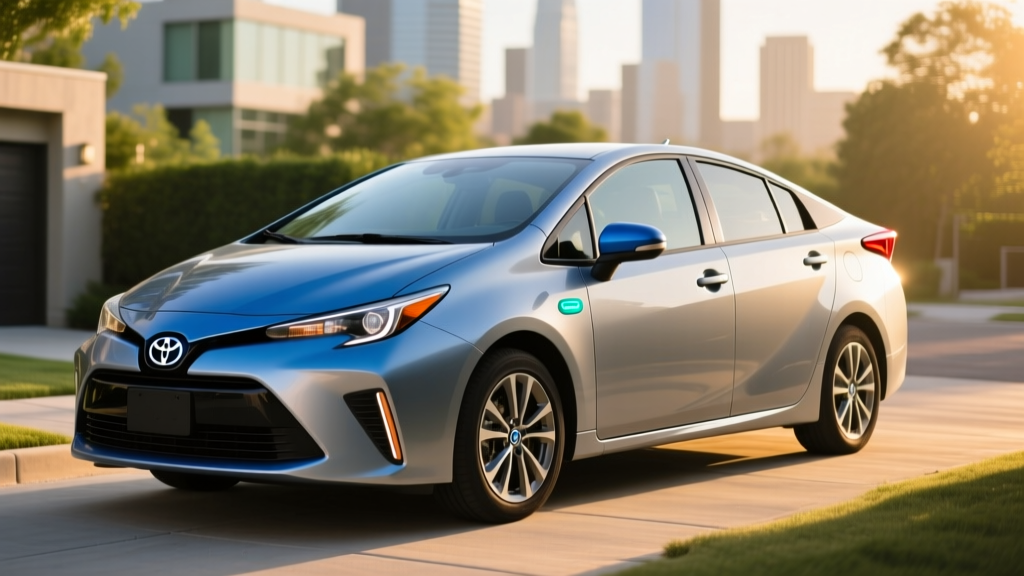
The fourth-generation Toyota Prius (XW50) launched for the 2016 model year, and by the 2017 model year it had solidified its position as the most fuel-efficient mass-market hybrid on the road. If you're researching the 2017 Toyota Prius hybrid today — likely as a used-car purchase — you're looking at a vehicle that routinely delivers over 50 MPG in real-world driving, carries one of the strongest reliability records in the industry, and costs a fraction of a new EV or PHEV.
This guide covers everything a buyer in 2026 needs to know: exact EPA and real-world MPG figures, the difference between the standard Prius (HEV) and the Prius Prime (PHEV), battery longevity data, replacement costs, and whether this hybrid still makes sense versus a newer plug-in hybrid or full battery-electric vehicle.
2017 Toyota Prius: HEV vs. Prius Prime PHEV — What's the Difference?
Toyota sold two distinct electrified Prius models for 2017. Confusing them is common but costly — they operate differently, serve different use cases, and have different maintenance profiles.
| Attribute | 2017 Prius (HEV) | 2017 Prius Prime (PHEV) |
|---|---|---|
| Powertrain type | Conventional hybrid (self-charging) | Plug-in hybrid (external charging capable) |
| Needs to plug in? | No — regenerative braking + engine charge the battery | Optional — plugs in for EV-mode range; runs as HEV when depleted |
| Battery capacity | 0.75 kWh (NiMH, 207.2V) | 8.8 kWh (lithium-ion, 351.5V) |
| Electric-only range | N/A (EV mode ~1 mi at low speed) | 25 miles (EPA) |
| Combined MPG (hybrid mode) | 54 MPG (EPA combined, Eco trim) | 54 MPG (EPA combined, after EV range depleted) |
| MPGe (electric + hybrid) | N/A | 133 MPGe (EPA combined) |
| Total range | ~580 miles | ~640 miles (25 EV + 615 hybrid) |
| DC fast charging | No | No — Level 1/2 AC only |
| Level 2 charge time (0–100%) | N/A | ~2 hours at 240V / 3.3 kW |
| Level 1 charge time (120V) | N/A | ~5.5 hours |
| Federal tax credit (at launch) | $0 | $4,502 (now expired for new purchases) |
Key takeaway: The standard 2017 Prius is a conventional hybrid (HEV). It never plugs in. The gasoline engine and regenerative braking keep its small NiMH battery charged. The Prius Prime is a plug-in hybrid (PHEV) with a larger lithium-ion battery that provides 25 miles of electric-only driving when charged, then seamlessly transitions to hybrid operation.
Fuel Economy: EPA Ratings and Real-World MPG
The 2017 Prius comes in several trims, and EPA ratings vary slightly depending on wheel size and equipment weight. Here's the full breakdown from fueleconomy.gov:
| Trim | City MPG | Highway MPG | Combined MPG |
|---|---|---|---|
| Prius Two Eco (lightest) | 58 | 53 | 56 |
| Prius Two / Three / Four / Four Touring | 54 | 50 | 52 |
| Prius Prime (hybrid mode, battery depleted) | 54 | 53 | 54 |
| Prius Prime (combined EV + hybrid) | 133 MPGe | 54 MPG / 133 MPGe | |
Real-World MPG: What Owners Actually See
Hybrids, unlike EVs, often exceed their EPA city ratings in stop-and-go traffic because regenerative braking recovers energy that a gas car wastes as heat. Based on aggregated owner data from Fuelly and long-term fleet testing:
- City driving: 52–60 MPG is typical. The Eco trim regularly hits 58+ MPG in urban traffic.
- Highway driving (70–75 mph): Expect 44–48 MPG. Aerodynamic drag and the engine running more frequently at sustained speed reduce efficiency — a common hybrid characteristic.
- Cold weather (below 35°F): MPG drops 10–15% due to engine running longer for cabin heat and reduced battery efficiency. Expect 42–48 MPG combined in winter.
- Combined real-world average: Most owners report 48–55 MPG over mixed driving, closely matching the EPA combined rating.
For context, a comparable 2017 gasoline compact like the Honda Civic averages 32–36 MPG combined. The Prius delivers roughly 40–50% better fuel economy per mile driven.
Powertrain Specs: Engine, Motor, and Combined Output
| Specification | 2017 Prius (HEV) | 2017 Prius Prime (PHEV) |
|---|---|---|
| Engine | 1.8L 4-cylinder Atkinson cycle | 1.8L 4-cylinder Atkinson cycle |
| Engine horsepower | 95 HP @ 5,200 rpm | 95 HP @ 5,200 rpm |
| Engine torque | 105 lb-ft @ 3,600 rpm | 105 lb-ft @ 3,600 rpm |
| Electric motor output | 71 HP / 120 lb-ft | 71 HP / 120 lb-ft |
| Net combined system HP | 121 HP | 121 HP |
| Transmission | eCVT (planetary gearset) | eCVT (planetary gearset) |
| Drivetrain | FWD | FWD |
| 0–60 mph | ~10.5 seconds | ~10.9 seconds (heavier battery) |
| Curb weight | 3,042–3,117 lbs | 3,365 lbs |
| Battery type | NiMH (0.75 kWh) | Lithium-ion (8.8 kWh) |
The 2017 Prius uses Toyota's Hybrid Synergy Drive, which pairs the 1.8L Atkinson-cycle engine with two motor-generators (MG1 and MG2) through a planetary gearset. This eCVT is not a belt-driven CVT — it has no belts, no clutches, and no fixed gear ratios. The result is one of the most durable and low-maintenance transmissions in any vehicle. There are no friction surfaces to wear out in the traditional sense.
The 121 HP combined output makes the Prius adequate for commuting but not quick. Highway merging requires planning, and the engine drones noticeably under hard acceleration. This is a deliberate engineering trade-off: Toyota optimized the powertrain for efficiency, not performance.
Hybrid Battery Longevity, Warranty, and Replacement Cost
Battery lifespan is the single most common concern for used Prius buyers. Here's what the data shows after nearly a decade on the road:
2017 Prius Hybrid Battery Warranty
- Hybrid battery warranty (original): 8 years / 100,000 miles (10 years / 150,000 miles in CARB states: CA, CT, ME, MD, MA, NJ, NY, OR, RI, VT, WA)
- Hybrid system components warranty: 8 years / 100,000 miles — covers inverter, transaxle, ECU
- Capacity retention threshold: Toyota does not publish a specific % threshold; warranty covers "abnormal" degradation that impairs function
Real-World Battery Lifespan Data
By 2026, many 2017 Prius vehicles have accumulated 120,000–180,000+ miles. The fourth-generation NiMH battery pack has proven durable:
- Expected lifespan: 150,000–200,000+ miles before significant degradation is typical for the NiMH pack in the standard Prius.
- Degradation pattern: NiMH batteries lose capacity gradually. Most owners notice a 5–10% MPG reduction over 100,000 miles, not a sudden failure.
- Failure mode: Individual cell imbalance is more common than total pack failure. A single weak cell can trigger warning lights while the rest of the pack remains functional.
- Prius Prime lithium-ion battery: The 8.8 kWh lithium-ion pack in the Prime has shown excellent longevity, with minimal reported capacity loss at 100,000+ miles. Lithium-ion chemistry generally degrades more predictably than NiMH.
Battery Replacement Costs (2026 Pricing)
| Option | Cost Range | Warranty | Notes |
|---|---|---|---|
| New OEM Toyota battery | $2,200–$3,000 (parts + labor) | 3 years / unlimited miles | Dealer-installed; most expensive but guaranteed fit |
| Refurbished/remanufactured pack | $1,000–$1,800 | 1–3 years typically | Replaced weak cells; quality varies by vendor |
| Individual cell replacement | $400–$800 | Varies | Only failed cells replaced; requires diagnostic expertise |
| Used salvage pack | $500–$1,000 | 30–90 days | Highest risk; unknown remaining life |
For a 2017 Prius with 150,000+ miles, a refurbished pack at $1,200–$1,500 installed is often the most cost-effective choice. The vehicle's residual value makes a $3,000 OEM battery hard to justify unless you plan to keep it for another 100,000 miles.
Pricing and Tax Credit Eligibility in 2026
Used Market Pricing
As of early 2026, the 2017 Toyota Prius trades on the used market at these approximate values (based on Kelley Blue Book and Cars.com listings):
- 2017 Prius Two/Three (80,000–120,000 mi): $14,000–$18,000
- 2017 Prius Four/Four Touring (80,000–120,000 mi): $16,000–$20,000
- 2017 Prius Prime (80,000–120,000 mi): $16,500–$21,000
- Low-mileage examples (under 60,000 mi): Add $2,000–$4,000 to above ranges
Federal Tax Credit Status
The 2017 Prius Prime originally qualified for a $4,502 federal tax credit under the previous IRC §30D rules. However, this credit has long since expired for new purchases — Toyota hit the 200,000-vehicle manufacturer cap in 2017, eliminating credits for all new Toyota plug-in vehicles until the Inflation Reduction Act restructured the program.
For used purchases in 2026, the relevant credit is the Used Clean Vehicle Credit (§25E):
- Credit amount: 30% of sale price, up to $4,000 maximum
- Vehicle requirements: Must be at least 2 model years old (2017 qualifies), sold for $25,000 or less, purchased from a licensed dealer
- Buyer income limits (2026): AGI ≤ $75,000 single / $112,500 head of household / $150,000 married filing jointly
- Prius Prime eligibility: Yes — it's a qualifying PHEV with ≥4 kWh battery
- Standard Prius (HEV): Does NOT qualify — conventional hybrids are excluded from §25E
- Lifetime limit: One used-EV credit per buyer every 3 years
A 2017 Prius Prime purchased from a dealer for $18,000 by an income-eligible buyer could yield a $4,000 credit (30% of $18,000 = $5,400, capped at $4,000). Always confirm current eligibility at irs.gov before purchasing — rules can change.
Who Should Buy a 2017 Prius vs. a PHEV or Full EV?
Choose the 2017 Toyota Prius (HEV) if:
- You cannot charge at home (no garage, apartment living, no outlet access)
- Your budget is under $20,000 and you want maximum MPG with minimum risk
- You drive 10,000–15,000 miles/year in mixed city/highway conditions
- You want proven 150,000+ mile reliability with minimal maintenance
- You don't want to think about charging, plugs, or battery management
Choose the 2017 Prius Prime (PHEV) if:
- You have home charging (even a standard 120V outlet works overnight)
- Your daily commute is under 25 miles round-trip (you'll rarely use gas)
- You want EV-mode driving for errands but gas flexibility for road trips
- You qualify for the $4,000 used-vehicle credit and want to offset purchase cost
Choose a newer full EV (e.g., 2022+ Chevy Bolt, Nissan Leaf) if:
- You have reliable Level 2 home charging
- Your daily driving is under 150 miles and you rarely take 300+ mile road trips
- You want zero tailpipe emissions and minimal drivetrain maintenance
- You qualify for the §30D new EV credit ($7,500) or §25E used credit on a qualifying BEV
Pros and Cons of the 2017 Toyota Prius
Pros
- 52–56 MPG EPA combined; real-world often matches or exceeds city rating
- Exceptional reliability — Toyota's hybrid system is one of the most proven in production
- Low running costs: ~$1,100–$1,300/year in fuel at 12,000 mi/yr and $3.20/gal
- Spacious hatchback cargo area (21.6 cu ft behind rear seats, 50.7 cu ft folded)
- Strong resale value relative to other 2017 compacts
- No plug-in required — zero charging infrastructure dependency
- Standard Toyota Safety Sense P (pre-collision, lane departure, auto high beams, dynamic radar cruise)
Cons
- Sluggish acceleration (10.5 sec 0–60) — merging and passing require patience
- Noticeable engine drone under hard acceleration (eCVT characteristic)
- Ride quality is firm; road noise is above average for the class
- Rear visibility is compromised by the split rear window and spoiler
- Infotainment system is dated: no Apple CarPlay or Android Auto in 2017
- Base NiMH battery will eventually need replacement ($1,000–$3,000)
- No DC fast charging on the Prime — long road trips rely entirely on the gas engine
Frequently Asked Questions
How many MPG does the 2017 Toyota Prius hybrid get?
The 2017 Prius Eco trim achieves 58 city / 53 highway / 56 combined MPG per the EPA. Other trims are rated at 54 city / 50 highway / 52 combined. Real-world owners typically report 48–55 MPG in mixed driving, with city MPG often exceeding the EPA rating thanks to regenerative braking.
How far can the 2017 Prius Prime go on electric only?
The 2017 Prius Prime delivers 25 miles of EPA-rated electric-only range from its 8.8 kWh lithium-ion battery. In warm weather with gentle driving, owners report 27–30 miles. In cold weather (below 40°F) or at highway speeds, expect 18–22 miles before the gas engine engages. After EV range is depleted, it operates as a standard hybrid at 54 MPG combined.
Is the 2017 Prius hybrid reliable, and what does battery replacement cost?
Yes — the 2017 Prius is among the most reliable vehicles in its class. Toyota's hybrid system has been refined over 20+ years. The eCVT transmission has no belts or friction clutches to wear. The NiMH hybrid battery typically lasts 150,000–200,000 miles. When replacement is needed, costs range from $500 (used pack) to $3,000 (new OEM), with refurbished packs at $1,000–$1,800 being the most popular choice. The original 8-year/100,000-mile hybrid warranty has expired for most 2017 models by 2026.
Does the 2017 Toyota Prius qualify for any tax credit?
The standard 2017 Prius (HEV) does not qualify for any federal tax credit — conventional hybrids are ineligible. The 2017 Prius Prime (PHEV) can qualify for the Used Clean Vehicle Credit (§25E) in 2026: up to $4,000 (30% of sale price) if purchased from a dealer for $25,000 or less and the buyer meets income limits ($75K single / $150K married). Confirm eligibility at irs.gov before purchasing, as rules are subject to legislative change.
Does the 2017 Prius need to be plugged in?
The standard 2017 Prius (HEV) never needs to plug in. Its small 0.75 kWh NiMH battery charges through regenerative braking and the gasoline engine. The Prius Prime (PHEV) can plug in to access its 25 miles of electric-only range, but it's not required — the Prime runs perfectly as a conventional hybrid if you never charge it.
How does the 2017 Prius compare to a full EV like the Chevy Bolt?
A used 2022 Chevy Bolt EV offers 259 miles of EPA range, zero tailpipe emissions, and lower maintenance (no oil changes, no gas engine). However, the Bolt requires reliable home charging, costs more on the used market ($18,000–$24,000), and can be impractical for 300+ mile road trips without DC fast-charging infrastructure. The 2017 Prius is the safer choice if you lack home charging, frequently drive long distances, or want the lowest upfront cost with proven longevity.