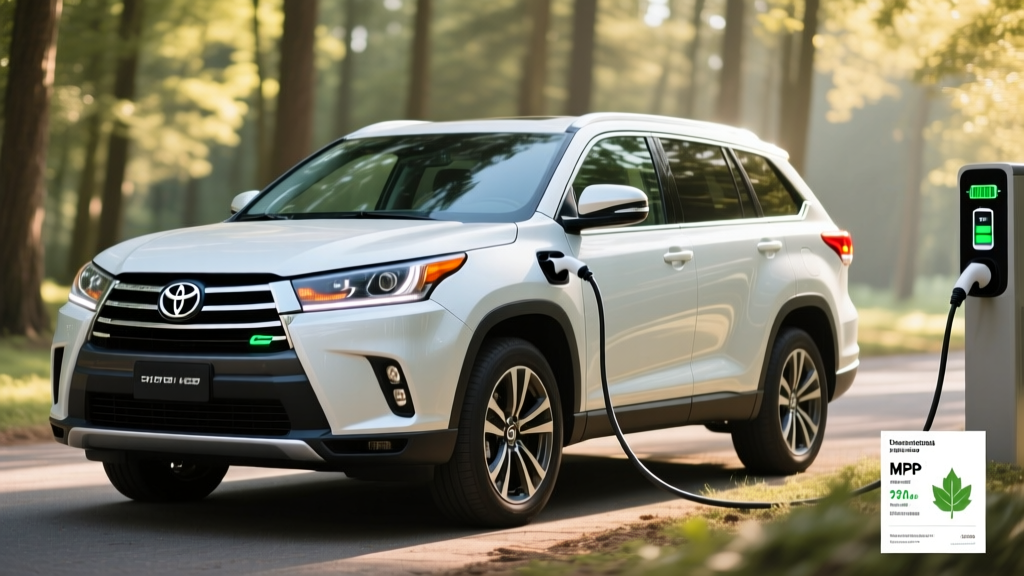
The 2017 Toyota Highlander Hybrid occupies a specific niche in the used-electrified market: a three-row family hauler that sips fuel without ever needing a plug. With EPA ratings of 27 city / 28 highway / 28 combined MPG, it remains one of the most efficient midsize SUVs you can buy on the secondhand market. But as a seven-year-old hybrid in 2026, buyers have legitimate questions about battery longevity, replacement costs, and whether a newer PHEV or full EV might be a smarter purchase.
This guide breaks down the exact powertrain specs, real-world fuel economy data, battery health expectations, and ownership economics of the 2017 Highlander Hybrid — so you can decide if it's the right fit for your garage.
HEV vs PHEV: What the 2017 Highlander Hybrid Actually Is
The 2017 Toyota Highlander Hybrid is a conventional hybrid electric vehicle (HEV). It is not a plug-in hybrid (PHEV). This distinction matters enormously for how you'll own and operate it:
| Feature | 2017 Highlander Hybrid (HEV) | Typical PHEV (e.g., RAV4 Prime) | Full EV (e.g., Tesla Model Y) |
|---|---|---|---|
| Plug-in charging required? | No — self-charging via regenerative braking | Yes — plug in for electric-only range | Yes — plug in for all driving |
| Electric-only range | Less than 1 mile at low speed | 30–42 miles | 250–330+ miles |
| Gasoline engine | Yes — 3.5L V6 | Yes — typically 2.5L 4-cyl | No |
| Battery size | ~1.9 kWh (NiMH) | 13–18 kWh (Li-ion) | 60–100 kWh (Li-ion) |
| Fuel economy (combined) | 28 MPG | 94 MPGe (electric) / 38 MPG (gas) | 100–130 MPGe |
| Federal tax credit (new) | None | $7,500 (if eligible at purchase) | Up to $7,500 (if eligible) |
The Highlander Hybrid captures energy during braking and deceleration to recharge its small nickel-metal hydride (NiMH) battery pack. You never plug it in. You simply fill it with gasoline and drive — the hybrid system automatically manages the balance between electric motor assist and engine power to maximize efficiency.
Fuel Economy: EPA Ratings and Real-World MPG
| Driving Cycle | EPA Rating | Real-World Expectation |
|---|---|---|
| City | 27 MPG | 28–32 MPG (hybrids excel in stop-and-go) |
| Highway | 28 MPG | 25–27 MPG (less regen benefit at steady speed) |
| Combined | 28 MPG | 26–30 MPG depending on driving mix |
Source: EPA Fuel Economy Guide
Toyota's hybrid system is at its best in city driving, where frequent braking events feed energy back into the battery and the electric motor handles low-speed acceleration. Many Highlander Hybrid owners report city MPG that actually exceeds the EPA estimate — 30 to 32 MPG in moderate-temperature urban commuting is common. Highway driving tells a different story: the 3,900-pound SUV faces more aerodynamic drag and less regenerative opportunity, so expect 25–27 MPG on sustained freeway runs.
Cold-weather impact: In sub-30°F conditions, expect a 2–4 MPG drop. The gasoline engine runs more frequently to maintain cabin heat and battery temperature, reducing the system's ability to shut the engine off at stops.
Powertrain Specs: Engine, Motors, and Combined Output
| Specification | Detail |
|---|---|
| Engine | 3.5L V6 Atkinson-cycle (2GR-FXE) |
| Engine output | 245 HP @ 6,000 rpm |
| Front electric motor | 123 kW (165 HP) |
| Rear electric motor | 50 kW (67 HP) — AWD models only |
| Combined system horsepower | 306 HP net |
| Transmission | eCVT (electronically controlled continuously variable) |
| Drivetrain | AWD-i (electronic all-wheel drive via rear motor) |
| 0–60 MPH | ~7.4 seconds |
| Towing capacity | 3,500 lbs |
| Curb weight | ~4,700 lbs |
The 2017 model year brought a refreshed Highlander Hybrid with the updated 3.5L V6 and Toyota's eCVT planetary gearset — not a belt-driven CVT like those found in some competitors. This design is mechanically simple, with no clutch packs or friction bands to wear out, which is a key reason for the powertrain's durability record.
The AWD-i system uses a dedicated rear electric motor rather than a mechanical driveshaft connecting the front and rear axles. This means the rear wheels are powered entirely by electricity when traction demands it, and there's no parasitic drivetrain loss from a spinning propshaft during normal driving.
Hybrid Battery: Size, Chemistry, Warranty, and Replacement Cost
Battery specification: ~1.9 kWh nickel-metal hydride (NiMH), 244.8V nominal
Original warranty: 8 years / 100,000 miles (10 years / 150,000 miles in CARB states including CA, NY, MA, and others)
2026 status: Original warranty has expired for nearly all 2017 models
The Highlander Hybrid's NiMH battery pack is small by modern standards — roughly 1.9 kWh of total capacity. But that's by design. A conventional hybrid doesn't need large energy storage because it never drives significant distances on electricity alone. The battery serves as a buffer: absorbing regenerative braking energy and releasing it during acceleration assist.
Degradation reality: NiMH chemistry degrades more gracefully than early lithium-ion cells. Most 2017 Highlander Hybrids still on the road in 2026 retain 85–92% of their original battery capacity. You'll notice degradation as slightly reduced fuel economy and less electric-motor assist — not a sudden failure. Toyota's hybrid battery management system keeps the pack within a narrow state-of-charge window (roughly 40–80%), which dramatically extends cycle life.
Replacement cost (2026 estimates):
- New OEM battery from Toyota: $3,500–$4,500 (parts + labor at a dealership)
- Refurbished/remanufactured battery: $1,800–$2,800 installed
- Individual module replacement (if only a few cells fail): $400–$800 at a hybrid specialist shop
The good news: the 2GR-FXE V6 and Toyota's hybrid synergy drive system have an outstanding reliability track record. Consumer Reports consistently rates the Highlander Hybrid among the most reliable three-row SUVs. Hybrid system failures before 200,000 miles are uncommon when the vehicle has been maintained per schedule.
Pricing in 2026: Used Market Values and Tax Credit Status
The 2017 Highlander Hybrid was offered in three trims when new, with original MSRPs ranging from roughly $47,000 to $52,000. In the 2026 used market:
- LE trim: $18,000–$22,000 (80K–110K miles)
- Limited trim: $22,000–$27,000 (60K–90K miles)
- Limited Platinum trim: $25,000–$30,000 (50K–80K miles)
Federal tax credit: The IRS §30D Clean Vehicle Credit applies only to new and qualifying used electric vehicles and plug-in hybrids purchased from a dealer. The 2017 Highlander Hybrid is a conventional HEV and does not qualify for any federal tax credit — neither the new-vehicle credit nor the up-to-$4,000 used-EV credit. This credit exclusion applies to all conventional hybrids that cannot plug in.
State incentives: A handful of states offer modest rebates or HOV-lane access for hybrid vehicles, but most incentive programs have shifted focus to PHEVs and BEVs. Check your state's energy office or DMV for current availability.
Who Should Choose the 2017 Highlander Hybrid (And Who Shouldn't)
Pros
- 28 MPG combined in a 3-row SUV — exceptional for the class
- No plug-in charging required; works with any lifestyle
- Proven Toyota reliability with 200K+ mile potential
- Standard AWD-i for snow and rain traction
- 3,500-lb towing capacity
- Spacious cabin with 8-passenger seating
Cons
- No electric-only driving range (less than 1 mile at parking speeds)
- Dated infotainment compared to 2026 models
- No federal tax credit eligibility
- Highway MPG doesn't significantly beat the non-hybrid V6 at cruise
- NiMH battery replacement is an eventual $2K–$4.5K expense
- Missing modern ADAS features (no lane-centering, basic adaptive cruise only)
Choose the 2017 Highlander Hybrid if: You need three rows and AWD, primarily drive in mixed city/highway conditions, don't have access to plug-in charging at home, and want a proven, low-maintenance hybrid that will run reliably past 200,000 miles with basic maintenance.
Consider a PHEV (like a newer RAV4 Prime or Grand Highlander Hybrid) if: You have home charging and a commute under 40 miles. A PHEV lets you drive most days on electricity alone while retaining a gas engine for road trips — delivering 90+ MPGe on daily drives.
Consider a full EV (like a Kia EV9 or Tesla Model X) if: You have reliable home Level 2 charging, your daily driving is under 250 miles, and you want to eliminate gasoline entirely while accessing current federal tax credits on new purchases.
Ownership Costs: 5-Year Fuel and Maintenance Comparison
| Cost Category (5 years / 75K miles) | 2017 Highlander Hybrid | 2017 Highlander V6 (gas) | 2024 EV (e.g., Model Y) |
|---|---|---|---|
| Fuel / electricity | $7,800 (at $3.50/gal, 28 MPG) | $10,500 (at $3.50/gal, 21 MPG) | $3,200 (at $0.14/kWh) |
| Maintenance (oil, filters, brakes) | $2,200 | $3,500 | $1,200 |
| Estimated repair reserve | $1,500 | $1,800 | $800 |
| 5-year total operating cost | ~$11,500 | ~$15,800 | ~$5,200 |
The Highlander Hybrid saves roughly $4,300 in operating costs over five years compared to the gas-only V6 Highlander — primarily through a 33% reduction in fuel consumption and reduced brake wear (regenerative braking extends pad life significantly). A modern EV saves even more, but requires charging infrastructure and a higher upfront purchase price.
Pre-Purchase Checklist for a Used 2017 Highlander Hybrid
If you're evaluating a specific 2017 Highlander Hybrid in 2026, these are the items to verify:
- Hybrid battery health check: Ask a Toyota dealer to run a hybrid battery diagnostic. The tech can read individual module voltages and internal resistance. Look for less than 0.2V variance between modules.
- Hybrid system warranty status: Confirm whether the original 8yr/100K (or 10yr/150K in CARB states) warranty has expired. If the vehicle has under 100K miles, some coverage may remain.
- Service records: Verify regular oil changes (every 10K miles with synthetic) and inverter coolant service (first at 100K miles, then every 50K).
- Brake wear: Original brake pads often last 80K–120K miles on Toyota hybrids thanks to regenerative braking. Check remaining pad thickness.
- Tire condition: AWD-i models wear all four tires; uneven wear may indicate alignment or motor issues.
Frequently Asked Questions
How many MPG does the 2017 Toyota Highlander Hybrid get?
The EPA rates it at 27 city / 28 highway / 28 combined MPG. In real-world driving, city-heavy commuters often see 30–32 MPG, while highway-dominant driving drops to 25–27 MPG. Cold weather reduces efficiency by 2–4 MPG.
Does the 2017 Highlander Hybrid need to be plugged in?
No. This is a conventional hybrid (HEV), not a plug-in hybrid (PHEV). The battery recharges through regenerative braking and the gasoline engine. You never plug it in — just fill it with gasoline like any other car.
How far can it drive on electric power alone?
Less than 1 mile, and only at very low speeds (under 25 MPH). The hybrid battery is too small (~1.9 kWh) to provide meaningful electric-only range. The electric motor's role is to assist the gasoline engine, not replace it.
Is the hybrid battery reliable, and what does replacement cost?
Toyota's NiMH hybrid batteries have an excellent longevity record. Most retain 85–92% capacity after 7+ years. When replacement is eventually needed, expect $3,500–$4,500 for a new OEM battery or $1,800–$2,800 for a refurbished unit. Individual module repair can cost as little as $400–$800.
Does the 2017 Highlander Hybrid qualify for any tax credit?
No. The IRS §30D federal tax credit applies only to plug-in electric vehicles (BEVs and PHEVs). Conventional hybrids like the Highlander Hybrid do not qualify for any federal purchase incentive, whether bought new or used. Some states may offer minor incentives — check your state energy office.
Hybrid vs PHEV vs EV — which should I choose?
If you lack home charging access and need three rows, the HEV (Highlander Hybrid) is your best option. If you can charge at home and commute under 40 miles, a PHEV gives you electric-only daily driving with gas-engine backup. If you have Level 2 home charging and want zero tailpipe emissions, a full EV offers the lowest operating costs and access to current federal tax credits.
How does the 2017 Highlander Hybrid compare to newer models?
The 2020+ fourth-generation Highlander Hybrid switched to a 2.5L four-cylinder hybrid system with 243 combined HP and improved fuel economy (35–36 MPG combined). If budget allows, the newer generation is meaningfully more efficient and includes updated safety tech (Toyota Safety Sense 2.0 with lane-centering). The 2017 model trades efficiency and features for a lower purchase price and the proven V6 engine.
Sources: EPA Fuel Economy, IRS Clean Vehicle Credits, NHTSA