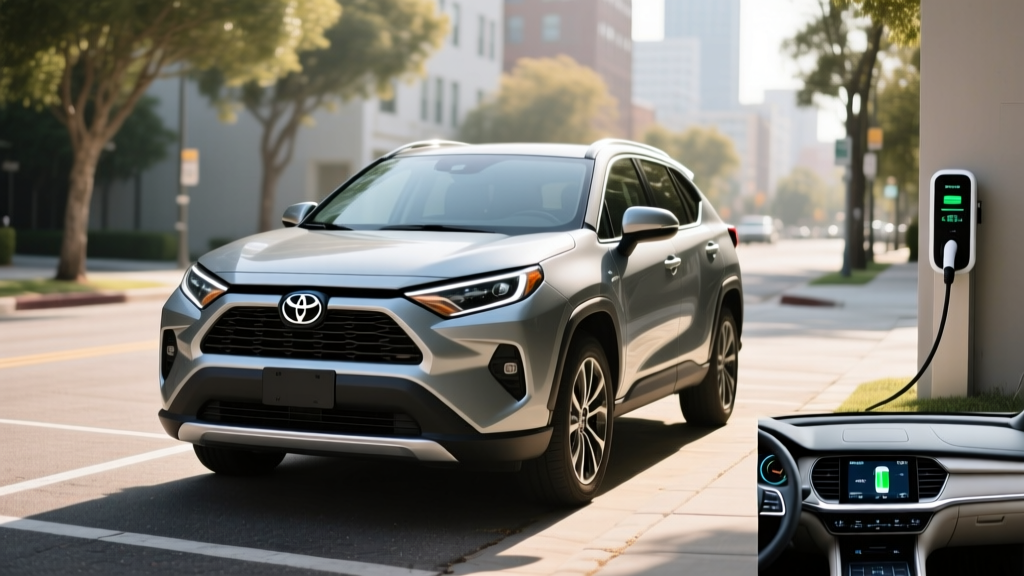
The 2017 Toyota RAV4 Hybrid remains one of the most sought-after used hybrid SUVs on the market, and for good reason: it pairs Toyota's proven Hybrid Synergy Drive with a practical compact crossover footprint. If you're researching 2017 RAV4 Hybrid mileage, the short answer is an EPA-estimated 32 MPG combined — but the real-world picture, especially in city driving, is even more favorable than the sticker suggests.
Because the 2017 RAV4 Hybrid is a conventional hybrid (HEV), not a plug-in, you'll never need to plug it in. It generates all its electricity through regenerative braking and the gasoline engine. Below, we break down exact fuel economy figures, the hybrid battery's expected lifespan and replacement cost, how this generation stacks up against newer RAV4 Hybrids and PHEVs, and whether buying a used 2017 model still makes financial sense in 2026.
2017 RAV4 Hybrid MPG: EPA Ratings and Real-World Results
The EPA rates the 2017 RAV4 Hybrid AWD (the only drivetrain configuration offered for the hybrid that year) at the following fuel economy figures:
| Drive Cycle | EPA Estimate | Real-World Expectation |
|---|---|---|
| City | 34 MPG | 33–37 MPG |
| Highway | 30 MPG | 28–31 MPG |
| Combined | 32 MPG | 30–34 MPG |
Source: fueleconomy.gov
Like most Toyota hybrids, the 2017 RAV4 Hybrid tends to exceed its EPA city estimate in stop-and-go traffic. That's because the electric motor handles low-speed propulsion while regenerative braking recaptures energy that a gas-only vehicle would waste as heat. Highway mileage dips slightly because the gasoline engine does most of the work at sustained speeds, and the vehicle's boxy crossover profile creates aerodynamic drag.
In cold weather (below 30°F), expect a 5–10% reduction in fuel economy. The engine runs more frequently to maintain cabin heat and keep the hybrid battery at optimal operating temperature. Owners in northern climates commonly report 28–30 MPG combined during winter months, rebounding to 33+ MPG in warmer weather.
Powertrain Specs: How the Hybrid System Delivers That Mileage
The 2017 RAV4 Hybrid uses Toyota's fourth-generation Hybrid Synergy Drive, pairing a 2.5-liter Atkinson-cycle four-cylinder engine with two motor-generators and a nickel-metal hydride (NiMH) hybrid battery pack.
| Specification | 2017 RAV4 Hybrid |
|---|---|
| Engine | 2.5L 4-cyl Atkinson cycle |
| Combined Net Horsepower | 194 HP |
| Electric Motors | Front MG + Rear MG (AWD) |
| Hybrid Battery Type | NiMH (nickel-metal hydride) |
| Hybrid Battery Capacity | ~1.6 kWh (gross) |
| Drivetrain | Electronic On-Demand AWD (AWD-i) |
| Transmission | eCVT (electronically controlled CVT) |
| 0–60 MPH | ~7.8 seconds |
| Fuel Tank | 14.8 gallons |
| Total Range (est.) | ~470 miles |
The rear-mounted motor-generator provides electric AWD without a mechanical driveshaft — it engages the rear wheels only when slip is detected or during initial acceleration. This system adds minimal weight and avoids the drivetrain losses of a traditional AWD setup, which is partly why the hybrid's mileage penalty versus the FWD gas RAV4 is so modest.
HEV vs PHEV vs EV: Which Powertrain Is Right for You?
The 2017 RAV4 Hybrid is a conventional hybrid (HEV). It cannot be plugged in and has no electric-only driving range to speak of — the small NiMH battery assists the gas engine but doesn't power the vehicle independently for any meaningful distance. If you're cross-shopping, here's how the three electrified powertrains compare:
| Factor | HEV (2017 RAV4 Hybrid) | PHEV (RAV4 Prime) | BEV (bZ4X / Tesla Model Y) |
|---|---|---|---|
| Plug-in Required? | No | Optional (but recommended) | Yes |
| Electric-Only Range | N/A | 42 mi (2026 RAV4 Prime) | 250–330 mi |
| Combined MPG / MPGe | 32 MPG | 38 MPG (gas) / 94 MPGe (elec) | 110–130 MPGe |
| Home Charging Needed | No | Recommended for max benefit | Essential |
| Used Price Range (2026) | $17,000–$23,000 | $32,000–$40,000 | $25,000–$38,000 |
| Federal Tax Credit (Used) | Not eligible | Up to $4,000 (§25E used) | Up to $4,000 (§25E used) |
Choose the 2017 RAV4 Hybrid (HEV) if: You want lower fuel costs without changing your routine — no plugging in, no home charger installation, no range planning. Ideal if you lack reliable access to charging at home or work.
Choose a RAV4 Prime (PHEV) if: You can charge at home and want 42 miles of electric-only commuting with a gas engine for longer trips. Higher upfront cost but dramatically lower fuel spend on short commutes.
Choose a BEV if: You have home charging, your daily driving is under 250 miles, and you want to eliminate gasoline entirely. Lowest per-mile energy cost but highest purchase price.
Hybrid Battery Lifespan, Warranty, and Replacement Cost
The single biggest concern for any used hybrid buyer is battery longevity. The 2017 RAV4 Hybrid's NiMH battery pack is proven technology — Toyota has refined this chemistry over two decades of Prius and Camry Hybrid production.
Original Warranty: Toyota warranted the 2017 RAV4 Hybrid's hybrid battery for 8 years / 100,000 miles (10 years / 150,000 miles in California and states that follow CARB emissions standards).
Real-World Lifespan: Based on fleet data and owner reports, Toyota NiMH hybrid batteries typically last 150,000–200,000+ miles before significant degradation. Many first-generation Prius batteries exceeded 200,000 miles with usable capacity.
Replacement Cost (2026): A new OEM hybrid battery from Toyota runs approximately $3,000–$4,500 installed at a dealership. Refurbished or aftermarket NiMH packs are available for $1,500–$2,500 installed through independent hybrid specialists. Individual module replacement (only failed cells) can cost as little as $500–$1,000.
NiMH batteries degrade gradually rather than failing catastrophically. You'll notice reduced fuel economy (perhaps dropping from 32 to 26–28 MPG combined) and more frequent engine engagement before the battery becomes non-functional. A hybrid battery health check — available at any Toyota dealer or through an OBD-II scanner app like Dr. Prius — can quantify remaining capacity before you buy.
2017 RAV4 Hybrid Trim Levels and Used Pricing
Toyota offered the 2017 RAV4 Hybrid in two primary trims: the XLE and the Limited. A sporty SE Hybrid was not available until the 2019 refresh. Here's what you'll find on the used market in 2026:
| Trim | Original MSRP (2017) | Used Price Range (2026) | Key Features |
|---|---|---|---|
| XLE Hybrid | $30,725 | $17,000–$20,500 | Toyota Safety Sense P, 7" touchscreen, dual-zone climate, blind-spot monitor |
| Limited Hybrid | $34,510 | $19,500–$23,000 | Leather, JBL audio, navigation, heated front seats, power liftgate |
The 2017 RAV4 Hybrid does not qualify for the federal §30D new clean vehicle credit (it's a used purchase and was never a plug-in). However, the §25E used clean vehicle credit does not apply either — that credit is limited to used EVs and PHEVs with at least 4 kWh of battery capacity that were originally eligible for the new-vehicle credit. The conventional RAV4 Hybrid doesn't meet that threshold.
Some states offer point-of-sale rebates for used hybrids, but these vary widely. Check your state's energy office or IRS §25E guidelines for current eligibility.
Reliability, Safety, and Long-Term Ownership Costs
The 2017 RAV4 Hybrid scores well on the metrics that matter for a used compact SUV:
Safety: The 2017 RAV4 earned the IIHS Top Safety Pick+ designation with its standard Toyota Safety Sense P suite (pre-collision braking, lane departure alert, automatic high beams, and full-speed-range adaptive cruise control). The NHTSA gave it a 5-star overall safety rating.
Reliability: Toyota's 2.5L Atkinson-cycle engine is one of the most durable four-cylinders in production. The eCVT has no belts, clutches, or traditional friction components to wear out — it's a planetary gearset that Toyota has refined since the 1997 Prius. Major maintenance items are limited to standard oil changes (every 10,000 miles with synthetic), brake fluid, coolant, and transmission fluid. Brake pad life is extended significantly by regenerative braking — many owners report original brake pads lasting 80,000–100,000 miles.
Estimated 5-Year Ownership Cost (used, 15,000 mi/yr):
| Category | Annual Cost | 5-Year Total |
|---|---|---|
| Fuel (32 MPG, $3.40/gal) | $1,594 | $7,969 |
| Insurance (national avg) | $1,300 | $6,500 |
| Maintenance | $450 | $2,250 |
| Estimated Repairs | $300 | $1,500 |
| Total (excl. purchase price) | $3,644 | $18,219 |
For comparison, a 2017 gas-only RAV4 AWD (EPA 25 MPG combined) would cost approximately $2,040/year in fuel — a $446 annual premium over the hybrid. Over five years, the hybrid saves roughly $2,230 in fuel, which largely offsets any price premium paid at purchase.
Pros and Cons of Buying a Used 2017 RAV4 Hybrid
Pros
- 32 MPG combined real-world; 34+ MPG in city driving
- Standard AWD (AWD-i) with no fuel-economy penalty
- Toyota Safety Sense P standard on every trim
- Proven NiMH hybrid battery with 150K–200K+ mile lifespan
- eCVT reliability — no traditional transmission wear items
- Regenerative braking extends brake pad life to 80K–100K mi
- No plug-in charging required — zero lifestyle adjustment
Cons
- 30 MPG highway trails some turbo-gas competitors at steady speed
- NiMH battery less energy-dense than modern lithium-ion packs
- No federal or state tax credits for this used HEV purchase
- 2017 infotainment feels dated — no Apple CarPlay / Android Auto
- Cabin noise under hard acceleration (CVT drone)
- Cargo volume (35.6 cu ft) slightly reduced vs gas model due to battery placement
How the 2017 RAV4 Hybrid Mileage Compares to Newer Models
If you're weighing a used 2017 against a newer RAV4 Hybrid, here's how the mileage progression looks across generations:
| Model Year | EPA Combined MPG | Battery Type | Combined HP |
|---|---|---|---|
| 2017 RAV4 Hybrid | 32 MPG | NiMH | 194 HP |
| 2020 RAV4 Hybrid (5th gen) | 40 MPG | NiMH | 219 HP |
| 2024 RAV4 Hybrid | 39 MPG | Li-ion | 219 HP |
| 2026 RAV4 Hybrid | 41 MPG | Li-ion | 219 HP |
The fifth-generation RAV4 Hybrid (2019+) jumped to 40 MPG combined thanks to the TNGA platform, a more efficient transaxle, and lithium-ion battery adoption in later years. That's a 25% fuel economy improvement over the 2017 model. If fuel savings is your primary motivator and your budget allows, a 2020+ RAV4 Hybrid offers meaningfully better mileage. However, a used 2017 model at $17,000–$23,000 versus $30,000+ for a comparable 2020 creates a purchase-price gap that takes years of driving to recoup through fuel savings alone.
Frequently Asked Questions
How many MPG does the 2017 RAV4 Hybrid actually get?
The EPA rates it at 34 city / 30 highway / 32 combined. In real-world driving, most owners report 30–34 MPG combined, with city-heavy commutes often reaching 35–37 MPG thanks to the hybrid system's regenerative braking advantage. Highway-only driving at 75+ MPH may dip to 28–29 MPG.
Does the 2017 RAV4 Hybrid need to be plugged in?
No. The 2017 RAV4 Hybrid is a conventional hybrid (HEV). It charges its own small NiMH battery through regenerative braking and the gasoline engine. There is no plug, no charging cable, and no electric-only driving range. You fuel it exactly like a gas car.
How long will the hybrid battery last, and what does replacement cost?
Toyota's NiMH hybrid batteries typically last 150,000–200,000+ miles based on two decades of fleet data. The original warranty was 8 years/100,000 miles (10 years/150,000 miles in CARB states). If replacement is needed, expect $3,000–$4,500 for a new OEM pack or $1,500–$2,500 for a refurbished unit from a hybrid specialist.
Does the 2017 RAV4 Hybrid qualify for any tax credit?
No. As a conventional hybrid (not a plug-in), it never qualified for the federal §30D new vehicle credit, and it does not qualify for the §25E used clean vehicle credit. Some states may offer minor registration-fee reductions or HOV lane access for hybrids, but there is no federal tax incentive for purchasing a used 2017 RAV4 Hybrid.
Is the 2017 RAV4 Hybrid reliable compared to the gas-only RAV4?
Yes — the hybrid variant is generally considered as reliable or more reliable than the gas-only model. The eCVT eliminates traditional transmission wear components, regenerative braking extends brake life, and the Atkinson-cycle 2.5L engine runs under less thermal stress than a conventional Otto-cycle engine. The hybrid battery is the only unique wear item, and its 150K+ mile expected lifespan rarely becomes a problem within typical ownership periods.
Should I buy a 2017 RAV4 Hybrid or a newer model?
If budget is the priority, the 2017 at $17,000–$23,000 used is a strong value — you get proven hybrid reliability and 32 MPG for thousands less than a 2020+ model. If maximum fuel economy matters most, the 2020+ RAV4 Hybrid's 40–41 MPG combined saves roughly $350–$400 more per year in fuel, but the $8,000–$12,000 higher purchase price takes 20+ years to offset at average mileage. Buy the 2017 for value; buy newer for maximum efficiency and modern infotainment.