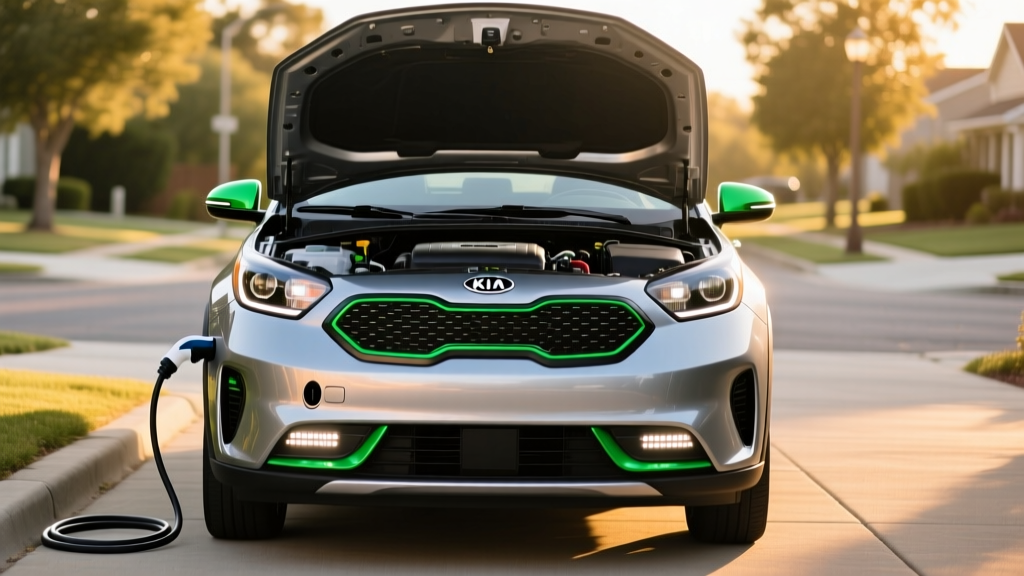
Quick Verdict: The 2017 Kia Niro Hybrid in 2026
The 2017 Kia Niro launched as something unusual — a dedicated hybrid crossover with no gas-only counterpart. Nearly a decade later, it remains one of the most efficient used hybrids you can buy, with EPA ratings that still compete with brand-new models. As a conventional hybrid (HEV), it requires no plug, no behavior change, and no charging infrastructure — just fill up and drive. For budget-conscious buyers in 2026 who want hybrid efficiency without EV complexity, the used 2017 Niro is a compelling, data-backed choice.
How Many MPG Does the 2017 Kia Niro Hybrid Get?
The EPA published three distinct fuel economy ratings for the 2017 Niro, split by trim level. This matters because wheel size and equipment weight meaningfully affect efficiency — something many used buyers overlook.
| Trim Level | City MPG | Highway MPG | Combined MPG |
|---|---|---|---|
| FE (base, 16" wheels) | 52 | 49 | 50 |
| LX / EX (18" wheels) | 46 | 40 | 43 |
| Touring / Touring Launch (18" + leather) | 46 | 40 | 43 |
Source: fueleconomy.gov
Real-World MPG: What Owners Actually Report
EPA stickers are a baseline, not a guarantee. The 2017 Niro's Atkinson-cycle 1.6L engine paired with a 43-hp electric motor and 6-speed dual-clutch transmission produces real-world results that vary with driving style and climate:
- City driving (stop-and-go): The FE trim routinely achieves 48–54 MPG in real-world urban use. Hybrids thrive here because regenerative braking recaptures energy that gas cars waste as heat.
- Highway cruising (65–75 mph): Expect 40–46 MPG combined on the FE, and 36–41 MPG on heavier Touring trims. The Niro's aerodynamic crossover profile helps, but highway efficiency drops versus city — typical for hybrids.
- Cold weather (below 35°F): Plan for a 10–15% reduction. The engine runs more frequently to provide cabin heat and maintain catalyst temperature, reducing electric-motor reliance. Expect 40–44 MPG combined on the FE in winter.
- Combined real-world average: Owner-reported data on Fuelly and forums clusters around 44–48 MPG for FE owners and 38–42 MPG for Touring owners over multi-year ownership.
The 7-MPG spread between FE and Touring trims is significant — roughly 1.5 extra gallons per 1,000 miles driven. Over 15,000 annual miles, that's ~$75–$90 more per year in fuel at $3.50/gallon. Trim choice matters.
Powertrain and Hybrid System Specs
The 2017 Niro uses Kia's first dedicated hybrid platform, shared with the Hyundai Ioniq. Unlike Toyota's planetary-gear CVT approach (used in the Prius), Kia opted for a 6-speed dual-clutch automatic — giving the Niro more conventional shift feel at a slight efficiency trade-off.
| Component | Specification |
|---|---|
| Gas Engine | 1.6L GDI 4-cylinder (Atkinson cycle), 103 hp / 109 lb-ft |
| Electric Motor | Permanent-magnet synchronous, 43 hp (32 kW) / 125 lb-ft |
| Combined System Output | 139 hp / 195 lb-ft |
| Transmission | 6-speed dual-clutch automatic (DCT) |
| Hybrid Battery | 1.56 kWh lithium-ion polymer (Li-ion), located under rear seat |
| Drivetrain | Front-wheel drive |
| 0–60 mph | ~9.7 seconds (EPA test data / Car and Driver) |
| Curb Weight | 3,163 lbs (FE) – 3,307 lbs (Touring) |
The 1.56 kWh battery is small by PHEV or BEV standards — it's not designed for electric-only driving beyond low-speed creep. Its job is to buffer regenerative energy, enable engine-off coasting, and provide torque fill during acceleration. This small capacity is actually an advantage for longevity: shallow charge cycles produce less thermal stress than the deep cycles in larger batteries.
Hybrid Battery Lifespan, Warranty, and Replacement Cost
Battery longevity is the single most common concern for used-hybrid buyers — and it's valid. The 2017 Niro's lithium-ion polymer pack is now 9 years old in 2026, making warranty status and replacement economics critical purchase factors.
| Item | Details |
|---|---|
| Original Hybrid Battery Warranty | 10 years / 100,000 miles (from original in-service date) |
| Warranty Transferability | Reduces to 5 years / 60,000 miles for second+ owners in most states |
| CARB-State Exception | California and CARB-adopting states: 10 yr / 150,000 mi transfers to subsequent owners |
| Capacity Retention Threshold | Kia replaces if battery falls below ~60–70% of original capacity (dealer-diagnosed) |
| OEM Battery Replacement Cost | $2,500–$3,800 (parts + dealer labor, 2026 pricing) |
| Aftermarket/Refurbished Option | $1,500–$2,500 (independent hybrid shops, reconditioned cells) |
| Typical Degradation at 100K Miles | 10–18% capacity loss based on owner reports — generally does not affect MPG noticeably |
Real-world failure data is encouraging. The Niro's 1.56 kWh pack experiences relatively mild stress compared to PHEV or BEV batteries. Most owner forums and repair databases show battery replacement rates under 5% through 120,000 miles. When failures do occur, they're often individual cell module issues rather than full-pack replacements.
Reliability, Safety Ratings, and Known Issues
The 2017 Niro earned strong safety credentials. The NHTSA awarded it a 5-star overall safety rating, and the IIHS named it a Top Safety Pick when equipped with optional forward collision warning and automatic emergency braking.
Common Issues to Inspect
- Dual-clutch transmission shudder: Some owners report low-speed hesitation or shudder, particularly in stop-and-go traffic. Usually resolved with a software update or clutch-adaptation reset at the dealer. Test-drive in city traffic to check.
- 12V auxiliary battery drain: The Niro uses a conventional 12V battery (separate from the hybrid pack) for electronics. Parasitic drain from infotainment or dashcam accessories can kill it during extended parking. Budget $150–$200 for a replacement if needed.
- Infotainment lag: The 2017 UVO infotainment system is functional but dated by 2026 standards. Apple CarPlay and Android Auto are supported on EX and above trims — a significant advantage over the base FE's simpler display.
- Brake feel: Regenerative blending can make the brake pedal feel inconsistent — a common hybrid trait. Not a defect, but worth experiencing on a test drive if you're new to hybrids.
Overall Reliability Assessment
J.D. Power rated the 2017 Niro at 78/100 for quality and reliability — about average for its class. Consumer Reports members reported better-than-average reliability for the 2017 model year. The powertrain's simplicity (naturally aspirated engine, no turbo, proven hybrid architecture) contributes to long-term durability. With proper maintenance — oil changes every 7,500 miles and transmission fluid service at 60,000–100,000 miles — these powertrains routinely reach 200,000+ miles.
Does the 2017 Kia Niro Hybrid Qualify for Any Tax Credit?
No. The 2017 Kia Niro Hybrid (HEV) does not qualify for the federal §30D Clean Vehicle Credit. Under current IRS rules, only battery electric vehicles (BEVs) and plug-in hybrids (PHEVs) with sufficient battery capacity are eligible. Conventional hybrids that cannot be plugged in are excluded entirely.
The 2017 Niro Plug-In Hybrid (PHEV) was eligible for a federal credit when new, but that credit has since expired for used purchases unless the vehicle meets the separate Used Clean Vehicle Credit (§25E) requirements: sale price under $25,000, buyer income caps, and purchased from a licensed dealer. A 2017 Niro PHEV could potentially qualify for up to $4,000 under §25E in 2026 — but the HEV version cannot.
| Credit Type | Niro Hybrid (HEV) | Niro Plug-In Hybrid (PHEV) |
|---|---|---|
| §30D New Vehicle Credit (up to $7,500) | Not eligible | Expired — was eligible when new |
| §25E Used Vehicle Credit (up to $4,000) | Not eligible | Potentially eligible (price <$25K, income caps apply) |
| State/Local Incentives | Rare — check state programs | Some states offer used-PHEV rebates |
Tax rules change frequently. Consult a tax professional and verify current IRS §30D and §25E guidance before purchasing.
Who Should Buy the 2017 Niro Hybrid vs. a PHEV or Full EV?
The 2017 Niro HEV occupies a specific niche. Here's a decision framework based on your driving pattern and infrastructure access:
Choose the 2017 Niro Hybrid (HEV) If:
- You lack home charging access (apartment, street parking)
- Your budget is under $16,000
- You want zero behavior change — just drive and refuel
- You drive 10,000–15,000 miles/year mostly in mixed city/highway
- You want crossover ride height without SUV fuel costs
Look at a PHEV or Full EV Instead If:
- You have Level 2 home charging and a short commute (<30 mi)
- You want to eliminate or drastically reduce gasoline purchases
- You qualify for §25E used-EV credits or state rebates
- You drive mostly in city traffic where electric-only mode maximizes savings
- You want access to HOV lanes (available in some states for PHEVs/EVs, not HEVs)
Annual Fuel Cost Comparison
At 15,000 miles/year and $3.50/gallon, here's how the 2017 Niro HEV stacks up against common alternatives:
| Vehicle | Combined MPG / MPGe | Annual Fuel Cost |
|---|---|---|
| 2017 Kia Niro FE (HEV) | 50 MPG | ~$1,050 |
| 2017 Kia Niro Touring (HEV) | 43 MPG | ~$1,221 |
| 2017 Toyota RAV4 (gas AWD) | 25 MPG | ~$2,100 |
| 2017 Honda CR-V (gas FWD) | 30 MPG | ~$1,750 |
| 2026 Hyundai Kona Electric (BEV) | 120 MPGe | ~$525 (electricity) |
The Niro FE saves roughly $1,000/year versus a comparable gas crossover — meaning a $13,000 used Niro pays back its premium over a gas alternative in about 3–4 years through fuel savings alone.
Pros and Cons at a Glance
Pros
- Class-leading 50 MPG combined (FE trim) — still competitive in 2026
- No plug required — zero charging infrastructure dependency
- Generous cargo space (22.7 cu ft behind rear seats, 54.5 cu ft folded)
- Standard Apple CarPlay / Android Auto on EX+ trims
- Strong safety ratings (5-star NHTSA, IIHS Top Safety Pick)
- Proven, simple powertrain with low maintenance costs
- Comfortable ride quality for a compact crossover
Cons
- Modest 139 hp — acceleration is leisurely (9.7s 0–60)
- DCT can feel hesitant at low speeds in heavy traffic
- Touring trim sacrifices 7 MPG for leather and features
- Infotainment system is dated by 2026 standards
- No AWD option — FWD only limits snow-belt appeal
- Hybrid battery is 9 years old — verify SoH before purchase
- No federal tax credit eligibility for the HEV variant
Frequently Asked Questions
How many MPG does the 2017 Kia Niro Hybrid get in real driving?
The EPA rates the FE trim at 52 city / 49 highway / 50 combined, and the Touring at 46/40/43. Real-world owners typically report 44–48 MPG combined for the FE and 38–42 for the Touring. City driving tends to match or exceed EPA numbers, while sustained highway speeds above 70 mph and cold weather reduce efficiency by 10–15%.
Is the 2017 Niro a plug-in hybrid?
The standard 2017 Niro Hybrid (HEV) is NOT a plug-in. It charges its 1.56 kWh battery through regenerative braking and the gasoline engine — you never plug it in. Kia introduced the Niro Plug-In Hybrid (PHEV) for the 2018 model year with an 8.9 kWh battery and 26 miles of electric-only range. If plug-in capability matters to you, look for a 2018+ Niro PHEV instead.
How long does the 2017 Niro hybrid battery last?
Kia warranted the hybrid battery for 10 years / 100,000 miles from the original in-service date. In 2026, most 2017 Niros are at or near the end of that original warranty window. Real-world data suggests the 1.56 kWh lithium-ion pack typically retains 82–90% of original capacity at 100,000 miles. Full battery replacement costs $2,500–$3,800 at a dealer, or $1,500–$2,500 through independent hybrid specialists using reconditioned cells. Failure rates remain low under 5% at this mileage.
Does the 2017 Niro Hybrid qualify for a tax credit?
No. The conventional hybrid (HEV) version does not qualify for any federal tax credit under current IRS §30D or §25E rules — only plug-in hybrids and battery electric vehicles are eligible. Some state or local programs may offer minor incentives for used hybrid purchases, but these vary widely by jurisdiction. Check your state's energy office for current programs.
Is the 2017 Kia Niro Hybrid reliable?
Yes, with caveats. The powertrain is proven and simple — naturally aspirated engine, modest hybrid system, no turbo. Consumer Reports and J.D. Power data show better-than-average reliability for the 2017 model year. The main items to watch are DCT low-speed shudder (usually fixable with a software update), 12V battery drain, and hybrid battery health as the pack ages past 100,000 miles. A pre-purchase inspection including a hybrid battery SoH test is strongly recommended.
Hybrid vs. PHEV vs. EV — which is right for me?
If you cannot charge at home, the HEV (this Niro) is your best electrified option — no infrastructure needed. If you have Level 2 home charging and a commute under 30 miles, a PHEV like the 2018+ Niro Plug-In lets you drive electric daily while keeping a gas engine for road trips. If you have home charging and want to eliminate gasoline entirely, a used BEV like the Chevy Bolt or Hyundai Kona Electric offers lower running costs — but requires commitment to charging logistics. The 2017 Niro HEV is the lowest-risk, lowest-complexity entry into electrified driving.