Quick Verdict: A Proven Hybrid Sedan That Still Delivers
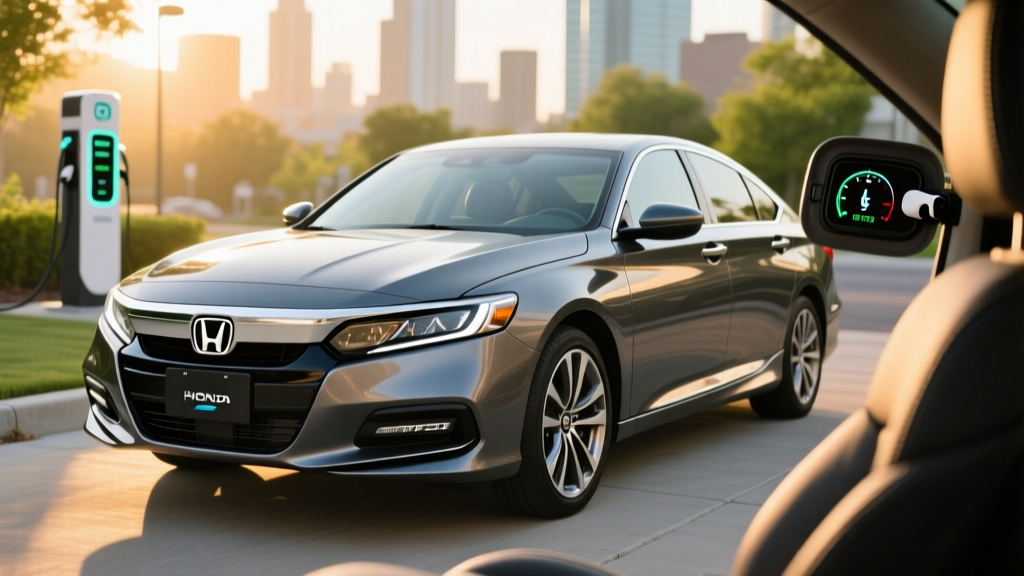
The 2017 Honda Accord Touring Hybrid occupies a specific niche in the used-car market: a full-size, fully loaded conventional hybrid (HEV) that sips fuel without requiring a plug, a charging routine, or any behavioral change from the driver. Nearly a decade after its launch, this ninth-generation Accord remains one of the most efficient midsize sedans ever built, with an EPA rating of 48 MPG combined — a figure that still competes with brand-new 2026 hybrids.
As a conventional hybrid, the Accord Hybrid does not plug in. It is not a plug-in hybrid (PHEV) and has no electric-only driving range. Instead, it uses a compact lithium-ion battery pack that recharges through regenerative braking and the gasoline engine. If you want a sedan that maximizes fuel economy without lifestyle adjustment, this car still makes a compelling case on the used market.
HEV vs. PHEV: Where the Accord Hybrid Fits
Before diving into specs, it is critical to understand what this car is — and what it is not.
| Feature | 2017 Accord Hybrid (HEV) | Typical PHEV (e.g., 2026 RAV4 Prime) | Full EV (e.g., 2026 Tesla Model 3) |
|---|---|---|---|
| Plug-in charging? | No — self-charging | Yes — plug in for EV range | Yes — plug in always |
| Electric-only range | ~1–2 mi at low speed | 35–42 mi EPA | 250–350+ mi EPA |
| Fuel type | Gasoline + regen | Gasoline + electricity | Electricity only |
| EPA combined | 48 MPG | 94 MPGe / 38 MPG gas | 132 MPGe |
| Tailpipe emissions | Low (hybrid) | Low (EV mode) / moderate (gas) | Zero tailpipe |
The Accord Hybrid is a conventional hybrid (HEV). You never plug it in. The 1.3 kWh lithium-ion battery charges itself via regenerative braking and the 2.0-liter Atkinson-cycle engine. This is fundamentally different from a plug-in hybrid like the Toyota RAV4 Prime or Chrysler Pacifica PHEV, which offer 30–40+ miles of electric-only driving before the gas engine engages.
Fuel Economy: EPA Ratings and Real-World MPG
The headline number for the 2017 Accord Hybrid is its EPA fuel economy, which remains exceptional for a full-size sedan.
| Driving Cycle | EPA Rating | Real-World Expectation |
|---|---|---|
| City | 49 MPG | 47–52 MPG (hybrids often exceed EPA in city) |
| Highway | 47 MPG | 42–46 MPG (aerodynamic drag, sustained speed) |
| Combined | 48 MPG | 44–49 MPG |
Source: fueleconomy.gov — 2017 Honda Accord Hybrid
Why Hybrids Often Beat EPA in the City
Conventional hybrids like the Accord thrive in stop-and-go traffic. Every brake application recovers kinetic energy through regenerative braking, recharging the battery and reducing the engine's workload. At low speeds, the electric motor handles more propulsion, and the engine shuts off at stops. Owners who drive predominantly in urban or suburban environments frequently report 50+ MPG in warm weather. Highway driving reverses this advantage: sustained speeds demand continuous engine output, and aerodynamic drag dominates efficiency.
Cold-Weather Impact
Expect a 5–10% MPG reduction in winter conditions (below 40°F). The engine runs more frequently to maintain cabin heat and battery temperature, reducing electric-motor assist time. In our experience, a 48 MPG combined rating typically drops to 42–44 MPG in sustained sub-freezing commutes.
Powertrain and Performance Specifications
| Specification | 2017 Honda Accord Hybrid Touring |
|---|---|
| Engine | 2.0L Atkinson-cycle inline-4 |
| Engine HP | 143 hp @ 6,200 rpm |
| Electric Motor HP | 184 hp (drive motor) |
| Combined System Output | 212 hp |
| Transmission | e-CVT (two-motor hybrid system) |
| 0–60 mph | ~7.1 seconds |
| Drivetrain | Front-wheel drive |
| Battery Type | Lithium-ion (1.3 kWh) |
| Fuel Tank | 12.8 gallons |
| Total Driving Range | ~614 miles (EPA combined) |
Honda's two-motor hybrid system is distinct from the planetary-gear design used in Toyota's Hybrid Synergy Drive. The Accord's system uses one motor primarily as a generator and a second as the drive motor. At highway speeds, a lock-up clutch mechanically connects the engine to the wheels for direct drive. This design delivers smooth, electric-like acceleration from a stop and avoids the "rubber-band" feel some drivers associate with older CVTs.
Touring Trim: What You Get
The Touring was the top-tier trim for the 2017 Accord Hybrid. Standard equipment includes:
- Leather-trimmed heated and ventilated front seats
- Heated rear seats
- Honda Sensing suite (adaptive cruise control, lane-keeping assist, collision mitigation braking, road departure mitigation)
- Navigation with 7-inch touchscreen
- Premium audio system
- LED headlights with auto high-beam
- Rain-sensing wipers
- Front and rear parking sensors
Hybrid Battery Lifespan, Warranty, and Replacement Cost
2017 Accord Hybrid Battery Warranty (Original)
Original coverage: 8 years / 80,000 miles (10 years / 150,000 miles in CARB states including CA, NY, MA, CT, ME, MD, NJ, OR, RI, VT, WA)
Capacity threshold: Honda covers the IMA (Integrated Motor Assist) battery if it fails or drops below functional specifications.
2026 status: Most 2017 models have exceeded the 8-year/80,000-mile federal warranty. CARB-state vehicles may still have coverage through the 10-year/150,000-mile provision, but only if mileage remains under the cap.
Real-World Battery Longevity
The 2017 Accord Hybrid uses a 1.3 kWh lithium-ion pack — far smaller than a PHEV or BEV battery. Because Honda's hybrid system maintains a narrow state-of-charge window (roughly 40–60% SoC during normal driving), the cells experience minimal stress. This conservative charge management is a key reason Honda hybrid batteries routinely last 150,000–200,000+ miles before significant degradation.
Based on owner reports and repair data through 2025:
- Typical lifespan: 150,000–200,000+ miles before replacement is needed
- Replacement cost (OEM): $2,000–$3,500 installed at a Honda dealer
- Replacement cost (aftermarket/refurbished): $1,200–$2,000 installed at an independent hybrid specialist
- Failure rate: Low — the 2017 model year has fewer battery complaints than earlier Accord Hybrid generations
Signs of Hybrid Battery Degradation
Watch for these indicators as the vehicle ages:
- Noticeable drop in fuel economy (e.g., from 48 to 38–40 MPG combined)
- Engine running more frequently, including at stops
- Reduced regenerative braking feel
- IMA warning light or "Check Hybrid System" message
If the battery does need replacement, the relatively small 1.3 kWh pack keeps costs far below those of a PHEV or full EV battery replacement, which can exceed $8,000–$15,000.
Used Pricing and Tax Credit Eligibility in 2026
Current Used Market Value
As of early 2026, the 2017 Honda Accord Hybrid Touring trades in the used market at the following approximate ranges:
- 60,000–80,000 miles: $16,000–$19,500
- 80,000–110,000 miles: $13,000–$16,500
- 110,000–140,000+ miles: $10,500–$13,500
Prices vary by region, condition, service history, and whether the hybrid battery has been replaced. A documented battery replacement is a value-add that commands a $1,000–$1,500 premium.
Tax Credit Situation
The 2017 Accord Hybrid does not qualify for the federal §30D new clean vehicle credit — it was never eligible as a new vehicle either, because conventional hybrids (HEVs) do not meet the plug-in requirement. The §30D credit applies only to plug-in vehicles (PHEVs and BEVs) with a battery capacity of at least 7 kWh and meeting current sourcing, MSRP, and income requirements per IRS guidelines.
The used clean vehicle credit (§25E) also requires the vehicle to be a plug-in EV or fuel cell vehicle. Conventional hybrids like the Accord Hybrid are excluded.
Bottom line: there are no federal tax credits available for purchasing a used 2017 Accord Hybrid. Some states may offer minimal incentives for high-efficiency used vehicles, but these are rare and jurisdiction-specific. Check your state's energy or environmental agency for details.
Reliability and Ownership Costs
The 2017 Accord Hybrid benefits from Honda's strong reliability reputation and the mechanical simplicity of its hybrid system. The e-CVT has no traditional transmission bands, clutches, or torque converter to wear out. There is no starter motor — the hybrid system starts the engine via the motor/generator. Brake pad life is extended significantly by regenerative braking; many owners report 80,000+ miles on original pads.
Estimated Annual Operating Costs (2026)
| Category | Annual Estimate | Notes |
|---|---|---|
| Fuel (12,000 mi/yr @ 48 MPG) | $750–$875 | Based on $3.00–$3.50/gal regular unleaded |
| Insurance | $1,100–$1,500 | Varies by state, age, driving record |
| Maintenance | $400–$600 | Oil changes, tires, cabin filter; no transmission fluid changes typically needed |
| Total annual operating | $2,250–$2,975 | Excludes depreciation, registration, loan interest |
For comparison, a 2017 Accord 2.4L gasoline model (EPA 30 MPG combined) would cost approximately $1,200–$1,400 annually in fuel alone — a $325–$650 yearly premium over the hybrid.
Who Should Choose the 2017 Accord Hybrid Touring?
Choose the 2017 Accord Hybrid Touring If:
- You want 45+ MPG without plugging in or changing your routine
- Your commute is city-heavy or mixed suburban (where hybrids shine)
- You need a spacious, comfortable sedan with a large trunk (13.5 cu ft)
- You want Honda Sensing safety tech at a used-car price
- You plan to keep the car 3–5 years and want predictable, low operating costs
Look at a PHEV Instead If:
- You have home charging and want 30–40 miles of daily electric-only commuting
- You want to qualify for a used-EV tax credit (up to $4,000 under §25E)
- Your daily driving is under 40 miles round-trip and you want to rarely buy gas
Look at a Full EV Instead If:
- You have reliable home Level 2 charging
- You want zero tailpipe emissions and minimal maintenance (no oil changes, fewer brake replacements)
- Your daily driving is under 250 miles and you can access DC fast charging for road trips
Pros and Cons at a Glance
Pros
- 48 MPG combined EPA — still among the best of any midsize sedan in 2026
- No plug-in required — zero infrastructure dependency
- Touring trim is fully loaded: leather, ventilated seats, Honda Sensing, LED headlights
- Spacious cabin and 13.5 cu ft trunk (hybrid battery is under the rear seat, preserving cargo space)
- Proven hybrid system with low failure rates and affordable battery replacement
- Smooth, quiet electric-motor-dominant acceleration from stops
Cons
- No plug-in capability — cannot drive on electric-only power beyond ~1 mile at low speed
- No federal or state tax credits available for this conventional hybrid
- Infotainment system is dated by 2026 standards (no wireless CarPlay/Android Auto)
- Original hybrid battery warranty has expired for most examples (unless CARB-state and under 150k miles)
- Rear visibility is slightly compromised by the trunk-mounted spoiler design
- 2017 model year was the final year of the ninth generation — styling reads as older
Frequently Asked Questions
How many MPG does the 2017 Honda Accord Hybrid get?
The EPA rates the 2017 Accord Hybrid at 49 MPG city, 47 MPG highway, and 48 MPG combined. In real-world driving, city-heavy commuters often see 50+ MPG, while sustained highway driving yields 42–46 MPG. Cold weather reduces economy by roughly 5–10%.
Is the 2017 Accord Hybrid a plug-in hybrid?
No. The 2017 Accord Hybrid is a conventional hybrid (HEV). It does not plug in. The 1.3 kWh lithium-ion battery recharges through regenerative braking and the gasoline engine. Honda did not offer a plug-in Accord for the 2017 model year in the United States.
How far can the 2017 Accord Hybrid drive on electric only?
Approximately 1–2 miles at very low speeds (under 25 mph) on a fully charged hybrid battery. This is not a meaningful electric-only range — the car is designed to blend electric and gasoline power continuously, not to drive solely on electricity.
Is the hybrid battery reliable, and what does replacement cost?
Yes. Honda's hybrid battery in the 2017 Accord is known for longevity, with many lasting 150,000–200,000+ miles. OEM replacement costs $2,000–$3,500 at a dealer. Aftermarket or refurbished replacements run $1,200–$2,000 at independent shops. The original 8-year/80,000-mile warranty (10 years/150,000 miles in CARB states) has expired for most vehicles as of 2026.
Does the 2017 Accord Hybrid qualify for any tax credit?
No. The federal §30D new vehicle credit and the §25E used vehicle credit both require a plug-in vehicle (PHEV or BEV). Conventional hybrids are not eligible for any federal tax credit. Check your state's energy agency for any local efficiency incentives, but these are uncommon for non-plug-in hybrids.
How does the 2017 Accord Hybrid compare to the 2017 Toyota Camry Hybrid?
The 2017 Camry Hybrid (EPA 40–42 MPG combined) trails the Accord Hybrid by roughly 6–8 MPG. The Accord also offers more rear-seat legroom and a more advanced hybrid powertrain (212 hp vs. 200 hp). However, the Camry Hybrid has a slightly larger trunk and a more conventional driving feel. Both are excellent used hybrid sedans; the Accord wins on efficiency, the Camry on cargo space.
What should I check before buying a used 2017 Accord Hybrid?
- Verify hybrid battery health — ask for a dealer diagnostic report showing battery module voltages
- Check for IMA system warning lights or stored diagnostic trouble codes
- Review service records for regular oil changes (every 7,500 miles with 0W-20 synthetic)
- Confirm whether the vehicle was originally sold in a CARB state (affects extended battery warranty eligibility)
- Inspect brake pad thickness — regenerative braking extends pad life, but original pads at 100,000+ miles may be due for replacement