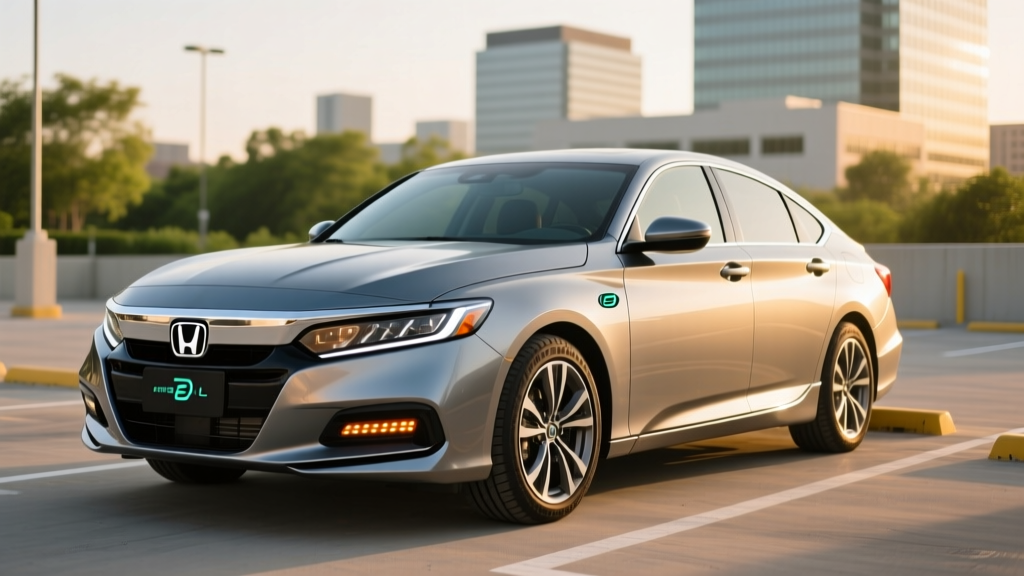
The 2017 Honda Accord Hybrid EX-L was one of the most efficient midsize sedans of its era, and nearly a decade later it remains a compelling used-hybrid option for buyers who want excellent fuel economy without plugging in. With its 49 MPG city EPA rating, leather-trimmed EX-L interior, and Honda's proven two-motor hybrid system, this sedan still punches above its weight. But in a market now flooded with plug-in hybrids and full EVs, does a conventional hybrid from 2017 still make sense? Here's the data-driven breakdown.
HEV vs PHEV vs EV: Where the 2017 Accord Hybrid Fits
Before diving into specs, it's essential to distinguish the three electrified powertrain types, because the 2017 Accord Hybrid is strictly a conventional hybrid electric vehicle (HEV). It has no plug, no electric-only driving range to speak of, and requires zero behavior change from a gas-car owner.
| Feature | HEV (e.g., 2017 Accord Hybrid) | PHEV (e.g., Chrysler Pacifica Hybrid) | BEV (e.g., Tesla Model 3) |
|---|---|---|---|
| Plug-in charging? | No — gasoline only | Yes — Level 1/2 AC | Yes — Level 1/2/DC |
| Electric-only range | ~1 mile at low speed | 20–45 miles typical | 250–400+ miles |
| Fuel source | Gasoline | Gasoline + electricity | Electricity only |
| Federal tax credit (§30D) | Not eligible | Up to $7,500 (if qualified) | Up to $7,500 (if qualified) |
| Best for | No home charging access; long commutes | Short daily commute + road trips | Home charging + mostly under 300 mi/day |
The Accord Hybrid captures energy through regenerative braking and its gasoline engine — you simply fill it at any gas station and drive. There is no charging cable, no range anxiety, and no need for a Level 2 home charger installation.
2017 Accord Hybrid EX-L: Powertrain and Performance Specs
| Specification | 2017 Accord Hybrid EX-L |
|---|---|
| Engine | 2.0L Atkinson-cycle inline-4 |
| Engine horsepower | 143 hp @ 6,200 rpm |
| Electric motors | Two-motor i-MMD system |
| Combined system output | 212 hp |
| 0–60 mph | ~7.2 seconds |
| Transmission | Single-speed direct drive (no traditional CVT) |
| Drivetrain | Front-wheel drive |
| Hybrid battery | 1.3 kWh lithium-ion (not plug-in) |
| Curb weight | ~3,536 lbs |
| Fuel tank | 12.8 gallons |
| Total driving range | ~614 miles (EPA combined) |
Honda's i-MMD (Intelligent Multi-Mode Drive) system is fundamentally different from Toyota's planetary-gear hybrid setup. In most driving conditions, the gasoline engine acts as a generator, powering the electric drive motor while the engine stays in its most efficient RPM band. At highway speeds (roughly above 45 mph under steady load), a lock-up clutch connects the engine directly to the wheels. This means the car drives more like an EV around town — smooth, linear torque delivery — with the efficiency benefits of a hybrid.
Fuel Economy: EPA Ratings vs Real-World MPG
| Driving Condition | EPA Rating | Real-World Expectation |
|---|---|---|
| City | 49 MPG | 47–52 MPG (hybrids often exceed EPA in stop-and-go) |
| Highway | 47 MPG | 42–46 MPG (steady high-speed driving reduces hybrid advantage) |
| Combined | 48 MPG | 44–49 MPG depending on driving mix |
Source: EPA Fuel Economy Guide
Real-world MPG note: Hybrid fuel economy is highly sensitive to driving style. The Accord Hybrid's regenerative braking system recaptures the most energy in city traffic with frequent stops — many owners report exceeding the 49 MPG city EPA figure in warm-weather urban commuting. Conversely, sustained highway driving at 75+ mph, cold winter temperatures (below 30°F), and aggressive acceleration can drop combined MPG into the low 40s. Expect roughly 44–49 MPG combined in typical mixed driving.
At 48 MPG combined and a national average gas price of roughly $3.10/gallon (early 2026), annual fuel cost for 15,000 miles of driving comes to approximately $969 — compared to $1,860 for a comparable 25 MPG gas-only midsize sedan. That's roughly $891 in annual fuel savings.
EX-L Trim: What You Get for the Money
The EX-L sits in the upper-middle of the 2017 Accord Hybrid lineup, below the top Touring trim. It was originally priced at roughly $32,905 MSRP when new. In the 2026 used market, expect to pay between $16,000 and $21,000 depending on mileage, condition, and region.
EX-L standard equipment includes:
- Leather-trimmed seats with heated front seats
- 8-way power driver's seat with lumbar support
- Apple CarPlay and Android Auto on a 7-inch touchscreen
- Honda Sensing suite (adaptive cruise control, lane-keeping assist, forward-collision warning with automatic emergency braking, road-departure mitigation)
- Moonroof
- Auto-dimming rearview mirror with HomeLink
- 17-inch alloy wheels
- LED headlights and daytime running lights
The Honda Sensing suite is noteworthy — in 2017, comprehensive ADAS was still a premium feature, and Honda bundled it standard on all Accord Hybrid trims. Note that these are SAE Level 1–2 driver-assist features; they assist with steering and speed but require full driver attention at all times.
Battery Lifespan, Warranty, and Replacement Cost
Hybrid Battery Warranty (Original): Honda covered the 2017 Accord Hybrid's lithium-ion battery pack for 8 years / 100,000 miles (extended to 10 years / 150,000 miles in California Air Resources Board states, including CA, CT, MA, ME, MD, NJ, NY, OR, RI, VT, WA). For a 2017 model, the standard 8-year warranty has now expired in most states as of 2025, though CARB-state vehicles retain coverage through 2027 or 150,000 miles.
Honda's hybrid battery degradation in the Accord Hybrid is generally modest. The 1.3 kWh battery is small and is managed conservatively — the system rarely uses the full capacity, maintaining a buffer at both the top and bottom of the state-of-charge window. This significantly extends cycle life. Owner reports and long-term tests suggest capacity loss of roughly 5–10% over 100,000 miles, which translates to a negligible MPG reduction (perhaps 1–2 MPG at worst).
If the hybrid battery does fail out of warranty, replacement costs in 2026 are:
- Dealer replacement (new OEM): $3,000–$4,500 including labor
- Refurbished/remanufactured pack: $1,800–$2,800 including labor
- Individual cell/module replacement (specialty hybrid shops): $800–$1,500
The smaller 12V auxiliary battery (standard lead-acid or AGM) typically costs $150–$250 to replace and should be swapped every 3–5 years, same as any conventional vehicle.
Reliability Record and Safety Ratings
The 2017 Accord Hybrid earned strong marks across the board:
- IIHS: Top Safety Pick+ (when equipped with Honda Sensing, which is standard on all Hybrid trims) — source: IIHS
- NHTSA: 5-star overall safety rating — source: NHTSA
- Consumer Reports: Above-average predicted reliability for the hybrid powertrain; the i-MMD system has fewer moving parts than a conventional transmission (no gear shifts, no belt-driven accessories)
Common issues reported by owners at higher mileage (80,000+ miles) include:
- Brake actuator noise (the regenerative braking system's transition to friction brakes can produce a clunk — typically cosmetic but worth checking)
- Infotainment screen delamination on early-build 2017 models
- Air conditioning condenser failures (a known issue across the 9th-gen Accord platform)
Tax Credit Eligibility: What Applies in 2026?
The 2017 Honda Accord Hybrid is a conventional HEV, which means it does not qualify for the federal §30D new-vehicle EV tax credit or the §25E used-EV credit. Those credits are reserved for plug-in vehicles — battery electric vehicles (BEVs) and plug-in hybrids (PHEVs) that meet battery-capacity, critical-mineral sourcing, MSRP cap, and buyer income requirements as outlined on IRS.gov.
Some states historically offered hybrid-specific rebates (e.g., certain HOV-lane access stickers in California for hybrid vehicles), but most of these programs have shifted focus exclusively to plug-in vehicles. Check your state's energy or DMV website for any residual hybrid incentives, but do not count on a tax credit for this purchase.
Who Should Buy the 2017 Accord Hybrid EX-L in 2026?
Pros
- 48 MPG combined EPA — outstanding real-world fuel savings
- No charging infrastructure needed — gas-and-go simplicity
- Honda Sensing ADAS standard (rare for 2017 at this price)
- Smooth, EV-like driving feel in city thanks to i-MMD
- Spacious midsize cabin with 13.5 cu ft trunk (only slightly less than gas Accord)
- Strong IIHS Top Safety Pick+ rating
- Depreciation already absorbed — strong value at $16K–$21K used
Cons
- No electric-only range — not a plug-in hybrid
- No federal tax credit eligibility
- Trunk space reduced vs gas Accord due to battery placement (13.5 vs 15.8 cu ft)
- Original 8-year hybrid battery warranty expired in most states
- Infotainment system dated by 2026 standards (small screen, sluggish UI)
- Highway MPG advantage narrows at sustained 75+ mph speeds
Decision Framework: Is This the Right Electrified Vehicle for You?
Choose the 2017 Accord Hybrid EX-L if: You lack home-charging access (apartment, street parking), commute in stop-and-go traffic where hybrids shine, want minimal ownership complexity, and need a comfortable midsize sedan under $22,000.
Consider a PHEV instead if: You have home Level 2 charging, your daily commute is under 40 miles round-trip, and you want to drive mostly on electricity while keeping a gas backup for road trips.
Consider a full BEV if: You have reliable home charging, drive under 250 miles daily, want zero tailpipe emissions, and can access the federal used-EV tax credit (up to $4,000 under §25E for qualified used plug-in vehicles).
Frequently Asked Questions
How many MPG does the 2017 Honda Accord Hybrid get?
The EPA rates it at 49 MPG city, 47 MPG highway, and 48 MPG combined. In real-world mixed driving, most owners see 44–49 MPG combined, with city driving often exceeding the EPA estimate thanks to regenerative braking.
Does the 2017 Accord Hybrid need to be plugged in?
No. This is a conventional hybrid (HEV), not a plug-in hybrid (PHEV). It recharges its small 1.3 kWh battery through regenerative braking and the gasoline engine. You fuel it exclusively at gas stations.
How long will the hybrid battery last?
Honda's lithium-ion hybrid battery is designed to last the life of the vehicle with conservative charge-management buffers. Most units show only 5–10% capacity loss over 100,000 miles. Failures before 150,000 miles are uncommon but not unheard of. Budget $1,800–$4,500 for an out-of-warranty replacement depending on whether you choose refurbished or new OEM.
Is the 2017 Accord Hybrid EX-L reliable?
Yes. The i-MMD hybrid powertrain has fewer wear components than a traditional automatic transmission. Honda Sensing safety tech was standard. The main concerns at higher mileage are the AC condenser (a known 9th-gen Accord issue) and brake actuator transition noise. Overall, it rates above average for its model year.
Does the 2017 Accord Hybrid qualify for any tax credit?
No. As a conventional hybrid (HEV), it is not eligible for the federal §30D new clean vehicle credit or the §25E used clean vehicle credit. Those credits apply only to plug-in vehicles (BEVs and PHEVs) that meet specific battery sourcing, MSRP, and income requirements. Some states may offer minor hybrid incentives — check your state's energy office.
Hybrid vs PHEV vs EV — which should I choose in 2026?
If you cannot charge at home, a conventional hybrid like the Accord Hybrid remains the smartest electrified choice — no infrastructure needed, instant fuel savings. If you can install a Level 2 charger and have a short commute, a PHEV lets you drive most days on electricity while retaining gas range for trips. If you have home charging and mostly drive under 250 miles daily, a BEV offers the lowest per-mile fuel cost and qualifies for used-EV tax credits up to $4,000.
How does the Accord Hybrid compare to a Toyota Camry Hybrid?
The 2017 Camry Hybrid (pre-redesign) was rated at 40/38/40 MPG EPA — notably less than the Accord Hybrid's 49/47/48. The Accord Hybrid also offered more horsepower (212 vs 200 combined) and a more refined i-MMD drive experience. The Camry Hybrid's advantage was a slightly larger trunk and Toyota's long-standing hybrid reputation, though Honda's system has proven equally durable.