Quick Verdict: Is the 2017 Ford Fusion Hybrid Still a Smart Buy?
The 2017 Ford Fusion Hybrid earned its reputation as one of the most efficient midsize sedans of its era, and nearly a decade later, its powertrain has proven remarkably durable. With an EPA-rated 42 MPG combined and a hybrid system shared with the C-Max and Lincoln MKZ, this generation of Fusion Hybrid offers strong reliability data, predictable maintenance costs, and a used-market price that makes it one of the most accessible hybrid sedans available in 2026.
But buying a nine-year-old hybrid means one question dominates every others: how long will the battery last, and what does replacement cost? This guide breaks down every ownership factor — from real-world fuel economy to battery degradation timelines — so you can evaluate a used 2017 Fusion Hybrid with confidence.
HEV vs PHEV: Which 2017 Fusion Did Ford Actually Sell?
Ford offered two electrified Fusion variants for 2017, and confusing them is the single most common buyer mistake on the used market. Here is the critical distinction:
2017 Ford Fusion Hybrid (HEV)
- Type: Conventional hybrid — no plug, no external charging
- Battery: 1.4 kWh lithium-ion (usable capacity far smaller)
- Electric-only driving: Brief low-speed EV mode (under ~1 mile)
- Refueling: Gas station only, exactly like a conventional car
- EPA MPG: 43 city / 41 highway / 42 combined
2017 Ford Fusion Energi (PHEV)
- Type: Plug-in hybrid — requires external charging to access EV range
- Battery: 7.6 kWh lithium-ion (gross), ~5.8 kWh usable
- Electric-only range: EPA-rated 22 miles on battery alone
- Total range: ~610 miles (EV + gasoline combined)
- Charging: Level 1 (120V) ~7 hours, Level 2 (240V) ~2.5 hours, no DC fast charging
- MPGe: 97 MPGe combined (EV mode); 42 MPG combined (gas-only hybrid mode)
This article focuses on the conventional Fusion Hybrid (HEV), since that is the model most buyers search for when evaluating reliability. We address the Energi PHEV where its battery and drivetrain differences affect long-term ownership.
Fuel Economy: EPA Sticker vs Real-World MPG
The 2017 Fusion Hybrid carries an EPA rating of 43 city / 41 highway / 42 combined MPG — numbers that placed it ahead of the 2017 Toyota Camry Hybrid (40 combined) and competitive with the Honda Accord Hybrid (48 combined, though Honda's two-motor system operates differently at highway speeds). You can verify these figures at fueleconomy.gov.
| Driving Scenario | EPA Estimate | Real-World Expectation |
|---|---|---|
| City (stop-and-go) | 43 MPG | 42–47 MPG (regenerative braking excels here) |
| Highway (70+ mph) | 41 MPG | 36–40 MPG (aero drag, less regen benefit) |
| Combined (mixed) | 42 MPG | 38–44 MPG depending on route and climate |
| Cold weather (below 30°F) | Not rated | 34–38 MPG (engine runs more for cabin heat) |
Why real-world city MPG often beats the sticker: Conventional hybrids recapture kinetic energy during braking and use the electric motor for low-speed acceleration — the exact conditions of urban driving. Highway driving, by contrast, relies more heavily on the gasoline engine since aerodynamic drag dominates at speed and there is minimal braking to recapture energy.
Over a 15,000-mile year at $3.20/gallon (2026 national average), the Fusion Hybrid's 42 MPG combined translates to roughly $1,143 in annual fuel cost — compared to approximately $1,829 for a comparable 26 MPG gas-only midsize sedan. That is roughly $686 in annual fuel savings.
Powertrain Specs: What Powers the 2017 Fusion Hybrid
| Specification | 2017 Ford Fusion Hybrid |
|---|---|
| Engine | 2.0L Atkinson-cycle inline-4 |
| Engine horsepower | 141 hp @ 6,000 rpm |
| Electric motor output | 118 hp (88 kW) |
| Combined system output | 188 hp |
| Transmission | eCVT (planetary gearset, not a belt-driven CVT) |
| Drivetrain | Front-wheel drive |
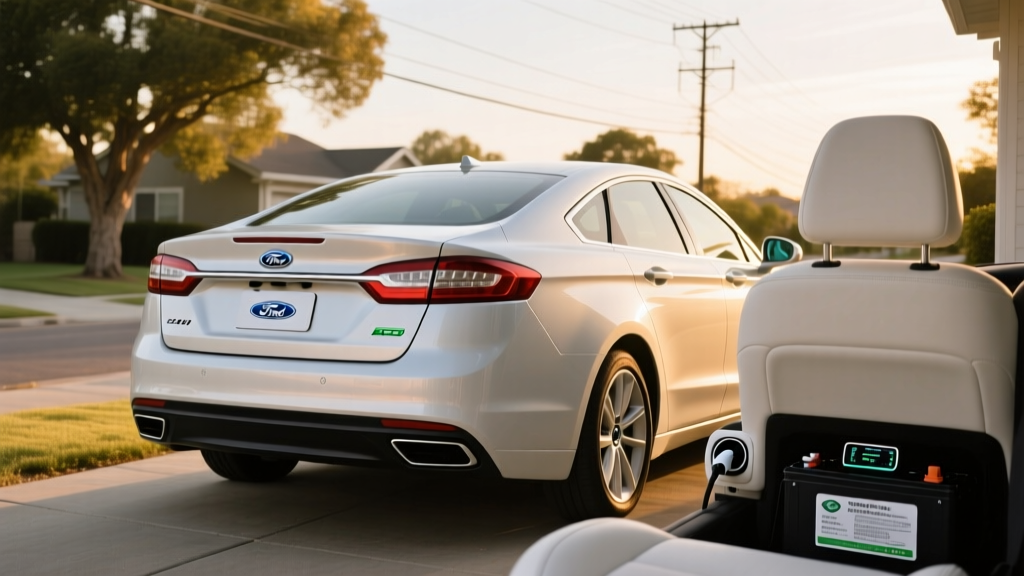
| Hybrid battery | 1.4 kWh lithium-ion (located behind rear seat) |
| 0–60 mph | ~7.8 seconds |
| Curb weight | ~3,624 lbs |
Ford's hybrid system in this generation uses a planetary gearset eCVT — fundamentally different from the rubber-belt CVTs found in some competitors. This design has no belts or cones to wear, contributing significantly to the powertrain's long-term durability. The eCVT is essentially a power-split device that blends engine and motor output seamlessly without traditional gear shifts.
2017 Ford Fusion Hybrid Reliability: What the Data Shows
The 2017 Fusion Hybrid benefits from Ford's second-generation hybrid architecture, which debuted in the 2013 model year and was refined through 2019. By 2017, most early-generation software and component issues had been resolved. Here is what reliability data tells us:
Consumer Reports and J.D. Power rated the 2017 Fusion Hybrid above average for its class in powertrain reliability, with the hybrid system itself generating fewer complaints than the conventional gasoline-only Fusion's 1.5L and 2.0L EcoBoost engines — which had documented coolant intrusion issues in certain model years.
Common failure points on high-mileage examples (100,000+ miles):
- 12V auxiliary battery: Like any vehicle, the standard 12V battery requires replacement every 4–6 years. A weak 12V battery can prevent the hybrid system from booting — this is not a hybrid battery issue.
- Brake actuator recall: Certain 2013–2018 Fusion Hybrids were subject to a brake system recall (NHTSA recall 19V-533 for the brake pressure accumulator). Verify recall completion at nhtsa.gov/recalls using the VIN before purchase.
- Inverter coolant pump: Rare but documented failures on higher-mileage units. Replacement cost is approximately $400–$600.
- Regenerative braking feel: Not a failure, but some drivers report a nonlinear brake pedal feel as the system transitions between regenerative and friction braking. This is normal operation.
Hybrid Battery Warranty & Replacement Cost
Original warranty: Ford warranted the 2017 Fusion Hybrid's high-voltage battery for 8 years / 100,000 miles (extended to 10 years / 150,000 miles in California and states that follow CARB emissions standards).
In 2026: The factory warranty has expired for most 2017 models unless the vehicle was sold new in a CARB state and has under 150,000 miles. Always verify remaining warranty via a Ford dealer using the VIN.
Battery replacement cost: A new OEM hybrid battery pack for the 2017 Fusion Hybrid runs approximately $2,500–$3,500 installed at a dealership. Independent hybrid specialists and refurbished packs can reduce this to $1,500–$2,200.
Real-world lifespan data: The 1.4 kWh lithium-ion pack in the Fusion Hybrid is relatively small and is never fully cycled (the system maintains a state-of-charge buffer between roughly 30% and 70%). This shallow-cycling strategy dramatically extends cell life. Most reported battery failures occur above 180,000–200,000 miles. Many Fusion Hybrids in taxi and rideshare fleets have exceeded 250,000 miles on the original battery.
Pricing in 2026: What You Will Actually Pay
The 2017 Ford Fusion Hybrid was originally priced from $25,295 MSRP (S trim) to approximately $33,000 (Platinum trim). In the 2026 used market, expect the following ranges depending on mileage and condition:
| Trim | Mileage Range | 2026 Used Price (est.) |
|---|---|---|
| S (base) | 80,000–110,000 mi | $10,500–$13,000 |
| SE (mid) | 70,000–100,000 mi | $12,000–$15,500 |
| Titanium / Platinum | 60,000–90,000 mi | $14,000–$17,500 |
Tax credit eligibility: The 2017 Fusion Hybrid does not qualify for the federal §30D new-vehicle tax credit (which applies only to new purchases). However, under the IRS used clean vehicle credit (§25E), a used Fusion Hybrid could qualify for up to $4,000 or 30% of the sale price (whichever is less) if:
- The sale price is $25,000 or less (virtually all used 2017 Fusion Hybrids meet this)
- The buyer's adjusted gross income is below $75,000 (single), $112,500 (head of household), or $150,000 (joint)
- The vehicle is purchased from a licensed dealer (private-party sales do not qualify)
- The buyer has not claimed the used-vehicle credit in the prior 3 years
At typical used prices of $11,000–$16,000, the 30% calculation yields $3,300–$4,800, but the credit is capped at $4,000. Verify current rules at irs.gov, as incentive programs can change.
Fusion Hybrid vs Fusion Energi vs Full EV: Which Fits You?
Choose the 2017 Fusion Hybrid (HEV) if:
- You have no access to home or workplace charging
- You want maximum fuel savings with zero behavior change
- Your daily commute is longer than 22 miles (the Energi's EV range)
- You want the lowest purchase price among electrified Fusions
- You drive 15,000+ miles annually and want proven high-mileage durability
Choose the 2017 Fusion Energi (PHEV) if:
- You can install a Level 2 charger at home (240V)
- Your daily commute is under 22 miles round-trip (you may rarely use gas)
- You want EV-mode driving for short trips but gasoline flexibility for road trips
- You are willing to pay a $1,500–$3,000 used-market premium over the HEV
Choose a full EV (e.g., used Tesla Model 3, Chevy Bolt) if:
- You have reliable home Level 2 charging
- You want zero gasoline expenses and minimal drivetrain maintenance
- Your typical trips fall within 200–250 miles (or you are comfortable with DC fast charging on road trips)
- You want stronger acceleration and one-pedal driving
For buyers considering the Energi PHEV: its 7.6 kWh battery provides 22 miles of electric-only range — enough for many commutes but not enough to eliminate gas entirely for most drivers. The Energi also sacrificed approximately 4 cubic feet of trunk space to accommodate the larger battery, reducing cargo volume to roughly 8.2 cu ft compared to the HEV's 12.0 cu ft.
Pre-Purchase Checklist: What to Verify Before Buying
If you are evaluating a specific 2017 Fusion Hybrid, follow this checklist:
- Run the VIN at nhtsa.gov/recalls — confirm the brake accumulator recall (19V-533) was performed.
- Request a hybrid battery health report — a Ford dealer can pull the battery's State of Health (SoH) via OBD-II. Acceptable SoH is above 75% capacity retention.
- Check the 12V battery date code — if it is over 4 years old, budget $150–$200 for replacement.
- Verify transmission fluid service history — Ford recommends eCVT fluid inspection at 150,000 miles; replacement is advisable if no record exists.
- Test the A/C and heating in EV mode — the electric A/C compressor and electric heater are hybrid-specific components; replacement costs are higher than conventional equivalents.
- Inspect for coolant leaks near the engine block — while this is more common on the EcoBoost gasoline models, it is worth checking on any used Fusion.
Frequently Asked Questions
How many MPG does the 2017 Ford Fusion Hybrid actually get?
The EPA rates it at 43 city / 41 highway / 42 combined. In real-world driving, most owners report 38–44 MPG combined, with city driving often exceeding the EPA estimate and sustained highway driving falling a few MPG below it. Cold weather can drop combined MPG to the mid-30s.
Is the 2017 Ford Fusion Hybrid reliable at high mileage?
Yes. The hybrid powertrain — particularly the eCVT planetary gearset and the shallow-cycling battery strategy — has proven durable well past 200,000 miles. The most common expenses at high mileage are the 12V battery, brake actuator recall completion, and standard suspension wear items. The high-voltage hybrid battery typically lasts 180,000+ miles before significant capacity loss.
What does a hybrid battery replacement cost for the 2017 Fusion?
A new OEM battery from a Ford dealer costs approximately $2,500–$3,500 installed. Refurbished or aftermarket packs from independent hybrid specialists can bring the cost down to $1,500–$2,200. Given the battery's typical lifespan of 180,000+ miles, many owners will never need a replacement.
Does the 2017 Ford Fusion Hybrid qualify for any tax credit?
It is not eligible for the §30D new-vehicle credit. However, income-qualified buyers purchasing from a dealer may claim the §25E used clean vehicle credit of up to $4,000 (30% of sale price, capped at $4,000). The vehicle must sell for $25,000 or less, and buyer income must fall below IRS thresholds. Confirm eligibility at irs.gov before relying on the credit.
Does the Fusion Hybrid need to be plugged in?
No. The conventional Fusion Hybrid (HEV) charges its small battery entirely through regenerative braking and the gasoline engine. You fuel it at a gas station like any other car. Only the Fusion Energi (PHEV) variant benefits from being plugged in.
How does the Fusion Hybrid compare to a 2017 Toyota Camry Hybrid?
The Fusion Hybrid rates at 42 MPG combined versus the 2017 Camry Hybrid's 40 MPG combined (LE trim). The Fusion offers slightly more interior volume and a more engaging driving feel, while the Camry Hybrid has marginally stronger long-term reliability ratings and a larger dealer network. Both are excellent used hybrid choices; the decision often comes down to which specific vehicle you can find with better maintenance records and lower mileage in your market.