2016 Toyota RAV4 Hybrid MPG: What the EPA Says vs. Real-World Driving
If you're researching the 2016 RAV4 Hybrid mileage a decade after its debut, you're likely evaluating one on the used market. The 2016 model year marked the RAV4 Hybrid's U.S. introduction, and its fuel-economy figures remain competitive against newer compact hybrid SUVs. Here's exactly what the EPA rates it at — and what owners actually see.
| Driving Cycle | EPA MPG |
|---|---|
| City | 34 MPG |
| Highway | 31 MPG |
| Combined | 32 MPG |
Source: EPA fueleconomy.gov
The city-highway split tells you everything about how Toyota's Hybrid Synergy Drive works. The 2.5-liter Atkinson-cycle four-cylinder engine (150 hp) pairs with front and rear electric motors for a combined system output of 194 horsepower. In stop-and-go traffic, the electric motors shoulder more of the load, regenerative braking recaptures energy, and the engine shuts off at stops — that's why the city number is higher than the highway figure.
HEV vs. PHEV vs. EV: Where the 2016 RAV4 Hybrid Fits
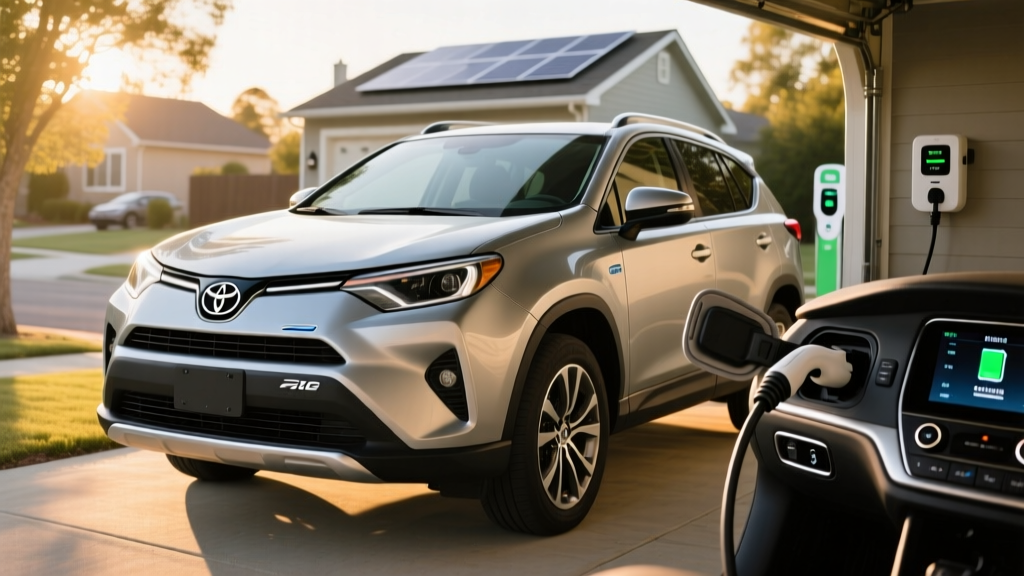
The 2016 RAV4 Hybrid is a conventional hybrid electric vehicle (HEV). It does not plug in. It has no electric-only driving range. It charges its own small battery through regenerative braking and the gasoline engine. If you're seeing "plug-in" RAV4 content online, that refers to the RAV4 Prime (PHEV), which didn't arrive until the 2021 model year.
| Factor | HEV (2016 RAV4 Hybrid) | PHEV (e.g., RAV4 Prime) | BEV (e.g., bZ4X) |
|---|---|---|---|
| Plugs In? | No | Yes | Yes |
| Electric-Only Range | 0 miles (EV mode ~0.5 mi at low speed) | 42 miles (EPA) | 222–252 miles (EPA) |
| Fuel/Charging Infra Needed | Gas stations only | Gas + Level 2 recommended | Level 2 home or DCFC required |
| Used Price Range (2026) | $14,000–$20,000 | $28,000–$38,000 | $18,000–$28,000 |
| Best For | No home charging, want simplicity | Home charging + short commutes | Home charging + zero tailpipe emissions |
If you don't have access to a garage or driveway with a 120V or 240V outlet, a conventional HEV like the 2016 RAV4 Hybrid is the most practical electrified option. You get meaningful fuel savings over the gas-only RAV4 (EPA 26 MPG combined for the 2016 AWD gas model) without any change to your fueling routine.
Powertrain and Battery Specifications
| Specification | Value |
|---|---|
| Engine | 2.5L Atkinson-cycle I4 |
| Engine Horsepower | 150 hp |
| Front Electric Motor | 105 kW (141 hp) |
| Rear Electric Motor (AWD-i) | 50 kW (67 hp) |
| Net System Horsepower | 194 hp |
| Hybrid Battery Type | Nickel-Metal Hydride (NiMH) |
| Hybrid Battery Capacity | ~1.6 kWh (not usable for EV driving) |
| Drivetrain | Electronic On-Demand AWD (AWD-i) |
| 0–60 mph | ~7.8 seconds |
| Towing Capacity | 1,750 lbs |
The 2016 RAV4 Hybrid uses a NiMH battery pack, not the lithium-ion packs found in newer Toyota hybrids (the 2023+ RAV4 Hybrid switched to a lithium-ion pack). NiMH packs are proven and durable but heavier and less energy-dense. The pack is small — roughly 1.6 kWh — because its job is to buffer energy for acceleration assist and regen capture, not to drive the vehicle on electricity alone.
The AWD-i system uses the rear electric motor to power the rear wheels when slip is detected or under hard acceleration. There's no mechanical driveshaft connecting the front and rear axles — it's entirely electric. This means AWD engagement is instant but limited; the rear motor disengages above ~25 mph under light loads to save energy.
Hybrid Battery Lifespan, Warranty, and Replacement Cost
This is the top concern for used hybrid buyers, and it's worth addressing directly. Toyota's NiMH hybrid batteries have an exceptionally strong longevity record. Data from fleet operators and owner surveys shows these packs commonly last 150,000–200,000+ miles before significant degradation. The Prius, which uses a similar NiMH architecture, has documented cases exceeding 300,000 miles on the original battery.
However, age matters as much as mileage. A 2016 RAV4 Hybrid is now 10 years old. NiMH cells degrade gradually, and the most common failure mode is individual cell imbalance rather than total pack death. Signs of a weakening hybrid battery include:
- Noticeable MPG drop (e.g., falling from 32 to 25–27 combined)
- The gasoline engine running more frequently and at higher RPMs
- Reduced regenerative braking feel
- A hybrid system warning light on the dash
Replacement cost in 2026:
- New OEM Toyota pack: $3,000–$4,500 (parts + labor at a dealer)
- Refurbished/reconditioned pack: $1,500–$2,500 from aftermarket hybrid specialists
- Individual cell replacement: $500–$1,200 if only a few modules have failed (requires a hybrid-specialist shop)
Before buying a used 2016 RAV4 Hybrid, request a hybrid battery health check from a Toyota dealer or qualified hybrid mechanic. They can read the battery's state of health (SoH) and check for cell voltage variance through the OBD-II port. A healthy pack should show less than 0.3V difference between the highest and lowest cell blocks.
2026 Used Pricing and Tax Credit Eligibility
The 2016 RAV4 Hybrid was offered in two trims: XLE (base, starting at ~$29,270 MSRP new) and Limited (~$34,510 MSRP new). In the 2026 used market, expect to pay:
- XLE (80,000–120,000 miles): $14,000–$17,500
- Limited (80,000–120,000 miles): $17,000–$21,000
- Low-mileage examples (<60,000 miles): Add $2,000–$4,000 to the above ranges
Federal tax credit: The 2016 RAV4 Hybrid does not qualify for the IRS §30D new clean vehicle credit — that credit applies only to new plug-in vehicles (PHEVs and BEVs) meeting battery-sourcing and MSRP requirements. However, if you purchase this vehicle from a dealer for $25,000 or less, it may qualify for the Used Clean Vehicle Credit (IRC §25E), which provides 30% of the sale price, up to $4,000. Key §25E requirements:
- Sale price must be $25,000 or less
- Buyer income caps: $75,000 single / $112,500 head of household / $150,000 joint (modified AGI)
- Vehicle must be at least 2 model years old (2016 qualifies)
- Must purchase from a licensed dealer (private-party sales excluded)
- The vehicle must have a battery — conventional hybrids technically meet this, but IRS guidance on §25E has primarily applied to PHEVs and BEVs; consult a tax professional to confirm HEV eligibility
For full rules, see the IRS Used Clean Vehicle Credit page.
Who Should Buy the 2016 RAV4 Hybrid in 2026?
- You want AWD and strong city MPG without plugging in
- You lack home charging access (apartment, street parking)
- You want proven Toyota hybrid reliability on a $15K–$20K budget
- Your commute is city-heavy (where it beats its EPA rating)
- You need cargo space (38.4 cu ft behind rear seats) and 1,750-lb towing
- You want electric-only driving (consider a RAV4 Prime PHEV or a BEV)
- You drive mostly highway miles (the gas RAV4 or a diesel may be close in efficiency)
- You need modern ADAS (2016 predates Toyota Safety Sense standard fitment on Hybrid trims — verify TSS-P presence by VIN)
- You want the latest infotainment (2016 uses Toyota's older Entune system, no wireless CarPlay)
Compared to a full EV like a used Chevrolet Bolt EUV or Nissan Leaf, the RAV4 Hybrid eliminates range anxiety and charging logistics entirely — but you'll still spend $1,200–$1,800/year on gasoline at 2026 fuel prices (assuming 12,000 miles/year and $3.50/gallon). A BEV's electricity cost for the same mileage runs roughly $400–$700/year depending on local rates.
Reliability and Known Issues
The 2016 RAV4 Hybrid rates well for reliability. NHTSA records show few major recalls specific to the hybrid system. The most commonly reported issues across owner forums and repair databases include:
- Hybrid battery cooling fan: The fan filter (located near the rear seat) can clog with dust and pet hair, causing the battery to overheat and reduce performance. Clean it every 15,000–20,000 miles — it's a $15 DIY part.
- 12V auxiliary battery: Like all hybrids, the RAV4 has a standard 12V battery that can fail every 4–6 years. A dead 12V battery will prevent the hybrid system from starting, even if the high-voltage pack is fully charged.
- Brake actuator: Some Toyota hybrids from this era have had brake booster pump recalls. Check whether recall campaign ZJC (brake actuator) was performed on the specific VIN at a Toyota dealer.
Overall, the hybrid powertrain is one of the lowest-maintenance systems on the vehicle. There's no conventional starter motor, no alternator, no serpentine belt, and the e-CVT transmission has no friction bands or clutch packs to wear. Brake pads often last 80,000+ miles thanks to regenerative braking handling most deceleration.
Frequently Asked Questions
How many MPG does the 2016 RAV4 Hybrid actually get?
The EPA rates it at 34 city / 31 highway / 32 combined. Real-world city drivers often see 34–37 MPG. Highway-heavy drivers at 70+ mph should expect 28–30 MPG. Cold weather reduces efficiency by 5–10%.
Does the 2016 RAV4 Hybrid need to be plugged in?
No. It is a conventional hybrid (HEV), not a plug-in hybrid. The battery charges itself through regenerative braking and the gasoline engine. You fuel it exclusively at gas stations.
How long will the hybrid battery last in a 2016 RAV4?
Toyota's NiMH hybrid batteries commonly last 150,000–200,000+ miles. At 10 years old, age-related degradation is a factor. Expect a replacement cost of $1,500–$4,500 depending on whether you choose refurbished or new OEM.
Is the 2016 RAV4 Hybrid good in snow?
The AWD-i system provides electric on-demand all-wheel drive, which is adequate for light snow and slippery roads. It's not a dedicated off-road system — the rear motor disengages at higher speeds under light load. For heavy snow regions, winter tires make a bigger difference than the AWD system alone.
Does the 2016 RAV4 Hybrid qualify for any tax credit?
It does not qualify for the §30D new vehicle credit. It may qualify for the §25E used clean vehicle credit (up to $4,000) if purchased from a dealer for $25,000 or less and the buyer meets income requirements. However, §25E eligibility for conventional hybrids (vs. PHEVs/BEVs) should be confirmed with a tax professional. See IRS guidance.
What's the difference between the 2016 RAV4 Hybrid and the RAV4 Prime?
The RAV4 Prime is a plug-in hybrid (PHEV) introduced for the 2021 model year. It has a larger 18.1 kWh lithium-ion battery, 42 miles of electric-only range, 302 combined horsepower, and qualifies for federal tax credits when purchased new. The 2016 RAV4 Hybrid is a conventional HEV with no plug, no electric-only range, and 194 hp.