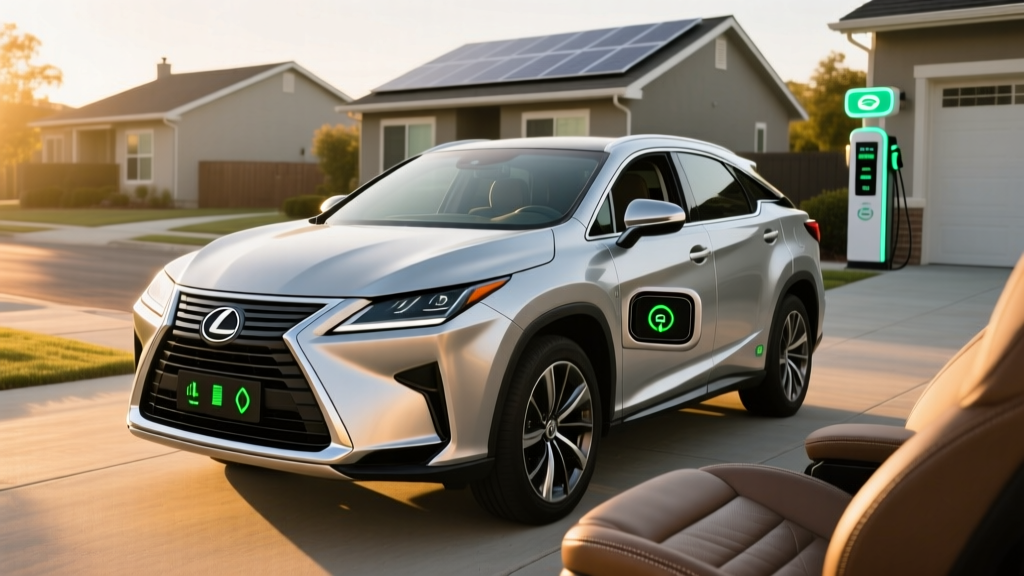
A decade after its debut, the 2016 Lexus RX 450h remains one of the most searched luxury hybrid SUVs on the used market — and for good reason. It pairs Lexus reliability with a proven hybrid powertrain that delivers genuine fuel savings without requiring a plug. For buyers in 2026 weighing a used luxury hybrid against newer plug-in hybrids or full EVs, the fourth-generation RX 450h deserves a careful look. Here's the data-driven breakdown.
2016 Lexus RX 450h: Key Specifications at a Glance
| Spec | Value |
|---|---|
| Powertrain | 3.5L V6 + 2 electric motors (AWD) / 1 motor (FWD) |
| Combined Horsepower | 308 hp |
| 0–60 mph | 7.7 seconds (AWD) |
| EPA Fuel Economy (AWD) | 30 city / 28 highway / 30 combined MPG |
| EPA Fuel Economy (FWD) | 31 city / 30 highway / 30 combined MPG |
| Hybrid Battery | ~1.9 kWh NiMH (self-charging HEV, not plug-in) |
| Fuel Tank | 17.2 gallons |
| Total Range | ~516 miles (AWD) |
| Drivetrain | FWD or e-AWD |
| Hybrid Battery Warranty (Original) | 8 years / 100,000 miles (10 yr/150k in CARB states) |
| Original MSRP (Base AWD) | ~$53,035 |
| 2026 Used Price Range | $18,000 – $28,000 depending on mileage/condition |
HEV vs. PHEV: The 2016 RX 450h Is a Conventional Hybrid
Before diving into fuel economy, it's critical to understand what you're buying. The 2016 Lexus RX 450h is a conventional hybrid electric vehicle (HEV) — not a plug-in hybrid (PHEV). This distinction matters enormously for ownership expectations.
| Feature | 2016 RX 450h (HEV) | Typical PHEV (e.g., 2026 RAV4 Prime) | Full EV (BEV) |
|---|---|---|---|
| Plug-in Required? | No — regenerative braking + engine charges battery | Yes — Level 1 or Level 2 | Yes — Level 2 or DC fast |
| Electric-Only Range | ~1–2 miles at very low speeds | 35–42 miles | 250–350+ miles |
| Battery Size | ~1.9 kWh NiMH | ~18.1 kWh lithium-ion | 60–100+ kWh lithium-ion |
| Fuel Economy (gas mode) | 30 MPG combined | 38 MPG combined (after EV range) | N/A — electric only |
| Tax Credit Eligibility (2026) | None — HEVs excluded from §30D | Up to $7,500 if sourcing/income/MSRP rules met | Up to $7,500 if sourcing/income/MSRP rules met |
The RX 450h's hybrid system uses a small nickel-metal hydride (NiMH) battery that charges itself through regenerative braking and the gasoline engine. You never plug it in. The electric motors assist during acceleration and enable brief low-speed electric-only movement (typically under 25 mph for a mile or less), but the V6 engine is the primary propulsion source.
Fuel Economy: EPA Numbers and Real-World MPG
The EPA rates the 2016 RX 450h AWD at 30 city / 28 highway / 30 combined MPG. The FWD variant edges slightly higher at 31 city / 30 highway / 30 combined.
| Driving Scenario | EPA Estimate | Real-World Expectation |
|---|---|---|
| City (stop-and-go) | 30 MPG (AWD) | 30–33 MPG — hybrids excel here thanks to regen braking |
| Highway (70+ mph) | 28 MPG (AWD) | 26–28 MPG — less electric assist at sustained speed |
| Combined | 30 MPG (AWD) | 28–31 MPG depending on driving mix |
| Cold Weather (below 30°F) | N/A | 24–27 MPG — engine runs more for cabin heat |
Like most Toyota/Lexus hybrids, the RX 450h tends to meet or slightly exceed its EPA city rating in real-world driving. Hybrid systems recover the most energy during frequent stops, making city commutes the ideal use case. Highway efficiency drops because the electric motors contribute less at sustained cruising speeds, and the 4,500-pound curb weight works against it.
For comparison, the non-hybrid 2016 RX 350 (AWD) is EPA-rated at 19 city / 26 highway / 22 combined. The hybrid's 8 MPG combined advantage translates to roughly 130 fewer gallons per year at 15,000 miles of driving — a savings of approximately $450–$550 annually at 2026 fuel prices.
Powertrain and Performance: 308 Horsepower with Hybrid Smoothness
The 2016 RX 450h pairs a 3.5-liter V6 (259 hp on its own) with Lexus's Hybrid Synergy Drive system. In the AWD configuration, two electric motor-generators work with the engine through an electronically controlled continuously variable transmission (eCVT). A rear-mounted electric motor provides all-wheel-drive traction without a mechanical driveshaft — this "e-AWD" system engages the rear wheels only when slip is detected or during hard acceleration.
Combined system output is 308 horsepower, making the 450h the most powerful RX variant of its generation. The 0–60 mph time of 7.7 seconds (AWD) is respectable for a luxury midsize SUV, and the eCVT delivers seamless, shift-free acceleration. The trade-off is the characteristic CVT drone under hard acceleration — there are no simulated gear shifts to break up the engine note.
Driving dynamics prioritize comfort over sportiness. The suspension absorbs road imperfections well, and cabin isolation is a strong point. This is a cruiser, not a canyon carver, and the hybrid powertrain's smoothness reinforces that character.
Hybrid Battery Longevity, Warranty, and Replacement Cost
2016 RX 450h Hybrid Battery: What You Need to Know
- Chemistry: Nickel-Metal Hydride (NiMH) — proven, durable, less energy-dense than lithium-ion but highly tolerant of charge cycling
- Original Warranty: 8 years / 100,000 miles federally; 10 years / 150,000 miles in California and states adopting CARB emissions standards
- Current Status (2026): Most 2016 examples are now outside original hybrid battery warranty unless in CARB states with under 150k miles
- Expected Lifespan: 150,000–200,000+ miles with proper maintenance — many Toyota/Lexus NiMH packs exceed 200k miles
- Replacement Cost: $3,000–$5,500 for a new OEM battery pack installed at a dealership; $1,500–$2,800 for a refurbished/reconditioned pack from independent hybrid specialists
Battery reliability is the top concern for any used hybrid buyer, and the RX 450h's NiMH pack is one of the most proven in the industry. Toyota and Lexus have been refining this chemistry since the original 1997 Prius. The NiMH cells degrade more gracefully than early lithium-ion packs — rather than sudden capacity cliff failure, they typically lose 10–20% capacity over 150,000+ miles, which manifests as slightly reduced electric-assist contribution and marginally lower MPG.
Independent hybrid shops across the US now offer reconditioned battery packs for $1,500–$2,800, which replaces only the degraded cells rather than the entire assembly. This has dramatically reduced the cost of ownership for out-of-warranty Lexus hybrids. A full OEM replacement at a Lexus dealer runs $3,000–$5,500 depending on labor rates in your area.
For context, a 2016 RX 450h with 120,000 miles and a healthy hybrid battery should have no issues reaching 200,000+ miles before a pack replacement is needed. Many owners report original batteries lasting the life of the vehicle. According to Consumer Reports data, Toyota/Lexus hybrid battery failure rates remain among the lowest in the industry.
Reliability and Ownership Costs in 2026
The 2016 RX 450h carries Lexus's reputation for reliability, and the data backs it up. The fourth-generation RX platform (2016–2022) has consistently earned above-average reliability scores. The hybrid system adds complexity but has proven remarkably durable — the eCVT transmission, in particular, has fewer wear components than a conventional automatic (no clutch packs, no torque converter).
Key ownership considerations for 2026 buyers:
- Routine maintenance is straightforward: synthetic oil changes every 10,000 miles, brake pad life is extended significantly by regenerative braking (many owners report 80,000+ miles on original pads)
- Insurance costs are moderate for a luxury SUV — typically $1,400–$2,000 annually depending on region and driving record
- No plug-in infrastructure needed — if you lack home charging access, the HEV architecture eliminates this barrier entirely
- Depreciation advantage: A 2016 RX 450h has already absorbed most of its depreciation. Purchase at $18k–$28k, maintain well, and resale value holds strong relative to non-hybrid competitors
Tax Credits and Incentives: Does the 2016 RX 450h Qualify?
The 2016 Lexus RX 450h does not qualify for the federal §30D clean vehicle tax credit. Under current IRS rules, only plug-in electric vehicles (BEVs and PHEVs with at least 7 kWh of battery capacity) are eligible. As a conventional HEV with a ~1.9 kWh NiMH battery, the RX 450h is excluded.
There are also no federal credits available for used HEV purchases. Some states and municipalities occasionally offer rebates for used hybrid purchases or reduced registration fees, but these vary by jurisdiction and change frequently. Check your state's energy office or department of environmental quality for current programs.
If tax credit eligibility is a priority, you would need to look at a newer PHEV (such as the Lexus NX 450h+ or Toyota RAV4 Prime) or a full BEV to access the up-to-$7,500 federal credit — subject to MSRP caps, buyer income limits, and battery component/critical mineral sourcing requirements.
Who Should Buy the 2016 RX 450h — And Who Shouldn't
Pros
- 30 MPG combined is excellent for a 4,500-lb luxury SUV
- No plug-in required — works with any lifestyle
- 308 hp provides confident passing power
- Proven NiMH hybrid battery with 200k+ mile potential
- Strong Lexus reliability and resale value
- Extended brake pad life from regenerative braking
- Quiet, comfortable ride quality
Cons
- No meaningful electric-only driving range
- No federal tax credit eligibility
- eCVT drone under hard acceleration
- 2016 infotainment system is dated (no native Apple CarPlay/Android Auto)
- AWD system is reactive, not a true performance AWD
- Out-of-warranty battery replacement is a $3k–$5.5k risk
- Hybrid premium over RX 350 takes 3–5 years to recoup in fuel savings
Decision Framework: Is the 2016 RX 450h Right for You?
Choose the 2016 RX 450h if: You want a luxury midsize SUV with strong fuel economy, you lack home charging access (apartment/condo living), you prioritize long-term reliability and low running costs, and you want to avoid the complexity and cost of a plug-in vehicle.
Choose a PHEV instead if: You have reliable Level 2 home charging, your daily commute is under 35 miles (where electric-only range covers most driving), and you want to access the $7,500 federal tax credit on a new purchase.
Choose a full EV instead if: You want zero tailpipe emissions, minimal maintenance, access to HOV lanes and tax credits, and you have charging access at home or work. Consider models like the Hyundai Ioniq 5, Tesla Model Y, or Ford Mustang Mach-E in the $35k–$50k range.
Frequently Asked Questions
How many MPG does the 2016 Lexus RX 450h hybrid get?
The EPA rates the AWD model at 30 city / 28 highway / 30 combined MPG. The FWD version is rated at 31 city / 30 highway / 30 combined. In real-world driving, expect 28–33 MPG combined depending on your city/highway mix, with cold weather reducing that to 24–27 MPG.
Does the 2016 RX 450h need to be plugged in?
No. The RX 450h is a conventional hybrid (HEV), not a plug-in hybrid. Its battery charges through regenerative braking and the gasoline engine. You simply fuel it like any other vehicle.
How long does the 2016 RX 450h hybrid battery last?
Toyota/Lexus NiMH hybrid batteries commonly last 150,000–200,000+ miles. Many original batteries from this era are still in service. If replacement is needed, expect $3,000–$5,500 for a new OEM pack or $1,500–$2,800 for a reconditioned unit.
Does the 2016 RX 450h qualify for any tax credit?
No. Federal §30D clean vehicle credits apply only to plug-in vehicles (BEVs and qualifying PHEVs). The RX 450h's conventional hybrid system does not qualify. Check your state for any local hybrid incentive programs.
Is the 2016 RX 450h reliable?
Yes. The fourth-generation RX platform and Lexus's Hybrid Synergy Drive are among the most reliable powertrains in the luxury SUV segment. The eCVT has fewer moving parts than a conventional automatic, and regenerative braking extends brake pad life significantly. According to IIHS, the 2016 RX also earned strong crash-test ratings.
How does the RX 450h compare to the newer Lexus RX 500h?
The current-generation RX 500h uses a turbocharged 2.4L hybrid powertrain making 366 hp with an EPA-estimated 27 MPG combined — actually lower fuel economy than the 2016 RX 450h's 30 MPG, traded for more performance. The 2016 model remains more fuel-efficient for daily commuting, while the 500h prioritizes acceleration and modern tech.
What's the total cost of ownership vs. the gas-only RX 350?
At 15,000 miles per year and $3.50/gallon fuel, the RX 450h uses approximately 500 gallons/year ($1,750) vs. the RX 350 AWD's 682 gallons/year ($2,387) — a savings of roughly $637 annually. Over 5 years, that's ~$3,185 in fuel savings, which largely offsets the used-market price premium the 450h commands over the 350.