Quick Verdict: The 2016 Lexus GS 450h a Decade Later
The 2016 Lexus GS 450h occupies a rare niche: a midsize luxury sport sedan that pairs a 3.5-liter V6 with an electric motor for 338 combined horsepower while returning an EPA-rated 31 MPG combined. A decade after its release, it remains one of the most refined conventional hybrids (HEVs) Lexus ever built — and on the used market in 2026, it represents a compelling value proposition for buyers who want luxury and efficiency without plugging in.
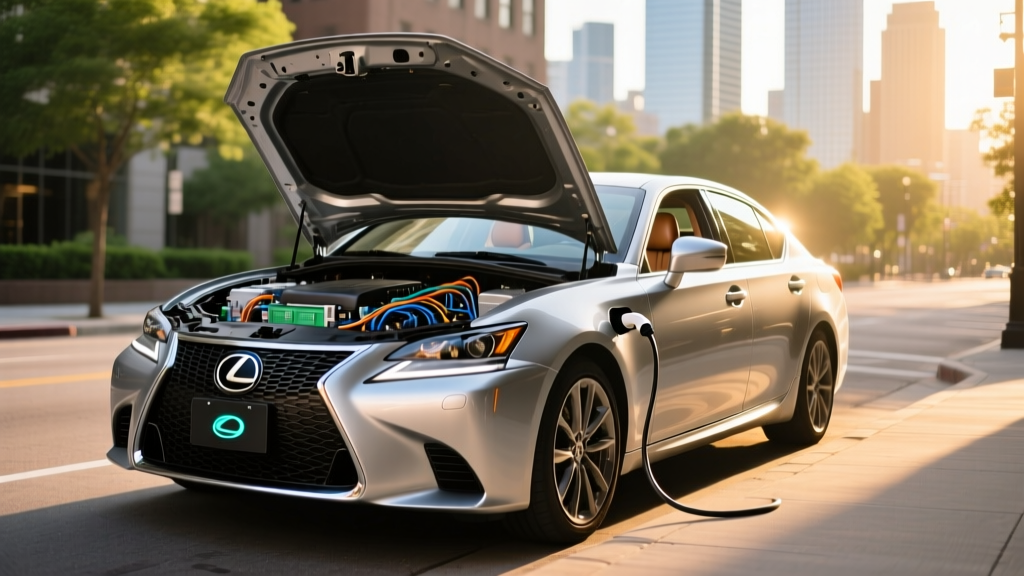
This is not a plug-in hybrid (PHEV). The GS 450h charges its battery exclusively through regenerative braking and the gasoline engine. You will never need to find a charger. That distinction matters, especially as the market floods with PHEVs and BEVs that demand home charging infrastructure.
A conventional hybrid (HEV) like the GS 450h uses a small battery (roughly 1.9 kWh) that recharges itself through braking and engine power. It cannot drive on electric power alone for meaningful distances, and it never plugs in. A plug-in hybrid (PHEV) has a larger battery (typically 10–25 kWh), can travel 20–50 miles on electricity alone, and must be plugged in to realize its efficiency advantage. The GS 450h is strictly an HEV.
2016 Lexus GS 450h: Powertrain and Performance Specs
| Spec | Value |
|---|---|
| Powertrain | 3.5L V6 + electric motor (HEV) |
| Combined Horsepower | 338 hp |
| Engine Output | 286 hp @ 6,000 rpm (V6 alone) |
| Electric Motor Output | ~197 hp (motor alone, peak) |
| Transmission | CVT (eCVT planetary gearset) |
| Drivetrain | Rear-wheel drive |
| 0–60 mph | 5.7 seconds |
| Hybrid Battery | ~1.9 kWh, nickel-metal hydride (NiMH) |
| Plug-In Capable? | No (conventional HEV) |
| Original MSRP (2016) | ~$63,230 (base) |
| 2026 Used Price Range | $16,000–$26,000 (depending on mileage/condition) |
The GS 450h uses Toyota's proven hybrid synergy drive system — the same planetary eCVT architecture found in the Prius, but scaled up for a performance sedan. The result is seamless power delivery with no traditional gear shifts. The 338 hp figure represents combined net output; because the engine and motor peak at different RPMs, you don't simply add the two numbers together.
At 5.7 seconds to 60 mph, the GS 450h was genuinely quick for a luxury hybrid in 2016, and that performance holds up today. The eCVT eliminates shift shock and keeps the engine in its optimal power band during hard acceleration.
Fuel Economy: EPA Ratings vs. Real-World MPG
| Driving Cycle | MPG |
|---|---|
| City | 29 |
| Highway | 34 |
| Combined | 31 |
Source: EPA fueleconomy.gov
Hybrids typically exceed their EPA city rating in stop-and-go traffic, where regenerative braking recaptures the most energy. Owners report 30–33 MPG in mixed suburban driving. Highway cruising at 75+ mph may yield 28–31 MPG, as the electric motor contributes less at sustained high speeds. In cold weather (below 30°F), expect a 5–10% drop due to engine warm-up cycles and reduced battery efficiency. A realistic year-round average for mixed driving is 29–32 MPG.
For context, the non-hybrid 2016 GS 350 (same 3.5L V6, no electric assist) rates at 19 city / 28 highway / 22 combined. The GS 450h delivers a 41% improvement in combined fuel economy while producing substantially more power. That's the hybrid advantage: you don't sacrifice performance for efficiency.
Hybrid Battery Longevity: Warranty, Degradation, and Replacement Cost
This is the single most important question for anyone buying a 10-year-old hybrid: how long will the battery last, and what does it cost to replace?
Lexus warranted the 2016 GS 450h hybrid battery for 8 years / 100,000 miles (10 years / 150,000 miles in California and states adopting CARB emissions standards). By 2026, most examples have aged out of factory coverage unless they were certified pre-owned (CPO) with an extended warranty.
The GS 450h uses a nickel-metal hydride (NiMH) battery pack, not the lithium-ion chemistry found in newer hybrids and EVs. NiMH is less energy-dense but extremely durable — Toyota/Lexus NiMH packs from the early Prius era are still running at 200,000+ miles in many cases. The key degradation factor for NiMH is heat and sustained high state-of-charge, both of which the GS 450h's battery management system actively mitigates by keeping the pack between roughly 40% and 80% SoC.
Hybrid Battery Replacement Cost in 2026
- New OEM battery (Lexus dealer): $3,500–$5,000 installed
- Refurbished/remanufactured battery: $1,500–$2,800 installed
- Individual cell/module replacement: $500–$1,200 (if only one or two modules have failed — a common repair at specialist hybrid shops)
Most 2016 GS 450h owners will never need a full battery replacement. The NiMH chemistry degrades gradually rather than failing catastrophically. A pack at 150,000 miles may have lost 15–25% of its original capacity, but because the battery is small (1.9 kWh) and primarily assists acceleration rather than providing electric-only range, the impact on fuel economy is modest — perhaps 1–2 MPG less than when new.
Warning signs of a failing hybrid battery include: a noticeable drop in fuel economy, the battery gauge cycling rapidly between full and near-empty, a dashboard warning light ("Check Hybrid System"), and reduced regenerative braking feel. If you're buying used, have a hybrid-qualified technician perform a battery health check — many can read individual module voltages to identify weak cells.
HEV vs. PHEV vs. Full EV: Which Powertrain Fits You?
| Factor | HEV (GS 450h) | PHEV | Full EV (BEV) |
|---|---|---|---|
| Plugs in? | No | Yes | Yes |
| Home charging needed? | No | Recommended | Essential |
| Electric-only range | ~1 mi (low speed) | 20–50 mi | 200–400 mi |
| Fuel/energy cost per mile | ~$0.11 | $0.04–$0.11 | $0.03–$0.06 |
| Upfront cost (used market) | $16K–$26K | $25K–$45K | $20K–$50K+ |
| Range anxiety? | None | Minimal | Depends on charging access |
| Federal tax credit (used) | Not eligible | Up to $4,000* | Up to $4,000* |
*The IRS Used Clean Vehicle Credit under §25E provides up to $4,000 (30% of sale price, max $4,000) for qualifying used EVs and PHEVs sold for $25,000 or less. The conventional hybrid GS 450h does not qualify. Income caps and vehicle eligibility rules apply — consult a tax professional.
Choose the GS 450h (HEV) if: You have no home charging access, want a luxury sedan with strong performance and solid efficiency, and don't want to think about plugging in. Ideal for apartment dwellers and drivers who take frequent long road trips.
Choose a PHEV if: You can install a Level 2 charger at home, most of your daily driving is under 30 miles, but you still want a gas engine for long trips without planning charging stops.
Choose a full EV if: You have reliable home charging, your daily commute is within the vehicle's range, you want the lowest per-mile energy cost, and you're willing to plan longer road trips around DC fast-charging stops.
Tax Credits and Incentives: What Applies in 2026?
Because the 2016 Lexus GS 450h is a conventional hybrid (HEV) with no plug-in capability, it does not qualify for the federal §30D New Clean Vehicle Credit or the §25E Used Clean Vehicle Credit. These credits are reserved for plug-in vehicles (BEVs and PHEVs) that meet battery-sourcing, MSRP, and buyer income requirements.
Some states offer their own incentives for hybrid purchases, but these are increasingly focused on plug-in vehicles. Check your state's energy office or department of environmental quality for any remaining hybrid-specific rebates. At the federal level, there is no tax advantage to buying a used HEV in 2026.
What the GS 450h does offer is a lower total cost of ownership through fuel savings. At 31 MPG combined versus the GS 350's 22 MPG, and with gas averaging roughly $3.50/gallon in 2026, a driver covering 15,000 miles per year saves approximately $700–$800 annually on fuel. Over five years of ownership, that's $3,500–$4,000 in fuel savings — roughly equivalent to what a used EV credit would provide, but spread over time rather than at purchase.
Driving Impressions and Ownership Practicalities
The GS 450h was Lexus's answer to the BMW 5 Series and Mercedes E-Class, and it delivers on that promise with a distinctly hybrid character. The eCVT provides linear, uninterrupted acceleration — there are no gear shifts to interrupt the surge. The trade-off is that under hard acceleration, the engine drones at a constant RPM (a characteristic of planetary CVTs), which some drivers find unrefined compared to a traditional automatic.
Ride quality is excellent, with adaptive variable suspension available on higher trims. The cabin is insulated from road and wind noise to a degree that still impresses in 2026. The 12.3-inch infotainment screen was large for its era, though the Lexus Remote Touch interface (a joystick-like controller) draws criticism for being less intuitive than a touchscreen.
Maintenance Advantages of the Hybrid System
One often-overlooked benefit of the GS 450h's hybrid powertrain: reduced mechanical wear. Regenerative braking handles much of the deceleration, meaning brake pads routinely last 80,000–120,000 miles. The eCVT has no traditional clutch packs or bands to wear out. And because the engine shuts off at stops and during low-load coasting, it accumulates fewer running hours than a conventional engine at the same mileage.
Known Issues to Watch
- Inverter coolant pump: Some owners report failures around 100,000–130,000 miles (~$400–$700 repair)
- 12V auxiliary battery: Like all hybrids, the GS 450h has a conventional 12V battery that can fail independently of the hybrid pack. If the car won't start or shows electrical gremlins, check the 12V first.
- Brake actuator assembly: The electro-hydraulic brake system is complex and expensive to replace if it fails ($1,500–$2,500). Listen for unusual grinding or a firm pedal that doesn't modulate smoothly.
Pros and Cons: 2016 Lexus GS 450h in 2026
- 338 hp with 31 MPG combined — genuine performance-efficiency balance
- No plug-in charging required; zero range anxiety
- Proven Toyota/Lexus hybrid reliability with NiMH durability
- Strong luxury sedan value at $16K–$26K used
- Reduced brake and transmission wear vs. conventional drivetrains
- Quiet, refined cabin with excellent ride quality
- 5.7-second 0–60 mph — still quick by any standard
- No federal tax credit eligibility (HEV, not plug-in)
- eCVT drone under hard acceleration
- Lexus Remote Touch interface is dated and frustrating
- Rear visibility is limited; trunk space reduced by battery placement
- Hybrid battery replacement cost ($1,500–$5,000) if needed out of warranty
- Rear-wheel drive only — no AWD option unlike some competitors
- Fuel savings vs. a PHEV/EV are modest if you have home charging
Frequently Asked Questions
How many MPG does the 2016 Lexus GS 450h hybrid get?
The EPA rates the 2016 GS 450h at 29 city / 34 highway / 31 combined MPG. In real-world mixed driving, most owners see 29–33 MPG, with city driving often matching or slightly exceeding the EPA city figure thanks to regenerative braking. Highway driving above 75 mph may dip to 28–30 MPG.
Does the 2016 Lexus GS 450h need to be plugged in?
No. The GS 450h is a conventional hybrid (HEV), not a plug-in hybrid (PHEV). Its small NiMH battery recharges through regenerative braking and the gasoline engine. You will never need a charging cable, a home charger, or a public charging station.
How far can the GS 450h drive on electric power alone?
Effectively zero miles at meaningful speeds. The GS 450h can creep at very low speeds (under 25 mph) for roughly one mile on battery power alone, such as in a parking lot or heavy traffic. This is not a usable electric-only range — it's an assist function to smooth stop-and-go driving and reduce fuel consumption at idle. If you want 20+ miles of electric-only driving, you need a PHEV.
Is the 2016 Lexus GS 450h reliable? What does a battery replacement cost?
Yes. The GS 450h benefits from Toyota/Lexus's decades of hybrid engineering. The NiMH battery pack is exceptionally durable, with many examples lasting 150,000–200,000+ miles before significant degradation. If replacement is needed, expect $1,500–$2,800 for a refurbished pack or $3,500–$5,000 for a new OEM unit installed. Individual module repairs can cost as little as $500–$1,200. The original hybrid battery warranty was 8 years/100,000 miles (10 years/150,000 miles in CARB states), which has expired for most 2016 models by 2026.
Does the 2016 Lexus GS 450h qualify for any tax credit?
No. Because the GS 450h is a conventional hybrid (HEV) with no plug-in capability, it does not qualify for the federal §30D New Clean Vehicle Credit or the §25E Used Clean Vehicle Credit. These credits are reserved for battery-electric vehicles (BEVs) and plug-in hybrids (PHEVs). Some states may offer minor incentives for hybrid vehicles — check your state energy office for current programs.
How does the GS 450h compare to newer Lexus hybrids?
The 2016 GS 450h was discontinued after the 2017 model year when Lexus restructured its sedan lineup. Its spiritual successor in terms of hybrid luxury performance would be the current Lexus LC 500h (coupe) or the ES 300h (sedan, though less powerful). Newer Lexus hybrids use lithium-ion batteries with slightly better energy density, but the core eCVT architecture remains fundamentally similar. The GS 450h's 338 hp output still exceeds most current Lexus hybrid sedans.
Should I buy a 2016 GS 450h or a used Tesla Model S instead?
These are fundamentally different ownership experiences. The GS 450h requires no charging infrastructure, has a proven 20-year hybrid track record, and costs $16K–$26K with no fuel-cost premium. A used 2016 Model S (roughly $18K–$28K in 2026) offers 200+ miles of electric range, instant torque, and Supercharger access — but demands reliable home charging, carries higher insurance costs, and presents battery replacement risk at $12,000–$20,000 if needed out of warranty. If you can charge at home and want the lowest per-mile cost, the Model S wins. If you want zero charging hassle and predictable ownership costs, the GS 450h is the safer bet.
Sources: EPA fueleconomy.gov, IRS Used Clean Vehicle Credit, IIHS Safety Ratings