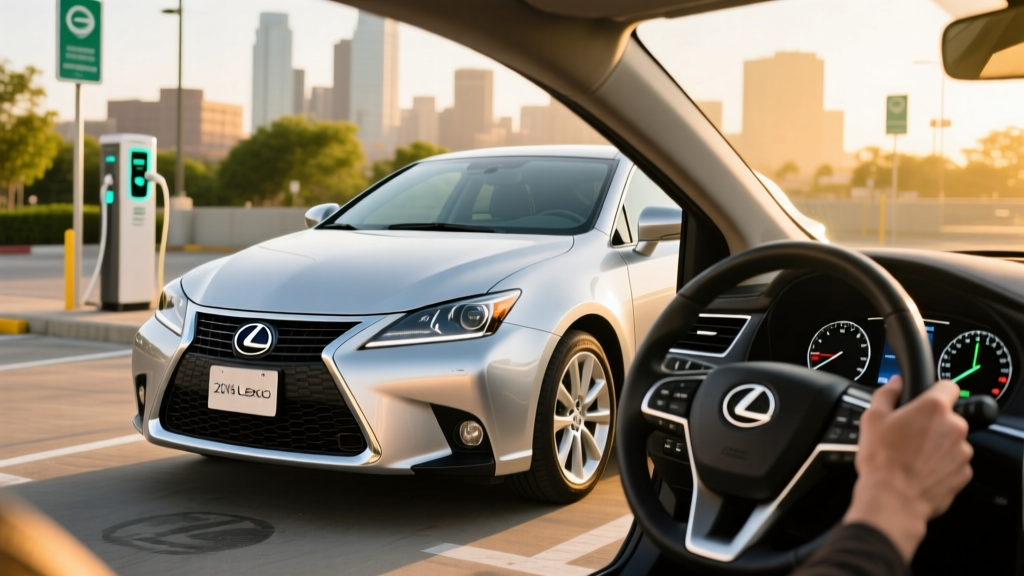
The 2016 Lexus CT 200h occupies a specific niche in the used-hybrid market: a luxury-branded compact hatchback that sips fuel, costs relatively little to maintain, and asks nothing of your driving routine. It is a conventional hybrid (HEV), not a plug-in — you never plug it in, and it has no electric-only driving range to manage. For buyers in 2026 weighing a used hybrid against a new EV or a conventional gas car, the CT 200h deserves a careful look based on its efficiency numbers, Toyota-derived reliability, and rock-bottom used pricing.
This guide covers the 2016 Lexus CT 200h hybrid powertrain specs, real-world MPG expectations, battery longevity and replacement costs, and how it stacks up against modern alternatives.
2016 Lexus CT 200h Powertrain and Specs
The CT 200h shares its hybrid powertrain architecture with the Toyota Prius of the same era — specifically, the third-generation Prius (XW30) platform. Under the hood sits a 1.8-liter inline-four Atkinson-cycle gasoline engine paired with an electric motor-generator, routed through a planetary-gear eCVT transmission.
| Specification | Value |
|---|---|
| Gasoline Engine | 1.8L inline-4 Atkinson cycle |
| Engine Horsepower | 98 hp @ 5,200 rpm |
| Electric Motor Output | 80 hp (60 kW) |
| Combined Net Horsepower | 134 hp |
| Transmission | eCVT (planetary gearset) |
| Drivetrain | Front-wheel drive |
| Hybrid Battery | 1.3 kWh (nominal), Nickel-Metal Hydride (NiMH) |
| 0–60 mph | ~9.8 seconds |
| EPA Fuel Economy (Combined) | 42 MPG |
| EPA City / Highway | 43 city / 40 highway MPG |
| Fuel Tank Capacity | 11.9 gallons |
| Total Driving Range | ~499 miles (EPA est.) |
| Cargo Volume (rear seats up) | 14.3 cu ft |
| Cargo Volume (rear seats folded) | 37.4 cu ft |
A critical distinction: the CT 200h is a conventional hybrid (HEV), not a plug-in hybrid (PHEV). Its 1.3 kWh NiMH battery is charged exclusively through regenerative braking and the gasoline engine. There is no charging port, no plug, and no electric-only range beyond brief low-speed assist. This is fundamentally different from a PHEV like the Toyota RAV4 Prime, which carries a much larger battery (18.1 kWh) and offers 42 miles of electric-only driving before the engine engages.
HEV vs. PHEV vs. EV: Which Fits Your Driving?
Hybrid Type Comparison
| Feature | HEV (CT 200h) | PHEV (e.g., RAV4 Prime) | BEV (e.g., Model 3) |
|---|---|---|---|
| Plug Required? | No | Yes (optional benefit) | Yes (mandatory) |
| Electric-Only Range | None (assist only) | 25–42 miles typical | 250–350+ miles |
| Total Range | ~499 mi | 500–600 mi combined | 250–350+ mi |
| Gas Engine | Yes (primary + regen) | Yes (backup + highway) | None |
| Home Charging Needed | No | Recommended (Level 2) | Required (Level 2) |
| Best For | No plug access, low-fuss efficiency | Short commutes + road trips | Home charging + daily driving |
The 2016 CT 200h is ideal for buyers who want hybrid efficiency without any lifestyle change. No charger installation, no range planning, no app management. You fill it with gas and drive. The trade-off is that you never escape gasoline entirely — but at 42 MPG combined, you visit the pump far less often than in a conventional gas car averaging 25–30 MPG.
Fuel Economy: EPA Numbers and Real-World MPG
| Cycle | EPA Rating |
|---|---|
| City | 43 MPG |
| Highway | 40 MPG |
| Combined | 42 MPG |
Source: fueleconomy.gov — 2016 Lexus CT 200h
Real-World MPG Expectations
Hybrids often exceed their EPA city rating in stop-and-go driving because regenerative braking recovers energy that a gas car wastes as heat. The CT 200h is no exception. Owner-reported data on Fuelly and similar tracking platforms consistently shows real-world combined averages between 40 and 46 MPG, with city-heavy commuters sometimes logging 45+ MPG in warm weather.
Highway driving is where the CT 200h's efficiency dips relative to its city number. At sustained 75–80 mph speeds, the electric motor contributes less, and the 1.8L engine does most of the work. Expect 37–40 MPG on long highway trips. Cold weather (below 40°F) reduces battery efficiency and increases engine-on time for cabin heat, dropping real-world combined to roughly 36–39 MPG in winter conditions.
Battery Longevity, Warranty, and Replacement Cost
The CT 200h uses a Nickel-Metal Hydride (NiMH) hybrid battery pack rated at approximately 1.3 kWh nominal capacity. This is a small, proven battery — the same chemistry and architecture Toyota has used across millions of Prius vehicles since the early 2000s.
Lexus warranted the 2016 CT 200h hybrid battery for 8 years / 100,000 miles (10 years / 150,000 miles in CARB states: CA, CT, ME, MA, NJ, NY, OR, RI, VT, WA). By 2026, a 2016 model's original warranty has expired or is expiring, depending on mileage and state.
How Long Does the CT 200h Battery Last?
NiMH hybrid batteries in Toyota/Lexus vehicles have an extensive track record. The CT 200h battery typically lasts 150,000 to 200,000+ miles before significant degradation or failure. Unlike the large lithium-ion packs in EVs, this small NiMH battery experiences shallow charge/discharge cycles (it never fully depletes or fully charges), which greatly extends its life.
Based on owner forums and repair data, battery failures on the CT 200h before 120,000 miles are uncommon. Most failures occur between 150,000 and 200,000 miles, and many units exceed 200,000 miles without replacement.
Battery Replacement Cost
| Option | Estimated Cost | Notes |
|---|---|---|
| New OEM Lexus Battery | $3,000–$4,000 (parts + labor) | Dealer-installed, full warranty |
| Refurbished/Reconditioned Pack | $1,200–$2,200 | Replaced cells, aftermarket warranty varies |
| Individual Cell Replacement | $500–$1,000 | Specialist shops replace bad modules only |
| Used Salvage Battery | $400–$800 + install | From wrecked CT 200h/Prius; condition unknown |
The CT 200h's battery replacement cost is modest compared to EV traction battery replacements (which can run $8,000–$20,000+). Because the pack is small and shares architecture with the Prius, parts availability is excellent and independent hybrid specialists are widespread.
Reliability and Ownership Costs
The 2016 CT 200h benefits from one of the most proven hybrid powertrains ever built. The 1.8L 2ZR-FXE engine and eCVT transmission have been used in the Prius since 2009 with minimal changes. There is no turbocharger, no traditional automatic transmission with clutch packs, and no complex emissions equipment beyond standard catalytic converters.
Consumer Reports historically rated the CT 200h highly for reliability, and J.D. Power gave the 2016 model above-average dependability scores. Common maintenance items are straightforward: oil changes (0W-20 synthetic, every 10,000 miles), brake pad replacement (regenerative braking extends pad life significantly — many owners report 80,000+ miles on original pads), and standard coolant and transmission fluid service.
Insurance costs for a 2016 CT 200h in 2026 are low relative to new vehicles. Expect annual premiums in the $900–$1,400 range depending on your state, driving record, and coverage level.
Used Pricing and Tax Credit Eligibility in 2026
As of early 2026, the 2016 Lexus CT 200h trades on the used market for approximately $12,000–$18,000 depending on mileage, condition, trim, and region. Low-mileage examples (under 60,000 miles) in Premium or F Sport trims command the higher end of that range.
Does the 2016 CT 200h Qualify for a Federal Tax Credit?
No. The 2016 Lexus CT 200h does not qualify for the federal §30D Clean Vehicle Credit. The §30D credit applies only to new qualifying plug-in electric vehicles (BEVs and PHEVs) with battery capacity of at least 7 kWh. The CT 200h is a conventional hybrid with a 1.3 kWh NiMH battery and no plug — it has never been eligible for any federal EV or plug-in tax credit.
Additionally, the used EV tax credit (up to $4,000 under §25E) applies only to used plug-in vehicles (BEVs and PHEVs) with a battery of at least 7 kWh, sold for $25,000 or less. The CT 200h does not qualify here either, as it is not a plug-in vehicle.
Some states offer separate incentives for hybrid purchases, but these are uncommon for conventional (non-plug-in) hybrids in 2026. Check your state's energy or DMV website for current programs.
Who Should Buy the 2016 Lexus CT 200h Hybrid?
Choose the CT 200h If:
- You cannot install a home charger (apartment, street parking)
- You want 40+ MPG with zero behavior change
- You value Lexus build quality at a budget price
- Your commute is city-heavy (where hybrids shine)
- You want proven reliability with low maintenance costs
- Your budget is $12K–$18K for a used vehicle
Look Elsewhere If:
- You want electric-only driving (consider a PHEV or BEV)
- You need strong acceleration (9.8s 0–60 is slow by 2026 standards)
- You prioritize modern infotainment (2016 tech is dated)
- You want federal tax credits (only available on qualifying plug-in vehicles)
- You need significant cargo space (14.3 cu ft is compact)
- You frequently drive long highway stretches (a diesel or PHEV may suit better)
Frequently Asked Questions
How many MPG does the 2016 Lexus CT 200h get?
The EPA rates the 2016 CT 200h at 43 MPG city, 40 MPG highway, and 42 MPG combined. Real-world driving typically yields 40–46 MPG combined, with city-heavy commutes sometimes exceeding the EPA city rating and highway-dominant or cold-weather driving dropping to 36–40 MPG.
Is the 2016 Lexus CT 200h a plug-in hybrid?
No. The CT 200h is a conventional hybrid (HEV). It has no charging port and cannot be plugged in. The battery charges through regenerative braking and the gasoline engine. If you want a Lexus plug-in hybrid, look at newer models like the NX 450h+ or RX 500h, though these are significantly more expensive on the used market.
How much does it cost to replace the hybrid battery?
A new OEM hybrid battery for the 2016 CT 200h costs approximately $3,000–$4,000 installed at a dealer. Refurbished packs run $1,200–$2,200, and individual cell replacement at a hybrid specialist can cost $500–$1,000. Battery failures before 150,000 miles are uncommon.
Is the 2016 CT 200h reliable?
Yes. The CT 200h uses the proven third-generation Prius powertrain, which has been in service since 2009 across millions of vehicles. The eCVT has no traditional transmission clutches or bands to fail, regenerative braking extends brake pad life, and the 1.8L Atkinson-cycle engine is under-stressed. It is one of the most reliable vehicles in the Lexus lineup.
Does the 2016 Lexus CT 200h qualify for any tax credit?
No. The CT 200h is a conventional hybrid, not a plug-in vehicle. It does not qualify for the federal §30D new clean vehicle credit or the §25E used clean vehicle credit. Both credits require plug-in capability and a minimum battery capacity of 7 kWh. The CT 200h's 1.3 kWh NiMH battery does not meet these thresholds.
How does the CT 200h compare to a used Prius?
The 2016 CT 200h and 2016 Prius share the same powertrain, but the Prius achieves slightly better fuel economy (EPA 52 MPG combined for the Prius Two Eco trim vs. 42 MPG for the CT 200h). The CT 200h offers a more premium interior, quieter cabin, and Lexus dealership experience. If maximum MPG is your priority, the Prius wins. If you prefer luxury materials and ride quality, the CT 200h is the choice — at a ~10 MPG penalty.