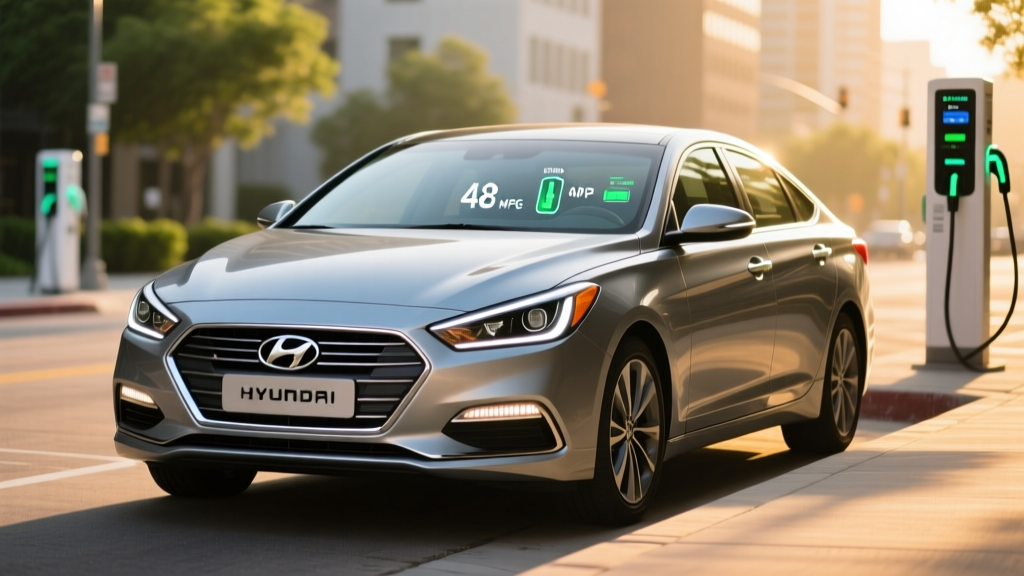
The 2016 Hyundai Sonata Hybrid SE occupies a specific niche in the used-car market: a midsize conventional hybrid sedan that prioritizes fuel efficiency and comfort without requiring any change in driving habits. You never plug it in. You just fill it with gas and drive. For buyers in 2026 who want hybrid efficiency without the complexity of a plug-in hybrid (PHEV) or the charging logistics of a full battery-electric vehicle (BEV), this Sonata remains a practical, data-backed option.
This guide breaks down the exact EPA figures, real-world MPG expectations, battery longevity, replacement costs, and whether this eight-year-old hybrid still makes financial sense against newer alternatives.
HEV vs PHEV: What the 2016 Sonata Hybrid Actually Is
The 2016 Hyundai Sonata Hybrid SE is a conventional hybrid electric vehicle (HEV). It pairs a gasoline engine with an electric motor and a small battery pack that recharges through regenerative braking and engine power. There is no plug. There is no electric-only driving range to manage. The system decides when to use the motor, the engine, or both.
HEV vs PHEV vs BEV — Quick Distinction
| Feature | HEV (This Sonata) | PHEV (e.g., Sonata PHEV) | BEV (e.g., Ioniq 6) |
|---|---|---|---|
| Plug-in charging | No | Yes | Yes |
| Electric-only range | None (motor assists) | ~20–30 mi | 250–360+ mi |
| Battery size | 1.62 kWh | 9.8 kWh | 77.4 kWh |
| Fuel required | Gasoline | Gasoline + electricity | Electricity only |
| Federal tax credit (new) | None | Up to $7,500 (if eligible) | Up to $7,500 (if eligible) |
Hyundai also sold a Sonata Plug-In Hybrid for the 2016 model year, which is a separate vehicle with a larger 9.8 kWh battery, roughly 27 miles of electric-only range, and a J1772 charge port. That PHEV variant is not what this review covers. If you're shopping for a 2016 Sonata Hybrid SE, you're looking at the non-plug-in HEV.
Fuel Economy: EPA Numbers and Real-World MPG
The 2016 Sonata Hybrid SE carries an EPA rating of 39 MPG city / 43 MPG highway / 41 MPG combined according to fueleconomy.gov. The Limited trim, which adds weight and larger wheels, drops slightly to 38/43/40 MPG.
2016 Sonata Hybrid SE — EPA Fuel Economy Breakdown
| Driving Condition | EPA Rating | Real-World Expectation |
|---|---|---|
| City | 39 MPG | 40–44 MPG (hybrids excel in stop-and-go) |
| Highway | 43 MPG | 38–42 MPG (sustained 70+ MPH reduces regen benefit) |
| Combined | 41 MPG | 38–42 MPG depending on driving mix |
| Cold weather (below 32°F) | — | 34–37 MPG (engine runs more for cabin heat) |
Conventional hybrids typically exceed their EPA city rating in real-world urban driving because regenerative braking recaptures energy at every stoplight. Highway driving is where the Sonata Hybrid's efficiency dips — at sustained speeds above 70 MPH, the gasoline engine does most of the work with minimal electric assist. In winter, expect a 10–15% MPG reduction as the engine runs longer to provide cabin heating and maintain battery temperature.
For comparison, the 2016 gasoline-only Sonata 2.4L SE achieves 25/38/29 MPG combined. The hybrid's 41 MPG combined represents a 41% improvement in fuel economy over the gas model.
Powertrain and Performance Specifications
2016 Hyundai Sonata Hybrid SE — Key Specifications
| Specification | Value |
|---|---|
| Engine | 2.0L GDI 4-cylinder |
| Engine horsepower | 154 HP @ 6,000 RPM |
| Electric motor output | 38 kW (51 HP) |
| Combined system output | 193 HP |
| Transmission | 6-speed automatic |
| Hybrid battery capacity | 1.62 kWh (lithium-ion polymer) |
| 0–60 MPH | ~8.2 seconds (est.) |
| Curb weight | 3,457 lbs |
| Fuel tank capacity | 18.5 gallons |
| Total driving range | ~758 miles (18.5 gal × 41 MPG) |
| EPA combined MPG | 41 MPG |
The 2016 Sonata Hybrid uses Hyundai's parallel hybrid architecture. The 2.0-liter gasoline engine and the 38 kW electric motor can drive the wheels independently or together, routed through a conventional 6-speed automatic transmission rather than a CVT. This gives the Sonata Hybrid a more natural acceleration feel compared to competitors like the Toyota Camry Hybrid, which uses an eCVT planetary gearset.
The 193 combined horsepower is adequate for daily driving and highway merging, but this is not a performance-oriented sedan. The 0–60 time of roughly 8.2 seconds trails the turbocharged gas Sonata Sport 2.0T (around 7.0 seconds) and feels deliberate rather than quick.
Battery Longevity, Warranty, and Replacement Cost
Hybrid Battery Warranty — Original Terms
Original coverage: 10 years / 100,000 miles (whichever comes first) for the hybrid battery pack, applicable to the original owner. For subsequent owners, coverage typically transfers as 10 years / 100,000 miles from the original in-service date in most states, though some states may differ. Hyundai's hybrid system components (motor, inverter) carry the same warranty period.
For a 2016 model in 2026: The original 10-year warranty window has closed or is closing for most vehicles. Verify remaining coverage with a Hyundai dealer using the VIN.
The 1.62 kWh lithium-ion polymer battery in the Sonata Hybrid is far smaller than a BEV battery, and its job is less demanding — it buffers regenerative energy and provides electric assist, not sustained propulsion. This means the battery experiences shallower charge-discharge cycles, which reduces degradation stress.
In practice, Hyundai's hybrid batteries from this generation have shown solid longevity. Reports from high-mileage owners and fleet data suggest these packs commonly last 150,000–200,000 miles before significant capacity loss affects fuel economy. The battery doesn't typically "fail" catastrophically; instead, it gradually loses capacity, and the car relies more on the gasoline engine, reducing MPG by 3–5 MPG over time.
If replacement is needed, expect to pay between $2,000 and $3,500 for a refurbished or new hybrid battery pack, including labor. Independent hybrid specialists often offer refurbished packs at the lower end of that range. A new OEM pack from Hyundai typically runs $2,800–$3,200 for the part alone. Given the vehicle's used-market value, this is a cost worth factoring into your purchase decision.
Pricing, Value, and Tax Credit Eligibility
The 2016 Sonata Hybrid SE originally carried an MSRP of approximately $26,000 (before destination). In the 2026 used-car market, expect to pay between $9,000 and $14,000 depending on mileage, condition, and region. Lower-mileage examples (under 80,000 miles) command the higher end.
Federal tax credit: The 2016 Sonata Hybrid SE does not qualify for the federal §30D new clean vehicle credit, which applies only to new plug-in vehicles (PHEVs and BEVs). As a conventional HEV with no plug, it was never eligible. On the used market, the Used Clean Vehicle Credit (up to $4,000 or 30% of sale price) also applies only to used PHEVs and BEVs — not conventional hybrids. There is no federal tax incentive for purchasing a used HEV.
State incentives: A small number of states offer modest rebates or HOV lane access for hybrids, but these programs have largely shifted focus to plug-in vehicles. Check your state's energy or DMV website for current hybrid-specific benefits, if any.
The value proposition here is straightforward: you're paying for fuel savings, not incentives. At 41 MPG combined versus 29 MPG for the gas Sonata, and with gas averaging roughly $3.20/gallon, the hybrid saves approximately $500–$700 per year in fuel costs for a driver covering 15,000 miles annually.
Who Should Buy This Hybrid vs a PHEV or Full EV
Reasons to Choose the 2016 Sonata Hybrid SE
- No charging access at home or work — you need a car that runs on gas alone
- Budget under $15,000 for a fuel-efficient midsize sedan
- Long highway commutes where hybrid efficiency still beats gas-only
- Preference for conventional driving with no range planning
- Want lower maintenance costs (no oil changes more frequent than gas, fewer brake replacements due to regen)
Reasons to Look Elsewhere
- You have home charging and could benefit from PHEV electric-only commuting
- You want zero tailpipe emissions — consider a BEV like the Chevrolet Bolt EV or Hyundai Ioniq 5
- You need modern ADAS features (the 2016 Sonata Hybrid SE lacks automatic emergency braking standard, lane-keep assist)
- You want federal tax credits — only available on eligible new or used PHEVs/BEVs
- High-mileage example (>130,000 mi) approaching potential battery replacement
Decision Framework
Choose the 2016 Sonata Hybrid SE if: You lack plug-in charging access, drive 12,000–20,000 miles per year, and want a comfortable midsize sedan that sips fuel without any behavioral changes.
Choose a used PHEV (e.g., 2017–2019 Sonata Plug-In Hybrid, Prius Prime) if: You can charge at home and your daily commute is under 25 miles — you'd drive mostly on electricity and use gas only for longer trips.
Choose a used BEV (e.g., Chevrolet Bolt EV, Nissan Leaf) if: You have reliable home charging, your daily driving is under 200 miles, and you want the lowest per-mile energy cost and zero tailpipe emissions.
Reliability and Safety Record
The 2016 Sonata Hybrid earned a 5-star overall safety rating from NHTSA and was an IIHS Top Safety Pick when equipped with optional forward collision warning. Standard safety equipment includes stability control, six airbags, and a rearview camera. Automatic emergency braking was not standard on the SE trim — it was part of an optional package or standard on the Limited.
On reliability, the 2016 Sonata Hybrid scores average to above-average in long-term owner surveys. The hybrid powertrain itself has proven durable. Common non-hybrid issues reported include infotainment system glitches, minor interior trim wear, and occasional brake caliper sticking — none of which are hybrid-specific. The hybrid system (battery, motor, inverter) has not been a frequent failure point based on owner forums and repair databases.
2016 Sonata Hybrid SE FAQ
How many MPG does the 2016 Hyundai Sonata Hybrid SE get?
The EPA rates it at 39 MPG city, 43 MPG highway, and 41 MPG combined. In real-world city driving with frequent stops, many owners report 42–45 MPG. Highway driving at 75+ MPH tends to yield 37–40 MPG. Cold weather reduces efficiency by roughly 10–15%.
Does the 2016 Sonata Hybrid need to be plugged in?
No. The 2016 Sonata Hybrid SE is a conventional hybrid (HEV). The battery charges through regenerative braking and the gasoline engine. You never plug it in. Hyundai sold a separate Sonata Plug-In Hybrid variant that does require charging — that is a different model.
How long will the hybrid battery last?
Based on owner data and hybrid system design, the 1.62 kWh battery typically lasts 150,000–200,000 miles before meaningful degradation. It rarely fails suddenly; instead, it gradually loses capacity, causing a modest MPG reduction. The original warranty was 10 years/100,000 miles, which has now expired for most 2016 examples.
What does a replacement hybrid battery cost?
Expect $2,000–$3,500 for a replacement, depending on whether you choose a refurbished pack from an independent hybrid shop or a new OEM unit from Hyundai. Labor typically adds $300–$500. Given the car's current market value of $9,000–$14,000, a battery replacement is a significant but not prohibitive expense.
Does the 2016 Sonata Hybrid qualify for any tax credit?
No. Federal clean vehicle credits (§30D for new, §25E for used) apply only to plug-in vehicles — PHEVs and BEVs. The conventional Sonata Hybrid SE has no plug and was never eligible for federal tax incentives. Check your state's programs for any hybrid-specific rebates, though most have shifted to plug-in vehicles.
How does the Sonata Hybrid compare to the Toyota Camry Hybrid?
The 2016 Camry Hybrid LE rates at 42 MPG combined versus the Sonata's 41 MPG — a negligible difference. The Camry uses an eCVT, which some drivers find droney under acceleration, while the Sonata's 6-speed automatic feels more conventional. The Sonata offers a slightly larger trunk and more rear legroom. Both have strong reliability records.
Is the 2016 Sonata Hybrid SE a good buy in 2026?
At $9,000–$14,000 with a clean history and under 120,000 miles, it's a solid value for a buyer who needs a no-plug, fuel-efficient sedan. Prioritize examples with maintenance records showing regular oil changes and brake inspections. Budget $500–$1,000 annually for standard maintenance, and set aside a reserve for a potential hybrid battery replacement if the vehicle is above 130,000 miles.