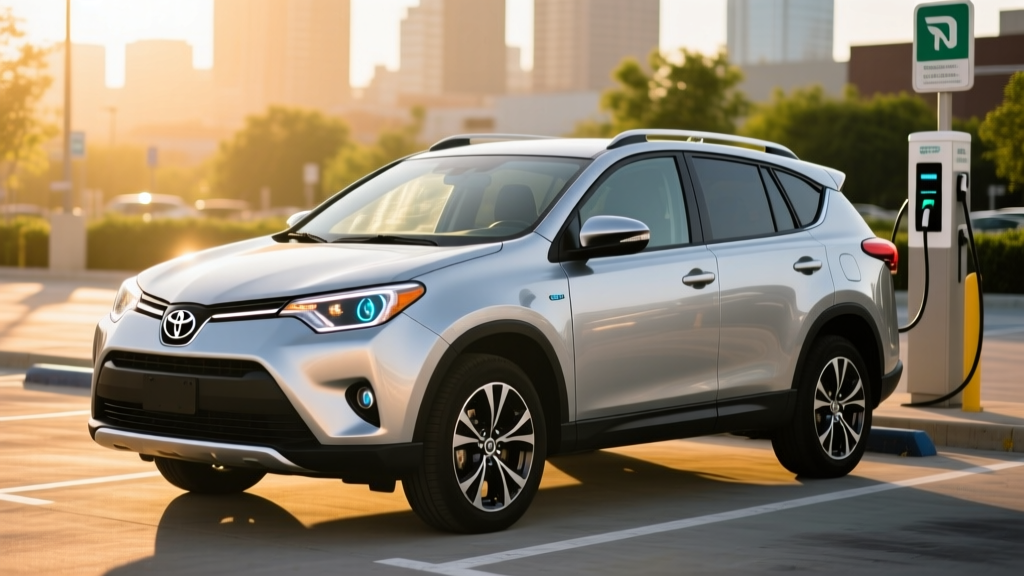
The 2016 Toyota RAV4 Hybrid was one of the first mainstream compact SUVs to pair a gasoline engine with an electric motor system — and nearly a decade later, it remains one of the most sought-after used hybrids on the market. If you're researching the 2016 hybrid RAV4 MPG numbers before buying a used example, you're looking at a vehicle that still delivers impressive efficiency by today's standards. This guide covers the EPA ratings, real-world fuel economy, battery longevity, replacement costs, and how this first-generation RAV4 Hybrid stacks up against modern alternatives in 2026.
2016 RAV4 Hybrid MPG: EPA Ratings and Real-World Results
The EPA rated the 2016 Toyota RAV4 Hybrid at figures that remain competitive even against newer compact SUVs. Here's the official breakdown from fueleconomy.gov:
| Metric | 2016 RAV4 Hybrid (AWD) |
|---|---|
| City MPG | 34 MPG |
| Highway MPG | 31 MPG |
| Combined MPG | 32 MPG |
| Annual Fuel Cost (est.) | ~$1,550 |
| CO₂ Emissions | 277 g/mi |
Real-World MPG vs. EPA Sticker
The 2016 RAV4 Hybrid's hybrid system excels in stop-and-go city driving, where the electric motor handles low-speed propulsion and regenerative braking recovers energy. Many owners report 33-36 MPG in city driving, exceeding the EPA city estimate. Highway driving at sustained 70-75 mph speeds tends to return 28-30 MPG, slightly below the EPA highway number. Cold-weather operation (below 40°F) can reduce combined fuel economy by 2-4 MPG as the engine runs more frequently for cabin heat and battery warming.
For context, the 2026 Toyota RAV4 Hybrid achieves an EPA-estimated 39 MPG combined — a meaningful improvement driven by a more efficient 2.5L Dynamic Force engine and refined hybrid transaxle. But the 2016 model's 32 MPG combined still beats most non-hybrid compact SUVs by 8-12 MPG.
Powertrain Specs: Engine, Motors, and Combined Output
The 2016 RAV4 Hybrid uses Toyota's well-proven Hybrid Synergy Drive system. Here's the full powertrain breakdown:
| Specification | Detail |
|---|---|
| Gas Engine | 2.5L inline-4 (2AR-FXE, Atkinson cycle) |
| Engine Power | 150 hp @ 5,700 rpm / 137 lb-ft torque |
| Front Electric Motor | 105 kW (141 hp) / 247 lb-ft |
| Rear Electric Motor (AWD) | 50 kW (67 hp) / 103 lb-ft |
| Combined System Output | 194 hp |
| Transmission | eCVT (planetary gearset, no traditional gears) |
| Drivetrain | Electronic AWD (e-AWD, rear motor only) |
| 0-60 mph | ~8.1 seconds |
| Hybrid Battery | 1.6 kWh nickel-metal hydride (NiMH) |
| Towing Capacity | 1,750 lbs |
The e-AWD system in the 2016 RAV4 Hybrid is not a mechanical all-wheel-drive setup. Instead, the rear electric motor engages automatically when the front wheels slip or during hard acceleration from a stop. This approach saves weight and eliminates a driveshaft, but it provides less rear-torque bias than the 2026 RAV4 Hybrid's more powerful rear motor. In snowy or wet conditions, the system is adequate for light traction needs but not a substitute for a dedicated AWD system on steep or icy terrain.
HEV vs. PHEV vs. EV: Which Powertrain Fits Your Needs?
The 2016 RAV4 Hybrid is a conventional hybrid (HEV) — it does not plug in. This is an important distinction because Toyota did not offer a plug-in RAV4 (the RAV4 Prime PHEV) until the 2021 model year. Here's how the three powertrain types compare:
| Feature | HEV (2016 RAV4 Hybrid) | PHEV (2026 RAV4 Prime) | BEV (2026 Tesla Model Y) |
|---|---|---|---|
| Plug-in Required? | No — self-charging | Yes — Level 1 or 2 | Yes — Level 2 or DC fast |
| Electric-Only Range | ~0.5 mi at low speed | 42 mi (EPA) | 310 mi (EPA) |
| Total Range | ~450 mi (14.5-gal tank) | ~600 mi combined | 310 mi |
| Combined Efficiency | 32 MPG | 94 MPGe / 38 MPG (gas) | 122 MPGe |
| Battery Size | 1.6 kWh (NiMH) | 18.1 kWh (Li-ion) | 75 kWh (NMC) |
| Home Charging Needed? | No | Recommended | Essential |
| Federal Tax Credit | None | Up to $7,500 (§30D) | Up to $7,500 (§30D) |
Choose the HEV (like this 2016 RAV4 Hybrid) if: you lack access to home or workplace charging, drive a mix of city and highway, want minimal maintenance complexity, and prefer a lower upfront cost on the used market.
Choose a PHEV if: you can charge at home, your daily commute is under 40 miles, and you want the option of zero-emission driving for errands while retaining gas flexibility for road trips.
Choose a full EV if: you have reliable home Level 2 charging, your daily driving is predictable, and you want the lowest per-mile fuel cost and near-zero drivetrain maintenance.
Hybrid Battery Longevity, Warranty, and Replacement Cost
For any used hybrid buyer, the traction battery is the single biggest financial risk. Here's what you need to know about the 2016 RAV4 Hybrid's battery:
Battery Warranty and Expected Lifespan
Original warranty: Toyota covered the hybrid battery for 8 years / 100,000 miles in most states, and 10 years / 150,000 miles in California-emission states (CA, CT, ME, MA, NJ, NY, OR, RI, VT, WA). Since the 2016 model year, most original hybrid battery warranties have now expired by time (2024-2026) unless the vehicle was registered in a CARB state and has fewer than 150,000 miles.
Real-world lifespan: Toyota's NiMH hybrid batteries have proven exceptionally durable. Fleet data and owner surveys indicate most RAV4 Hybrid batteries retain 80%+ capacity at 150,000 miles. Failures before 200,000 miles are uncommon, though individual cells can weaken in high-heat climates (AZ, TX, FL).
Replacement cost in 2026: A new OEM hybrid battery from Toyota runs approximately $3,000-$4,200 including labor at a dealership. Independent hybrid specialists offer refurbished NiMH battery packs for $1,500-$2,500. Individual cell module replacement (if only a few cells are weak) can cost as little as $500-$900 at a specialist shop.
Before purchasing a used 2016 RAV4 Hybrid, request a hybrid battery health check from a Toyota dealer or qualified hybrid technician. They can read the battery's internal resistance values and state-of-health data through Toyota's Techstream diagnostic software. Look for a pack with less than 15% internal resistance variance between modules.
Used 2016 RAV4 Hybrid Pricing in 2026
The 2016 RAV4 Hybrid was offered in two trims: the XLE and the Limited. Here's what you can expect to pay on the used market in 2026:
| Trim | Original MSRP (2016) | 2026 Used Price Range |
|---|---|---|
| XLE Hybrid | $29,270 | $13,500 – $18,000 |
| Limited Hybrid | $34,510 | $16,000 – $21,500 |
Prices vary significantly by mileage, condition, battery health, and regional demand. Hybrids command a premium in markets with high gas prices (CA, OR, WA, HI) and in areas with harsh winters where the AWD system adds value.
Does the 2016 RAV4 Hybrid Qualify for Any Tax Credit?
No. The 2016 RAV4 Hybrid is a conventional HEV and does not qualify for the federal §30D Clean Vehicle Credit. That credit is reserved for plug-in electric vehicles (PHEVs and BEVs) with a minimum battery capacity of 7 kWh. The RAV4 Hybrid's 1.6 kWh NiMH battery falls far short of this threshold.
Additionally, because this is a 2016 model, even the Used Clean Vehicle Credit (up to $4,000 or 30% of sale price under §25E) does not apply — that credit requires the vehicle to be a qualified plug-in EV or fuel cell vehicle. There is no federal tax incentive for purchasing a used conventional hybrid.
Some states and municipalities offer registration fee reductions, HOV lane access, or parking benefits for hybrid vehicles. Check your local DMV or Alternative Fuels Data Center for state-specific incentives.
2016 RAV4 Hybrid vs. Modern Alternatives
Is the 2016 RAV4 Hybrid still a smart buy in 2026, or should you look at newer options? Here's a practical comparison:
Reasons to Buy the 2016 RAV4 Hybrid
- Low entry cost: $13,500-$21,500 vs. $33,000+ for a new 2026 RAV4 Hybrid
- Proven reliability: Toyota's 2AR-FXE engine and NiMH battery are among the most durable powertrain components ever mass-produced
- No charging needed: Ideal for apartment dwellers and those without garage access
- Strong parts support: Every Toyota dealer can service the hybrid system
- 32 MPG combined still beats most 2026 gas-only compact SUVs
Reasons to Consider a Newer Alternative
- Lower efficiency: 2026 RAV4 Hybrid gets 39 MPG combined (22% better)
- Dated tech: No Apple CarPlay/Android Auto, basic infotainment, no modern ADAS beyond Toyota Safety Sense-P (added late in 2016 production)
- Safety: Early 2016 models lack the TSS-P suite (pre-collision, lane departure alert, auto high beams) — confirm the build date
- Battery age risk: Even durable NiMH batteries degrade; a replacement could add $2,000-$4,000 to your ownership cost
- No tax credits: A new PHEV like the RAV4 Prime can net up to $7,500 in federal credits
If your budget is firm around $18,000-$20,000, the 2016 RAV4 Hybrid Limited is hard to beat for a reliable, efficient AWD SUV. But if you can stretch to $30,000+, a low-mileage 2022-2024 RAV4 Hybrid or a certified pre-owned model offers significantly better fuel economy, modern safety tech, and remaining factory hybrid warranty coverage.
Ownership Costs: Fuel, Maintenance, and Insurance
Here's a realistic 5-year ownership cost projection for a 2016 RAV4 Hybrid purchased in 2026 at approximately 80,000 miles, driven 12,000 miles per year:
| Cost Category | 5-Year Estimate |
|---|---|
| Purchase Price (XLE avg.) | $16,000 |
| Fuel (32 MPG, $3.40/gal avg.) | $6,375 |
| Maintenance (oil, brakes, tires, fluids) | $3,200 |
| Insurance (national avg.) | $6,500 |
| Potential Battery Replacement | $0 – $3,500 |
| Total 5-Year Cost | $32,075 – $35,575 |
For comparison, a gas-only 2016 RAV4 (non-hybrid, 25 MPG combined) would cost approximately $8,160 in fuel over the same period — nearly $1,800 more. The hybrid's regenerative braking also extends brake pad life significantly; many owners report original brake pads lasting 80,000-100,000 miles.
Frequently Asked Questions
How many MPG does the 2016 RAV4 Hybrid actually get?
The EPA rates it at 34 city / 31 highway / 32 combined MPG. In real-world driving, expect 33-36 MPG in city traffic and 28-30 MPG on sustained highway trips. Cold weather and heavy cargo reduce these figures by 2-4 MPG.
Does the 2016 RAV4 Hybrid need to be plugged in?
No. The 2016 RAV4 Hybrid is a conventional hybrid (HEV). It charges its small 1.6 kWh battery through regenerative braking and the gasoline engine. There is no plug, no charging port, and no electric-only driving range beyond very low-speed creep (under 1 mile at parking-lot speeds).
Is the 2016 RAV4 Hybrid reliable?
Yes. According to data tracked by owner surveys and reliability databases, the 2016 RAV4 Hybrid is among the most reliable compact SUVs of its generation. The 2.5L Atkinson-cycle engine is under-stressed, the eCVT has no traditional transmission bands or clutches to wear, and the NiMH battery is proven to last 200,000+ miles in most conditions. The main watch items are standard wear items: suspension bushings, water pump, and brake actuators.
What does a hybrid battery replacement cost?
A new OEM NiMH battery from Toyota costs approximately $3,000-$4,200 installed. Refurbished packs from independent hybrid specialists run $1,500-$2,500. Cell-level repairs (replacing only weak modules) can cost $500-$900. Most 2016 RAV4 Hybrid batteries have not needed replacement at current mileage averages.
Does the 2016 RAV4 Hybrid qualify for a tax credit?
No. Conventional hybrids do not qualify for the federal §30D Clean Vehicle Credit or the §25E Used Clean Vehicle Credit. These credits require plug-in capability and a minimum battery capacity of 7 kWh. The 2016 RAV4 Hybrid's 1.6 kWh battery does not meet these requirements.
Is the 2016 RAV4 Hybrid good in snow?
The electronic AWD system provides adequate traction for moderate snow and icy intersections. The rear electric motor engages automatically when front-wheel slip is detected. However, it cannot send sustained torque to the rear wheels at highway speeds like a mechanical AWD system. Pair the AWD with dedicated winter tires for the best results in heavy snow regions.
Should I buy a 2016 RAV4 Hybrid or a newer model?
If your budget is under $20,000, the 2016 model offers strong value with proven reliability. If you can spend $30,000+, a 2022-2026 RAV4 Hybrid provides 39 MPG combined, Toyota Safety Sense 2.0, Apple CarPlay, and remaining factory warranty. For maximum efficiency and tax credit eligibility, the RAV4 Prime PHEV (2021+) offers 42 miles of electric range but starts above $40,000 on the used market.