Quick Verdict: The 2016 Avalon Hybrid a Decade Later
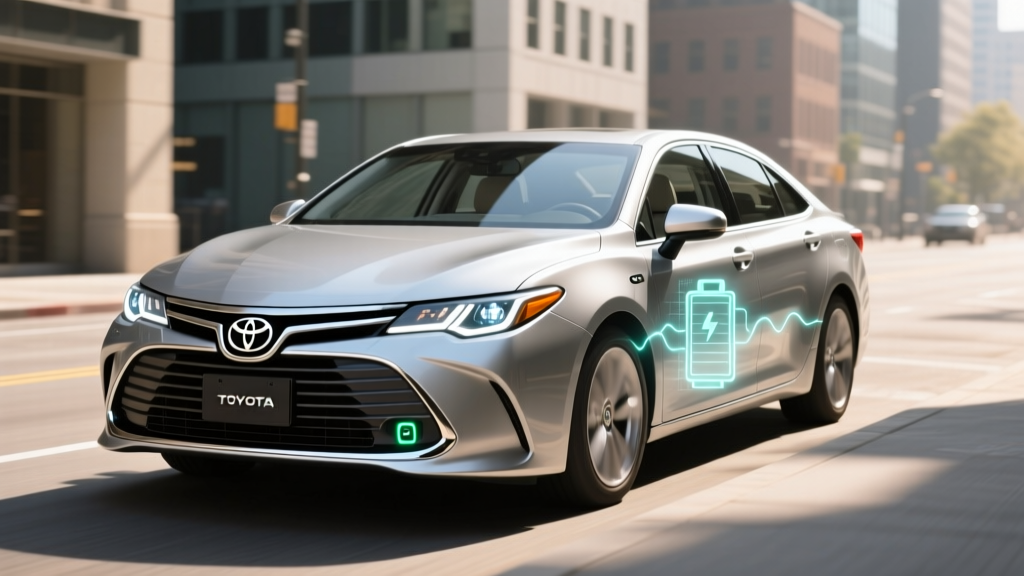
The 2016 Toyota Avalon Hybrid is a full-size, conventional hybrid electric vehicle (HEV) that pairs a 2.5-liter four-cylinder engine with Toyota's Hybrid Synergy Drive system. It does not plug in — it charges its own small battery through regenerative braking and the gasoline engine. A decade after its debut, it remains one of the most fuel-efficient large sedans ever sold in the U.S., and on the used market in 2026, it represents a compelling value proposition for buyers who want EV-like city efficiency without charging infrastructure.
This guide covers everything a prospective used buyer needs to know: EPA and real-world fuel economy, the hybrid battery's expected lifespan and replacement cost, how the Avalon Hybrid stacks up against modern PHEVs and full EVs, and whether any tax credits apply.
HEV vs PHEV: Understanding the 2016 Avalon Hybrid
Before diving into specs, it is critical to understand what this car is — and what it is not.
Conventional Hybrid (HEV) — 2016 Avalon Hybrid
- No plug. No charging cable. You fuel it like a normal car.
- Small battery (~1.6 kWh usable) charged by regen braking and the engine.
- Electric motor assists the gas engine; can drive short distances on electric only at low speeds.
- Primary benefit: dramatically improved fuel economy, especially in city driving.
Plug-In Hybrid (PHEV) — e.g., Toyota Prius Prime
- Has a plug. Charges from a wall outlet or public charger.
- Larger battery (8–18+ kWh depending on model) providing 25–45 miles of electric-only driving.
- After electric range is depleted, operates as a conventional hybrid.
- Primary benefit: daily electric commuting with gas backup for longer trips.
The 2016 Avalon Hybrid is strictly an HEV. There was never a plug-in variant of the Avalon. If you want plug-in capability from Toyota in a similar size class, you would need to look at a different model entirely.
Fuel Economy: EPA Ratings and Real-World MPG
The EPA rated the 2016 Avalon Hybrid at the following fuel economy figures, which you can verify on fueleconomy.gov:
| Driving Cycle | EPA Rating |
|---|---|
| City | 40 MPG |
| Highway | 39 MPG |
| Combined | 40 MPG |
These numbers were exceptional for a 17-foot-long, 3,600-pound sedan in 2016 and remain competitive today. For comparison, the gas-only 2016 Avalon with its 3.5L V6 was rated at 21 city / 30 highway / 24 combined.
Real-World MPG: What Owners Actually See
Toyota's hybrid system excels in stop-and-go traffic, where the electric motor handles low-speed driving and the engine shuts off at stops. Real-world data from owner communities and fuel-tracking apps consistently shows:
- City driving: 38–44 MPG. Many owners exceed the EPA city estimate in warm weather with moderate traffic, because regenerative braking recaptures energy that a gas car would waste as heat.
- Highway driving (65–75 mph): 35–39 MPG. Hybrids lose their city advantage at sustained highway speeds, where the gasoline engine does most of the work. Aerodynamic drag on a large sedan also plays a role.
- Cold weather (below 35°F): Expect a 5–10% drop. The engine runs more often to provide cabin heat and to reach operating temperature, reducing electric-motor utilization.
- Combined real-world average: Most owners report 37–41 MPG in mixed driving, closely tracking the EPA combined figure.
At 40 MPG combined and a national average gas price of roughly $3.10/gallon (early 2026), the Avalon Hybrid costs approximately $0.078 per mile in fuel. That compares to $0.129/mile for the V6 Avalon at 24 MPG — a savings of about $500 per year at 10,000 miles annually.
Powertrain Specs: Engine, Motor, and Combined Output
| Specification | 2016 Avalon Hybrid |
|---|---|
| Engine | 2.5L Atkinson-cycle inline-4 |
| Engine Power | 156 hp @ 5,700 rpm |
| Engine Torque | 156 lb-ft @ 4,500 rpm |
| Electric Motor | Permanent-magnet synchronous (105 kW / 141 hp) |
| Combined Net Horsepower | 200 hp |
| Transmission | Electronically controlled CVT (eCVT) |
| Drivetrain | Front-wheel drive |
| 0–60 mph | ~8.0 seconds |
| Hybrid Battery | Nickel-metal hydride (NiMH), ~1.6 kWh gross |
| Fuel Tank | 13.2 gallons |
| Total Range (est.) | ~520 miles |
The eCVT is not a belt-and-pulley CVT like those in some conventional cars. It uses a planetary gearset to blend engine and motor power — there is no belt to wear, and it is one of the most durable transmissions Toyota has ever built. This matters for used buyers evaluating long-term reliability.
Hybrid Battery Lifespan, Warranty, and Replacement Cost
This is the single most common concern for used hybrid buyers. Here is the data.
Original Battery Warranty
Toyota warranted the 2016 Avalon Hybrid's battery pack for 8 years / 100,000 miles (10 years / 150,000 miles in California and states that adopted CARB emissions standards). As of 2026, original factory warranty coverage has expired for virtually all examples on the road unless a certified extended warranty was purchased and remains active.
Expected Battery Lifespan
Toyota's NiMH hybrid batteries have a strong longevity track record. Based on fleet data and owner reports across Toyota's hybrid lineup (Prius, Camry Hybrid, Avalon Hybrid):
- Typical lifespan: 150,000–200,000 miles before significant capacity loss or failure.
- Many units exceed 200,000 miles with no battery replacement, especially in moderate climates.
- Heat is the primary enemy. Vehicles in Arizona, Texas, and other hot-climate states may see earlier degradation. The Avalon Hybrid's battery is air-cooled (located behind the rear seat), and keeping the cooling vent unobstructed is important.
- Capacity loss is gradual. Unlike a full EV battery where degradation directly reduces range, a hybrid battery's reduced capacity mainly affects fuel economy and electric-assist availability. Even a degraded hybrid battery may still function — just with slightly lower MPG.
Battery Replacement Cost (2026 Estimates)
- New OEM battery from Toyota: $2,500–$3,500 (part only); $3,500–$4,500 installed at a dealership.
- Refurbished/remanufactured battery: $1,200–$2,000 installed at an independent hybrid specialist.
- Individual module replacement: Some hybrid specialists can replace only the failed module(s) within the pack for $400–$800, though this is a shorter-term fix.
For a car that may be worth $12,000–$18,000 on the used market in 2026, a battery replacement is a meaningful but not catastrophic expense — especially weighed against the $500+/year in fuel savings the hybrid system provides.
Is the 2016 Avalon Hybrid Reliable?
Toyota's hybrid powertrain is among the most proven in the industry. The Avalon Hybrid shares its core hybrid system with the Camry Hybrid, a powertrain that has been in continuous production since 2006 with incremental refinements.
Key reliability factors for the 2016 model year:
- Engine: The 2AR-FXE 2.5L Atkinson-cycle engine is under-stressed (it operates in a narrow RPM band thanks to electric assist) and has no turbocharger, direct injection carbon buildup issues, or complex emissions equipment like a DPF. Timing chain, not belt.
- eCVT transmission: Planetary gearset design with no friction bands, belts, or clutches to wear. Failures are rare.
- Brakes: Regenerative braking handles most deceleration, so the friction brake pads and rotors last significantly longer than on a gas car — 80,000–100,000+ miles is common for original pads.
- 12V auxiliary battery: Like any car, the 12V battery will need replacement every 4–6 years. The Avalon Hybrid uses a standard 12V battery (located in the trunk), not the high-voltage traction battery.
The 2016 Avalon earned a Top Safety Pick designation from the IIHS, with Good ratings in all crashworthiness tests.
Tax Credits and Incentives in 2026
Because the 2016 Avalon Hybrid is a conventional HEV (not a plug-in), it does not qualify for the federal §30D Clean Vehicle Credit. That credit, which offers up to $7,500, applies only to new battery electric vehicles (BEVs) and plug-in hybrid electric vehicles (PHEVs) that meet battery sourcing, MSRP, and buyer income requirements.
For used buyers in 2026, here is the incentive landscape:
- Federal used clean vehicle credit (§25E): Up to $4,000 (30% of sale price, capped at $4,000) for qualifying used BEVs and PHEVs. Conventional hybrids like the Avalon Hybrid do not qualify.
- State incentives: A handful of states offer rebates or HOV lane access for hybrids, but most state-level EV incentive programs have shifted focus exclusively to BEVs and PHEVs. Check your state's energy or DMV website for current programs.
- No federal or state hybrid-specific tax credit currently applies to the 2016 Avalon Hybrid.
The lack of tax incentives is offset by the car's low purchase price on the used market and its strong fuel savings over time.
Avalon Hybrid vs PHEV vs Full EV: Which Should You Choose?
Choose the 2016 Avalon Hybrid If:
- You cannot charge at home (apartment, street parking, no garage).
- You want zero behavior change — just fill up with gas and go.
- Your budget is under $18,000 and you want a large, comfortable sedan.
- You drive 8,000–12,000 miles/year and want to minimize fuel costs without a large upfront investment.
- You value proven reliability with a long track record.
Consider a PHEV or Full EV Instead If:
- You can install a Level 2 home charger and want daily electric-only commuting.
- You want access to HOV lanes, state rebates, or the federal tax credit (new or used).
- You want the latest safety tech (AEB, lane centering) — the 2016 Avalon predates Toyota Safety Sense-P as standard equipment on all trims.
- You drive more than 15,000 miles/year, where the higher efficiency of a full EV translates to larger dollar savings.
- You want modern infotainment (Apple CarPlay, Android Auto) — the 2016 Avalon does not support either natively.
To put the fuel cost comparison in perspective for 10,000 miles/year:
| Vehicle Type | Example | Energy Cost/Year |
|---|---|---|
| Conventional Hybrid (HEV) | 2016 Avalon Hybrid (40 MPG) | ~$775 (gas) |
| Plug-In Hybrid (PHEV) | 2025 Prius Prime (52 MPG + 44 mi EV) | ~$450–$600 (gas + electricity) |
| Battery Electric (BEV) | 2025 Tesla Model 3 (4.0 mi/kWh) | ~$350–$500 (electricity) |
| Gas-Only Sedan | 2016 Avalon V6 (24 MPG) | ~$1,290 (gas) |
The Avalon Hybrid sits in a practical middle ground: substantially cheaper to fuel than a gas car, but not as cheap as a BEV charged on residential electricity rates. The trade-off is zero charging hassle and a lower purchase price.
2016 Avalon Hybrid Trims and Used Market Pricing (2026)
When new, the 2016 Avalon Hybrid was offered in three trims: XLE Premium, XLE Touring, and Limited. Original MSRPs ranged from approximately $37,850 to $44,350.
On the used market in early 2026, typical asking prices are:
- XLE Premium (80k–120k miles): $11,000–$14,000
- XLE Touring (70k–100k miles): $13,000–$16,000
- Limited (60k–90k miles): $15,000–$18,000
The Limited trim adds ventilated front seats, a premium JBL audio system, navigation, and rear sunshades. All trims share the identical hybrid powertrain and fuel economy.
Frequently Asked Questions
How many MPG does the 2016 Avalon Hybrid get?
The EPA rates it at 40 city / 39 highway / 40 combined. Real-world owners typically see 37–41 MPG combined, with city driving often exceeding 40 MPG and highway driving settling around 36–39 MPG depending on speed and temperature.
Does the 2016 Avalon Hybrid need to be plugged in?
No. It is a conventional hybrid (HEV), not a plug-in hybrid (PHEV). The hybrid battery charges automatically through regenerative braking and the gasoline engine. You refuel it exactly like a standard gasoline car.
How far can it drive on electric power alone?
Very short distances — typically under 1 mile at speeds below 25 mph. The hybrid system uses the electric motor for low-speed maneuvering, engine starts, and acceleration assist, but the ~1.6 kWh battery is far too small for meaningful electric-only range. This is normal for all conventional hybrids.
Is the hybrid battery expensive to replace?
A new OEM replacement costs $3,500–$4,500 installed at a dealer. Refurbished options run $1,200–$2,000. However, Toyota's hybrid batteries regularly last 150,000–200,000+ miles, so many used Avalon Hybrids will never need a replacement. Check the battery's state of health via a hybrid system diagnostic at a Toyota dealer before purchasing.
Does the 2016 Avalon Hybrid qualify for any tax credit?
No. The federal §30D new clean vehicle credit and the §25E used clean vehicle credit both require a plug-in vehicle (BEV or PHEV). The Avalon Hybrid is a conventional HEV and does not qualify for any current federal tax credit. Some states may offer minimal incentives for hybrids, but most have transitioned to BEV/PHEV-only programs.
Is the 2016 Avalon Hybrid a good buy in 2026?
For buyers who need a spacious, comfortable sedan with low fuel costs and cannot charge a plug-in vehicle at home, it remains an excellent choice. The powertrain is proven, the fuel savings are real, and used prices have depreciated to attractive levels. The main compromises are dated infotainment (no CarPlay/Android Auto), older safety technology compared to 2026 models, and no electric-only driving capability.
What should I check before buying a used 2016 Avalon Hybrid?
Request a hybrid battery health check from a Toyota dealer (the diagnostic report shows battery block voltage variance and state of charge). Verify the hybrid system warranty status. Check that the battery cooling vent (behind the rear seat) is not blocked. Review maintenance records for regular oil changes — the Atkinson-cycle engine still requires standard maintenance. A pre-purchase inspection by a technician familiar with Toyota hybrids is strongly recommended.