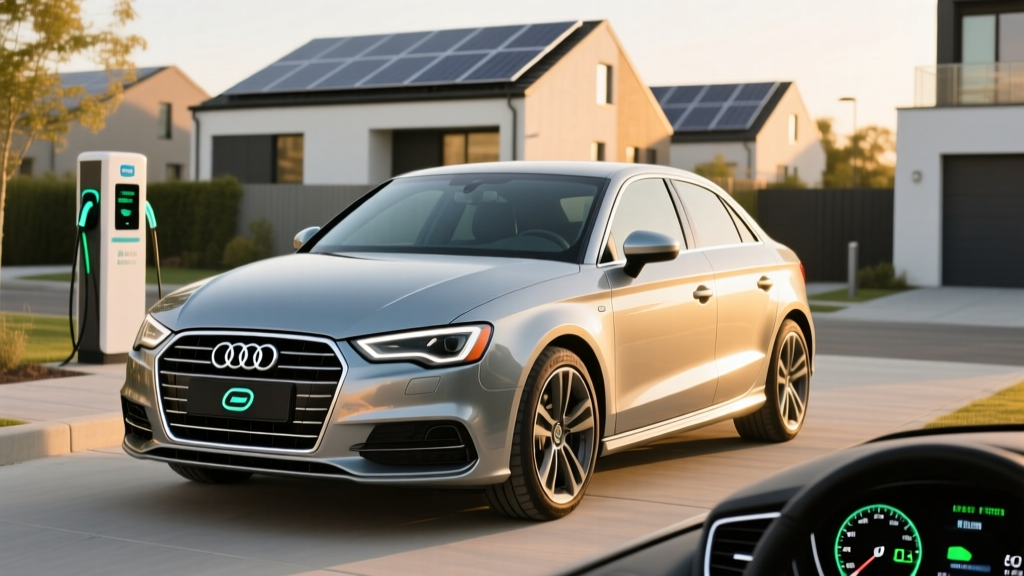
The 2016 Audi A3 Sportback e-tron was Audi's first plug-in hybrid (PHEV) sold in the United States, blending a turbocharged 1.4-liter engine with an electric motor in a compact luxury hatchback. A decade later, it remains a fixture on the used-EV market for buyers who want premium badges, short electric-only commutes, and a gas backup. But with aging batteries and shifting tax-credit rules, is the 2016 A3 e-tron still a smart buy in 2026?
This guide breaks down the exact specs, real-world efficiency, battery longevity expectations, and ownership economics you need to evaluate one today. We'll also clarify how this PHEV stacks up against a conventional hybrid (HEV) or a full battery-electric vehicle (BEV) so you can match the right powertrain to your driving pattern.
HEV vs PHEV vs BEV: Where Does the A3 e-tron Fit?
Before diving into the A3 e-tron's numbers, it's worth anchoring the three electrified powertrain types, because Audi only sold the plug-in hybrid (PHEV) version of the A3 in the U.S. — there was no conventional hybrid (HEV) A3.
| Feature | HEV (Conventional Hybrid) | PHEV (Plug-in Hybrid) | BEV (Full Electric) |
|---|---|---|---|
| Plugs in? | No — charges via regen & engine | Yes — Level 1 or Level 2 | Yes — Level 1, 2, or DC fast |
| Electric-only range | 0–1 mi at low speed | 10–40 mi (model dependent) | 200–400+ mi |
| Gas engine? | Yes | Yes | No |
| Example | Toyota Prius | 2016 Audi A3 e-tron | Tesla Model 3 |
The A3 e-tron is a PHEV: it has a gasoline engine and a battery you plug in to recharge. When the battery is depleted, it operates like a conventional hybrid, using regenerative braking and the engine to keep moving. This dual-mode flexibility is the core appeal — but it also means you carry the weight and complexity of two powertrains.
Powertrain and Performance Specs
The 2016 A3 Sportback e-tron pairs a 1.4-liter TFSI turbocharged four-cylinder engine (150 HP, 184 lb-ft torque) with an electric motor (102 HP, 243 lb-ft) integrated into the six-speed S tronic dual-clutch transmission. Combined system output is 204 horsepower and 258 lb-ft of torque.
| Specification | 2016 Audi A3 Sportback e-tron |
|---|---|
| Engine | 1.4L turbocharged 4-cyl (150 HP / 184 lb-ft) |
| Electric Motor | 102 HP / 243 lb-ft (integrated in transmission) |
| Combined System Output | 204 HP / 258 lb-ft |
| Transmission | 6-speed S tronic dual-clutch automatic |
| Drivetrain | Front-wheel drive |
| 0–60 mph | 7.6 seconds |
| Battery (usable) | 8.8 kWh lithium-ion (NMC chemistry) |
| EPA Electric Range | 16 miles |
| EPA Total Range (EV + gas) | 380 miles |
| Fuel Tank | 10.6 gallons |
| Base MSRP (2016) | $38,825 (Premium trim) |
The 8.8 kWh battery pack is modest by 2026 standards — most new PHEVs now carry 14–20 kWh packs yielding 30–45 miles of electric range. But for a 10-year-old PHEV, the A3 e-tron's pack was competitive at launch, and 16 electric miles still covers many short urban commutes.
Fuel Economy: EPA Ratings vs Real-World MPG
The EPA rates the 2016 A3 e-tron at 83 MPGe combined when operating in electric mode (accounting for electricity consumption), and 39 MPG combined when running on gasoline alone after the battery is depleted.
| Mode | City | Highway | Combined |
|---|---|---|---|
| Charge-sustaining (gas only) | 38 MPG | 40 MPG | 39 MPG |
| Charge-depleting (EV + gas) | 83 MPGe combined | ||
| Electric-only range | 16 miles (EPA) | ||
| Total range (EV + gas) | 380 miles | ||
Source: fueleconomy.gov — 2016 Audi A3 e-tron
Real-World MPG Expectations
Owner-reported data on Fuelly and Edmunds consistently shows real-world combined figures of 42–50 MPG for drivers who plug in regularly and keep trips within or near the electric range. Drivers who never plug in and treat it as a conventional hybrid typically see 35–38 MPG, slightly below the EPA's 39 MPG gas-only rating — the extra weight of the battery and motor (curb weight is 3,615 lbs, about 400 lbs heavier than a gas-only A3) penalizes efficiency when the electric system isn't being leveraged.
Real-world tip: To get the A3 e-tron's best efficiency, you must plug it in nightly. A driver with a 14-mile round-trip commute who charges daily might use gasoline only on weekends, achieving effective economy above 60 MPGe over a month. A driver who never charges will see no benefit over a conventional A3 and will pay a fuel-economy penalty for the dead battery weight.
Charging: Speed, Connector, and Home Setup
The 2016 A3 e-tron charges via a J1772 connector (the North American standard for Level 1 and Level 2 AC charging). It does not support DC fast charging — a common limitation for PHEVs of this era. The onboard charger is rated at 3.6 kW maximum.
| Charging Level | Power | Time (0–100%) | Notes |
|---|---|---|---|
| Level 1 (120V household) | ~1.4 kW | ~8 hours | Overnight from a standard outlet |
| Level 2 (240V) | 3.6 kW (max) | ~2.5 hours | Home wallbox or public Level 2 |
| DC Fast Charge | Not supported | N/A | No CCS or CHAdeMO capability |
A full Level 2 charge in roughly 2.5 hours is practical for topping up at work or home between commutes. Because the battery is only 8.8 kWh, you don't need an expensive high-power home charger — even a basic 16-amp Level 2 unit ($250–$400) will max out the car's onboard charger.
Charging Cost Estimate
At the U.S. average residential electricity rate of ~$0.16/kWh (2026 EIA data), a full charge costs roughly $1.41 (8.8 kWh × $0.16). That's about $0.09 per electric mile — compared to roughly $0.13–$0.15 per mile on gasoline at $3.50/gal and 39 MPG. The savings are real but modest because the electric range is so short.
Battery Longevity, Warranty, and Replacement Cost
Hybrid and PHEV battery anxiety is the top concern for used buyers. Here's what you need to know about the A3 e-tron's 8.8 kWh lithium-ion pack.
Original battery warranty: Audi covered the A3 e-tron's high-voltage battery for 8 years or 100,000 miles (whichever came first), with a capacity retention threshold of roughly 70%. For most 2016 models, this warranty has now expired or is expiring in 2024–2026 depending on mileage.
Degradation Expectations
Lithium-ion batteries in PHEVs typically lose 10–20% of capacity over 8–10 years, depending on climate, charging habits, and depth of discharge cycles. Real-world A3 e-tron owner reports suggest electric range dropping from 16 miles to roughly 12–14 miles after 8 years of use — a noticeable but not catastrophic decline.
Factors that accelerate degradation in this pack:
- Frequent DC-level heat exposure: Though the A3 e-tron can't DC fast charge, repeated Level 2 charging in hot climates (Arizona, Texas) without thermal preconditioning can stress NMC cells.
- Deep cycling: Regularly running the battery to 0% before recharging, rather than topping up at 20–30% remaining.
- Prolonged storage at 100% SoC: Leaving the car fully charged and unplugged for weeks.
Battery Replacement Cost
If the high-voltage battery fails out of warranty, replacement costs for the A3 e-tron's pack typically range from $4,000 to $7,000 including parts and labor at an Audi dealer. Independent EV repair shops may offer refurbished packs for $2,500–$4,000. This is a meaningful expense on a car that now trades for $12,000–$18,000 on the used market, so battery health should be a deal-point during purchase negotiations.
Request a state-of-health (SoH) readout from the dealer or a qualified technician before buying. An SoH below 75% on a 10-year-old pack suggests accelerated degradation and potential near-term replacement.
12V Battery Note
Like all electrified vehicles, the A3 e-tron also has a conventional 12V auxiliary battery that powers electronics and starts the hybrid system. This battery typically lasts 4–6 years and costs $200–$350 to replace. A dead 12V battery will prevent the car from starting even if the high-voltage pack is fully charged — a common roadside-assistance call for PHEV owners who don't realize the 12V still exists.
Used Pricing and Tax Credit Eligibility in 2026
As of early 2026, the 2016 Audi A3 Sportback e-tron trades on the used market for approximately:
- $12,000–$14,000 — higher mileage (80K+), cosmetic wear, or unknown battery health
- $14,000–$16,500 — average mileage (50K–80K), good condition
- $16,500–$19,000 — low mileage (under 50K), excellent condition, documented battery SoH
Does It Qualify for a Federal Tax Credit?
The used-EV federal tax credit (§25E) provides up to $4,000 or 30% of the sale price (whichever is less) for qualifying pre-owned plug-in vehicles purchased from a dealer. The 2016 A3 e-tron can qualify, but several conditions must be met:
- Sale price must be $25,000 or less — most A3 e-trons fall under this cap.
- Buyer income limits: Modified AGI must not exceed $75,000 (single), $112,500 (head of household), or $150,000 (joint filers).
- Vehicle must be at least 2 model years old — a 2016 model qualifies.
- Must be purchased from a licensed dealer — private-party sales do not qualify.
- Must be the first qualifying used sale of this specific VIN after August 16, 2022.
- Credit is non-refundable — it can reduce your tax liability to zero but won't generate a refund beyond what you owe.
Source: IRS §25E Used Clean Vehicle Credit
At a typical sale price of $15,000, the maximum credit would be $4,000 (30% of $15,000 = $4,500, but the cap is $4,000). This can meaningfully reduce the effective purchase price — but confirm eligibility with a tax professional before relying on it, as IRS rules are subject to change and individual circumstances vary.
The new-vehicle §30D credit ($7,500) is irrelevant here since the A3 e-tron was discontinued after the 2019 model year and is no longer sold new.
Reliability and Common Issues
The A3 e-tron's powertrain is generally reliable, drawing on VW Group's well-tested EA211 1.4T engine and a proven DSG transmission variant. However, several known issues affect 2016–2019 models:
- Mechatronic unit (DSG control module): Some owners report hesitation or rough shifts linked to the transmission control unit. Repairs run $1,500–$3,000.
- Water pump / thermostat housing: A known weak point on the 1.4T engine, with plastic housings cracking. Replacement is $600–$1,000.
- Charge port latch: The locking mechanism on the J1772 inlet can fail, preventing secure charging connection. Replacement is roughly $300–$500.
- Brake caliper corrosion: Because regenerative braking reduces friction brake use, rear calipers can seize from disuse. Periodic brake servicing is important.
Check NHTSA for open recalls and ensure any outstanding service bulletins have been addressed. The A3 e-tron earned an IIHS Top Safety Pick rating for 2016 with acceptable headlight ratings on certain trims.
Source: NHTSA — 2016 Audi A3 Sportback e-tron
Who Should Buy the 2016 A3 e-tron — and Who Shouldn't
Pros
- Premium interior and ride quality for a used PHEV under $18K
- 16-mile EV range covers many short commutes gas-free
- 204 HP combined provides spirited acceleration (0–60 in 7.6s)
- Hatchback practicality with 13.6 cu ft cargo space
- Eligible for up to $4,000 used-EV tax credit
- Gas backup eliminates range anxiety for road trips
Cons
- Only 16 miles of electric range — less than half of modern PHEVs
- No DC fast charging capability
- Battery warranty expired or expiring — replacement risk of $4K–$7K
- Front-wheel drive only — no quattro AWD option
- Discontinued model — limited dealer familiarity and parts availability
- Small 10.6-gallon fuel tank limits highway range between fill-ups
Choose the 2016 A3 e-tron If:
- Your daily commute is under 20 miles round-trip and you can charge at home nightly.
- You want a premium-badge hatchback without paying 2026 new-car prices.
- You take 2–3 road trips per year and want gas-engine flexibility without range anxiety.
- You qualify for the §25E used-EV credit and can reduce the effective price to $11K–$14K.
Look Elsewhere If:
- Your commute exceeds 30 miles — the electric range won't cover it, and you'll burn gas daily.
- You want a fully electric experience — consider a used BMW i3, Chevrolet Bolt EV, or Nissan Leaf instead.
- You need all-wheel drive — the A3 e-tron is FWD only; look at a used Volvo XC60 T8 or Mitsubishi Outlander PHEV.
- You're uncomfortable with out-of-warranty battery risk on a European luxury car.
Frequently Asked Questions
How many MPG does the 2016 Audi A3 e-tron get?
The EPA rates it at 39 MPG combined (38 city / 40 highway) in gas-only mode, and 83 MPGe combined when using the electric charge. Real-world owners who plug in regularly report 42–50 MPG combined over mixed driving.
How far can the 2016 A3 e-tron go on electric only?
The EPA rates it at 16 miles of electric-only range. In real-world driving, expect 13–15 miles in moderate weather, dropping to 10–12 miles in cold weather (below 35°F) due to cabin heating demand and reduced battery efficiency.
Is the 2016 Audi A3 e-tron a conventional hybrid or a plug-in hybrid?
It is a plug-in hybrid (PHEV). You can plug it in to recharge the 8.8 kWh battery for electric-only driving. However, you can also drive it without ever plugging in — it will function as a conventional hybrid using the gas engine and regenerative braking, though with reduced efficiency.
What is the battery replacement cost for the A3 e-tron?
A dealer replacement runs $4,000–$7,000. Independent shops may offer refurbished packs for $2,500–$4,000. Always request a state-of-health (SoH) readout before purchasing a used A3 e-tron.
Does the 2016 A3 e-tron qualify for any tax credit in 2026?
It may qualify for the federal §25E used clean vehicle credit of up to $4,000 if purchased from a dealer for $25,000 or less, and the buyer meets income limits ($75K single / $150K joint). It does not qualify for the new-vehicle §30D credit. Confirm with a tax professional.
Can the 2016 A3 e-tron DC fast charge?
No. It supports only Level 1 (120V) and Level 2 (240V) AC charging via a J1772 connector. A full Level 2 charge takes approximately 2.5 hours.
Is the 2016 A3 e-tron reliable?
Overall reliability is average for a European luxury PHEV of this era. The powertrain is sound, but known issues include the DSG mechatronic unit, water pump housing, and charge port latch. Budget $1,500–$2,500 annually for maintenance and repairs once the original warranty expires.
Hybrid vs PHEV vs EV — which should I choose?
If you have home charging and a short commute, a PHEV like the A3 e-tron lets you drive electric daily with gas backup. If you can't charge at home, a conventional hybrid (HEV) like the Toyota Prius is simpler. If your commute is long and you want zero gas use, a full BEV (like a used Chevy Bolt or Tesla Model 3) offers 200+ miles of range — but requires reliable charging access.
Final Assessment
The 2016 Audi A3 Sportback e-tron occupies a specific niche in 2026: an affordable entry point into plug-in hybrid ownership with luxury-car refinement, for buyers whose daily driving stays under 16 miles. Its 204 HP combined output and hatchback versatility make it more engaging and practical than economy PHEVs from the same era.
However, its short electric range, expired battery warranty, and lack of DC fast charging are real limitations. The potential $4,000 used-EV tax credit makes the economics compelling — but only if you verify battery health, confirm credit eligibility, and commit to nightly charging. For buyers who can't plug in at home, a conventional hybrid or a full BEV will deliver a better ownership experience.