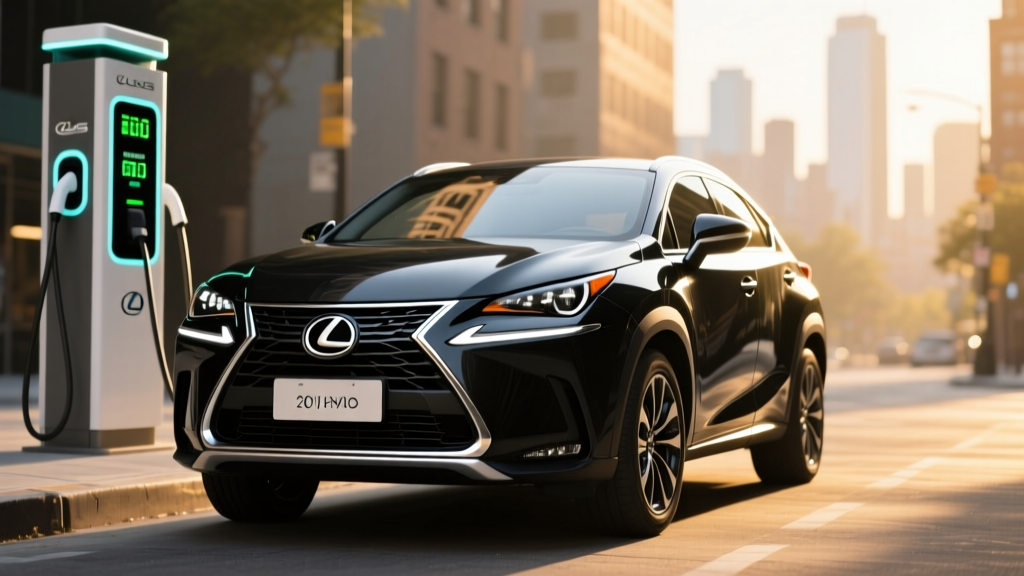
The 2015 Lexus NX 300h hybrid sits in an unusual spot in 2026: it's a decade-old luxury compact crossover that still delivers fuel economy rivaling much newer vehicles. With an EPA-estimated 33 MPG combined, Toyota/Lexus hybrid synergy drive reliability, and a used market price that often falls between $14,000 and $22,000, the NX 300h draws buyers who want premium badges without premium fuel bills. But a 10-year-old hybrid battery raises real questions. Here's everything you need to know before buying one.
HEV vs PHEV: What the 2015 NX 300h Actually Is
Before diving into specs, it's essential to understand that the 2015 Lexus NX 300h is a conventional hybrid electric vehicle (HEV), not a plug-in hybrid (PHEV). This distinction shapes the entire ownership experience.
| Feature | 2015 NX 300h (HEV) | Plug-In Hybrid (PHEV) | Battery Electric (BEV) |
|---|---|---|---|
| Plug-in charging required? | No — self-charging via regen & engine | Yes — for electric-only range | Yes — sole energy source |
| Electric-only range | ~1 mile at very low speed | Typically 20–50 miles | 200–400+ miles |
| Total range | ~470 miles (14.5-gal tank) | 350–500+ miles combined | 200–400+ miles |
| Federal tax credit (§30D) | Not eligible | Up to $7,500 (if qualified) | Up to $7,500 (if qualified) |
| Battery size | ~1.6 kWh (NiMH) | 10–20 kWh (lithium-ion) | 60–100+ kWh |
The NX 300h uses a small nickel-metal hydride (NiMH) battery pack that charges exclusively through regenerative braking and the gasoline engine. You never plug it in. The electric motor assists the engine during acceleration and can power the car solo at very low speeds for brief distances — think crawling through a parking lot. This is fundamentally different from a PHEV like the Toyota RAV4 Prime, which offers 42 miles of genuine electric-only driving before the engine engages.
Powertrain Specs: Engine, Motors, and Combined Output
The 2015 NX 300h pairs a 2.5-liter Atkinson-cycle four-cylinder engine with Lexus's Hybrid Synergy Drive system. Here's the complete powertrain breakdown:
| Specification | 2015 Lexus NX 300h |
|---|---|
| Engine | 2.5L 4-cyl Atkinson cycle (2AR-FXE) |
| Engine horsepower | 150 HP @ 5,700 RPM |
| Electric motor (front) | 105 kW (141 HP) |
| Net combined system HP | 194 HP |
| Drivetrain | AWD (e-AWD with rear electric motor) |
| Transmission | eCVT (planetary gearset, no fixed gears) |
| 0–60 mph | ~9.2 seconds |
| Battery type | Nickel-metal hydride (NiMH) |
| Battery capacity | ~1.6 kWh (gross) |
| Curb weight | ~3,990 lbs |
| Fuel tank | 14.5 gallons |
| Towing capacity | Not rated for towing |
The 194 combined horsepower figure is modest for a luxury compact crossover, and the 9.2-second 0–60 time confirms this isn't a performance vehicle. The eCVT keeps the engine in its most efficient rev range, prioritizing fuel economy over acceleration urgency. The AWD system uses a separate rear-mounted electric motor that engages when slip is detected — there's no mechanical driveshaft connecting front and rear axles.
Fuel Economy: EPA Ratings vs. Real-World MPG
| Driving Cycle | EPA Estimate | Real-World Expectation |
|---|---|---|
| City | 33 MPG | 33–37 MPG |
| Highway | 30 MPG | 27–31 MPG |
| Combined | 33 MPG | 30–34 MPG |
Source: EPA Fuel Economy Guide
The 2015 NX 300h carries an EPA rating of 33 MPG combined (33 city / 30 highway). As with most Toyota/Lexus hybrids, real-world results often exceed the EPA city estimate because the hybrid system does its best work in stop-and-go traffic where regenerative braking frequently recharges the battery and the engine shuts off at stops.
Highway driving is a different story. At sustained 70–80 mph speeds, the electric motor contributes less, and the 2.5L engine does most of the work while pushing nearly 4,000 pounds. Expect highway fuel economy in the 27–31 MPG range depending on speed, terrain, and tire condition. Cold weather (below freezing) typically drops overall fuel economy by 5–10% as the engine runs more frequently to maintain cabin heat and battery temperature.
With the 14.5-gallon fuel tank, real-world total range sits between 430 and 490 miles — adequate for most road trips with just one or two fuel stops.
Hybrid Battery Lifespan, Warranty, and Replacement Cost
Original hybrid battery warranty: 8 years / 100,000 miles (10 years / 150,000 miles in CARB states including California, New York, Massachusetts, and others adopting California emissions standards).
Status in 2026: All 2015 NX 300h vehicles have exceeded the standard 8-year federal warranty period. Those in CARB states may still have coverage if under 150,000 miles and within 10 years — but the 10-year mark passed in 2025, meaning factory warranty coverage has effectively expired for all 2015 models.
The NiMH battery in the NX 300h is one of the most proven hybrid battery packs in existence. It shares architecture with the Toyota Camry Hybrid and RAV4 Hybrid, which collectively have accumulated billions of real-world miles. NiMH chemistry is less energy-dense than modern lithium-ion but is remarkably tolerant of the shallow charge-discharge cycles that hybrids use. The NX 300h's hybrid system keeps the battery in a narrow state-of-charge window (roughly 40–80%), which dramatically extends cell life.
Expected lifespan: Most NX 300h battery packs last 150,000–200,000+ miles with no significant degradation. Failures before 120,000 miles are uncommon. That said, a 2015 model is now 11 years old, and age-related degradation — particularly in hot climates — is a legitimate concern regardless of mileage.
Replacement cost in 2026:
- New OEM battery (Lexus dealer): $3,000–$4,500 including labor
- Remanufactured battery (third-party): $1,500–$2,500 including core exchange
- Individual cell/module replacement: $500–$1,200 if only specific modules have failed (requires a shop experienced in hybrid battery repair)
Before buying any 2015 NX 300h, request a hybrid battery health check from a Lexus dealer or qualified hybrid specialist. The OBD-II diagnostic port can report battery state of health (SoH), individual module voltage deltas, and any stored hybrid system fault codes. A module voltage spread greater than 0.3V under load typically signals impending failure.
Pricing, Used Market Values, and Tax Credit Reality
The 2015 Lexus NX 300h originally carried an MSRP starting around $39,720 for the base AWD trim, with well-equipped examples reaching $47,000+ with options like the Luxury Package, navigation, and the F Sport appearance package.
Used market pricing in 2026:
- High mileage (120,000+ miles): $12,000–$15,000
- Average mileage (70,000–110,000 miles): $15,000–$19,000
- Low mileage (under 60,000 miles, excellent condition): $19,000–$23,000
Federal tax credit: The 2015 NX 300h does not qualify for the federal §30D new clean vehicle credit — it's a conventional hybrid, not a plug-in vehicle. It also does not qualify for the up-to-$4,000 used EV credit (§25E), which applies only to battery electric vehicles and plug-in hybrids with at least 7 kWh of battery capacity. The NX 300h's 1.6 kWh NiMH pack falls well below that threshold.
Some states and municipalities offer modest incentives for used hybrid purchases or local registration discounts, but these vary widely by jurisdiction. Check your state energy office or department of environmental quality for current programs.
NX 300h vs. the Alternatives: Hybrid, PHEV, or Full EV?
The 2015 NX 300h competes against newer vehicles across three powertrain categories. Here's how the decision framework breaks down:
Choose the 2015 NX 300h if:
- You want a luxury badge on a budget ($15K–$20K)
- You have no access to home or workplace charging
- Your commute is city-heavy with frequent stop-and-go traffic
- You want proven, decade-tested hybrid reliability with minimal maintenance
- You drive 10,000–15,000 miles per year and want ~$1,200–$1,500 annual fuel costs
Choose a newer PHEV (e.g., Toyota RAV4 Prime, Lexus NX 450h+) if:
- You have home Level 2 charging and a commute under 40 miles round-trip
- You want 30–42 miles of electric-only driving for daily errands
- You qualify for the $7,500 federal tax credit on a new purchase
- You want modern safety tech (the 2015 NX lacks automatic emergency braking as standard)
Choose a full BEV (e.g., Tesla Model Y, Hyundai Ioniq 5) if:
- You have reliable home charging and want zero gasoline expenses
- Your daily driving is under 250 miles with occasional road trips
- You want the lowest per-mile fuel cost (~$0.04–$0.06/mile vs. ~$0.12/mile for the NX 300h at $3.50/gallon)
- You value instant torque, one-pedal driving, and minimal drivetrain maintenance
The NX 300h's strongest argument in 2026 is simplicity: no plug, no range anxiety, no charging-network dependency, no battery thermal management worries. You fuel it at any gas station and drive. For apartment dwellers or those without charging access, this remains a significant advantage over PHEVs and BEVs.
Reliability, Safety, and Known Issues
Lexus consistently ranks at or near the top of J.D. Power and Consumer Reports reliability studies, and the NX 300h is no exception. The 2AR-FXE engine is a derivative of the Camry Hybrid powertrain — one of the most extensively validated hybrid systems ever produced. Common maintenance items include standard brake pad replacement (though regenerative braking extends pad life to 60,000–80,000+ miles in many cases), inverter coolant pump inspection, and the typical wear items any 10-year-old vehicle requires.
Known issues to check before purchase:
- Water pump (electric): Some 2AR-FXE engines experienced premature electric water pump failure — verify replacement history or check for coolant leak signs
- Brake actuator: Toyota/Lexus hybrid brake actuators can fail and are expensive (~$1,500–$2,000) — listen for unusual buzzing or grinding from the brake pedal area
- Infotainment: The 2015 NX uses Lexus's Remote Touch Interface (RTI) with a joystick-style controller, which is widely regarded as frustrating to use. Apple CarPlay/Android Auto were not available in the 2015 model year. Aftermarket head unit replacements are common
- Safety tech gap: The 2015 NX 300h lacked Lexus Safety System+ (LSS+) as standard — automatic emergency braking, lane departure alert, and adaptive cruise control were optional on some trims and absent on others. By 2026 standards, this is a significant deficit
The 2015 NX earned an IIHS Top Safety Pick rating when equipped with optional front crash prevention. NHTSA gave it a 4-star overall rating. See the IIHS rating page for full test results.
Who Should Buy the 2015 Lexus NX 300h in 2026?
Pros
- 33 MPG combined — excellent for a luxury AWD crossover
- Bulletproof hybrid powertrain with massive service history
- Lexus build quality, quiet cabin, comfortable ride
- No plug-in charging required — works for any living situation
- Low used-market entry price ($15K–$20K typical)
- Strong resale value retention relative to non-hybrid luxury rivals
Cons
- 9.2-second 0–60 — sluggish acceleration
- Dated infotainment with no smartphone integration
- Missing modern ADAS features (AEB, lane keeping) on most examples
- Hybrid battery replacement risk ($2K–$4.5K) as vehicles age
- Not eligible for any federal tax credit
- Small cargo area (17.7 cu ft behind rear seats) vs. rivals
The ideal 2015 NX 300h buyer is someone who prioritizes fuel efficiency and low running costs in a premium-badged package, doesn't need cutting-edge infotainment or driver-assistance technology, and has no ability to install home EV charging. It's a strong choice as a second vehicle, a commuter for city-heavy routes, or an entry point into the Lexus ownership experience at a fraction of new-car pricing.
If you can charge at home and have a larger budget, a newer PHEV like the 2025 Lexus NX 450h+ (37 miles electric-only, 84 MPGe combined) or a full BEV will deliver dramatically lower running costs and modern safety technology. But for buyers constrained by budget or charging access, the 2015 NX 300h remains a rational, reliable, and economical choice — a decade after it first rolled off the assembly line.
Frequently Asked Questions
How many MPG does the 2015 Lexus NX 300h get?
The EPA rates the 2015 NX 300h at 33 MPG city, 30 MPG highway, and 33 MPG combined. In real-world driving, owners frequently report 33–37 MPG in city conditions and 27–31 MPG on the highway. Overall annual averages typically land between 30 and 34 MPG depending on driving mix.
Does the 2015 NX 300h need to be plugged in?
No. The NX 300h is a conventional hybrid (HEV), not a plug-in hybrid. Its small NiMH battery recharges exclusively through regenerative braking and the gasoline engine. There is no charging port and no electric-only range beyond very low-speed, short-distance maneuvers.
How far can the 2015 NX 300h drive on electric power alone?
Effectively less than one mile, and only at speeds below ~25 mph. The hybrid system uses the electric motor to assist during acceleration and to creep through parking lots, but it cannot sustain highway speeds or meaningful distances on electric power alone. This is normal for conventional hybrids and is not a limitation — the system is designed to optimize fuel economy, not to provide electric-only driving.
Is the 2015 NX 300h hybrid battery reliable, and what does replacement cost?
The NiMH battery pack is one of the most reliable components in the vehicle, commonly lasting 150,000–200,000+ miles. If replacement becomes necessary, expect to pay $3,000–$4,500 for a new OEM battery at a Lexus dealer, or $1,500–$2,500 for a remanufactured unit from a third-party supplier. Individual module repairs can cost as little as $500–$1,200 if only a few cells have degraded.
Does the 2015 Lexus NX 300h qualify for any tax credit?
No. The federal §30D new vehicle credit and §25E used vehicle credit both require plug-in capability and minimum battery capacity thresholds (at least 7 kWh for the used credit). The NX 300h's 1.6 kWh NiMH battery and conventional hybrid design make it ineligible for any federal tax incentive. Check your state and local programs for any hybrid-specific incentives, but these are uncommon in most jurisdictions.
What's the difference between the NX 300h and the NX 200t?
The 2015 NX 200t uses a turbocharged 2.0L four-cylinder engine making 235 HP with a conventional 6-speed automatic transmission. It achieves 22 MPG combined (22 city / 28 highway for FWD, 21/28 for AWD) per fueleconomy.gov. The NX 300h sacrifices 41 HP for 11 additional MPG combined and the smoothness of the hybrid system. The 200t is quicker (7.0 seconds 0–60) but costs significantly more in fuel over time.
Should I buy the 2015 NX 300h or a newer hybrid?
If budget is the primary constraint, the 2015 NX 300h offers excellent value at $15,000–$20,000. However, newer hybrids like the 2023+ Lexus NX 350h (39 MPG combined, Lexus Safety System+ 3.0, Apple CarPlay/Android Auto, available PHEV variant) offer substantially better fuel economy, modern safety tech, and current warranty coverage. If you can stretch your budget to $35,000+, a newer model delivers meaningfully more capability and peace of mind.