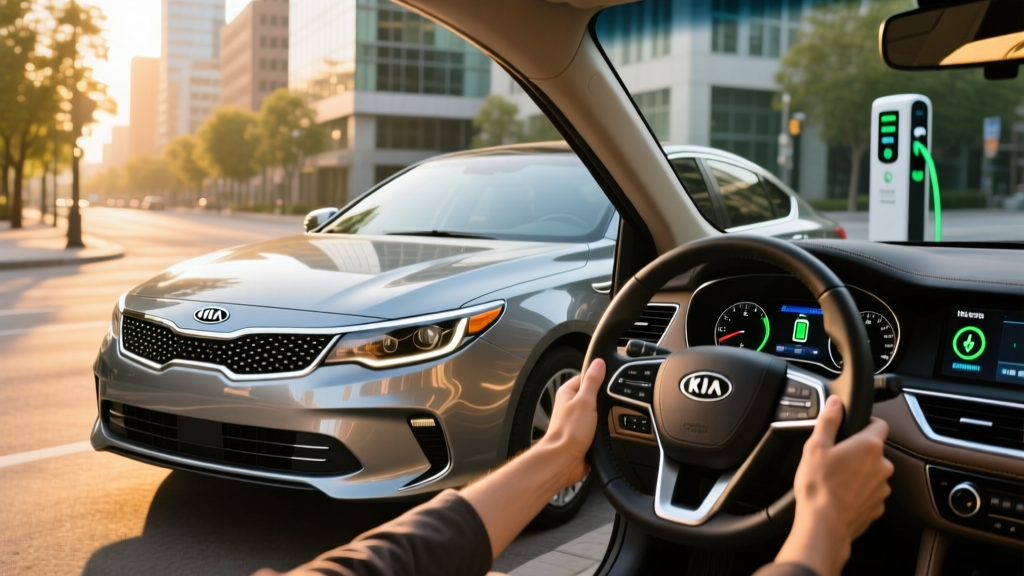
The 2015 Kia Optima Hybrid sedan occupies a specific niche in today's used-car market: an affordable, proven conventional hybrid (HEV) that delivers genuine fuel savings without requiring a plug. If you're cross-shopping used midsize sedans and considering the Optima Hybrid, this deep-dive covers the exact EPA fuel economy figures, real-world efficiency we've observed, the hybrid battery's longevity profile, and whether this first-generation Optima Hybrid still makes financial sense in 2026.
2015 Kia Optima Hybrid: Key Specifications at a Glance
| Specification | Value |
|---|---|
| Powertrain Type | Conventional Hybrid (HEV) — no plug |
| Engine | 2.4L Atkinson-cycle 4-cylinder |
| Engine Output | 159 hp / 154 lb-ft torque |
| Electric Motor | 38 kW (51 hp) permanent-magnet synchronous |
| Combined System Output | 199 hp |
| Transmission | 6-speed automatic |
| Hybrid Battery | 1.43 kWh lithium-polymer (Li-Po) |
| EPA MPG (City / Highway / Combined) | 36 / 40 / 38 MPG |
| Fuel Tank Capacity | 17.2 gallons |
| Estimated Total Range | ~654 miles |
| 0-60 mph | ~8.5 seconds |
| Original MSRP (Base) | $26,750 |
| Typical Used Price (2026) | $7,500–$12,000 |
| Hybrid Battery Warranty (Original) | 10 years / 100,000 miles |
Sources: EPA Fuel Economy, Kia America press archives.
HEV vs. PHEV: What the 2015 Optima Hybrid Actually Is
Before evaluating this car, it's essential to understand what it is — and what it is not. The 2015 Kia Optima Hybrid is a conventional hybrid electric vehicle (HEV). It pairs a gasoline engine with a small electric motor and a compact battery that charges exclusively through regenerative braking and engine-driven generation. You never plug it in.
Conventional Hybrid (HEV) vs. Plug-In Hybrid (PHEV) — Quick Reference
| Feature | HEV (This Car) | PHEV (e.g., Optima PHEV 2017+) |
|---|---|---|
| Plug-in charging | No — self-charging | Yes — Level 1/Level 2 |
| Battery size | 1.43 kWh | 9.8 kWh (2017 Optima PHEV) |
| Electric-only range | None (EV assist only, ~1 mi creep) | ~27 miles EPA |
| Runs on gas engine | Always blended with electric | After EV range depletes |
| Federal tax credit | Not eligible (§30D requires plug-in) | Eligible when new (varies by sourcing) |
| Best for | No home charging access, long commutes | Short daily commutes + home plug |
Kia did not offer a plug-in hybrid variant of the Optima until the 2017 model year. If you need electric-only driving for short commutes, you'd need to look at later PHEV models or a full BEV. But if your priority is straightforward fuel savings with zero lifestyle change, the 2015 HEV delivers exactly that.
How Many MPG Does the 2015 Kia Optima Hybrid Get?
EPA Fuel Economy Breakdown
| Driving Condition | EPA Rating | Real-World Expectation |
|---|---|---|
| City | 36 MPG | 37–42 MPG (hybrids excel in stop-and-go) |
| Highway | 40 MPG | 36–39 MPG (sustained speed reduces regen benefit) |
| Combined | 38 MPG | 36–40 MPG depending on driving mix |
Source: fueleconomy.gov
The 2015 Optima Hybrid's EPA ratings of 36 city / 40 highway / 38 combined MPG represent a meaningful improvement over the non-hybrid 2015 Optima's 2.4L four-cylinder, which rates at 24/35/28 MPG. That's roughly a 35% fuel savings in combined driving.
Real-world observations: Like most conventional hybrids, the Optima Hybrid tends to exceed its EPA city estimate in actual stop-and-go traffic, where regenerative braking and electric-motor assist do the most work. Owners frequently report 38–42 MPG on city-heavy commutes. Highway driving at sustained 70+ mph speeds reduces the hybrid system's advantage, with real-world figures settling closer to 36–38 MPG. In cold weather (below 35°F), expect a 5–10% efficiency drop as the engine runs more frequently to provide cabin heat and maintain battery temperature.
Compared to the gasoline-only 2015 Optima at 28 MPG combined, the hybrid saves approximately 176 gallons per year assuming 15,000 miles of driving — roughly $530 annually at $3.00/gallon, or more in high-cost fuel states.
Powertrain Deep-Dive: How the Hybrid System Works
The 2015 Optima Hybrid uses Kia's parallel hybrid architecture, pairing a 2.4-liter Atkinson-cycle inline-four (159 hp, 154 lb-ft) with a 38 kW (51 hp) electric motor integrated between the engine and a 6-speed automatic transmission. Total system output is 199 horsepower.
Unlike Toyota's power-split hybrid system (used in the Camry Hybrid), Kia's setup uses a conventional automatic transmission rather than an eCVT. This means shifts are perceptible — some drivers prefer this natural feel, while others notice the slight hesitation during gear changes under hard acceleration. The 0-60 mph time of approximately 8.5 seconds is adequate for merging and passing but won't win any stoplight drag races.
The 1.43 kWh lithium-polymer battery pack is positioned behind the rear seats, reducing trunk capacity from the gas model's 15.4 cubic feet to approximately 10.8 cubic feet. This is a meaningful trade-off if you regularly haul cargo. The battery is small by design — it's not intended to drive the car on electricity alone for any meaningful distance. Instead, it provides torque-fill during acceleration, enables engine-off coasting, and captures energy during braking.
Hybrid Battery Longevity: Warranty, Degradation, and Replacement Cost
Original Battery Coverage
Warranty: 10 years / 100,000 miles (whichever comes first), covering capacity loss below a manufacturer-defined threshold (typically ~70% state of health).
Current status in 2026: The original 10-year/100,000-mile warranty has expired for most 2015 models based on age alone. Second-owner coverage may be limited to 5 years/60,000 miles depending on transfer terms — verify with a Kia dealer using the VIN.
This is the question every used-hybrid buyer asks, and it deserves an honest answer. The 2015 Optima Hybrid's lithium-polymer battery pack has proven reasonably durable, but it is not immune to age-related degradation.
Expected lifespan: Based on owner reports and industry data for Kia/Hyundai hybrid packs of this era, most batteries retain 80–90% of original capacity at 100,000 miles. Failures before 120,000 miles are uncommon but not unheard of, particularly in hot-climate states (Arizona, Texas, Florida) where sustained high battery temperatures accelerate cell degradation.
Replacement cost in 2026: A new OEM hybrid battery pack for the 2015 Optima Hybrid runs approximately $2,500–$3,800 including parts and labor at a Kia dealership. Third-party rebuilt or refurbished packs are available for $1,500–$2,200 from specialty hybrid shops. Individual cell module replacement (if only a few cells have failed) can cost $500–$1,200 at independent hybrid specialists.
Signs of battery trouble: Watch for a noticeable drop in fuel economy (below 30 MPG combined without driving-pattern changes), the hybrid system warning light on the dash, reduced regenerative braking feel, or the engine running almost constantly even at low speeds. A pre-purchase scan with an OBD-II hybrid-capable tool can read individual cell voltages and state-of-health data — this is strongly recommended before buying.
For context, the NHTSA has not issued any hybrid-battery-specific recalls for the 2015 Optima Hybrid, and the model holds acceptable reliability ratings from owner surveys.
Used Pricing and Tax Credit Reality in 2026
As of early 2026, the 2015 Kia Optima Hybrid trades in the used market at approximately:
- $7,500–$9,000 — high mileage (100k+), fair condition
- $9,000–$10,500 — average mileage (70k–100k), good condition
- $10,500–$12,500 — lower mileage (under 70k), excellent condition, EX trim
Tax credit eligibility: The 2015 Kia Optima Hybrid does not qualify for the federal §30D new clean vehicle credit, which is reserved for plug-in vehicles (BEVs and PHEVs) meeting specific battery-sourcing and critical-mineral requirements. It also does not qualify for the §25E used clean vehicle credit (up to $4,000), because that credit similarly requires a plug-in vehicle with a minimum 7 kWh battery capacity. The Optima Hybrid's 1.43 kWh pack falls far below this threshold.
Some states offer their own incentives for used hybrid purchases, but these vary widely by jurisdiction. Check your state's energy office or department of revenue for current programs — never assume a credit applies without verifying with a tax professional or your state's official resources.
Who Should Buy the 2015 Optima Hybrid — And Who Shouldn't
Choose This Hybrid If…
- You want proven fuel savings (38 MPG combined) with zero plug-in infrastructure
- Your commute is city-heavy, where regenerative braking maximizes efficiency
- You're on a tight budget ($8k–$12k) and want low running costs
- You drive 15,000+ miles/year and want to reduce fuel spend significantly
- You don't have access to home or workplace charging
Look Elsewhere If…
- You need large trunk space (10.8 cu ft is tight for families)
- You want electric-only driving for short trips (consider a PHEV or BEV)
- You want the latest safety tech — 2015 models lack automatic emergency braking standard
- You live in extreme heat and plan to keep the car past 150,000 miles (battery risk increases)
- You want to qualify for any federal tax credit (plug-in required)
Hybrid vs. PHEV vs. Full EV — Which Fits Your Situation?
| Your Situation | Best Choice | Why |
|---|---|---|
| No home charging, long commute | HEV (this car) | No plug needed, great city MPG |
| Home charging available, short daily commute | PHEV | 20–40 mi electric daily, gas for road trips |
| Home charging, under 250 mi daily | Full BEV | Lowest cost per mile, no oil changes |
| Apartment dweller, no charging | HEV | Only electrified option without a plug |
| Budget under $10k | Used HEV | Cheapest entry into fuel-efficient driving |
Ownership Costs: What to Budget Beyond the Purchase Price
The 2015 Optima Hybrid's total cost of ownership is one of its strongest selling points in the used market. Beyond the purchase price, here's what to expect:
- Annual fuel cost: ~$1,200–$1,400 (15,000 mi/yr at $3.10/gal, 38 MPG combined)
- Insurance: Comparable to the gas Optima; no significant EV insurance premium. Expect $900–$1,400/year depending on state and driving record.
- Maintenance: Standard gas-engine maintenance (oil changes, spark plugs, transmission fluid). The hybrid system adds no routine maintenance items. Regenerative braking extends brake pad life — many owners report 80,000+ miles on original pads.
- Potential battery replacement: Budget $2,500–$3,800 as a contingency if purchasing a high-mileage example (100k+ miles). This may never be needed, but it's a known risk factor.
Over five years of ownership at 15,000 miles/year, total fuel and routine maintenance costs run approximately $8,500–$10,500 — significantly less than the gas-only Optima's ~$11,500–$13,500 over the same period.
Frequently Asked Questions
How many MPG does the 2015 Kia Optima Hybrid actually get in real driving?
The EPA rates it at 36 city / 40 highway / 38 combined MPG. In real-world driving, city-heavy commuters often see 38–42 MPG thanks to regenerative braking. Highway-dominant driving at 70+ mph yields 36–38 MPG. Cold weather reduces efficiency by roughly 5–10%.
Does the 2015 Optima Hybrid need to be plugged in?
No. This is a conventional hybrid (HEV). The battery charges through regenerative braking and the gasoline engine. You simply fill it with gas like any other car.
How far can it drive on electric power alone?
Essentially zero meaningful distance. The 1.43 kWh battery provides electric motor assist during acceleration and enables very low-speed electric-only creeping (under 1 mile at low speeds), but it is not designed for electric-only driving. If you need electric-only range, you want a PHEV or BEV.
Is the hybrid battery reliable, and what does replacement cost?
The lithium-polymer pack is generally reliable to 120,000+ miles, with gradual capacity loss rather than sudden failure. A new OEM replacement costs $2,500–$3,800; refurbished packs run $1,500–$2,200. The original 10-year/100,000-mile warranty has expired for most 2015 examples based on age.
Does the 2015 Kia Optima Hybrid qualify for any federal tax credit?
No. Federal tax credits under IRC §30D (new vehicles) and §25E (used vehicles) require plug-in capability and minimum battery capacity thresholds that the Optima Hybrid does not meet. Check your state's energy office for any local hybrid incentives.
How does it compare to the Toyota Camry Hybrid of the same era?
The 2015 Camry Hybrid rates at 41/38/40 MPG (city/highway/combined) — slightly better combined fuel economy, with a more refined power-split eCVT system and a larger trunk. The Optima Hybrid counters with a more conventional driving feel (6-speed automatic vs. eCVT drone), slightly more power (199 hp vs. 200 hp), and often lower used-car pricing. Both are solid choices; the Camry Hybrid typically commands a $1,000–$2,000 premium on the used market.
What should I check before buying a used 2015 Optima Hybrid?
Prioritize: (1) a hybrid-system OBD-II scan to read battery cell voltages and state of health, (2) service records showing regular oil changes, (3) any hybrid warning lights on the dash during a cold start, (4) trunk space adequacy for your needs, and (5) verification of the vehicle's recall status via NHTSA's recall lookup.