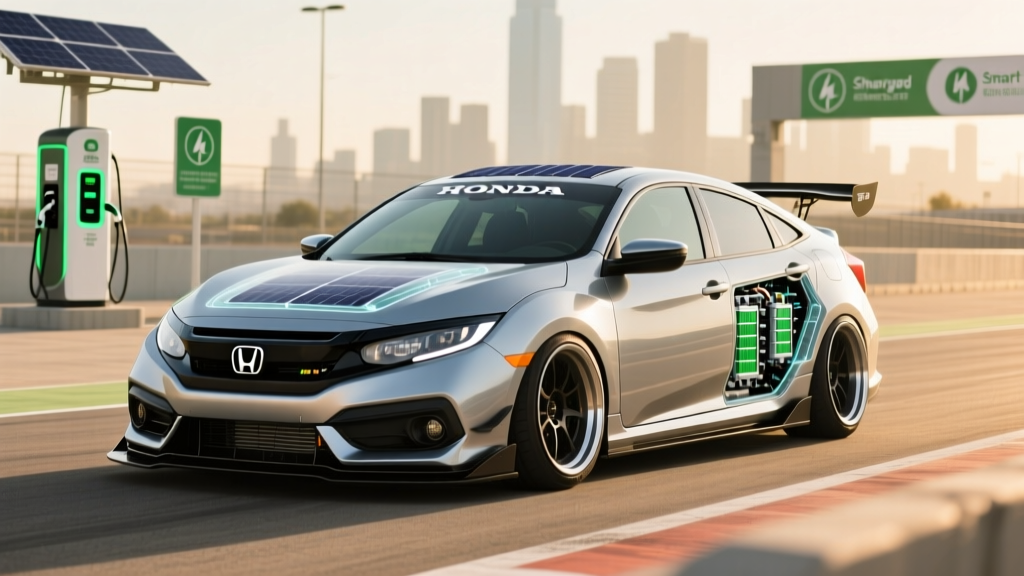
The 2015 Honda Civic Hybrid was one of the last compact sedans to use Honda's Integrated Motor Assist (IMA) parallel-hybrid system before the brand pivoted to its two-motor i-DCD and later e:HEV architectures. For used-car buyers and efficiency enthusiasts in 2026, the question isn't just whether this car still delivers on its EPA sticker — it's whether a 2015 Honda Civic Hybrid modified for even greater real-world efficiency is a smart project or a money pit. This guide breaks down the stock specs, what modifications actually move the needle on a conventional hybrid (HEV), battery replacement realities, and how this aging Civic stacks up against modern hybrids, PHEVs, and full EVs.
Stock Specs: What Honda Built for 2015
Before discussing modifications, it's essential to understand the baseline. The 2015 Civic Hybrid pairs a 1.5-liter i-VTEC inline-four with a 15 kW (20 hp) electric motor sandwiched between the engine and the CVT. Total system output is modest by today's standards.
| Specification | Value |
|---|---|
| Powertrain | 1.5L I-4 + IMA electric motor (parallel hybrid) |
| Combined Horsepower | 110 hp @ 5,500 rpm |
| Combined Torque | 127 lb-ft @ 1,000–3,500 rpm |
| Transmission | CVT (continuously variable) |
| Hybrid Battery | 0.5 kWh nickel-metal hydride (NiMH) |
| EPA City MPG | 44 mpg |
| EPA Highway MPG | 47 mpg |
| EPA Combined MPG | 45 mpg |
| Fuel Tank | 13.2 gallons |
| Total Range (est.) | ~594 miles |
| 0–60 mph | ~10.1 seconds |
| Drivetrain | Front-wheel drive |
Source: EPA Fuel Economy — 2015 Honda Civic Hybrid
A critical distinction: this is a conventional hybrid (HEV), not a plug-in hybrid (PHEV). The Civic Hybrid never plugs in. Its small NiMH battery recharges exclusively through regenerative braking and engine-driven generation. There is no electric-only driving mode of any meaningful distance — the motor assists the engine but cannot propel the car solo beyond very low-speed creep.
HEV vs PHEV: Why It Matters for Modifications
Conventional Hybrid (HEV): No plug. Small battery (typically under 2 kWh). Motor assists the gas engine. All energy ultimately comes from gasoline. Modifications focus on reducing parasitic losses and optimizing driving behavior.
Plug-in Hybrid (PHEV): Has a charge port. Larger battery (typically 8–25 kWh). Can drive 20–50 miles on electricity alone before the engine starts. Modifications can include EVSE upgrades and battery preconditioning tweaks.
The 2015 Civic Hybrid is firmly in the HEV camp — and that fundamentally limits what "modified" can mean.
Real-World MPG: Does the 2015 Civic Hybrid Beat Its EPA Sticker?
| Driving Scenario | Expected MPG | Notes |
|---|---|---|
| EPA Combined (sticker) | 45 mpg | Baseline reference |
| City / stop-and-go | 46–52 mpg | Regen braking maximizes IMA assist |
| Highway (70+ mph) | 38–43 mpg | Aero drag dominates; IMA assist minimal |
| Mixed suburban (45–55 mph) | 44–50 mpg | Sweet spot for this powertrain |
| Cold weather (<35°F) | 36–42 mpg | Engine runs longer for cabin heat; battery less efficient |
Like most Honda IMA vehicles, the Civic Hybrid rewards hypermiling and city driving. Owners on fueleconomy.gov's My MPG tracker consistently report averaging 43–48 mpg in mixed driving, with disciplined city drivers occasionally touching 50 mpg. Highway-heavy commutes at 75+ mph drop the figure noticeably — the 1.5L engine works harder, and the IMA system contributes less at sustained high speeds.
This is where the "modified" conversation begins. What can you actually change to push those numbers higher?
Modifying the 2015 Civic Hybrid: What Works and What Doesn't
Unlike turbocharged gas cars where an ECU tune and intake can unlock 30+ horsepower, modifying a conventional hybrid for efficiency is an exercise in marginal gains. Here's an honest assessment of common modifications and their real impact:
Tire and Rolling Resistance Upgrades
Switching from the stock all-season tires to ultra-low-rolling-resistance (LRR) tires like the Michelin Energy Saver A/S or Bridgestone Ecopia EP422 Plus is the single most impactful modification. Real-world testing by owners shows 2–4 mpg improvement in mixed driving. At roughly $600–$800 for a set of four, this pays for itself in fuel savings within 15,000–20,000 miles.
Weight Reduction
Removing unnecessary cargo, switching to a lighter 12V auxiliary battery (AGM or lithium), and deleting the spare tire in favor of a tire inflator kit can shave 30–60 lbs. The MPG impact is small — roughly 0.5–1 mpg — but it's essentially free if you're already replacing worn components.
Aerodynamic Tweaks
Aftermarket underbody panels, rear diffuser additions, and even grille blocking (partially covering the front grille in winter to reduce cooling airflow) can reduce drag. Grille blocking in cold months keeps the engine warmer, reducing cold-start fuel enrichment. Expect 1–2 mpg highway improvement, with negligible city impact.
IMA System "Tuning"
This is where caution is critical. The IMA system's assist and regen levels are controlled by the car's ECU and are not user-adjustable without specialized (and often proprietary) Honda diagnostic tools. Some owners have experimented with aftermarket OBD-II devices claiming to optimize shift points or throttle response, but the CVT's programming is already heavily efficiency-optimized. Gains from these devices are typically zero to negligible, and they risk triggering check-engine lights or voiding any remaining powertrain warranty.
What About Performance Modifications?
Aftermarket intake, exhaust, and "chip" tunes designed for the non-hybrid 1.8L Civic do not fit or function on the 1.5L IMA powertrain. The hybrid's engine is a unique variant. Forced-induction kits don't exist for this application. If performance is your goal, the 2015 Civic Hybrid is the wrong platform.
Pros: Modified 2015 Civic Hybrid
- LRR tires deliver measurable 2–4 mpg gains
- Low acquisition cost ($5,000–$9,000 used in 2026)
- No plug-in charging infrastructure needed
- Simple mechanical layout — easy DIY maintenance
- Proven Honda reliability for non-hybrid components
Cons: Modified 2015 Civic Hybrid
- IMA battery nearing end-of-life at 11 years old
- Very limited modification potential vs gas or EV platforms
- No electric-only driving — always burning fuel
- No federal tax credit eligibility (used HEV)
- Modest 110 hp — underpowered for highway merging
- Outdated infotainment and safety tech
IMA Battery Health, Replacement Cost, and Warranty
The 0.5 kWh NiMH IMA battery is the single biggest ownership variable for any used 2015 Civic Hybrid. Honda originally warranted the IMA battery for 8 years / 100,000 miles (10 years / 150,000 miles in CARB states including California, New York, Massachusetts, and others). In 2026, every 2015 Civic Hybrid is beyond the standard 8-year warranty window, though CARB-state examples with under 150,000 miles may still have residual coverage — verify with a Honda dealer using your VIN.
IMA Battery Replacement: What to Budget
OEM Honda replacement: $2,000–$3,000 (parts + labor at a dealership)
Aftermarket / refurbished NiMH pack: $1,200–$1,800 installed
DIY refurbished pack: $800–$1,200 for the cells (advanced DIY only — high-voltage safety precautions required)
Typical lifespan: 120,000–180,000 miles or 10–15 years before significant capacity loss triggers IMA warning lights
Warning signs: Frequent "IMA" dashboard light, reduced regen braking, noticeable MPG drop (5+ mpg below baseline), battery fan running constantly
A failing IMA battery doesn't strand you — the 1.5L engine can drive the car independently — but you'll lose most hybrid assist, dropping fuel economy to roughly 30–35 mpg (essentially a conventional Civic's efficiency) and triggering a check-engine light that will fail emissions inspection in most states.
For a 2015 Honda Civic Hybrid modified project car, budget for a battery replacement upfront. A refurbished pack with a 3-year warranty from a reputable hybrid specialist (like BumbleBee Batteries or Dorman's aftermarket offering) is the most cost-effective path, typically $1,500–$2,000 installed.
Tax Credits and Incentives: Does It Qualify?
The short answer: no. The 2015 Honda Civic Hybrid does not qualify for any current federal tax credit.
- IRS §30D New Clean Vehicle Credit ($7,500): Only for new vehicles. The Civic Hybrid is discontinued and was last sold new in 2015. Does not apply.
- IRS §25E Used Clean Vehicle Credit (up to $4,000): Available for used EVs and PHEVs purchased from a dealer for $25,000 or less. However, the credit requires the vehicle to have a plug — conventional hybrids (HEVs) do not qualify. The Civic Hybrid is an HEV, so it is ineligible.
- State incentives: Most state-level EV rebates and HOV-lane access programs have expired for the Civic Hybrid or never applied to non-plug-in vehicles. Check your state's energy office for any remaining legacy programs, but don't count on it.
Source: IRS — Clean Vehicle Tax Credits
2015 Civic Hybrid vs Modern Alternatives: Which Fits You?
If you're considering a modified 2015 Civic Hybrid, it's worth comparing the total cost against what a modern hybrid, PHEV, or EV delivers. Here's the decision framework:
Choose the 2015 Civic Hybrid (modified) if:
- Your total budget is under $10,000 including battery replacement
- You want a no-plug, simple commuter that sips fuel
- You enjoy DIY maintenance and light efficiency mods
- You drive mostly city/suburban under 55 mph
- You don't need modern ADAS or infotainment
Choose a modern HEV (e.g., 2026 Toyota Corolla Hybrid, ~$24,000) if:
- You want a warranty, modern safety (AEB, lane-keep), and CarPlay
- You value 50+ EPA combined MPG without modifications
- You plan to keep the car 8+ years
Choose a PHEV (e.g., 2026 Toyota Prius Prime, ~$33,000) if:
- You have home charging and a commute under 40 miles
- You want 40+ miles of electric-only driving for daily errands
- You qualify for the §30D $7,500 federal credit (income/MSRP/sourcing rules apply)
Choose a full EV (e.g., 2026 Chevrolet Equinox EV, ~$33,000) if:
- You have reliable home Level 2 charging
- You want zero gasoline expenses and minimal maintenance
- Your daily driving is under 250 miles
Is the 2015 Civic Hybrid Reliable in 2026?
Mechanically, the 1.5L engine and CVT in the 2015 Civic Hybrid are well-understood. The engine is under-stressed and, with regular oil changes, routinely exceeds 200,000 miles. The CVT is a Honda-designed unit that, unlike some Nissan CVTs of the same era, has a solid reliability record when fluid is changed every 30,000–60,000 miles.
The reliability wildcard is the IMA system. The NiMH battery, as discussed, is now 11 years old. The IMA motor itself is simple and durable — it's essentially a thin electric disc with no brushes or complex internals — and rarely fails. The inverter and DC-DC converter are also robust. In practice, battery degradation is the primary failure mode, not catastrophic system failure.
For the 2015 Honda Civic Hybrid modified buyer: reliability is good, but plan for a $1,500–$2,500 IMA battery refresh as part of your purchase budget. With that done, the car should deliver another 5–8 years of 43–50 mpg commuting with basic maintenance.
Frequently Asked Questions
How many MPG does the 2015 Honda Civic Hybrid get?
The EPA rates it at 44 city / 47 highway / 45 combined mpg. Real-world owners average 43–48 mpg in mixed driving, with city-heavy routes yielding 46–52 mpg and sustained highway driving at 70+ mph dropping to 38–43 mpg. With LRR tire modifications and disciplined driving, 48–52 mpg mixed is achievable.
Can the 2015 Civic Hybrid drive on electric only?
No. This is a conventional hybrid (HEV), not a plug-in. The 15 kW IMA motor assists the gasoline engine but cannot propel the car independently beyond very low-speed crawling. There is no EV mode button and no electric-only range to speak of.
Does a modified 2015 Civic Hybrid qualify for any tax credit?
No. The IRS §25E used clean vehicle credit requires a plug-in vehicle (EV or PHEV). Conventional hybrids are not eligible for any current federal tax credit. State incentives for non-plug-in hybrids have largely expired.
How much does an IMA battery replacement cost?
An OEM Honda replacement runs $2,000–$3,000 at a dealer. Aftermarket refurbished NiMH packs installed by a hybrid specialist typically cost $1,500–$2,000. DIY cell replacement is possible for $800–$1,200 but requires high-voltage safety knowledge.
What modifications actually improve MPG on this car?
Low-rolling-resistance tires (2–4 mpg gain) are the most effective modification. Grille blocking in winter (1–2 mpg), weight reduction (0.5–1 mpg), and careful driving technique round out the realistic options. ECU tuning, intake, and exhaust mods do not apply to the IMA powertrain.
Hybrid vs PHEV vs EV — which should I choose in 2026?
If your budget is under $10,000 and you can't charge at home, a used HEV like this Civic is practical. If you can spend $25,000–$35,000 and have home charging, a PHEV (40+ miles electric) or a full EV (250+ miles range) will dramatically cut fuel costs and offer modern safety tech. The Civic Hybrid makes sense as a budget commuter, not as a long-term technology investment.