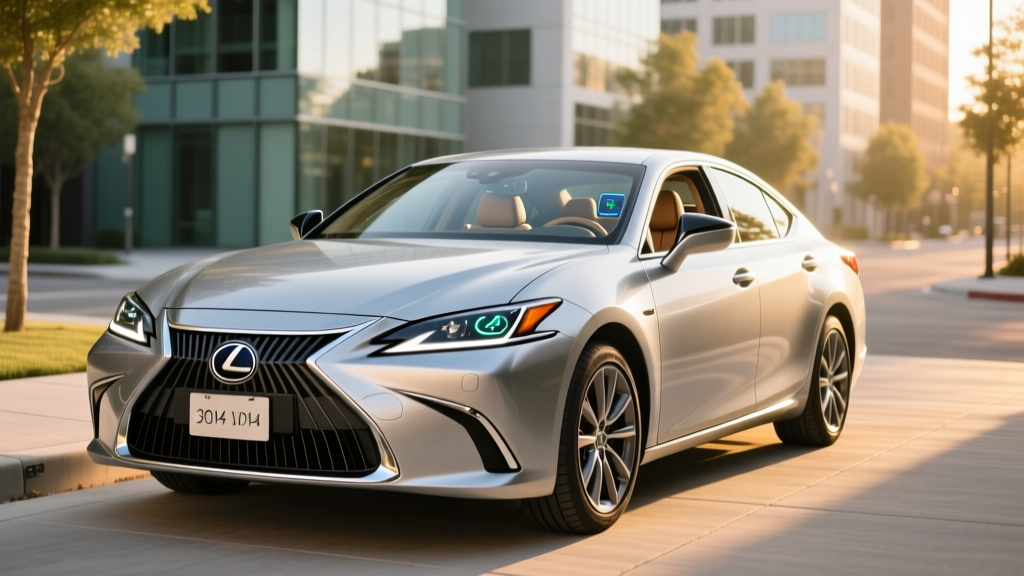
The 2014 Lexus ES 300h hybrid remains one of the most sensible luxury sedans on the used market for drivers who want premium comfort without the fuel bills — or the range anxiety — of a full electric vehicle. More than a decade after its debut, this conventional hybrid (HEV) continues to deliver exceptional fuel economy, a whisper-quiet cabin, and Toyota/Lexus reliability that has made it a staple among pragmatic luxury buyers.
But in 2026, with plug-in hybrids offering 30-40 miles of electric-only range and full EVs pushing past 300 miles of EPA range, does the ES 300h still make sense? We break down the real-world MPG, battery longevity, ownership costs, and where this hybrid fits in today's electrified landscape.
2014 Lexus ES 300h Hybrid Fuel Economy: EPA vs. Real-World MPG
The headline number for the 2014 ES 300h is its EPA-rated fuel economy, which remains competitive even against newer hybrids. Here's the official breakdown from fueleconomy.gov:
| Metric | MPG |
|---|---|
| City | 40 MPG |
| Highway | 39 MPG |
| Combined | 40 MPG |
| Annual fuel cost (est.) | ~$1,650 (at $3.30/gal) |
| Fuel type | Regular unleaded (87 octane) |
HEV vs. PHEV vs. EV: Where Does the ES 300h Fit?
The 2014 Lexus ES 300h is a conventional hybrid electric vehicle (HEV). This is a critical distinction. It does not plug in. It has no electric-only driving range beyond brief low-speed coasting. The small nickel-metal hydride (NiMH) battery charges exclusively through regenerative braking and the gasoline engine.
| Feature | HEV (e.g., ES 300h) | PHEV (e.g., RAV4 Prime) | BEV (e.g., Tesla Model 3) |
|---|---|---|---|
| Plug-in charging? | No | Yes (Level 1/2) | Yes (Level 1/2/DC) |
| Electric-only range | ~0.5 mi at low speed | 25-42 mi typical | 250-360+ mi |
| Battery size | ~1.6 kWh (NiMH) | 13-18 kWh (Li-ion) | 60-82 kWh (Li-ion) |
| Gasoline engine? | Yes (primary) | Yes (backup) | No |
| Home charging needed? | No | Recommended | Essential |
| Tailpipe emissions | Low | Low (zero in EV mode) | Zero |
Who should choose the ES 300h HEV? Drivers who lack access to home or workplace charging, who drive primarily in city/suburban conditions, and who want a luxury sedan experience without altering their fueling habits. You simply fill up at any gas station and drive.
Who should look at a PHEV instead? If you have access to a Level 2 charger at home and your daily commute is under 35 miles, a modern PHEV like the Lexus NX 450h+ or Toyota RAV4 Prime lets you drive almost entirely on electricity during the week, with a gas engine for longer trips.
Who should consider a full EV? Drivers with reliable home charging, predictable routes, and a willingness to plan around DC fast-charging on road trips. A 2026 Tesla Model 3 or Hyundai Ioniq 6 delivers 300+ miles of range and dramatically lower per-mile fuel costs.
Powertrain Specs: Engine, Motor, and Combined Output
The 2014 ES 300h pairs a 2.5-liter Atkinson-cycle four-cylinder engine with a permanent-magnet electric motor and an electronically controlled continuously variable transmission (eCVT). Here are the key figures:
| Specification | Value |
|---|---|
| Engine | 2.5L Atkinson-cycle I4 |
| Engine horsepower | 156 hp @ 5,700 RPM |
| Electric motor output | 105 kW (141 hp) |
| Net combined system horsepower | 200 hp |
| Transmission | eCVT |
| Drivetrain | Front-wheel drive |
| 0-60 MPH (est.) | ~7.8 seconds |
| Hybrid battery type | Nickel-metal hydride (NiMH) |
| Hybrid battery capacity | ~1.6 kWh (nominal) |
| Curb weight | ~3,680 lbs |
The eCVT is worth noting: unlike traditional belt-driven CVTs, Toyota/Lexus uses a planetary gearset that blends engine and motor power seamlessly. There are no belts to wear out, and the unit is widely regarded as one of the most durable transmissions in the industry. Acceleration is adequate for merging and highway passing, though the ES 300h prioritizes smoothness over sportiness. The electric motor provides strong initial torque from a stop, making the sedan feel quicker in city driving than the 7.8-second 0-60 time suggests.
Battery Longevity, Warranty, and Replacement Cost
This is the question every used hybrid buyer asks: how long will the battery last, and what does replacement cost?
Longevity data: Toyota/Lexus NiMH hybrid batteries have an exceptional track record. The Prius taxi fleet famously logged 300,000+ miles on original batteries. For the ES 300h, the NiMH pack is less stressed than lithium-ion alternatives because the hybrid system keeps the battery in a narrow state-of-charge window (roughly 40-80%), avoiding deep cycles that accelerate degradation. Most ES 300h owners report no battery issues at 150,000-200,000 miles.
Replacement cost in 2026:
- New OEM battery (Lexus dealer): $3,500 - $4,800 including labor
- Remanufactured battery: $1,800 - $2,800 including labor
- Individual module replacement: $400 - $800 (if only a few cells are weak — a specialist hybrid shop can test and replace individual modules rather than the entire pack)
Signs of hybrid battery degradation: Reduced fuel economy (dropping below 35 MPG combined), the engine running more frequently, or a "Check Hybrid System" warning on the dash. A pre-purchase scan with an OBD-II tool that reads hybrid battery health (voltage delta between modules) is strongly recommended before buying any used ES 300h.
Used Pricing in 2026 and Tax Credit Eligibility
The 2014 Lexus ES 300h has depreciated into an attractive price range for used luxury sedan shoppers. Current market values (as of early 2026):
| Condition / Mileage | Approximate Price |
|---|---|
| Excellent, under 80k miles | $16,000 - $19,000 |
| Good, 80k-120k miles | $12,500 - $16,000 |
| Fair, 120k-160k miles | $9,500 - $12,500 |
Federal tax credit status: The 2014 ES 300h does not qualify for the federal §30D new clean vehicle credit, which applies only to new plug-in vehicles (BEVs and PHEVs) meeting battery sourcing and MSRP requirements under current IRS rules. Conventional hybrids (HEVs) have never qualified for §30D.
Used EV credit (IRC §25E): This credit applies to used BEVs and PHEVs purchased from a dealer for $25,000 or less. Since the ES 300h is a conventional hybrid with no plug, it is not eligible for the used clean vehicle credit either.
State incentives: A small number of states offer modest incentives for used hybrid purchases, but these are rare and change frequently. Check your state's energy office or DMV for current programs. Most buyers should budget based on the purchase price alone, without expecting any tax credit offset.
Reliability, Safety, and Ownership Costs
The 2014 ES 300h benefits from the Lexus reputation for long-term reliability, and the data backs it up:
- J.D. Power dependability: The Lexus ES line consistently ranks among the top midsize luxury sedans in long-term dependability studies.
- NHTSA safety rating: The 2014 ES earned a 5-star overall safety rating from NHTSA.
- IIHS rating: The Insurance Institute for Highway Safety named it a Top Safety Pick for 2014.
- Common maintenance items: Standard maintenance (oil changes every 10,000 miles, brake fluid, coolant) is straightforward. The regenerative braking system extends pad life significantly — many owners report original brake pads lasting 80,000+ miles.
- Insurance cost: Moderate for the luxury segment. Expect $1,200-$1,600/year depending on state and driving record.
Pros
- 40 MPG combined — still excellent in 2026
- No plug-in charging required
- Quiet, well-insulated cabin
- Proven Toyota/Lexus hybrid reliability
- Regular 87-octane fuel
- Strong resale value retention
- Comfortable ride quality
Cons
- No electric-only driving range
- eCVT drone under hard acceleration
- Aging infotainment (no Apple CarPlay/Android Auto natively)
- Original hybrid battery warranty expired
- No federal tax credit eligibility
- Rear seat doesn't fold down (battery placement)
- FWD only — no AWD option
ES 300h vs. the Alternatives: What Else Should You Consider?
If you're shopping for a used luxury hybrid in the $12,000-$18,000 range, here's how the ES 300h stacks up against common alternatives:
| Vehicle | EPA Combined MPG | System HP | Used Price Range (2026) |
|---|---|---|---|
| 2014 Lexus ES 300h | 40 MPG | 200 hp | $10k - $19k |
| 2014 Toyota Avalon Hybrid | 40 MPG | 200 hp | $9k - $15k |
| 2015 BMW 535i (gas) | 23 MPG | 300 hp | $12k - $18k |
| 2016 Lincoln MKZ Hybrid | 38 MPG | 188 hp | $10k - $16k |
The Avalon Hybrid shares the same powertrain as the ES 300h but at a lower price point and without the Lexus badge or sound insulation. The MKZ Hybrid is a strong competitor with comparable economy but slightly less refinement. The ES 300h wins on cabin quietness, ride comfort, and long-term reliability reputation.
Frequently Asked Questions
How many MPG does the 2014 Lexus ES 300h hybrid get?
The EPA rates it at 40 MPG city, 39 MPG highway, and 40 MPG combined. Real-world city driving often yields 42-45 MPG thanks to regenerative braking, while sustained highway driving at 70+ MPH typically returns 36-38 MPG. Regular 87-octane fuel keeps costs low.
Does the 2014 ES 300h need to be plugged in?
No. The ES 300h is a conventional hybrid (HEV), not a plug-in hybrid. The battery charges through regenerative braking and the gasoline engine. You never plug it in — you simply refuel at any gas station as you would with a standard vehicle.
How long will the hybrid battery last?
Toyota/Lexus NiMH hybrid batteries commonly last 150,000-200,000+ miles with normal use. The hybrid system's narrow state-of-charge operating window (approximately 40-80%) minimizes stress on the cells. Many 10-year-old Lexus hybrids are still on their original battery packs. Pre-purchase diagnostics can assess remaining battery health.
What does a replacement hybrid battery cost?
A new OEM battery from a Lexus dealer runs $3,500-$4,800 installed. Remanufactured packs cost $1,800-$2,800 installed. In some cases, a hybrid specialist can replace individual weak modules for $400-$800, extending the pack's life at lower cost.
Does the 2014 Lexus ES 300h qualify for any tax credits?
No. The federal §30D new clean vehicle credit and the §25E used clean vehicle credit both require a plug-in vehicle (BEV or PHEV). The ES 300h is a conventional hybrid (HEV) and does not qualify for federal EV tax credits. Check your state for any hybrid-specific incentives, though these are uncommon.
Is the 2014 ES 300h a good buy in 2026?
For buyers who want a reliable, fuel-efficient luxury sedan without the infrastructure requirements of a plug-in vehicle, the 2014 ES 300h remains an excellent choice. At $10,000-$19,000, it offers 40 MPG, a refined cabin, and strong reliability data. The main trade-offs are the aging infotainment system, the expired battery warranty, and the lack of any electric-only range. If you have home charging access and a short commute, a used PHEV may offer lower operating costs — but for drivers who want simplicity and proven longevity, the ES 300h delivers.