Quick Verdict: A Budget-Friendly Used Hybrid With Real-World Credentials
The 2014 Kia Optima Hybrid is a conventional hybrid electric vehicle (HEV) — not a plug-in — meaning it never needs to be plugged in and generates all its electricity through regenerative braking and its gasoline engine. More than a decade after its debut, this midsize sedan remains a practical used-car option for drivers who want hybrid efficiency without the complexity of charging infrastructure. With an EPA-rated 35 MPG combined, a roomy cabin, and a hybrid battery warranty that may still have some coverage remaining on low-mileage examples, the 2014 Optima Hybrid deserves a closer look from cost-conscious commuters.
However, buying any 12-year-old hybrid comes with one overriding concern: the traction battery. In this review, we examine the 2014 Optima Hybrid's powertrain specs, real-world fuel economy, battery longevity data, replacement costs, and whether it still makes financial sense in 2026 compared to newer hybrids or a full EV.
2014 Optima Hybrid Powertrain and Performance Specs
| Specification | 2014 Kia Optima Hybrid |
|---|---|
| Powertrain Type | Conventional Hybrid (HEV) — no plug |
| Gasoline Engine | 2.4L inline-4 Atkinson-cycle (169 hp, 156 lb-ft) |
| Electric Motor | 35 kW (47 hp) permanent-magnet synchronous |
| Combined System Output | 206 hp, 195 lb-ft torque |
| Transmission | 6-speed automatic |
| Hybrid Battery | 1.4 kWh lithium-polymer (air-cooled) |
| 0–60 mph | ~8.7 seconds |
| Drivetrain | Front-wheel drive |
| Curb Weight | ~3,558 lbs |
The 2014 Optima Hybrid pairs Kia's 2.4-liter Atkinson-cycle four-cylinder with a 35 kW electric motor integrated into the transmission housing. Unlike Toyota's planetary-gear e-CVT approach, Kia opted for a traditional 6-speed automatic with a hybrid clutch module between the engine and transmission. This gives the Optima Hybrid a more conventional driving feel — with distinct gear shifts — at the cost of slightly less seamless electric-to-gas transitions compared to competitors like the Toyota Camry Hybrid or Ford Fusion Hybrid.
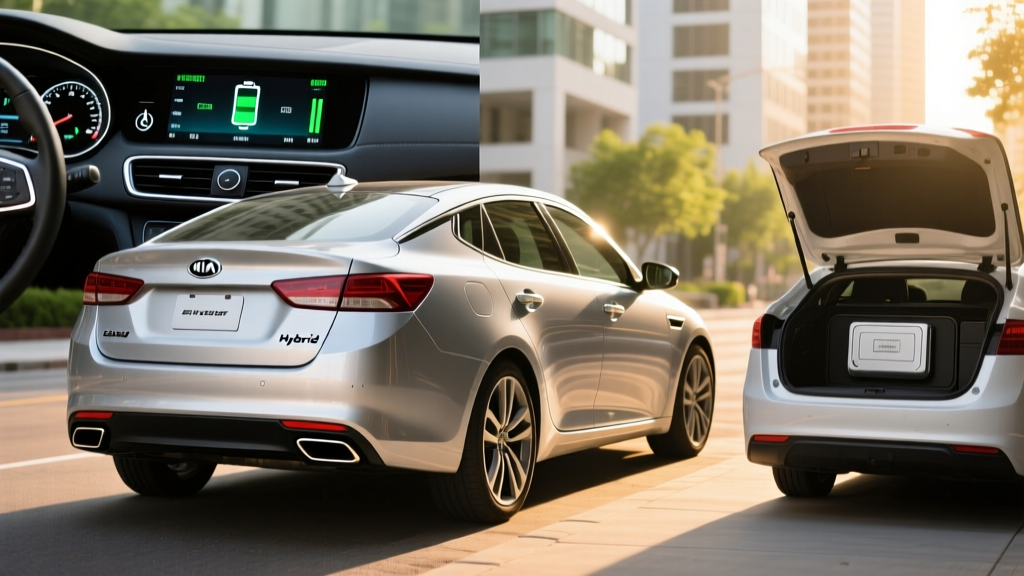
The 1.4 kWh lithium-polymer battery pack is compact and mounted behind the rear seat. It's important to understand that this is a very small battery by modern standards — it exists only to buffer energy from regenerative braking and enable short, low-speed electric-only assists. You cannot plug this car in. The battery is air-cooled, which is simpler but less optimal for longevity compared to liquid-cooled packs found in newer hybrids.
Fuel Economy: EPA Ratings vs. Real-World MPG
| Driving Condition | EPA Rating | Real-World Expectation |
|---|---|---|
| City | 35 MPG | 33–38 MPG |
| Highway | 39 MPG | 36–41 MPG |
| Combined | 35 MPG | 34–38 MPG |
According to fueleconomy.gov, the 2014 Kia Optima Hybrid earns an EPA rating of 35 MPG city, 39 MPG highway, and 35 MPG combined. Note that the combined figure is lower than the highway number — this is typical for conventional hybrids, which leverage regenerative braking and electric assist most effectively in stop-and-go city driving. The EPA combined rating reflects a 55% city / 45% highway driving mix.
Real-world reality check: Owners on Fuelly and Edmunds report combined averages between 34 and 38 MPG in mixed driving, with some drivers consistently exceeding the EPA city estimate in urban commuting. Highway efficiency at sustained 75+ MPH speeds may dip to 34–36 MPG due to aerodynamic drag and the engine running more frequently. In cold weather (below 30°F), expect a 3–5 MPG reduction as the engine runs longer to maintain cabin heat and battery temperature.
Compared to the non-hybrid 2014 Optima with the 2.4L engine (24/35/28 MPG city/highway/combined), the hybrid delivers roughly a 25% improvement in combined fuel economy — meaningful savings over years of commuting.
HEV vs. PHEV vs. Full EV: Which Powertrain Fits You?
| Factor | Conventional Hybrid (HEV) | Plug-In Hybrid (PHEV) | Battery Electric (BEV) |
|---|---|---|---|
| Plug-in required? | No | Yes (for EV range) | Yes (always) |
| Electric-only range | Minimal (~1 mi at low speed) | 20–50 miles typical | 200–400+ miles |
| Gasoline engine? | Yes (primary) | Yes (backup) | No |
| Home charging needed? | No | Recommended | Essential |
| Federal tax credit (2026)? | None for new; used-credit ineligible | Up to $7,500 (new, §30D rules apply) | Up to $7,500 (new, §30D rules apply) |
| Best for | No charging access; budget buyers | Short commutes + road trips | Home charging + mostly <300 mi trips |
The 2014 Optima Hybrid is a conventional HEV. There is no plug, no electric-only commuting range to speak of, and no eligibility for federal EV tax credits. It functions exactly like a gasoline car from the driver's perspective — you fill up at the gas station and drive. The hybrid system works invisibly in the background to improve fuel economy.
This makes the Optima Hybrid ideal for buyers who lack access to home or workplace charging, live in apartments, or simply don't want to think about charging logistics. If you can install a Level 2 charger at home and have a commute under 30 miles, a modern PHEV like the Toyota Prius Prime or Hyundai Tucson PHEV would offer substantially lower running costs. If you have reliable home charging and drive under 300 miles most days, a full EV eliminates gasoline entirely.
Hybrid Battery Lifespan, Warranty, and Replacement Cost
2014 Optima Hybrid Battery Warranty
- Original coverage: 10 years / 100,000 miles (hybrid battery and hybrid-system components)
- Non-transferable to second owner: In most states, Kia's 10-year powertrain warranty applies only to the original owner. Second and subsequent owners receive 5 years / 60,000 miles on the powertrain, but the hybrid battery coverage varies — confirm with a Kia dealer using the VIN.
- CARB states exception: In California and states adopting CARB emissions rules, the hybrid battery may carry a 10-year/150,000-mile emissions warranty that is transferable. Check your state's status.
- Capacity threshold: Kia typically warrants the hybrid battery against failure or loss of capacity below approximately 60–70% of original.
The 2014 Optima Hybrid's 1.4 kWh lithium-polymer battery is small and operates within a conservative state-of-charge window (roughly 30–70% SoC), which is favorable for longevity. Lithium-polymer chemistry, as used by Hyundai-Kia during this era, has proven reasonably durable, though it lacks the thermal management sophistication of liquid-cooled packs.
Battery replacement cost in 2026: A new OEM hybrid battery pack from Kia runs approximately $2,500–$3,500 for the part alone. With dealership labor, expect a total replacement cost between $3,500 and $5,000. Independent hybrid specialists and refurbished battery options have emerged as lower-cost alternatives, with reconditioned packs available for $1,500–$2,500 installed. Given that a well-maintained 2014 Optima Hybrid may only be worth $7,000–$10,000 in 2026, a full OEM battery replacement represents a significant percentage of the vehicle's value.
Longevity data: Real-world reports suggest the 2014 Optima Hybrid battery typically lasts 120,000–170,000 miles before significant degradation or failure. Some units have exceeded 200,000 miles. Key factors affecting lifespan include climate (extreme heat accelerates degradation in air-cooled packs), driving patterns (frequent high-load driving stresses the cells), and whether the battery cooling vents have been kept clear. If you're evaluating a used example, ask for a hybrid battery health check at a Kia dealership — they can read the battery's state of health (SoH) via the OBD-II system.
Pricing and Tax Credit Eligibility
Original MSRP (2014): The 2014 Kia Optima Hybrid had a starting price of approximately $26,700 (including destination). A fully loaded model with the Technology Package reached roughly $32,000.
Used market pricing in 2026: Expect to pay between $6,500 and $10,500 for a 2014 Optima Hybrid depending on mileage, condition, and region. Examples with under 80,000 miles and clean titles command the higher end of that range.
Tax credit reality: The 2014 Optima Hybrid is a conventional HEV and does not qualify for the federal §30D clean vehicle tax credit (which applies only to plug-in vehicles — PHEVs and BEVs — with specific battery sourcing, MSRP, and buyer income requirements per IRS guidelines). It is also ineligible for the used clean vehicle credit (which requires a plug-in vehicle priced under $25,000). Some states may offer minimal incentives for used hybrid purchases, but these are rare and vary by jurisdiction — check your state's energy office for current programs.
Driving Experience, Interior, and Practicality
The 2014 Optima Hybrid shares its sleek exterior design with the standard Optima, which was a standout in the midsize-sedan segment. Inside, the cabin offers comfortable front seats, a user-friendly infotainment system (by 2014 standards), and reasonable rear legroom. The hybrid battery behind the rear seat reduces trunk capacity to approximately 13.4 cubic feet from the standard 15.4 — a noticeable but manageable compromise.
On the road, the hybrid system is generally smooth, but the transition between electric-only and engine-assisted driving is more perceptible than in a Toyota Camry Hybrid. The 6-speed automatic produces familiar shift behavior rather than the drone of a CVT, which some drivers prefer. Steering feel is light and geared toward comfort rather than sportiness. Ride quality is composed over most surfaces, and highway noise isolation is adequate for the class.
Pros
- 35–39 MPG without ever plugging in
- Attractive exterior design that still looks modern
- Comfortable ride and quiet cabin at cruising speeds
- 6-speed automatic avoids CVT drone
- Strong standard feature list (Bluetooth, backup camera)
- Low used-car entry price in 2026
Cons
- Trunk space reduced to 13.4 cu ft due to battery placement
- Hybrid system transitions less refined than Toyota's system
- Air-cooled battery pack may degrade faster in hot climates
- No electric-only driving range of practical significance
- Battery replacement cost may approach vehicle value
- No federal tax credit eligibility
How the 2014 Optima Hybrid Compares to Key Rivals
| Model | EPA Combined MPG | System HP | Hybrid Battery | 2026 Used Price (approx.) |
|---|---|---|---|---|
| 2014 Kia Optima Hybrid | 35 MPG | 206 hp | 1.4 kWh Li-Polymer | $6,500–$10,500 |
| 2014 Toyota Camry Hybrid | 41 MPG | 200 hp | 1.6 kWh NiMH | $9,000–$13,000 |
| 2014 Ford Fusion Hybrid | 42 MPG | 188 hp | 1.4 kWh Li-ion | $7,500–$11,500 |
| 2014 Honda Accord Hybrid | 47 MPG | 196 hp | 1.3 kWh Li-ion | $9,500–$13,500 |
The 2014 Optima Hybrid trails its key competitors in EPA combined fuel economy by 6–12 MPG. The Camry Hybrid and Fusion Hybrid both achieve over 40 MPG combined, while the Accord Hybrid leads the class at 47 MPG. The Optima's advantage lies in its lower used-car pricing and its conventional automatic transmission, which some drivers prefer over the CVT-like behavior of the Toyota and Honda systems. If maximum fuel economy is your priority, the Accord or Camry Hybrid are stronger choices. If you want the best value entry point and appreciate the Optima's styling, the Kia remains competitive.
Frequently Asked Questions
How many MPG does the 2014 Optima Hybrid get?
The EPA rates the 2014 Kia Optima Hybrid at 35 MPG city, 39 MPG highway, and 35 MPG combined. Real-world owners report averages between 34 and 38 MPG combined, with city driving often exceeding the EPA estimate thanks to regenerative braking. Highway driving at speeds above 70 MPH may yield 34–36 MPG.
Does the 2014 Optima Hybrid need to be plugged in?
No. The 2014 Optima Hybrid is a conventional hybrid (HEV), not a plug-in hybrid. It charges its small 1.4 kWh battery through regenerative braking and the gasoline engine. You fuel it exclusively at gas stations, just like a regular car.
How far can the 2014 Optima Hybrid drive on electric only?
Effectively less than one mile, and only at very low speeds (under 25 mph). The battery is far too small for meaningful electric-only driving. Its purpose is to assist the gasoline engine during acceleration and to capture braking energy — not to replace gasoline driving. If you want electric-only commuting, you need a PHEV or a full EV.
Is the 2014 Optima Hybrid reliable?
Overall reliability is average for the segment. The conventional powertrain (engine and transmission) has proven durable with regular maintenance. The primary concern is the hybrid battery, which may require replacement between 120,000 and 170,000 miles. Air-cooled battery packs in hot climates tend to degrade faster. The IIHS gave the 2014 Optima good ratings in most crash tests. Check service records and have the hybrid battery health evaluated before purchase.
What does a replacement hybrid battery cost?
A new OEM battery from Kia costs approximately $3,500–$5,000 installed at a dealership. Refurbished or reconditioned battery packs from independent hybrid specialists cost $1,500–$2,500 installed. Given the vehicle's 2026 market value of $6,500–$10,500, weigh battery replacement cost carefully against the car's remaining useful life.
Does the 2014 Optima Hybrid qualify for any tax credit?
No. The federal §30D clean vehicle credit applies only to plug-in electric vehicles (PHEVs and BEVs) that meet battery sourcing, MSRP, and buyer income requirements. As a conventional hybrid, the Optima Hybrid does not qualify for federal or typical state EV incentives, whether purchased new or used.
Should I buy a 2014 Optima Hybrid or a newer used EV?
It depends on your budget and charging access. A 2014 Optima Hybrid at $7,000–$10,000 is cheaper upfront than most used EVs and requires no charging infrastructure. However, a used 2018–2020 Chevrolet Bolt EV or Nissan Leaf (often $10,000–$15,000) eliminates gasoline costs entirely if you can charge at home. If you lack charging access or drive over 350 miles regularly, the Optima Hybrid remains a practical choice. If you can charge at home and mostly drive under 200 miles, a used EV will save more over time.
Who Should Buy the 2014 Optima Hybrid in 2026?
Choose the 2014 Optima Hybrid if:
- You want a fuel-efficient daily driver under $10,000
- You cannot install a home charger or lack reliable public charging
- Your commute involves heavy stop-and-go traffic (where hybrids shine)
- You prefer a conventional driving experience with no range or charging anxiety
- You drive 12,000–15,000 miles per year and want to reduce fuel costs by roughly $400–$600 annually vs. the non-hybrid Optima
Look elsewhere if:
- You want electric-only commuting — consider a PHEV or BEV instead
- You live in an extremely hot climate (Phoenix, Las Vegas) where the air-cooled battery may have degraded significantly
- You need maximum cargo space (the battery intrudes on trunk volume)
- You prioritize the highest possible MPG — the Camry, Fusion, or Accord Hybrid all beat the Optima by 6–12 MPG combined
- You want federal or state EV incentives — these apply only to plug-in vehicles
The 2014 Kia Optima Hybrid occupies a specific niche in 2026: an affordable, no-plug-required hybrid sedan for budget-conscious buyers who want better fuel economy without lifestyle changes. It won't win an MPG shootout against its Toyota and Honda rivals, and its air-cooled battery design is a legitimate longevity concern in hot climates. But at under $10,000 with a clean history and a healthy battery, it's a rational choice for the right buyer. Before purchasing, invest in a pre-purchase inspection that includes hybrid battery diagnostics — that $150–$200 inspection could save you thousands.