Quick Verdict: A Performance Hybrid Ahead of Its Time
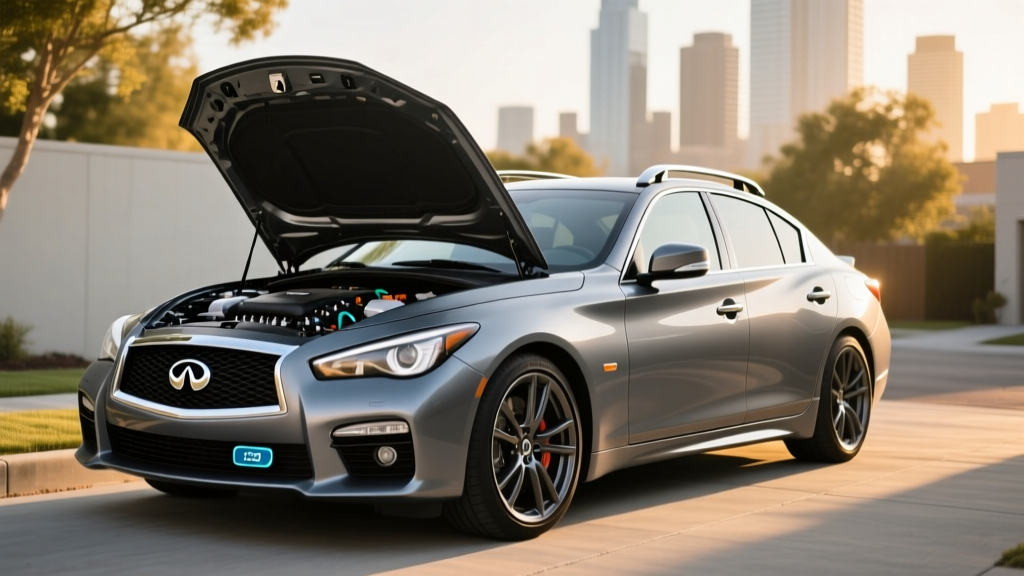
The 2014 Infiniti Q50 Hybrid was never about squeezing every last drop of fuel — it was about proving a luxury sport sedan could deliver 354 horsepower while still beating its V6 sibling at the pump. More than a decade later, this conventional hybrid (HEV) remains a compelling used-car proposition for buyers who want premium-badge performance without the plug-in commitment or the range variables of a full EV.
As a self-charging hybrid, the Q50 Hybrid requires zero lifestyle change: no charging cables, no home electrical upgrades, no route planning around public chargers. You fill it with gasoline and drive. The electric motor assists the 3.5-liter V6 during acceleration and enables brief electric-only motoring at low speeds, but the system is designed for efficiency augmentation, not electric-only commuting.
| Specification | Value |
|---|---|
| Powertrain | 3.5L V6 + electric motor (parallel hybrid) |
| Combined Horsepower | 354 hp |
| Engine Output | 302 hp / 258 lb-ft |
| Electric Motor Output | 67 hp / 214 lb-ft |
| Transmission | 7-speed automatic |
| EPA City MPG | 29 |
| EPA Highway MPG | 34 |
| EPA Combined MPG | 29 (RWD) / 28 (AWD) |
| Hybrid Battery | ~1.4 kWh lithium-ion (non-plug-in) |
| Drivetrain Options | RWD or AWD |
| 0–60 mph | ~5.1 seconds |
| Original MSRP (2014) | ~$44,700 (base) to ~$52,000 (loaded) |
| 2026 Used Price Range | $9,000 – $16,500 (depending on mileage/condition) |
HEV vs PHEV: Why the Q50 Hybrid Is Not a Plug-In
A common point of confusion in the used-luxury market is the distinction between a conventional hybrid (HEV) and a plug-in hybrid (PHEV). The 2014 Infiniti Q50 Hybrid is strictly a conventional HEV. It has no charge port, no plug, and no meaningful electric-only range. The small ~1.4 kWh lithium-ion battery recharges exclusively through regenerative braking and the gasoline engine.
| Feature | HEV (Q50 Hybrid) | PHEV (e.g., Toyota RAV4 Prime) | BEV (e.g., Tesla Model 3) |
|---|---|---|---|
| Plug-in Charging | No | Yes | Yes |
| Electric-Only Range | ~1 mi at low speed | 25–42 mi typical | 250–360+ mi |
| Battery Size | ~1.4 kWh | 14–22 kWh | 60–100 kWh |
| Fuel Required | Yes (gasoline) | Yes (gasoline + electricity) | No (electricity only) |
| Home Charger Needed | No | Recommended (Level 2) | Essential (Level 2) |
| Federal Tax Credit (New) | None | Up to $7,500 (§30D) | Up to $7,500 (§30D) |
If you're shopping for a hybrid you can plug in and drive 30+ miles on electricity alone, the Q50 Hybrid is not that vehicle. If you want a premium sedan that delivers better fuel economy than its gas-only counterpart with zero charging hassle, it fits the brief precisely.
Fuel Economy: EPA Ratings and Real-World MPG
The EPA rated the 2014 Infiniti Q50 Hybrid at 29 MPG city, 34 MPG highway, and 29 MPG combined for the rear-wheel-drive model. The AWD variant drops slightly to 27 city / 32 highway / 28 combined. These numbers represent a meaningful improvement over the standard Q50 3.7L V6, which was rated at roughly 20 city / 29 highway / 23 combined.
| Model | City | Highway | Combined |
|---|---|---|---|
| Q50 Hybrid (RWD) | 29 | 34 | 29 |
| Q50 Hybrid (AWD) | 27 | 32 | 28 |
| Q50 3.7 V6 (RWD) | 20 | 29 | 23 |
Real-World MPG: What Owners Actually See
Conventional hybrids tend to perform close to or slightly above their EPA city ratings because stop-and-go driving maximizes regenerative braking and electric motor assist. Highway driving, where the gasoline engine shoulders most of the load, may yield slightly lower figures than the EPA highway sticker suggests.
Owner-reported data from fuel-tracking platforms shows a real-world spread of roughly 26–31 MPG combined, with a median around 27–28 MPG for mixed driving. Drivers with heavy city commutes often report 30+ MPG, while sustained highway trips at 75+ mph tend to settle around 28–30 MPG. In cold weather, expect a 2–4 MPG dip due to reduced battery efficiency and longer engine warm-up cycles — a characteristic shared by all hybrids, not unique to the Q50.
Powertrain Deep Dive: 354 HP From a Hybrid
Infiniti's Direct Response Hybrid system pairs a 3.5-liter V6 (302 hp, 258 lb-ft) with a 50 kW (67 hp, 214 lb-ft) electric motor mounted between the engine and the 7-speed automatic transmission. The combined system output is rated at 354 hp. Unlike Toyota's power-split hybrid architecture, which uses a continuously variable transmission (CVT), Infiniti's setup routes power through a conventional stepped automatic — delivering the direct, linear acceleration feel that luxury-sport buyers expect.
The electric motor provides instant torque from standstill, filling the gap before the V6 reaches its power band. This results in a 0–60 mph time of approximately 5.1 seconds — quicker than the gas-only Q50 3.7 and competitive with entry-level German sport sedans of the era. The motor also enables engine-off coasting at highway speeds and brief electric-only creeping in parking lots or heavy traffic at speeds below roughly 25 mph, though this is measured in fractions of a mile, not meaningful EV range.
Hybrid Battery: Longevity, Warranty, and Replacement Cost
The Q50 Hybrid's lithium-ion battery pack is modest in capacity (~1.4 kWh usable) because it's designed for assist duty, not energy storage. This small size actually works in its favor for longevity: the battery operates under relatively light stress compared to larger packs in PHEVs and BEVs, and the vehicle's battery management system keeps the state of charge within a narrow, protective window.
Battery Warranty and Expected Lifespan
Original warranty: Infiniti covered the hybrid battery and related components for 8 years / 100,000 miles (extended to 10 years / 150,000 miles in California and states that follow CARB emissions standards). For a 2014 model, this factory warranty has expired as of 2022–2024 depending on the state.
Expected lifespan: Based on owner reports and the track record of similar Nissan/Infiniti hybrid systems, these packs typically last 150,000–200,000+ miles before significant degradation. Failure before 120,000 miles is uncommon.
Replacement cost (2026): A refurbished or new hybrid battery pack for the Q50 Hybrid runs approximately $2,500–$4,500 including labor at an independent hybrid specialist. Dealership pricing may reach $5,000–$6,500. Given the vehicle's current used-market value, an OEM dealer replacement may approach or exceed the car's worth — making independent shops or refurbished packs the practical choice.
If you're evaluating a used 2014 Q50 Hybrid, request a pre-purchase inspection that includes a hybrid battery health check. Many independent shops with hybrid scan tools can pull the battery's state-of-health (SoH) percentage and check for individual cell imbalance — the leading indicator of impending pack issues.
Pricing, Value, and Tax Credit Eligibility in 2026
When new, the 2014 Q50 Hybrid carried an MSRP starting around $44,700 for the base RWD model, climbing to $52,000+ for a fully loaded AWD Premium. In the 2026 used market, clean examples with 80,000–120,000 miles typically trade between $9,000 and $16,500, depending on condition, mileage, trim, and region.
Does the Q50 Hybrid Qualify for Any Tax Credit?
No. The 2014 Infiniti Q50 Hybrid does not qualify for the federal §30D clean vehicle tax credit. That credit applies only to new plug-in electric vehicles (BEVs and PHEVs) that meet battery-sourcing, MSRP, and buyer income requirements. Conventional hybrids like the Q50 Hybrid have never qualified for the federal plug-in credit.
On the used-EV front, the previously owned clean vehicle credit (up to $4,000 or 30% of sale price, whichever is less) also requires the vehicle to be a plug-in EV or fuel-cell vehicle. The Q50 Hybrid, as a non-plug-in HEV, is ineligible for this credit as well.
Some states and local utilities offer modest rebates or HOV-lane access for conventional hybrids, but these programs vary widely and many have sunsetted. Check your state's energy office or DMV for any remaining incentives in your jurisdiction.
Reliability and Ownership Costs
The Q50 Hybrid shares much of its architecture with the broader Nissan/Infiniti family, and its hybrid system has proven reasonably durable. The 7-speed automatic transmission (a Jatco unit) is generally reliable when serviced on schedule. The most commonly reported issues in owner forums involve 12-volt battery drain (the auxiliary battery, not the hybrid pack), occasional inverter cooling system faults, and standard luxury-car maintenance costs for items like brakes, suspension bushings, and electronics.
Annual maintenance for a 10+ year-old Infiniti typically runs $800–$1,500, depending on whether you use a dealership or independent mechanic. Insurance costs tend to be moderate for the segment — roughly $1,400–$2,000 annually for a driver with a clean record, though this varies by state and coverage level.
Compared to a full EV, the Q50 Hybrid will cost more in ongoing fuel and maintenance (oil changes, transmission fluid, spark plugs). Compared to the gas-only Q50, the hybrid saves approximately $400–$700 per year in fuel at 12,000 miles of annual driving and $3.50/gallon gasoline — a payback that has long since been realized on the used market through the hybrid's lower purchase price.
Pros
- 354 hp delivers genuine sport-sedan performance
- 29 MPG combined is strong for a 3,800-lb luxury sedan
- No plug-in required — zero lifestyle change
- Conventional automatic transmission (no CVT drone)
- Quiet, well-insulated cabin with premium materials
- Competitive used pricing vs. German rivals
Cons
- Hybrid battery replacement could total the car economically
- No electric-only commuting capability
- Rear visibility is compromised by the trunk-mounted battery
- Infiniti's infotainment (dual-screen) feels dated by 2026 standards
- Steering feel is numb compared to BMW 3 Series of the era
- No federal or state EV tax credits apply
Who Should Choose the Q50 Hybrid vs a Full EV or Gas Car?
Decision Framework
Choose the 2014 Q50 Hybrid if:
- You want a premium sport sedan under $15,000 with sub-30 MPG combined fuel consumption
- You lack access to home or workplace charging and aren't ready for an EV or PHEV
- You value straight-line performance (354 hp, 5.1s 0–60) alongside efficiency
- Your commute is mixed city/highway and you want regenerative braking benefits without plugging in
Choose a full EV (e.g., used Tesla Model 3, Hyundai Ioniq 5) if:
- You have Level 2 home charging and want near-zero fuel and maintenance costs
- You want to qualify for the used-EV tax credit (up to $4,000)
- Your daily commute falls within 200–250 miles and you accept public charging for road trips
Choose a PHEV (e.g., used BMW 330e, Toyota Camry Hybrid isn't PHEV but RAV4 Prime is) if:
- You have home charging and want 20–40 miles of electric-only daily commuting
- You still want gasoline flexibility for longer trips without charging stops
Choose a gas-only car if:
- Upfront cost is the absolute priority and you drive fewer than 8,000 miles/year
- You want the widest possible selection in the used market
Frequently Asked Questions
How many MPG does the 2014 Infiniti Q50 Hybrid get?
The EPA rates the RWD model at 29 city / 34 highway / 29 combined. The AWD model is rated 27 / 32 / 28. Real-world combined MPG typically falls between 26 and 31 depending on driving mix, with city-heavy driving yielding the best results thanks to regenerative braking.
Can the Q50 Hybrid drive on electric power only?
Only in very limited circumstances — at low speeds (under ~25 mph) for short distances (a fraction of a mile), such as creeping through a parking lot or in stop-and-go traffic. This is not a plug-in hybrid and does not offer meaningful electric-only range. The system is designed to assist the gasoline engine, not replace it.
Is the 2014 Q50 Hybrid reliable, and what does battery replacement cost?
The hybrid system has proven reasonably durable, with most packs lasting 150,000–200,000+ miles. The original 8-year/100,000-mile hybrid warranty has expired on all 2014 models. A replacement hybrid battery costs approximately $2,500–$4,500 at an independent specialist or $5,000–$6,500 at a dealership. Given the vehicle's used-market value of $9,000–$16,500, an independent shop or refurbished pack is the cost-effective path if replacement is needed.
Does the 2014 Infiniti Q50 Hybrid qualify for any tax credit?
No. As a conventional hybrid (HEV), it does not qualify for the federal §30D new clean vehicle credit or the previously owned clean vehicle credit. Those credits are reserved for plug-in vehicles (BEVs and PHEVs). Some state or utility programs may offer minor incentives for hybrids, but most have expired — check your local jurisdiction.
Hybrid vs PHEV vs EV — which powertrain fits my lifestyle?
A conventional hybrid like the Q50 Hybrid is best for drivers without charging access who want better fuel economy with zero routine behavior change. A PHEV suits drivers with home charging who want 20–40 miles of electric-only commuting plus gas flexibility for road trips. A full BEV is ideal for drivers with reliable home Level 2 charging who want the lowest operating costs and can plan around public DC fast charging for trips exceeding ~250 miles.
What should I check before buying a used 2014 Q50 Hybrid?
Prioritize a pre-purchase inspection that includes a hybrid battery state-of-health reading, inverter cooling system check, 12V auxiliary battery test, and standard mechanical inspection. Verify service records for transmission fluid changes. Check for any open recalls through NHTSA's recall lookup using the VIN.