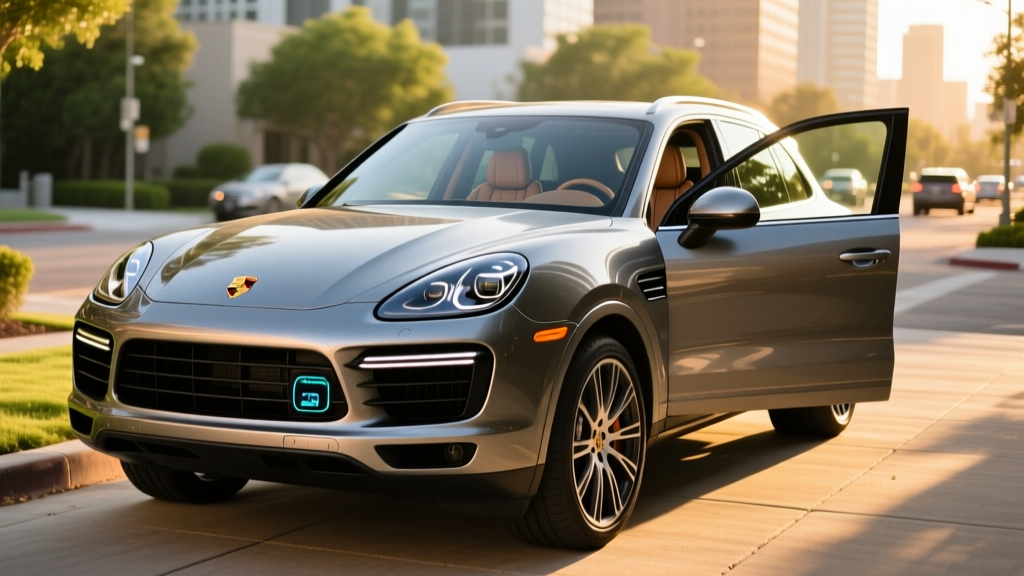
Quick Verdict: The 2014 Cayenne S Hybrid in the Used Market
The 2014 Porsche Cayenne S Hybrid occupies a narrow but specific niche in the used luxury SUV market: buyers who want Porsche performance credentials, all-wheel drive, and a modest fuel-economy bump over the standard V8 Cayenne — without plugging anything in. This is a conventional hybrid (HEV), not a plug-in hybrid (PHEV). It recovers energy through regenerative braking and uses a small battery buffer to assist acceleration and enable brief electric-only coasting, but it never charges from a wall outlet.
With a combined 380 horsepower from its supercharged 3.0L V6 and electric motor, the Cayenne S Hybrid hits 60 mph in roughly 6.1 seconds while returning an EPA-rated 23 MPG combined. That's a meaningful improvement over the non-hybrid Cayenne S of the same era, which managed around 19 MPG combined with its 4.8L V8. But in 2026, with modern PHEVs offering 30+ miles of electric-only range and full EVs exceeding 300 miles, where does a decade-old Porsche HEV fit? This guide breaks down every number that matters.
HEV vs PHEV: What the 2014 Cayenne S Hybrid Actually Is
Before diving into specs, it's critical to distinguish what this vehicle is — and what it isn't. Porsche offered two electrified Cayenne variants across different model years, and confusing them is a common buyer mistake.
2014 Cayenne S Hybrid (HEV)
- Type: Conventional (self-charging) hybrid
- Plug-in capable: No — charges only via engine and regen braking
- Battery: ~1.7 kWh nickel-metal hydride (NiMH)
- Electric-only driving: Very brief coasting at low speeds, not sustained EV mode
- Federal tax credit (when new): Qualified for a partial credit under pre-2023 rules; no credit available for used purchase under current §30D rules (vehicle MSRP and age exceed current used-EV credit parameters)
Cayenne S E-Hybrid (PHEV — 2015+)
- Type: Plug-in hybrid
- Plug-in capable: Yes — Level 2 AC charging via J1772
- Battery: 10.8 kWh lithium-ion (2015-2018); larger in later generations
- Electric-only range: ~14 miles EPA (2015 model year)
- Federal tax credit (when new): Qualified; current used-PHEV credit eligibility limited by §30D age and price caps
The 2014 model year is the final year for the first-generation Cayenne S Hybrid before Porsche replaced it with the plug-in Cayenne S E-Hybrid for 2015. If you're shopping for a Cayenne that plugs in, you need a 2015 or newer E-Hybrid. The 2014 S Hybrid is strictly an HEV.
Fuel Economy: EPA Ratings vs Real-World MPG
For a 4,700-pound luxury SUV from 2014, the Cayenne S Hybrid's fuel economy was genuinely impressive. Here's the official breakdown from fueleconomy.gov:
| Metric | EPA Rating | Real-World Expectation |
|---|---|---|
| City MPG | 20 | 19-22 (hybrids often match or beat EPA city) |
| Highway MPG | 24 | 22-25 (steady cruising favors the hybrid system) |
| Combined MPG | 23 | 21-24 depending on driving style and terrain |
| Annual fuel cost (est.) | ~$3,150 at 15,000 mi/yr and $3.50/gal premium | |
The hybrid system's biggest advantage shows up in city driving, where regenerative braking recaptures energy that would otherwise be lost as heat. Owners who do heavy stop-and-go commuting often report matching or slightly exceeding the 20 MPG city figure. Highway driving sees less hybrid benefit since the supercharged V6 does most of the work at sustained speed.
For comparison, the 2014 Cayenne S with the 4.8L V8 rated 17 city / 24 highway / 19 combined. The hybrid's 4 MPG combined improvement translates to roughly 75 fewer gallons per year at 15,000 miles — meaningful savings, though not transformative given the Cayenne's premium-fuel requirement and overall thirst.
Powertrain Specs: Supercharged V6 Meets Electric Motor
| Specification | 2014 Cayenne S Hybrid |
|---|---|
| Engine | 3.0L supercharged V6 |
| Engine output | 333 hp / 324 lb-ft torque |
| Electric motor output | 47 hp (34 kW) |
| Combined system output | 380 hp / 428 lb-ft torque |
| 0-60 mph | 6.1 seconds (Porsche est.) |
| Transmission | 8-speed Tiptronic S automatic |
| Drivetrain | All-wheel drive (AWD) |
| Curb weight | ~4,717 lbs |
| Towing capacity | 7,716 lbs (braked) |
| Battery type | NiMH, ~1.7 kWh |
| Hybrid system | Parallel hybrid (Porsche/Continental) |
The powertrain is a parallel hybrid layout developed jointly by Porsche and Volkswagen Group. The electric motor sits between the engine and transmission, providing torque fill during acceleration and enabling engine-off coasting at highway speeds (Porsche calls this "sailing mode"). The supercharger ensures strong low-end response even without turbo lag, which was a deliberate engineering choice over the turbocharged alternatives.
The 47-hp electric motor is modest by modern standards — it's there to assist, not to drive the vehicle independently for any meaningful distance. You may notice brief electric-only movement when pulling away from a stop at very low speeds, but the gas engine engages quickly. This is fundamentally different from a PHEV, which can sustain 20-40 miles of electric-only driving.
Battery Health, Warranty, and Replacement Costs
Original Hybrid Battery Warranty
When new, the 2014 Cayenne S Hybrid's NiMH battery pack was covered under Porsche's hybrid component warranty: 8 years / 100,000 miles (extended to 10 years / 150,000 miles in California Air Resources Board states and other states adopting CARB emissions standards).
In 2026: A 2014 model is now 12 years old. The original hybrid battery warranty has expired in all jurisdictions, even in CARB states where it extended to 10 years. Any battery failure is now an out-of-pocket expense for the owner.
This is the single most important ownership consideration for a used 2014 Cayenne S Hybrid. The NiMH battery pack, while more thermally stable than early lithium-ion packs, is now well past its design life. NiMH cells degrade gradually rather than failing catastrophically, so you may notice reduced electric-assist responsiveness and slightly lower fuel economy rather than a sudden failure. However, complete pack failure is possible.
Replacement cost: A new OEM hybrid battery pack from Porsche typically runs $3,000 to $5,000 including labor at a dealership. Independent hybrid-battery specialists may offer refurbished packs for $1,500 to $3,000. Individual cell replacement is possible at some specialists for $800 to $1,500 but requires careful cell-matching.
Pre-purchase advice: Before buying any 2014 Cayenne S Hybrid, request a hybrid battery state-of-health (SoH) diagnostic from a Porsche dealer or qualified independent shop. Look for voltage deviation across cells and check for any stored hybrid-system fault codes. Factor a potential $2,000-$5,000 battery replacement into your purchase budget if the pack hasn't been recently replaced.
Pricing and Tax Credit Reality for 2026 Buyers
The 2014 Cayenne S Hybrid originally carried an MSRP starting around $67,700 (before destination), with well-optioned examples pushing past $85,000. In the current used market, expect to pay:
- High mileage (90,000+ miles): $12,000 - $16,000
- Average mileage (50,000-90,000 miles): $16,000 - $24,000
- Low mileage, excellent condition (<50,000 miles): $24,000 - $32,000
Federal tax credit status: Under current IRS §30D used clean vehicle credit rules, the maximum credit is $4,000 (30% of sale price, capped). However, the 2014 Cayenne S Hybrid does not qualify for the used clean vehicle credit for two reasons:
- The vehicle must be at least two model years old (it qualifies on age), but the sale price must be $25,000 or less for the credit to apply at maximum value — many examples exceed this.
- More critically, the used-vehicle credit requires the vehicle to have a battery capacity of at least 7 kWh. The Cayenne S Hybrid's ~1.7 kWh NiMH pack falls far short of this threshold.
The plug-in Cayenne S E-Hybrid (2015+) with its 10.8 kWh pack would meet the battery-capacity requirement, though the $25,000 sale-price cap and buyer income limits still apply. Always verify current eligibility with a tax professional before counting on any credit.
Who Should Buy the 2014 Cayenne S Hybrid?
Pros
- 380 hp with 6.1-second 0-60 — genuine Porsche performance
- 23 MPG combined is strong for a 4,700-lb luxury SUV
- 7,700+ lb towing capacity
- Supercharged V6 avoids turbo lag common in competitors
- Premium interior with high build quality
- AWD standard for all-weather confidence
Cons
- Hybrid battery warranty expired — $2K-$5K replacement risk
- No electric-only driving capability (not a PHEV)
- No federal tax credit eligibility on used purchase
- Premium fuel required (91+ octane)
- Maintenance costs remain high (Porsche dealer rates)
- NiMH battery tech is dated vs modern lithium-ion systems
Choose the 2014 Cayenne S Hybrid if:
You want a used luxury performance SUV with better fuel economy than the V8 Cayenne, you don't have reliable access to home or workplace charging (ruling out PHEVs and EVs), and you can budget for potential hybrid-battery replacement. It's a strong fit for buyers who tow, drive in varied weather, and prioritize driving dynamics over maximum electrification.
Look elsewhere if:
You want meaningful electric-only range (consider a 2015+ Cayenne S E-Hybrid PHEV or a modern PHEV like the Toyota RAV4 Prime with 42 miles electric). If you have home charging and want zero tailpipe emissions on daily commutes, a full EV like a used Tesla Model X or BMW iX eliminates fuel costs entirely. If budget reliability is paramount, a Toyota Highlander Hybrid offers similar MPG with dramatically lower maintenance costs and a proven long-life hybrid system.
Hybrid vs PHEV vs EV: Which Fits Your Situation?
| Factor | HEV (like this Cayenne) | PHEV (e.g., Cayenne E-Hybrid) | Full EV (e.g., Tesla Model X) |
|---|---|---|---|
| Plug-in charging needed? | No | Yes, for EV range | Yes, always |
| Electric-only range | Negligible | 14-40+ miles | 250-350+ miles |
| Daily fuel cost (30-mi commute) | ~$6.30 (gas only) | ~$1.20 (electric) + gas if beyond EV range | ~$1.20 (electric only) |
| Home charging required? | No | Strongly recommended | Essential |
| Maintenance complexity | Engine + hybrid system | Engine + larger hybrid system + charger | Simplest (no engine) |
| Best for | No-charging-access buyers who want some efficiency | Home chargers with short commutes + road-trip flexibility | Home chargers committed to full electrification |
The 2014 Cayenne S Hybrid makes the most sense for buyers in the first column — those who cannot charge at home or work but still want a performance SUV with reasonable efficiency. If you can install a Level 2 charger at home, a PHEV or full EV will deliver substantially lower operating costs and a smoother, quieter daily driving experience.
Frequently Asked Questions
How many MPG does the 2014 Cayenne S Hybrid get?
The EPA rates it at 20 city / 24 highway / 23 combined. Real-world owners typically report 21-24 MPG combined, with city-heavy driving sometimes exceeding the 20 MPG city rating thanks to regenerative braking.
Can the 2014 Cayenne S Hybrid drive on electric power only?
Only for very brief, low-speed coasting. It is a conventional HEV, not a PHEV. There is no plug, no meaningful electric-only range, and no EV mode button that sustains battery-only driving. For electric-only capability, look at the 2015+ Cayenne S E-Hybrid plug-in.
Is the 2014 Cayenne S Hybrid reliable?
The mechanical powertrain (supercharged 3.0L V6, 8-speed automatic, AWD system) is generally robust, sharing architecture with Audi and VW models. The main reliability concern in 2026 is the aging NiMH hybrid battery, which is past its warranty period. Budget $2,000-$5,000 for a potential replacement. The rest of the vehicle follows typical Porsche maintenance costs — expect premium pricing for parts and service.
What does it cost to replace the hybrid battery?
A new OEM battery from Porsche runs approximately $3,000-$5,000 installed. Refurbished packs from independent hybrid specialists cost $1,500-$3,000. Cell-level repair is possible for $800-$1,500 at specialists. Get a state-of-health diagnostic before purchasing.
Does the 2014 Cayenne S Hybrid qualify for any tax credit?
No. Under current IRS §30D rules, the used clean vehicle credit requires a minimum 7 kWh battery capacity. The Cayenne S Hybrid's ~1.7 kWh NiMH pack does not meet this threshold. Additionally, buyer income caps and sale-price limits further restrict eligibility for most used hybrid purchases. The 2015+ Cayenne S E-Hybrid (PHEV, 10.8 kWh) may qualify if the sale price is $25,000 or less and buyer income falls within limits.
How does it compare to the non-hybrid 2014 Cayenne S?
The non-hybrid Cayenne S used a 4.8L V8 producing 400 hp and rated 17/24/19 MPG. The S Hybrid sacrifices 20 hp but gains 4 MPG combined (23 vs 19), plus stronger low-end torque from the electric motor assist. The hybrid also adds roughly 200 lbs of weight. Most buyers find the hybrid's efficiency gain worthwhile given the minimal performance trade-off.
Should I get a pre-purchase inspection?
Absolutely. Beyond the standard mechanical inspection, specifically request a hybrid battery diagnostic including cell voltage readings and state-of-health percentage. Check for any outstanding NHTSA recalls — the 2014 Cayenne had recalls related to the fuel system and seat belt components. A Porsche specialist or dealer can pull the complete service history and hybrid-system logs.