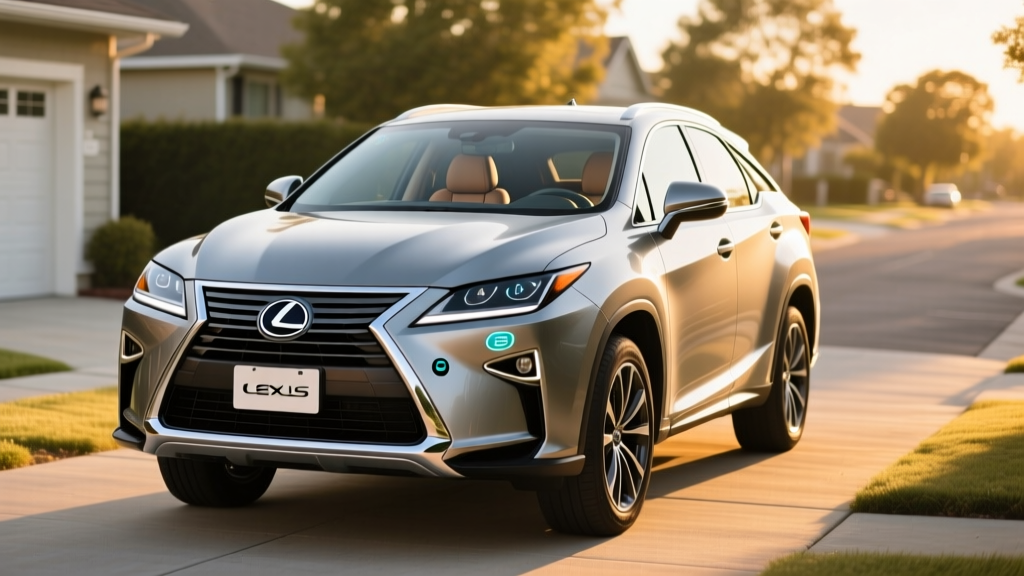
The 2013 Lexus RX 450h occupies a specific niche in the used electrified-vehicle market: a luxury midsize hybrid SUV from a brand synonymous with long-term reliability, offered today at a fraction of its original $47,310 MSRP. For buyers researching the 2013 Lexus 450h hybrid SUV as a potential daily driver in 2026, the key questions are fuel economy, hybrid battery longevity, and whether a 13-year-old HEV still makes financial sense compared to a modern PHEV or full EV.
This guide covers the exact numbers — EPA MPG, powertrain output, battery warranty status, replacement costs, and ownership economics — so you can evaluate the 2013 RX 450h with data, not guesswork.
2013 Lexus RX 450h Key Specifications
| Spec | Value |
|---|---|
| Powertrain | 3.5L V6 Atkinson-cycle + 2 electric motors (AWD: 3 motors) |
| Combined Horsepower | 295 hp (net system) |
| EPA MPG (City / Hwy / Combined) | 32 / 28 / 30 (AWD-e); 32 / 28 / 30 (FWD) |
| Battery Type | Nickel-Metal Hydride (NiMH), ~3.6 kWh total / ~1.4 kWh usable |
| 0–60 mph | ~7.4 seconds |
| Drivetrain | FWD or AWD (rear electric motor, no mechanical driveshaft) |
| Cargo Volume | 40.0 cu ft (rear seats up), 80.3 cu ft (rear seats folded) |
| Original MSRP (2013) | $47,310 (base FWD) – $48,710 (base AWD) |
| Typical 2026 Used Price | $12,000 – $18,000 depending on mileage/condition |
| Hybrid Battery Warranty (Original) | 8 years / 100,000 miles (10 yr/150,000 mi in CARB states) |
HEV vs. PHEV: What the RX 450h Actually Is
The 2013 Lexus RX 450h is a conventional hybrid electric vehicle (HEV), not a plug-in hybrid. This distinction is fundamental to ownership expectations:
| Feature | HEV (2013 RX 450h) | PHEV (e.g., 2026 RAV4 Prime) | BEV (e.g., 2026 Tesla Model Y) |
|---|---|---|---|
| Plugs in? | No — self-charging via engine + regen | Yes — Level 1/2 AC charging | Yes — AC + DC fast charging |
| Electric-only range | ~1–2 miles at very low speed | 35–42 miles EPA | 260–330+ miles EPA |
| Gas engine | 3.5L V6 (always available) | 2.5L I4 (kicks in after battery depletes) | None |
| Fuel/energy | Gasoline only | Gasoline + grid electricity | Grid electricity only |
| Federal tax credit (new) | None (expired for HEVs long ago) | Up to $7,500 (§30D, subject to sourcing/income rules) | Up to $7,500 (§30D, subject to sourcing/income rules) |
| Used EV credit (§25E) | Not eligible (HEV) | Eligible if ≤$25,000 sale price, income caps apply | Eligible if ≤$25,000 sale price, income caps apply |
The RX 450h's small NiMH battery recharges entirely through regenerative braking and the gasoline engine. There is no charging port, no plug, and no electric-only highway driving. It operates as a highly efficient gas vehicle that uses electric motors to assist acceleration, enable engine-off coasting, and recapture braking energy.
Fuel Economy: EPA Numbers vs. Real-World MPG
According to EPA data on fueleconomy.gov, the 2013 RX 450h carries the following ratings:
| Drivetrain | City | Highway | Combined |
|---|---|---|---|
| FWD | 32 MPG | 28 MPG | 30 MPG |
| AWD (AWD-e) | 32 MPG | 28 MPG | 30 MPG |
Real-world expectations: Toyota/Lexus hybrids consistently outperform their EPA city ratings in stop-and-go traffic because regenerative braking recovers more energy at low speeds. Owner-reported data on Fuelly and similar platforms shows many RX 450h drivers averaging 28–32 MPG combined, with city-heavy commuters occasionally hitting 33–34 MPG. Highway-only driving at 75+ mph typically drops to 25–27 MPG due to aerodynamic drag and reduced regen opportunity.
For comparison, the non-hybrid 2013 RX 350 (3.5L V6, AWD) is rated at 18 city / 24 highway / 20 combined. The 450h's 50% combined-MPG improvement is substantial and translates to roughly $500–$700 annual fuel savings at 15,000 miles/year and $3.50/gallon.
Powertrain and Hybrid System Architecture
The RX 450h uses Toyota's Hybrid Synergy Drive, pairing a 3.5-liter Atkinson-cycle V6 (producing 245 hp on its own) with a front-mounted electric motor/generator for a combined system output of 295 net horsepower. AWD-e models add a rear-axle electric motor (68 hp) that engages independently — there is no mechanical connection between the front and rear axles.
The Atkinson-cycle engine sacrifices some low-RPM torque for greater thermal efficiency by keeping the intake valve open longer during the compression stroke. The electric motor fills in the torque gap instantly, which is why the RX 450h feels responsive off the line despite its efficiency focus. The eCVT (electronically controlled continuously variable transmission) uses a planetary gearset rather than belts or cones, contributing to the system's renowned durability.
The hybrid battery pack is a NiMH (nickel-metal hydride) unit rated at approximately 3.6 kWh total capacity, with roughly 1.4 kWh usable. The system never fully charges or fully depletes the battery — the computer maintains a state-of-charge window (typically 40–80%) to maximize cycle life. This conservative buffer strategy is a primary reason Toyota/Lexus hybrid batteries routinely exceed 150,000 miles.
Hybrid Battery Longevity, Warranty, and Replacement Cost
Battery Warranty Status (2026)
The original hybrid battery warranty on the 2013 RX 450h was 8 years / 100,000 miles (extended to 10 years / 150,000 miles in CARB states including California, New York, Massachusetts, and others). As of 2026, every 2013 RX 450h has aged out of its original factory hybrid battery warranty regardless of mileage. Any battery failure is an out-of-pocket expense unless covered by an extended warranty purchased separately.
How long do these batteries actually last? Real-world data from Lexus dealer service departments and independent hybrid specialists indicates the NiMH pack in the 2010–2015 RX 450h typically delivers reliable service for 150,000–200,000+ miles. Failures before 120,000 miles are uncommon. The most frequent issue is not a sudden death but a gradual capacity loss that reduces MPG by 2–4 MPG and triggers a "Check Hybrid System" warning.
Replacement cost in 2026:
- OEM new battery (Lexus dealer): $3,500 – $5,000 installed
- Remanufactured battery (independent hybrid shop): $1,800 – $2,800 installed
- Individual module replacement: $400 – $900 (only failed modules replaced — viable when diagnostics show 1–2 weak cells out of 30+)
For a used RX 450h priced at $12,000–$18,000, a battery replacement represents a significant percentage of vehicle value. Before purchasing, request a hybrid battery health check — many dealers and hybrid specialists can read individual module voltages via OBD-II scan tool. Voltage spread across modules should be within 0.2V; wider spread signals impending failure.
Reliability, Safety, and Known Issues
The 2013 RX 450h benefits from Lexus's industry-leading build quality and the proven maturity of Toyota's hybrid system, which was in its third generation by 2013. The eCVT planetary gearset has no clutch packs, bands, or torque converters to wear out, and the electric motors have no brushes. These factors contribute to powertrain longevity that routinely exceeds 250,000 miles with basic maintenance.
Common non-hybrid issues to watch:
- Water pump (electric): The RX 450h uses an electric coolant pump for the inverter cooling circuit. Failure triggers a hybrid system warning. Replacement: $400–$700.
- Brake actuator: The regenerative braking system uses a complex electrohydraulic actuator. Some 2010–2013 RX models experienced premature wear; replacement runs $1,200–$1,800.
- 12V auxiliary battery: Like all hybrids, the RX 450h has a conventional 12V battery (located in the rear cargo area) that powers electronics and boots the hybrid system. If it dies, the car won't start even if the hybrid battery is full. Replacement every 4–5 years.
The 2013 RX 450h earned an IIHS Top Safety Pick rating and received 4 out of 5 stars overall from NHTSA. Standard safety equipment includes 10 airbags, stability control, and optional Pre-Collision System with adaptive cruise control.
Tax Credits and Incentives (2026)
The 2013 RX 450h does not qualify for any current federal tax credit:
- §30D New Clean Vehicle Credit: Only applies to new PHEVs and BEVs meeting battery sourcing, MSRP cap ($80,000 SUVs), and buyer income limits. The RX 450h is a conventional HEV and is no longer sold new.
- §25E Used Clean Vehicle Credit: Provides up to $4,000 (30% of sale price, max $4,000) for used BEVs and PHEVs priced at $25,000 or less. Conventional hybrids like the RX 450h are not eligible. The vehicle must have a plug to qualify.
Some states and utilities offer rebates for used hybrid purchases or for maintaining an efficient vehicle. Check your state's energy office or utility provider — but do not expect a credit comparable to the federal EV incentives. Consult IRS.gov for current credit rules or speak with a tax professional about your specific eligibility.
Who Should Buy the 2013 RX 450h in 2026?
Pros
- Proven, mature hybrid system with exceptional longevity data
- 30 MPG combined in a 4,600-lb luxury SUV — still competitive in 2026
- No plug required — ideal for apartment dwellers or those without home charging
- Lexus build quality, quiet cabin, smooth ride
- Low purchase price ($12K–$18K) with strong parts availability
- AWD-e system provides confident all-weather traction
Cons
- Original hybrid battery warranty expired — replacement is an out-of-pocket risk
- Dated infotainment (no Apple CarPlay/Android Auto, small 8-inch screen, no USB-C)
- No federal tax credit eligibility (HEV, not PHEV/BEV)
- NiMH battery less energy-dense than modern lithium packs — limits electric-only assist
- Higher maintenance cost than a new vehicle (13-year-old suspension, seals, cooling system)
Decision Framework: Is the 2013 RX 450h Right for You?
Choose the 2013 RX 450h if: You want a reliable, fuel-efficient luxury SUV without needing to install a home charger or rely on public charging infrastructure. You drive 10,000–15,000 miles/year in mixed city/highway conditions. You're comfortable budgeting $2,000–$4,000 for a potential hybrid battery replacement within the next 3–5 years.
Choose a modern PHEV (e.g., 2026 Toyota RAV4 Prime, Lexus NX 450h+) if: You have home charging access, want 35–40 miles of electric-only commuting, and want to qualify for the §30D or §25E tax credit. You value current infotainment, ADAS features, and a fresh battery warranty.
Choose a full BEV (e.g., 2026 Tesla Model Y, Hyundai Ioniq 5) if: You have reliable home Level 2 charging, want zero tailpipe emissions, desire the lowest per-mile fuel cost (~$0.04–$0.06/mi vs. ~$0.12/mi for the 450h at 30 MPG), and plan to keep the vehicle 8+ years.
Ownership Costs: 5-Year Outlook
For a buyer spending $15,000 on a 2013 RX 450h with 110,000 miles and keeping it 5 years (driving to ~160,000 miles), here's a realistic cost projection:
| Cost Category | 5-Year Estimate |
|---|---|
| Purchase price | $15,000 |
| Fuel (15,000 mi/yr × 5 yr ÷ 30 MPG × $3.50/gal) | $8,750 |
| Insurance (avg. $1,200/yr) | $6,000 |
| Maintenance (oil, brakes, tires, fluids) | $3,500 – $5,000 |
| Potential hybrid battery replacement | $0 – $3,500 |
| Estimated resale value (2031, ~160K mi) | –$6,000 – $8,000 |
| Total 5-year net cost | $27,250 – $32,250 |
Compare this to a new 2026 RAV4 Hybrid ($34,000 purchase, similar MPG, full warranty) and the used RX 450h saves roughly $8,000–$12,000 upfront but carries higher repair risk and no warranty safety net.
Frequently Asked Questions
How many MPG does the 2013 Lexus RX 450h get?
The EPA rates the 2013 RX 450h at 32 city / 28 highway / 30 combined for both FWD and AWD-e variants. Real-world owner reports typically cluster around 28–32 MPG combined, with city-heavy drivers often exceeding the EPA city rating thanks to regenerative braking.
Does the 2013 RX 450h need to be plugged in?
No. The 2013 RX 450h is a conventional hybrid (HEV), not a plug-in hybrid. Its small NiMH battery charges exclusively through regenerative braking and the gasoline engine. There is no charging port on the vehicle.
How far can the RX 450h drive on electric power alone?
Effectively less than 1 mile, and only at very low speeds (under 25 mph) with light throttle input. The system is designed for electric assist, not electric-only propulsion. If electric-only commuting range is a priority, look at a PHEV like the 2026 Lexus NX 450h+ (37 miles EV range) or a full BEV.
Is the 2013 RX 450h hybrid battery reliable, and what does replacement cost?
Toyota/Lexus NiMH hybrid batteries are among the most reliable in the industry, routinely lasting 150,000–200,000+ miles. If replacement is needed, expect $3,500–$5,000 for a new OEM battery at a Lexus dealer, or $1,800–$2,800 for a remanufactured unit at an independent hybrid specialist. Individual module replacement can cost as little as $400–$900 if only a few cells have degraded.
Does the 2013 RX 450h qualify for any tax credit in 2026?
No. The federal §30D new vehicle credit and §25E used vehicle credit both require the vehicle to be a plug-in hybrid (PHEV) or battery electric vehicle (BEV). Conventional hybrids (HEVs) are not eligible. The original hybrid vehicle tax credit that applied to the RX 450h when new expired many years ago.
What should I check before buying a used 2013 RX 450h?
Request a hybrid battery health scan showing individual module voltages (spread should be within 0.2V). Check for inverter coolant pump operation, brake actuator health, and 12V battery age. Verify maintenance records, especially for transmission fluid (ATF-WS) and inverter coolant changes. A pre-purchase inspection at a Lexus dealer or hybrid specialist ($150–$250) is strongly recommended.
How does the 2013 RX 450h compare to a modern hybrid SUV?
A 2026 Toyota RAV4 Hybrid achieves 41 MPG combined — roughly 37% better than the RX 450h — in a lighter, more affordable package with modern safety tech and infotainment. However, the RX 450h offers a quieter cabin, more premium materials, and a smoother ride. If luxury and comfort matter more than cutting-edge efficiency, the 450h remains a solid choice at its used price point.