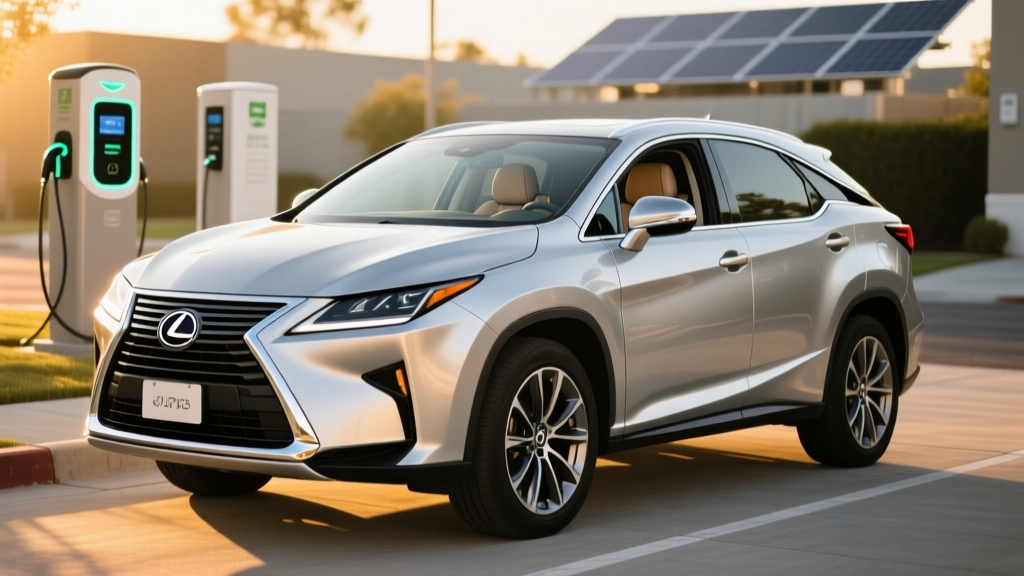
Quick Verdict: A Proven Hybrid Luxury SUV With Aging Grace
The 2013 Lexus RX 450h represents a specific moment in hybrid evolution: a conventional hybrid electric vehicle (HEV) that prioritizes seamless fuel savings over plug-in complexity. More than a decade after its debut, this midsize luxury SUV remains relevant for buyers seeking proven reliability, respectable fuel economy, and Lexus build quality — without the charging infrastructure demands of a plug-in hybrid (PHEV) or battery electric vehicle (BEV).
But buying a 13-year-old hybrid in 2026 raises legitimate questions: How has the nickel-metal hydride (NiMH) traction battery held up? What does replacement cost? And does the 30 MPG combined EPA rating still deliver real-world value against modern hybrids and PHEVs? This guide answers each with data.
| Spec | Value |
|---|---|
| Powertrain Type | Conventional Hybrid (HEV) — no plug-in |
| Combined Horsepower | 295 hp (net system) |
| Engine | 3.5L V6 Atkinson-cycle + 2 electric motor-generators |
| Drivetrain | FWD or AWD (rear electric motor on AWD) |
| Transmission | eCVT (planetary gearset, no fixed gears) |
| EPA MPG (FWD) | 32 city / 28 highway / 30 combined |
| EPA MPG (AWD) | 30 city / 28 highway / 29 combined |
| Traction Battery | NiMH, ~3.6 kWh (gross), not plug-in chargeable |
| 0-60 mph | ~7.4 seconds (FWD) |
| Cargo Volume | 44.6 cu ft (rear seats folded) |
| Original MSRP (2013) | $46,310 (FWD base) – $50,000+ (AWD loaded) |
| 2026 Used Market Range | $12,000 – $20,000 depending on mileage/condition |
| Hybrid Battery Warranty (Original) | 8 years / 100,000 miles (10 yr/150k in CARB states) |
HEV vs PHEV: Understanding What the RX 450h Is — and Isn't
This distinction matters because the "hybrid" label causes frequent confusion. The 2013 RX 450h is a conventional hybrid (HEV). It has no charging port, no plug, and no electric-only driving mode you can activate manually. The small NiMH battery recharges exclusively through regenerative braking and the gasoline engine. You fuel it like any other car — the hybrid system simply makes that fuel go further.
| Feature | HEV (RX 450h) | PHEV (e.g., 2026 RAV4 Prime) | BEV (e.g., 2026 Ioniq 5) |
|---|---|---|---|
| Plug-in Charging? | No | Yes (Level 1/2) | Yes (Level 1/2/DC) |
| Electric-Only Range | ~1 mi at low speed | 35–42 mi typical | 250–350 mi EPA |
| Gasoline Engine? | Yes (primary) | Yes (backup + hybrid) | No |
| Home Charger Needed? | No | Recommended | Essential |
| Fuel Cost per Mile | ~$0.13 (at $3.50/gal) | ~$0.04 electric / $0.12 gas | ~$0.04–$0.06 electric |
| Federal Tax Credit (New) | None | Up to $7,500 (§30D) | Up to $7,500 (§30D) |
| Best For | No home charging access; simple ownership | Short commutes + road trips | Home charging + low operating cost |
The RX 450h makes sense for drivers who lack reliable access to a charging outlet — apartment dwellers, street parkers, or those who simply want a "gas and go" experience with better fuel economy. If you have a garage with a 120V or 240V outlet and a short commute, a modern PHEV like the Toyota RAV4 Prime delivers far greater electric-only efficiency. But the RX 450h asks nothing of your electrical panel.
Fuel Economy: EPA Ratings and Real-World MPG
The EPA's official figures for the 2013 RX 450h break down as follows:
| Drivetrain | City MPG | Highway MPG | Combined MPG |
|---|---|---|---|
| FWD | 32 | 28 | 30 |
| AWD | 30 | 28 | 29 |
Notice the city-highway inversion: the RX 450h earns better MPG in city driving than on the highway. This is a hallmark of conventional hybrids. Regenerative braking recaptures kinetic energy during stop-and-go traffic, and the electric motor handles low-speed propulsion where gasoline engines are least efficient. On the highway, the V6 carries more of the load, and aerodynamic drag dominates.
Real-World MPG: What Owners Actually Report
Owner-reported data on Fuelly and similar tracking platforms shows the 2013 RX 450h averaging between 26 and 30 MPG combined in real-world driving over tens of thousands of miles. Several factors influence where you land:
- City-heavy commuting: Many owners report matching or slightly exceeding the 32 MPG city EPA figure, thanks to frequent regen opportunities.
- Highway-dominant driving: Sustained 70+ mph travel typically drops economy to 25–27 MPG.
- Cold weather: Below 40°F, expect a 10–15% fuel economy reduction as the engine runs longer to maintain cabin heat and battery temperature.
- Battery age: A degraded NiMH pack reduces the system's ability to capture and deploy regen energy, shaving 1–3 MPG off combined figures.
For a 4,500-pound luxury SUV, 28–30 MPG combined remains competitive even against 2026 non-hybrid midsize crossovers. The gas-only 2013 RX 350, by comparison, earned just 21 MPG combined (FWD) — a 30% deficit.
Powertrain Deep Dive: How 295 HP Moves 4,700 Pounds
The RX 450h pairs a 3.5-liter Atkinson-cycle V6 (producing 245 hp on its own) with two motor-generators in the front transaxle. Combined net system output is 295 horsepower — competitive with the V6-powered RX 350 of the same year, but delivered with fundamentally different character.
The Atkinson cycle sacrifices some low-end torque density for higher thermal efficiency. The electric motors fill that torque gap instantly, providing responsive launches from stoplights without the lag of a turbocharged engine. The eCVT transmission isn't a traditional continuously variable transmission with belts and pulleys; it's a Toyota-patented planetary gearset that blends engine and motor power seamlessly. There are no shift shocks, no rubber-band revving — just linear acceleration.
The AWD variant adds a third, independent electric motor on the rear axle. This rear motor provides up to 67 hp to the rear wheels when slip is detected or during hard acceleration. Unlike mechanical AWD systems, there's no driveshaft connecting front and rear — it's an "e-AWD" system, lighter and more efficient, though not designed for serious off-road duty.
Hybrid Battery Health: Lifespan, Degradation, and Replacement Cost
This is the single most important question for any used-hybrid buyer in 2026. The 2013 RX 450h uses a nickel-metal hydride (NiMH) traction battery pack rated at approximately 3.6 kWh gross capacity. This is a small pack by modern standards — for reference, a 2026 RAV4 Prime PHEV carries an 18.1 kWh lithium-ion pack — but the RX 450h's battery doesn't need to store much energy. It acts as a buffer, capturing braking energy and deploying it in short bursts.
Original Hybrid Battery Warranty
Lexus warranted the 2013 RX 450h hybrid battery for 8 years / 100,000 miles nationwide. In states that adopted California Air Resources Board (CARB) emissions standards — including California, New York, Massachusetts, and several others — the warranty extended to 10 years / 150,000 miles.
As of 2026, every 2013 RX 450h has aged out of its original factory hybrid battery warranty. Any battery failure is now an out-of-pocket expense unless covered by an extended warranty purchased separately.
How Long Do These NiMH Batteries Actually Last?
NiMH chemistry has a well-documented track record in Toyota/Lexus hybrids dating back to the 2001 Prius. Real-world data shows:
- Typical lifespan: 150,000 to 200,000 miles before significant degradation (defined as noticeable fuel economy loss or hybrid system warnings).
- Age factor: Calendar age matters alongside mileage. A 13-year-old NiMH pack with 80,000 miles may show similar degradation to a 7-year-old pack with 160,000 miles.
- Failure mode: NiMH packs rarely fail catastrophically. Instead, individual cells weaken, reducing the pack's usable capacity. This manifests as more frequent engine cycling, reduced regen effectiveness, and eventually a check-engine or hybrid-system warning light.
Battery Replacement Cost in 2026
If the hybrid battery in a 2013 RX 450h needs replacement, here's what to budget:
| Option | Parts Cost | Labor | Total Range |
|---|---|---|---|
| New OEM Lexus Battery | $3,500 – $4,500 | $500 – $900 | $4,000 – $5,400 |
| Remanufactured Battery (e.g., Green Bean, Dorman) | $1,800 – $2,800 | $500 – $900 | $2,300 – $3,700 |
| Individual Cell Module Replacement (specialist shop) | $200 – $600 | $800 – $1,500 | $1,000 – $2,100 |
The remanufactured route has matured considerably. Companies like Green Bean Battery offer rebuilt NiMH packs with 3–5 year warranties, often at half the OEM cost. For a vehicle worth $12,000–$20,000 on the used market, a $2,500–$3,500 battery replacement is a meaningful but manageable expense — roughly equivalent to a major transmission repair on a conventional vehicle.
Tax Credits and Incentives: What Applies in 2026?
The short answer: no federal tax credit applies to the 2013 RX 450h in 2026.
The IRS §30D Clean Vehicle Credit (up to $7,500) applies only to new qualifying plug-in electric vehicles and fuel cell vehicles. Conventional hybrids (HEVs) like the RX 450h have never qualified for the federal plug-in credit. When the 2013 RX 450h was new, it was eligible for a modest alternative motor vehicle tax credit (up to $2,200), but that provision expired long ago.
For used vehicles, the §25E Previously Owned Clean Vehicle Credit (up to $4,000 or 30% of sale price) applies only to used plug-in EVs and fuel cell vehicles purchased from a dealer for $25,000 or less. Conventional hybrids are excluded.
Some states offer their own incentives for hybrid purchases, but these typically target new vehicles. Check your state's energy or environmental agency for current programs. At the used-car price points the 2013 RX 450h commands in 2026, you're evaluating this vehicle on its fuel savings merits alone — not incentive economics.
Reliability and Long-Term Ownership
The 2013 RX 450h benefits from one of the strongest reliability reputations in the luxury SUV segment. The Toyota/Lexus hybrid synergy drive system has been iterated since 1997, and the 3.5L 2GR-FXE V6 engine is a well-understood, widely serviced powerplant.
Key reliability considerations specific to this model year:
- Hybrid inverter cooling: The 2013 RX 450h had a recall (13V-493) for the hybrid inverter's transistor module, which could overheat. Verify this recall was performed — it should be free at any Lexus dealer regardless of age.
- Brake wear: Regenerative braking significantly reduces mechanical brake wear. Original brake pads often last 80,000–120,000 miles.
- Water pump: The electric water pump on the hybrid system has a known failure point around 100,000–130,000 miles. Replacement runs $600–$900.
- 12V auxiliary battery: Located in the cargo area, this standard lead-accent battery typically lasts 3–5 years. A weak 12V battery can prevent the hybrid system from booting — a common "dead car" complaint that's actually just a $150 battery swap.
Maintenance costs remain moderate for a luxury vehicle. Expect $600–$1,000 annually for routine service (oil changes, fluid top-offs, tire rotation) at an independent shop familiar with Lexus hybrids. Dealer service runs 30–50% higher.
Who Should Buy the 2013 RX 450h — and Who Should Look Elsewhere
Pros
- 30 MPG combined in a 4,700-lb luxury SUV — no plug required
- Exceptional reliability track record for powertrain and hybrid system
- Smooth, linear acceleration from combined 295 hp
- Quiet, well-insulated cabin with premium materials
- Strong resale value retention relative to non-hybrid luxury SUVs
- Proven e-AWD system effective in rain and light snow
Cons
- Hybrid battery out of warranty — $2,300–$5,400 replacement risk
- Outdated infotainment (no Apple CarPlay/Android Auto, dated navigation)
- Heavy vehicle — 4,700 lbs impacts tire wear and braking distances
- No federal or state tax credits available
- Lower electric-only capability than any modern PHEV
- Dealer parts pricing remains premium-tier
Decision Framework
Choose the 2013 RX 450h if: You want a reliable luxury SUV with strong fuel economy, you don't have access to home charging, you drive 10,000–15,000 miles per year in mixed city/highway conditions, and you're comfortable budgeting $2,000–$4,000 for a potential battery replacement within your ownership window.
Choose a modern PHEV instead if: You have a garage with a 240V outlet, your daily commute is under 40 miles, and you want to drive primarily on electricity while keeping gas for road trips. A 2026 RAV4 Prime or Lexus NX 450h+ offers 35+ miles of electric range and qualifies for federal credits when purchased new.
Choose a full BEV if: You have reliable home charging, want the lowest per-mile operating cost, and are ready to plan around DC fast charging for road trips. A used Tesla Model Y or Hyundai Ioniq 5 delivers 250+ miles of range with near-zero maintenance.
Frequently Asked Questions
How many MPG does the 2013 RX 450h hybrid get?
The EPA rates the FWD model at 32 city / 28 highway / 30 combined MPG. The AWD model earns 30 city / 28 highway / 29 combined. Real-world owner averages cluster around 26–30 MPG combined, with city-heavy drivers often matching or exceeding the EPA city figure and highway-dominant drivers seeing 25–27 MPG.
Does the 2013 RX 450h need to be plugged in to charge?
No. The RX 450h is a conventional hybrid (HEV), not a plug-in hybrid (PHEV). It has no charging port. The hybrid battery recharges automatically through regenerative braking and the gasoline engine. You simply fill the gas tank as you would with any non-hybrid vehicle.
How much does it cost to replace the hybrid battery?
A new OEM Lexus battery runs $4,000–$5,400 installed. Remanufactured batteries from reputable suppliers cost $2,300–$3,700 installed. Individual cell module replacement at a hybrid specialist can cost as little as $1,000–$2,100. Most 2013 RX 450h batteries last 150,000–200,000 miles before significant degradation.
Is the 2013 RX 450h still a good buy in 2026?
Yes, if you prioritize reliability and fuel economy over modern infotainment and driver-assistance features. At $12,000–$20,000 on the used market, it offers luxury SUV comfort at 30 MPG with a well-proven powertrain. The main risk is hybrid battery replacement, which should be budgeted for within your first 2–3 years of ownership on a vehicle of this age.
Does the 2013 RX 450h qualify for any tax credit?
No. The federal §30D Clean Vehicle Credit and §25E Used Clean Vehicle Credit apply only to plug-in electric vehicles and fuel cell vehicles. Conventional hybrids like the RX 450h are not eligible. The original alternative motor vehicle credit that applied when the vehicle was new has expired. Check your state's energy office for any local hybrid incentives, though most target new purchases.
How does the RX 450h compare to a modern hybrid like the 2026 RAV4 Hybrid?
The 2026 RAV4 Hybrid achieves 39–41 MPG combined — roughly 30% more efficient — thanks to advances in battery chemistry (lithium-ion vs NiMH), more efficient motor-generators, and improved aerodynamics. However, the RX 450h offers a more premium interior, quieter ride, and stronger straight-line power (295 hp vs 219 hp). If fuel economy is your top priority, the modern RAV4 wins. If luxury and power matter more, the RX 450h holds its ground.
What should I check before buying a used 2013 RX 450h?
Prioritize: (1) Hybrid battery health — ask for a hybrid battery diagnostic report from a Lexus dealer or hybrid specialist showing individual cell voltage spread; (2) Verify recall 13V-493 (hybrid inverter) was completed; (3) Check maintenance records for coolant flushes on both the engine and inverter cooling loops; (4) Inspect the 12V auxiliary battery age; (5) Confirm the AWD rear motor engages during a test drive on a low-traction surface or during hard acceleration.