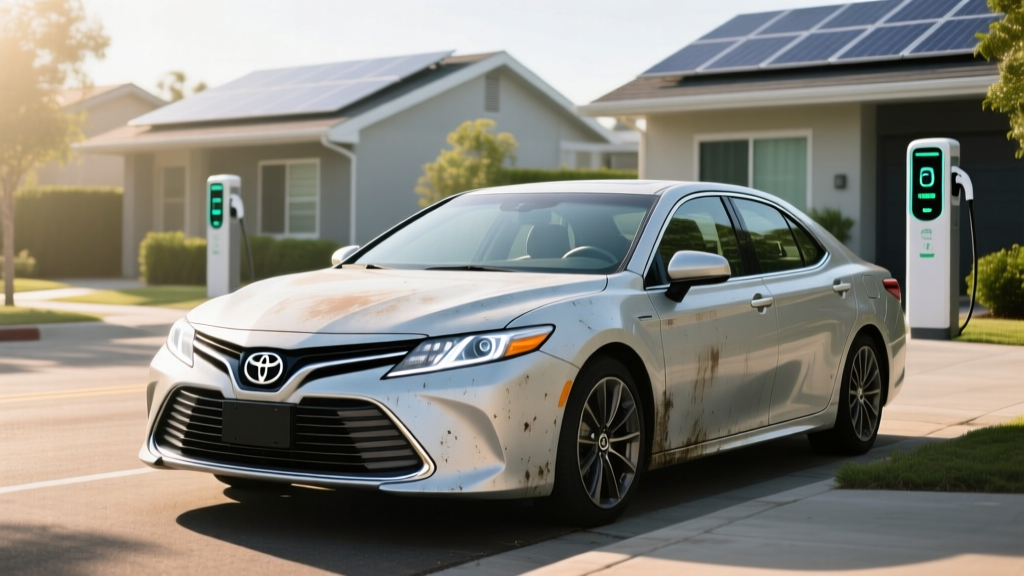
The 2012 Toyota Camry Hybrid occupies a specific place in the used-car market: it's a midsize sedan that delivers genuine fuel savings without requiring a plug, a charging routine, or any change in driving habits. Over a decade after its launch, buyers still search for this model because it represents a low-risk entry into hybrid ownership. But with a 14-year-old traction battery, degraded fuel economy, and zero federal tax credit eligibility, the calculus is different in 2026 than it was at the showroom.
This guide covers the 2012 Camry Hybrid's powertrain, real-world MPG, battery longevity, replacement costs, and how it stacks up against modern hybrids, PHEVs, and full EVs for today's buyers.
2012 Camry Hybrid Powertrain and Specs
The 2012 Camry Hybrid uses Toyota's Hybrid Synergy Drive system — a series-parallel full hybrid (HEV) architecture. It pairs a 2.5-liter inline-four Atkinson-cycle gasoline engine with an electric motor-generator, sending power to the front wheels through an electronically controlled continuously variable transmission (eCVT).
| Specification | Value |
|---|---|
| Powertrain Type | Full Hybrid (HEV) — no plug required |
| Gas Engine | 2.5L I4 Atkinson-cycle, 156 hp |
| Electric Motor | Permanent-magnet AC synchronous, 105 kW (141 hp) |
| Combined System Output | 200 hp net |
| Transmission | eCVT (planetary gearset) |
| Traction Battery | Nickel-Metal Hydride (NiMH), ~1.6 kWh (not plug-in) |
| Drivetrain | Front-wheel drive |
| 0–60 mph | ~7.6 seconds (est.) |
| Curb Weight | ~3,435 lbs |
| Original MSRP (2012) | $25,900 (base Hybrid LE) |
| 2026 Used Price Range | $7,000–$12,500 (private party, mileage-dependent) |
A critical distinction: the 2012 Camry Hybrid is a conventional hybrid (HEV), not a plug-in hybrid (PHEV). It charges its small NiMH battery exclusively through regenerative braking and the gasoline engine. You never plug it in. Toyota did not offer a Camry plug-in hybrid in 2012 — the Camry-based PHEV didn't arrive until later model years in limited markets, and Toyota's current PHEV offerings center on the RAV4 Prime and Prius Prime.
EPA Fuel Economy vs. Real-World MPG
| Driving Cycle | EPA MPG |
|---|---|
| City | 43 MPG |
| Highway | 39 MPG |
| Combined | 41 MPG |
The 2012 Camry Hybrid's EPA ratings of 43 city / 39 highway / 41 combined were class-leading at launch. The city figure exceeds the highway number — a hallmark of full hybrids, which rely heavily on electric-motor assist at low speeds and in stop-and-go traffic where regenerative braking recaptures the most energy.
Real-World MPG Expectations in 2026
Owner-reported data on fueleconomy.gov and Fuelly clusters around 37–42 MPG combined for vehicles in good condition. Several factors affect where a specific car lands:
- Battery health: A degraded NiMH pack reduces the car's ability to operate in EV-only mode at low speeds, pushing the engine to run more often. Expect a 2–5 MPG penalty on a car with significant battery degradation.
- Tire condition: The original low-rolling-resistance (LRR) tires contributed to the EPA rating. Replacement with standard all-season tires typically costs 1–3 MPG.
- Driving style: Aggressive acceleration defeats the hybrid system's efficiency advantage. Smooth, moderate driving in city conditions routinely yields 44–47 MPG from owners.
- Climate: Cold weather (below 40°F) reduces battery efficiency and forces the engine to run longer for cabin heat. Expect 34–38 MPG in winter months in northern climates.
HEV vs. PHEV vs. EV: Where Does the 2012 Camry Hybrid Fit?
| Factor | HEV (e.g., 2012 Camry Hybrid) | PHEV (e.g., 2026 Prius Prime) | BEV (e.g., 2026 Tesla Model 3) |
|---|---|---|---|
| Plug-in Required? | No | Yes (Level 1/2) | Yes (Level 2/DC) |
| Electric-Only Range | ~1 mile at low speed | 35–44 miles | 250–360+ miles |
| Total Range | ~550+ miles | ~550+ miles (gas + electric) | 250–360+ miles |
| Fuel/Charging Cost | Gasoline only | Gasoline + electricity | Electricity only |
| Federal Tax Credit (§30D) | None | Up to $7,500 (if eligible) | Up to $7,500 (if eligible) |
| Home Charging Needed? | No | Recommended | Essential |
| Maintenance Complexity | Low (engine + hybrid system) | Moderate (two full powertrains) | Low (no engine) |
Who Should Choose the 2012 Camry Hybrid?
This car fits a narrow but real buyer profile in 2026:
- No home charging access: Apartment dwellers or street-parkers who cannot install a Level 2 charger benefit from a hybrid's zero-plug convenience.
- Budget-constrained buyers: At $7,000–$12,500, a used 2012 Camry Hybrid costs a fraction of a new PHEV or BEV while still cutting fuel bills versus a gas-only Camry (~26 MPG combined for the 2012 gas 4-cylinder).
- High-mileage commuters: Drivers logging 15,000+ miles per year in mixed city/highway driving see meaningful fuel savings — roughly $600–$900/year versus a 26 MPG gas sedan at $3.20/gallon.
Who Should Look Elsewhere?
- Home-charging-capable buyers: If you can install a Level 2 charger, a used or new PHEV (like the Prius Prime) or a used BEV (like a 2020+ Chevy Bolt or Tesla Model 3) offers lower per-mile energy costs and potential tax credits.
- Buyers prioritizing warranty coverage: A 14-year-old car is largely out of factory warranty, including the hybrid battery warranty (see below).
- Tech-forward buyers: The 2012 Camry Hybrid lacks Apple CarPlay, Android Auto, modern ADAS (no automatic emergency braking, no lane-keeping assist), and contemporary infotainment.
Hybrid Battery Health, Warranty, and Replacement Cost
The hybrid traction battery is the single biggest ownership question for any used HEV. The 2012 Camry Hybrid uses a Nickel-Metal Hydride (NiMH) pack — the same chemistry Toyota used in the Prius for over a decade. NiMH is less energy-dense than modern lithium-ion but is known for predictable, gradual degradation rather than sudden failure.
Battery Degradation in 14-Year-Old NiMH Packs
NiMH batteries in Toyota hybrids typically retain 70–80% of original capacity at the 10-year mark based on fleet data and owner reports. For the 2012 Camry Hybrid, this means:
- The EV-only low-speed assist range shrinks (from already-short to nearly negligible).
- The engine engages more frequently, reducing MPG by 2–5 MPG from the original EPA rating.
- The battery cooling fan may run more often as internal resistance increases.
- The car remains drivable — degradation reduces efficiency but rarely renders the vehicle inoperable until individual cells fail.
Battery Replacement Costs in 2026
| Option | Cost Range | Warranty | Notes |
|---|---|---|---|
| New OEM Toyota Battery | $3,500–$4,500 (installed) | 3 yr / 36,000 mi | Available through Toyota dealers; most reliable option |
| Remanufactured Battery | $1,800–$2,800 (installed) | 1–3 yr (varies by shop) | Uses reconditioned NiMH modules; quality varies by supplier |
| Used/Salvage Battery | $800–$1,500 (installed) | 30–90 days typical | Highest risk; unknown remaining life |
| Individual Module Replacement | $400–$900 (installed) | Varies | Only viable if 1–2 modules are bad; requires cell-balancing expertise |
At a used-car price of $7,000–$12,500, a $3,500+ OEM battery replacement is a significant percentage of the vehicle's value. Buyers should always get a hybrid battery health check before purchase — many independent hybrid shops can perform a load test and report remaining capacity for $50–$150.
Is the 2012 Camry Hybrid Reliable?
The 2012 model year falls within Toyota's seventh-generation Camry (XV50), which earned a Top Safety Pick rating from the Insurance Institute for Highway Safety (IIHS) with "Good" ratings in moderate overlap front, side, roof strength, and head restraint tests. The hybrid variant shares the same structure.
Mechanically, the Camry Hybrid's powertrain is among the most proven in the industry. The eCVT has no clutch packs, bands, or torque converter — it's a planetary gearset with two motor-generators, and failures are rare. The 2.5L Atkinson-cycle engine runs under less thermal stress than a conventional engine due to its Miller-cycle operation and frequent electric-motor assist. Common non-hybrid maintenance items include:
- Brake pads last 80,000–120,000+ miles thanks to regenerative braking doing most deceleration work.
- The inverter cooling system should be inspected; coolant leaks from the inverter water pump have been reported on some XV50 hybrids.
- The 12V auxiliary battery (standard lead-acid, separate from the traction battery) typically lasts 4–6 years and is a common no-start culprit on neglected examples.
Tax Credit Eligibility: What You Can (and Can't) Claim
The 2012 Toyota Camry Hybrid does not qualify for the federal §30D clean vehicle tax credit. Under current IRS rules, the §30D credit applies only to new plug-in electric vehicles (PHEVs and BEVs) that meet battery capacity, critical-mineral sourcing, MSRP caps, and buyer income thresholds. Conventional hybrids (HEVs) like the 2012 Camry Hybrid have never been eligible for §30D.
Additionally, the federal used-EV credit (§25E, up to $4,000) applies only to used plug-in vehicles (PHEVs and BEVs) priced at $25,000 or less. A used conventional hybrid does not qualify.
- §30D New Clean Vehicle Credit: Not eligible (HEV, not plug-in)
- §25E Used Clean Vehicle Credit: Not eligible (HEV, not plug-in)
- State/local hybrid incentives: Vary by jurisdiction — some states offered rebates for HEVs in 2012 that have since expired. Check your state's current energy office or DMV for any remaining programs.
If tax credit eligibility is a priority, a used PHEV (like a 2021+ RAV4 Prime or Prius Prime) or a used BEV (like a Bolt or Model 3) may qualify for the §25E used-EV credit — up to $4,000 or 30% of the sale price, whichever is lower, for vehicles priced at $25,000 or less, subject to buyer income caps. Consult a tax professional for your specific situation.
2012 Camry Hybrid vs. Modern Alternatives
For context, here's how the 2012 Camry Hybrid compares to what you can buy in 2026:
| Specification | 2012 Camry Hybrid (Used) | 2026 Camry Hybrid (New) | 2026 Prius Prime (PHEV) |
|---|---|---|---|
| Powertrain | HEV (NiMH) | HEV (Li-ion) | PHEV (Li-ion) |
| Combined HP | 200 hp | 225 hp | 220 hp |
| EPA MPG (Combined) | 41 MPG | 52 MPG | 52 MPG (hybrid mode) / 127 MPGe (electric) |
| Electric-Only Range | ~1 mi | ~1 mi | ~44 mi |
| Plug-In Required? | No | No | Yes |
| Federal Tax Credit | None | None | Up to $7,500 (eligibility varies) |
| Base Price | $7,000–$12,500 (used) | ~$30,000 (MSRP) | ~$33,000 (MSRP) |
| Safety Tech | Basic (no AEB, no LKA) | TSS 3.0 (AEB, LKA, ACC) | TSS 3.0 (AEB, LKA, ACC) |
The 2026 Camry Hybrid achieves 52 MPG combined — an 11 MPG improvement over the 2012 model, thanks to a lighter lithium-ion battery pack, a more efficient fifth-generation hybrid system, and improved aerodynamics. The Prius Prime adds 44 miles of electric-only range for short commutes. However, both cost 3–4× more than a used 2012 Camry Hybrid.
- Choose the 2012 Camry Hybrid if: Your budget is under $12,000, you lack home charging, you want a proven low-maintenance hybrid, and you accept older safety tech and no warranty.
- Choose a 2026 Camry Hybrid if: You want a new-car warranty, modern ADAS (AEB, lane-keeping, adaptive cruise), 52 MPG, and can afford ~$30,000.
- Choose a PHEV (Prius Prime, RAV4 Prime) if: You have home charging, your daily commute is under 45 miles, and you want electric-only driving for most trips with gas-engine backup for road trips — plus potential §30D tax credit eligibility.
- Choose a full EV (BEV) if: You have reliable home charging, want the lowest per-mile fuel cost, prefer zero tailpipe emissions, and don't need 500+ mile single-tank range.
Pros and Cons
- 41 MPG EPA combined (43 city) — still competitive with many 2026 non-hybrid sedans
- No plug-in charging required — works with any gas station
- Proven, low-maintenance eCVT powertrain with rare major failures
- Low entry price ($7,000–$12,500 used)
- Strong regenerative braking extends brake pad life to 100K+ miles
- Spacious midsize cabin with 14.1 cu ft trunk
- Hybrid battery warranty expired — replacement costs $1,800–$4,500
- No federal or state tax credit eligibility
- Outdated safety tech — no automatic emergency braking, no lane-keeping assist
- Dated infotainment — no Apple CarPlay, Android Auto, or Bluetooth audio streaming on base trim
- NiMH battery degrades over time, reducing MPG by 2–5 from original rating
- 11 MPG less efficient than the 2026 Camry Hybrid
Frequently Asked Questions
How many MPG does the 2012 Toyota Camry Hybrid get?
The EPA rates it at 43 city / 39 highway / 41 combined MPG. In real-world driving from a well-maintained 2026 example, expect 37–42 MPG combined. City-heavy drivers often exceed the EPA city figure; highway-dominant and cold-climate drivers typically fall below the combined rating. A degraded hybrid battery can reduce real-world MPG to the low-to-mid 30s.
Does the 2012 Camry Hybrid need to be plugged in?
No. The 2012 Camry Hybrid is a conventional hybrid (HEV), not a plug-in hybrid (PHEV). It charges its small NiMH battery through regenerative braking and the gasoline engine. You fuel it exclusively at gas stations, just like a conventional car.
How far can the 2012 Camry Hybrid go on electric only?
Less than 1 mile, at very low speeds (under 25 mph), and only under light load with a fully charged hybrid battery. This is not a meaningful electric-only driving range — the system uses the electric motor primarily to assist the gas engine and enable engine-off coasting, not for sustained electric driving. For true electric-only range, you need a PHEV (35–44 miles) or a BEV (250–360+ miles).
Is the 2012 Camry Hybrid reliable, and what does a battery replacement cost?
The powertrain is among the most reliable in the industry — the eCVT and 2.5L Atkinson-cycle engine have proven durable past 200,000 miles with basic maintenance. The main risk is the NiMH hybrid battery, which at 14 years old is likely degraded and may need replacement. Costs range from $800 (used/salvage) to $4,500 (new OEM installed). A hybrid battery health check ($50–$150 at a specialist) before purchase is strongly recommended.
Does the 2012 Camry Hybrid qualify for any tax credit?
No. The federal §30D clean vehicle credit and the §25E used clean vehicle credit both require a plug-in vehicle (PHEV or BEV). The 2012 Camry Hybrid is a conventional HEV and does not qualify for any federal EV tax credit. State-level hybrid incentives that existed in 2012 have largely expired. Check your state's energy office for any current programs.
Should I buy a 2012 Camry Hybrid or a newer hybrid?
If your budget is strictly under $12,000 and you lack home charging, the 2012 Camry Hybrid remains a sensible, fuel-efficient choice. If you can spend $20,000–$30,000, a newer hybrid (2020+ Camry Hybrid, 2023+ Prius) offers dramatically better fuel economy (52–57 MPG), modern safety tech (AEB, lane-keeping), updated infotainment with smartphone integration, and remaining factory warranty — including hybrid battery coverage.