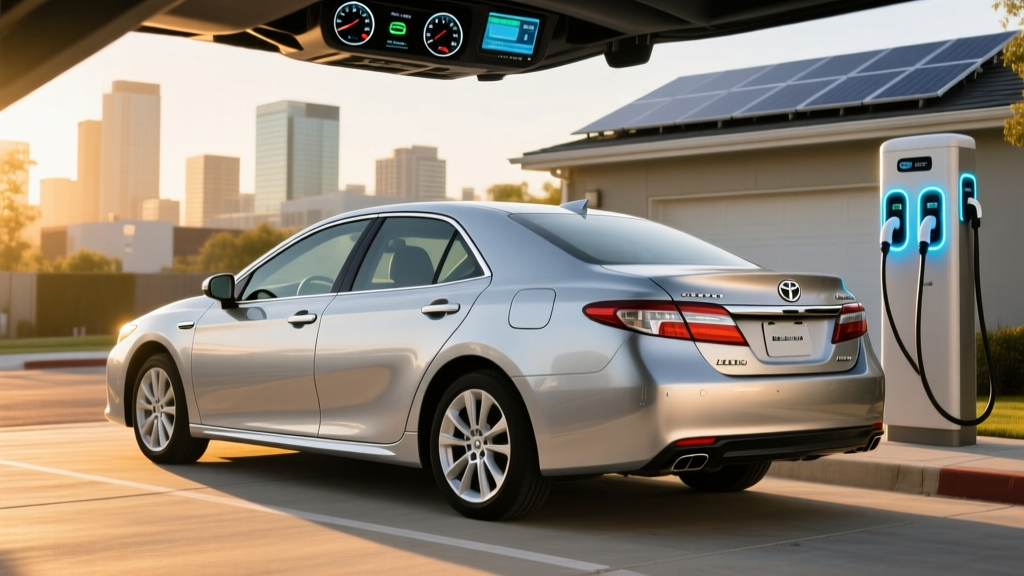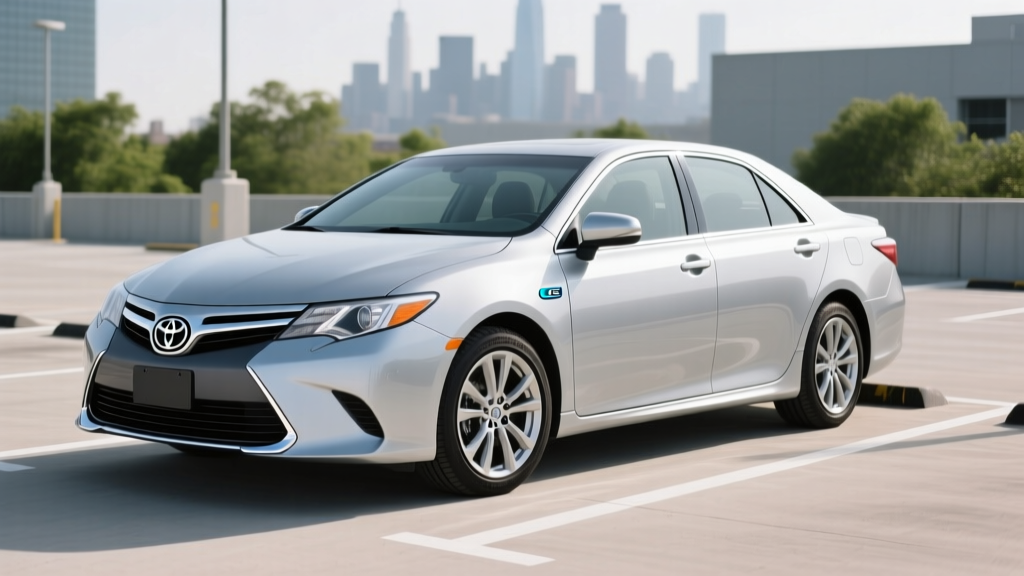
The 2012 Toyota Camry Hybrid LE occupies a specific niche in the used-car market: a midsize sedan that delivers genuine hybrid efficiency without requiring any change to your driving or fueling habits. More than a decade after its debut, it remains one of the most accessible entry points into hybrid ownership, with examples regularly appearing on the used market between $8,000 and $14,000 depending on mileage and condition. This review breaks down exactly what you get — and what to watch out for — if you're considering one in 2026.
HEV vs. PHEV: Where the Camry Hybrid Fits
Conventional Hybrid (HEV): The 2012 Camry Hybrid LE is a self-charging hybrid. It has no plug, no electric-only driving mode of meaningful distance, and requires zero infrastructure changes. The gasoline engine and regenerative braking keep a small battery charged. You simply fill it with gas and drive.
Plug-in Hybrid (PHEV): A PHEV like the Toyota Prius Prime or RAV4 Prime carries a larger battery (typically 13–18 kWh) that you plug in to charge, enabling 25–42 miles of electric-only driving before the gas engine engages. PHEVs require access to a charging outlet to realize their efficiency advantage.
Full EV (BEV): A battery electric vehicle like the Tesla Model 3 or Hyundai Ioniq 6 has no gasoline engine at all, relying entirely on a large battery pack (50–100+ kWh) and electric motors.
The 2012 Camry Hybrid LE is firmly in the HEV category. If you don't have access to home charging or want to avoid any plug-in logistics, this is the powertrain type designed for you.
Fuel Economy: EPA Ratings and Real-World MPG
| Metric | EPA Estimate | Real-World Expectation |
|---|---|---|
| City MPG | 43 MPG | 40–45 MPG (hybrids excel in stop-and-go) |
| Highway MPG | 39 MPG | 36–40 MPG (less regen benefit at steady speed) |
| Combined MPG | 41 MPG | 38–42 MPG depending on driving mix |
Source: EPA Fuel Economy Guide
The 2012 Camry Hybrid LE uses Toyota's Hybrid Synergy Drive, which allows the electric motor to handle low-speed driving and assists the gasoline engine during acceleration. In city driving, the system shuts off the engine at stops and uses regenerative braking to recapture energy — this is why the city MPG actually exceeds the highway figure, a hallmark of conventional hybrids.
Real-world note: Many owners report exceeding the EPA combined estimate in predominantly urban commutes. In mixed highway-and-city driving at 70+ mph, expect figures closer to 36–38 MPG. Cold weather reduces efficiency by roughly 5–8% due to increased engine idling for cabin heat and reduced battery efficiency.
Powertrain Specifications
| Specification | 2012 Camry Hybrid LE |
|---|---|
| Engine | 2.5L inline-4 (2AR-FXE, Atkinson cycle) |
| Engine Horsepower | 156 HP @ 5,700 RPM |
| Electric Motor | Permanent magnet synchronous, 105 kW (141 HP) |
| Net Combined System HP | 200 HP |
| Transmission | eCVT (planetary gearset, no traditional belt/pulleys) |
| Hybrid Battery | 1.6 kWh (usable ~1.0 kWh), Nickel-Metal Hydride (NiMH) |
| 0–60 MPH | ~7.6 seconds |
| Drivetrain | Front-wheel drive |
| Fuel Tank | 17.2 gallons |
| Total Driving Range | ~705 miles (EPA combined) |
| Curb Weight | ~3,435 lbs |
The 2.5-liter Atkinson-cycle engine sacrifices some low-RPM torque for greater thermal efficiency, while the electric motor fills in the torque gap off the line. The eCVT is not a conventional continuously variable transmission with a steel belt — it uses a planetary gearset that seamlessly blends power from the engine and motor. This design has proven extremely durable, with no belts or clutches to wear out.
Battery Health, Warranty, and Replacement Cost
Original Warranty: Toyota covered the hybrid battery for 8 years / 100,000 miles (10 years / 150,000 miles in California and states adopting CARB emissions standards). For a 2012 model, original factory coverage has expired unless the vehicle has exceptionally low mileage and is registered in a CARB state.
Battery Chemistry: Nickel-Metal Hydride (NiMH). This chemistry is heavier and less energy-dense than modern lithium-ion, but it has a well-documented track record for longevity. Many first-generation Prius and Camry Hybrid batteries have exceeded 200,000 miles before significant degradation.
What Is the Battery Replacement Cost?
If the hybrid battery does fail, here is what to expect in 2026:
- New OEM battery (Toyota dealer): $3,000–$4,000 installed
- Remanufactured battery: $1,500–$2,500 installed (from suppliers like Green Bean Battery or Dorman)
- Used/salvage battery: $500–$1,000 (higher risk, shorter remaining life)
- Individual cell/module replacement: $300–$800 if only one or two modules are weak (requires a shop with hybrid battery diagnostic capability)
Practical reality: The NiMH pack in the 2012 Camry Hybrid is one of the most reliable hybrid batteries Toyota has built. Complete failure is uncommon before 180,000–200,000 miles. More often, individual modules degrade unevenly, which can be addressed with module-level reconditioning at a fraction of full replacement cost. When evaluating a used example, request a hybrid battery health report from a Toyota dealer or a hybrid specialist — they can read the individual module voltage deltas to assess remaining life.
Pricing and Tax Credit Eligibility
As a used vehicle purchased in 2026, the 2012 Camry Hybrid LE is not eligible for the new-vehicle federal tax credit under IRS §30D. However, it may qualify for the Used Clean Vehicle Credit (IRC §25E):
- Credit amount: Up to $4,000 or 30% of the sale price, whichever is less
- Vehicle price cap: Sale price must be $25,000 or less (virtually all 2012 Camry Hybrids qualify)
- Buyer income cap: AGI must not exceed $75,000 (single), $112,500 (head of household), or $150,000 (joint filers)
- Dealer requirement: Must be purchased from a licensed dealer (private-party sales do not qualify)
- Vehicle age requirement: Must be at least 2 model years old (2012 easily qualifies)
- One-time use: The credit can only be claimed once per buyer every 3 years
Source: IRS Used Clean Vehicle Credit
Used market pricing (2026): Expect to pay $8,000–$14,000 for a 2012 Camry Hybrid LE depending on mileage (80K–160K miles), condition, and region. At a $12,000 dealer purchase price, the 30% calculation yields a $3,600 credit — making the effective cost as low as $8,400 for income-eligible buyers.
Who Should Choose the 2012 Camry Hybrid LE?
Pros
- Proven 41 MPG combined — real-world city driving often exceeds 43 MPG
- No plug required; zero infrastructure or habit changes
- Strong reliability record for powertrain and eCVT
- NiMH battery longevity often exceeds 200,000 miles
- Eligible for up to $4,000 used-EV credit for income-qualified buyers
- Comfortable midsize sedan with 15.4 cu ft trunk (only slightly reduced vs. gas Camry)
- Smooth, quiet operation in EV mode at low speeds
Cons
- No electric-only driving beyond ~1 mile at very low speed
- Outdated infotainment (no Apple CarPlay, Android Auto, or modern safety tech)
- NiMH battery is heavier and less efficient than modern Li-ion packs
- eCVT drone under hard acceleration (common to all Toyota hybrids of this era)
- Original hybrid battery warranty has expired on most examples
- Not eligible for the $7,500 new-vehicle §30D credit
Hybrid vs. PHEV vs. Full EV — Which Fits You?
Choose the 2012 Camry Hybrid LE (HEV) if: You want better fuel economy without changing your fueling routine, lack access to home or workplace charging, drive a mix of city and highway miles, and want a low-risk, proven platform at a budget price.
Choose a PHEV (e.g., Prius Prime, RAV4 Prime) if: You have reliable home charging, your daily commute is under 30–40 miles (within electric-only range), and you want to drive mostly on electricity while keeping a gas engine for longer trips.
Choose a full EV (e.g., Model 3, Ioniq 5) if: You have home Level 2 charging, want to eliminate gasoline entirely, your daily driving is under 250 miles, and you're ready for a higher upfront cost in exchange for lower per-mile energy costs and reduced maintenance.
Reliability and Long-Term Ownership Notes
Toyota's hybrid system in this generation is among the most thoroughly proven in the automotive industry. The eCVT planetary gearset has no friction bands, belts, or clutches to replace. The inverter and electric motor are sealed units that rarely fail. The most common maintenance items specific to the hybrid system are:
- Hybrid battery cooling fan filter: Located behind the rear seat on the passenger side. Clean or replace every 30,000–50,000 miles. A clogged filter causes the battery to overheat and degrade prematurely — this is the single most overlooked maintenance item on used Camry Hybrids.
- Brake actuator: The electrohydraulic brake system can develop issues around 120,000–150,000 miles. Replacement runs $1,200–$1,800. Watch for a stiff brake pedal or ABS warning light.
- Inverter coolant pump: Electric water pump circulates coolant through the inverter. Failure is uncommon but can cause the hybrid system to shut down. ~$400–$600 replacement.
According to NHTSA records, the 2012 Camry Hybrid has no major recurring safety recalls specific to the hybrid system. Standard Camry recalls (airbags, fuel lines) should be verified by VIN on NHTSA.gov before purchase.
Frequently Asked Questions
How many MPG does the 2012 Toyota Camry Hybrid LE get?
The EPA rates it at 43 city / 39 highway / 41 combined MPG. In real-world city-heavy driving, many owners achieve 42–45 MPG. Highway-only driving at 75+ mph typically yields 36–38 MPG. Cold weather and short trips reduce these figures by 5–10%.
Does the 2012 Camry Hybrid need to be plugged in?
No. This is a conventional hybrid (HEV), not a plug-in hybrid. The battery charges through regenerative braking and the gasoline engine. You never plug it in — just fill the 17.2-gallon tank with regular unleaded.
How far can it drive on electric power alone?
Under a mile at speeds below 25 MPH in ideal conditions. The 1.6 kWh NiMH battery is too small for meaningful electric-only driving. The electric motor primarily assists the gas engine and handles low-speed maneuvering to improve efficiency.
Is the hybrid battery reliable, and what does replacement cost?
Yes — the NiMH battery in this generation is known for lasting 180,000–250,000 miles with proper cooling system maintenance. If replacement is needed, expect $1,500–$2,500 for a remanufactured unit or $3,000–$4,000 for new OEM. Module-level repair can cost as little as $300–$800.
Does it qualify for any tax credit in 2026?
Not the new-vehicle §30D credit. However, if purchased from a dealer for $25,000 or less and your income falls under IRS thresholds ($75K single / $150K joint), you may qualify for the Used Clean Vehicle Credit under IRC §25E — up to $4,000 or 30% of sale price. Consult a tax professional to confirm eligibility.
How does the 2012 Camry Hybrid compare to a modern hybrid?
The current-generation Camry Hybrid (2025–2026) achieves 51–53 MPG combined using a lithium-ion battery and a more efficient fifth-generation hybrid system. You gain ~12 MPG and modern tech, but pay $29,000+ new versus $8,000–$14,000 used. The efficiency gap matters most if you drive 15,000+ miles annually — at that volume, the fuel savings of a newer hybrid can justify the higher purchase price within 4–5 years.