Quick Verdict: The 2012 Prius PHEV at a Glance
The 2012 Toyota Prius Plug-In Hybrid (sometimes called the Prius PHV) was Toyota's first mass-market experiment in bridging conventional hybrid efficiency with a plug-in electric commute. Over a decade later, it remains one of the most affordable entry points into plug-in ownership on the used market — typically changing hands for $6,000 to $10,000 depending on mileage and battery condition.
But with just 11 miles of EPA-rated electric-only range and a now-aging 4.4 kWh lithium-ion battery pack, the 2012 Prius PHEV is more of a hyper-efficient hybrid with a small electric bonus than a true EV alternative. Here's everything you need to know before buying one in 2026.
| Spec | Value |
|---|---|
| EPA Electric-Only Range | 11 miles (EV mode, blended) |
| EPA Combined MPGe (EV + Gas) | 95 MPGe |
| EPA Combined MPG (Gas Only) | 50 MPG |
| EPA City / Highway MPG (Gas) | 51 city / 49 highway |
| Battery Capacity (Usable) | ~3.0 kWh usable of 4.4 kWh total |
| Battery Chemistry | Lithium-ion (panasonic cells) |
| Combined Horsepower | 134 hp (net system) |
| Engine | 1.8L 4-cylinder Atkinson cycle (98 hp) |
| Electric Motor | 60 kW (80 hp) AC synchronous |
| Level 1 Charge Time (120V) | ~3 hours (0-100%) |
| Level 2 Charge Time (240V) | ~1.5 hours (0-100%) |
| DC Fast Charging | Not supported |
| Charge Port | J1772 |
| Original MSRP | $32,000 – $39,520 (before incentives) |
| 2026 Used Price Range | $6,000 – $10,000 |
| Battery Warranty (Original) | 8 years / 100,000 miles (10 yr / 150k in CARB states) |
HEV vs PHEV: What Made the 2012 Prius Plug-In Different
The standard third-generation Prius (2010–2015) is a conventional hybrid electric vehicle (HEV). It uses a small nickel-metal hydride (NiMH) battery charged exclusively by regenerative braking and the gasoline engine. You never plug it in. It gets an EPA-rated 50 MPG combined and operates seamlessly between gas and electric power.
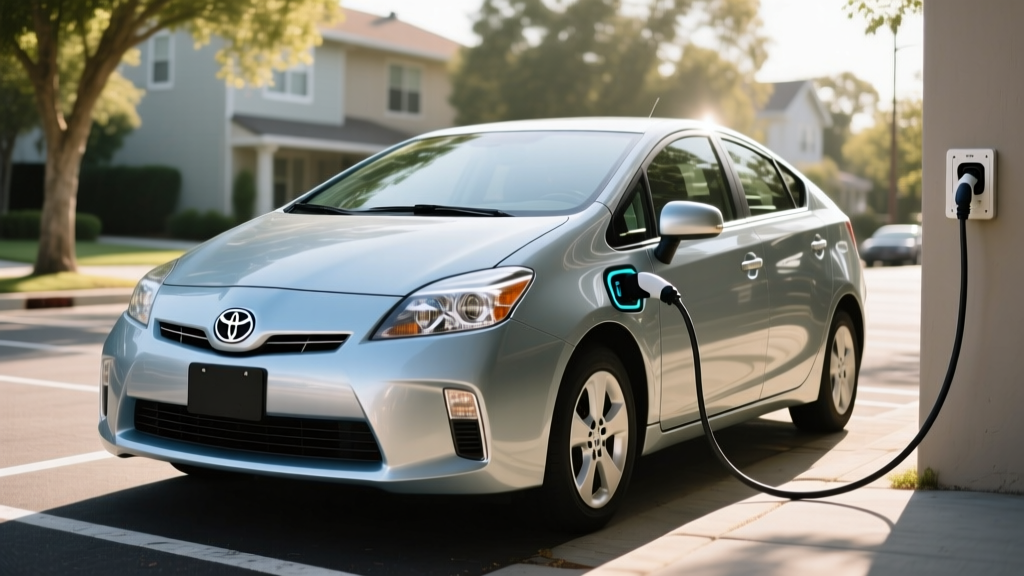
The 2012 Prius Plug-In Hybrid (PHEV) replaced that NiMH pack with a larger 4.4 kWh lithium-ion battery and added a charge port (J1772 connector). This allowed roughly 11 miles of electric-only driving at speeds up to 62 mph before the 1.8L gasoline engine engaged. Once the electric range was depleted, it reverted to standard hybrid operation at 50 MPG.
| Attribute | Standard Prius (HEV) | Prius Plug-In (PHEV) |
|---|---|---|
| Plugs In? | No | Yes (J1772) |
| Battery Type | NiMH (~1.3 kWh) | Lithium-ion (4.4 kWh) |
| Electric-Only Range | <1 mile at low speed | 11 miles (EPA) |
| Combined MPG (Gas) | 50 MPG | 50 MPG |
| Combined MPGe | N/A | 95 MPGe |
| Charge Time (120V) | N/A | ~3 hours |
| Charge Time (240V) | N/A | ~1.5 hours |
| Cargo Space | 21.6 cu ft | ~19 cu ft (battery intrusion) |
| Original MSRP | ~$24,000 | ~$32,000+ |
Fuel Economy: EPA Ratings vs. Real-World MPG
The 2012 Prius PHEV carries two sets of efficiency numbers depending on whether the battery is charged:
| Mode | City | Highway | Combined |
|---|---|---|---|
| EV + Gas (charged battery) | 95 MPGe combined | ~6 mi gas + 11 mi EV typical | |
| Gas Only (depleted battery) | 51 MPG | 49 MPG | 50 MPG |
According to fueleconomy.gov, the 2012 Prius Plug-In achieves 95 MPGe when operating on its combined electric and gasoline range, and 50 MPG combined once the battery is depleted and it functions as a standard hybrid.
Real-World MPG: What Owners Actually See
The Prius platform has a well-documented real-world advantage in city driving. Because regenerative braking recaptures energy in stop-and-go traffic, many owners report 52–56 MPG in city conditions — exceeding the EPA city rating. Highway driving at sustained 70+ mph speeds tends to drop to 44–47 MPG, below the EPA highway estimate, because aerodynamic drag dominates and regen opportunities are limited.
For the electric-only portion, the 11-mile EPA rating was measured under ideal conditions. In real-world commuting with HVAC use, hills, or cold weather, expect 7–9 miles of usable electric range. In freezing temperatures, the gasoline engine may engage almost immediately to provide cabin heat, effectively eliminating EV mode.
Charging: Level 1, Level 2, and the No-DC-Fast-Charge Limitation
The 2012 Prius PHEV uses a standard J1772 charge port and supports two charging levels:
- Level 1 (120V household outlet): Draws approximately 1.4 kW. A full charge from empty takes about 3 hours. This is practical for overnight topping up if your commute is short.
- Level 2 (240V): Draws approximately 3.3 kW. A full charge takes roughly 1.5 hours. This requires a dedicated 240V circuit and a J1772-compatible Level 2 EVSE (charging station).
DC fast charging is not supported. The 2012 Prius PHEV has no CCS, CHAdeMO, or any DC charge capability. This is typical of early PHEVs — the battery is small enough that Level 2 fills it quickly, and the vehicle wasn't designed for road-trip electric driving.
Charging cost is minimal. At the national average residential electricity rate of roughly $0.16/kWh, fully recharging the ~3.0 kWh usable battery costs approximately $0.48 — enough for about 9 miles of real-world electric driving. That translates to roughly 5.3 cents per electric mile, compared to approximately 12–14 cents per mile on gasoline at $3.20/gallon and 50 MPG.
Powertrain and Performance
The 2012 Prius PHEV shares the third-generation Prius Hybrid Synergy Drive powertrain with one key upgrade — the larger lithium-ion battery pack enables more sustained electric-only propulsion.
- Engine: 1.8-liter 4-cylinder Atkinson-cycle producing 98 hp and 105 lb-ft of torque
- Electric Motor: 60 kW (80 hp) AC synchronous motor integrated into the transaxle
- Net System Output: 134 hp combined
- Transmission: eCVT (planetary gearset, not a traditional belt CVT)
- 0–60 mph: Approximately 9.8 seconds
- Top Speed (EV mode): 62 mph
Performance is adequate for commuting but unremarkable. The eCVT delivers smooth, linear acceleration with no shift shock. The EV mode is quiet and refined for its short range. Highway merging requires planning — this is an efficiency-first vehicle, and the 134 hp system output reflects that priority.
Used Pricing, Tax Credits, and the 2026 Buying Landscape
The 2012 Prius PHEV originally retailed from $32,000 to $39,520 depending on trim (base and Advanced), before a $2,500 federal tax credit that was available at the time of purchase. That credit has long since expired for new purchases of this model.
Current Used Market Pricing (2026)
Expect to pay between $6,000 and $10,000 for a 2012 Prius Plug-In, depending on mileage, condition, and critically, battery health. Lower-mileage examples with documented battery health checks command the top of that range.
Does It Qualify for Any Tax Credit Today?
For used EV/PHEV purchases, the IRS §25E credit offers up to $4,000 or 30% of the sale price (whichever is lower) for qualifying used plug-in vehicles purchased from a licensed dealer. However, several conditions apply:
- The vehicle must be purchased from a licensed dealer (private-party sales do not qualify)
- The sale price must be $25,000 or less (the 2012 Prius PHEV easily clears this bar)
- The buyer must meet income caps: $75,000 single / $112,500 head of household / $150,000 joint filers (modified AGI)
- The vehicle must have a battery capacity of at least 7 kWh — and here the 2012 Prius PHEV does not qualify, as its 4.4 kWh pack falls below the §25E threshold
Battery Health, Warranty, and Replacement Cost
This is the single most important factor when evaluating any used Prius — and especially a 14-year-old PHEV.
Degradation Expectations
Lithium-ion batteries in early Prius PHEVs have generally held up well thanks to Toyota's conservative battery management system, which maintains a large buffer (only ~3.0 kWh of the 4.4 kWh pack is usable). However, after 12–14 years, expect 20–35% capacity loss in the traction battery. This means real-world electric-only range may have dropped from 11 miles to 5–8 miles on a good day.
The high-voltage battery's State of Health (SoH) can be checked via an OBD-II scanner with Toyota Hybrid-specific software (such as Techstream or the third-party Dr. Prius app). Always request this data before purchase.
Battery Replacement Cost
If the traction battery fails or degrades beyond usability:
- Toyota dealership replacement (new OEM): $3,000–$4,500 installed
- Refurbished/remanufactured pack: $1,500–$2,500 installed (independent hybrid shops)
- Individual cell module replacement: $500–$1,200 if only specific modules are weak (common failure mode)
At the $6,000–$10,000 purchase price, a $2,000–$4,000 battery replacement is a significant percentage of the vehicle's value. Factor this into your budget. Many used examples are sold with degraded batteries that the owner didn't want to replace.
The 12V Auxiliary Battery
The 2012 Prius PHEV also has a small 12V auxiliary battery (located in the rear cargo area) that powers the vehicle's computers and accessories. This is a standard automotive concern and typically costs $150–$250 to replace. A dead 12V battery will prevent the car from starting, even if the high-voltage pack is fully charged.
Reliability and Long-Term Ownership
The third-generation Prius platform (2010–2015) is widely regarded as one of the most reliable vehicles Toyota has ever built. The Hybrid Synergy Drive eCVT has no belts, clutches, or brushes to wear out, and the planetary gearset is exceptionally durable. Many standard Priuses from this era have surpassed 300,000 miles with minimal powertrain issues.
Specific concerns for the 2012 PHEV variant include:
- EGR (Exhaust Gas Recirculation) system clogging: A known issue in the Gen 3 Prius that can cause head gasket failure if not addressed. The EGR cooler and valve should be cleaned every 50,000–80,000 miles. Budget $300–$600 for this service if there's no record of it.
- Oil consumption: Some 2ZR-FXE engines in this generation consume oil between changes. Check oil levels regularly.
- Inverter coolant pump: Occasionally fails; replacement is ~$400–$700.
- Brake actuator: The regenerative braking system's accumulator can fail on higher-mileage units. Replacement runs $1,200–$1,800 at a dealer.
Overall, a well-maintained 2012 Prius PHEV is a low-risk used purchase mechanically — the hybrid system itself is remarkably robust. The main financial risk is the traction battery.
Who Should Buy the 2012 Prius PHEV — And Who Shouldn't
✓ Choose the 2012 Prius PHEV If:
- Your daily commute is under 10 miles and you can charge at home (120V is sufficient)
- You want the lowest possible cost-per-mile vehicle under $10,000
- You don't have reliable access to public DC fast charging and want to avoid full EV range limitations
- You need a proven, ultra-reliable commuter with cheap maintenance
- You live in a mild climate where cold-weather EV range loss is less of a factor
✗ Skip the 2012 Prius PHEV If:
- You want meaningful electric-only range (consider a 2017+ Prius Prime with 25 miles, or a 2021+ with 25–44 miles)
- You're looking for federal tax credit eligibility (the 4.4 kWh battery disqualifies it)
- You regularly drive in freezing climates where the EV mode will be negated
- Cargo space is a priority (the larger battery reduces rear cargo volume)
- You want modern safety tech — this model predates Toyota Safety Sense (no AEB, no lane-keeping assist)
Hybrid vs PHEV vs Full EV: Which Fits You?
The 2012 Prius PHEV sits in a narrow niche. Here's how to decide:
- Choose a conventional HEV (standard Prius) if you can't charge at home or at work. You'll get the same 50 MPG without needing a plug, and you'll save $1,000–$3,000 on the purchase price versus the PHEV variant.
- Choose this PHEV if you can plug in at home (even a standard 120V outlet), your commute is very short, and you want to burn less gasoline on daily errands while retaining unlimited range for road trips.
- Choose a full BEV if you want zero tailpipe emissions, minimal maintenance, and have home Level 2 charging. A used Chevrolet Bolt EV (2017–2023, 238–259 miles range) or used Nissan Leaf can be found in the $10,000–$16,000 range and may qualify for the $4,000 used-EV tax credit under §25E.
Frequently Asked Questions
How many MPG does the 2012 Prius Plug-In get?
The EPA rates it at 50 MPG combined (51 city / 49 highway) when running on gasoline after the battery is depleted. In real-world city driving, many owners see 52–56 MPG thanks to regenerative braking. Highway cruising at 70+ mph typically yields 44–47 MPG.
How far can the 2012 Prius PHEV go on electric only?
The EPA rates it at 11 miles of electric-only range in blended EV mode (the engine may briefly engage under heavy acceleration). Real-world range is typically 7–9 miles in moderate weather and can drop to 3–5 miles in cold conditions. Total combined range (electric + full gas tank) exceeds 500 miles.
Is the 2012 Prius PHEV reliable?
Yes. The Gen 3 Prius powertrain is one of Toyota's most durable. The eCVT, planetary gearset, and electric motor have very few failure points. The main risks are traction battery degradation (expected after 12+ years), EGR system clogging, and brake actuator wear at high mileage. With proper maintenance, 200,000+ miles is common.
What does it cost to replace the hybrid battery?
A new OEM battery from Toyota costs $3,000–$4,500 installed. Refurbished packs from independent hybrid specialists run $1,500–$2,500. Individual module replacement (often the actual fix) costs $500–$1,200. Always get a battery health report via OBD-II before purchasing.
Does the 2012 Prius PHEV qualify for any tax credit in 2026?
No. The federal §25E used clean vehicle credit requires a battery capacity of at least 7 kWh, and the 2012 Prius PHEV's 4.4 kWh pack does not meet this threshold. The original $2,500 federal credit available at new-vehicle purchase has long expired. No current federal incentive applies. Check your state's DMV or energy office for any local programs.
Can the 2012 Prius PHEV charge at public charging stations?
Yes, but only at Level 2 stations with a J1772 connector. It cannot use DC fast chargers (CCS, CHAdeMO, or NACS/Tesla Superchargers). Given the small battery, Level 2 charging fills it in about 1.5 hours. Most owners charge exclusively at home via a standard 120V outlet.
How does the 2012 Prius PHEV compare to the current Prius Prime?
The gap is enormous. The 2025–2026 Toyota Prius Prime offers 40–44 miles of electric-only range, a 13.6 kWh battery, 220 combined horsepower, DC fast charging (on select trims), Toyota Safety Sense 3.0, and qualifies for a portion of the §30D federal tax credit. If budget allows ($33,000+ new), the current Prime is a dramatically more capable vehicle. The 2012 model makes sense only as a budget used buy.