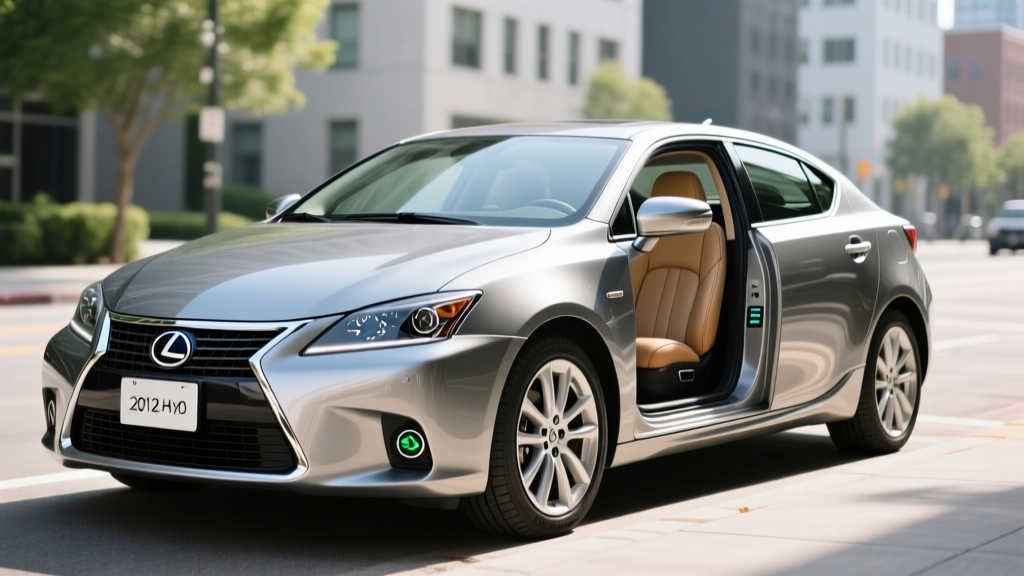
If you're researching used luxury compacts that sip fuel, the 2012 Lexus CT 200h hybrid keeps appearing on shortlists — and for good reason. It pairs Toyota's proven third-generation Prius powertrain with a Lexus badge, delivering over 40 MPG in a premium hatchback package. But as a used hybrid now well over a decade old, prospective buyers have legitimate questions: What's the real-world fuel economy? How much does a replacement hybrid battery cost? And does the CT 200h still hold up against modern hybrids and EVs in 2026?
This guide covers everything you need to evaluate a used 2012 CT 200h, from EPA and real-world MPG data to battery longevity, ownership costs, and how it stacks up against today's electrified options.
HEV vs PHEV: Where the CT 200h Fits
The 2012 Lexus CT 200h is a conventional hybrid electric vehicle (HEV) — not a plug-in hybrid (PHEV). This distinction matters because it defines how you interact with the car daily.
| Feature | HEV (CT 200h) | PHEV (e.g., Toyota Prius Prime) |
|---|---|---|
| Plug-in charging required? | No — regenerates via braking & engine | Yes — plug in for electric-only miles |
| Electric-only range | ~1 mile at very low speed | 25–44 miles (model dependent) |
| Battery size | 1.3 kWh (NiMH) | 8.8–13.6 kWh (Li-ion) |
| Federal tax credit (§30D) | Not eligible | Up to $7,500 (if requirements met) |
| Home charging needed? | No | Yes, for full benefit |
The CT 200h charges its small nickel-metal hydride (NiMH) battery through regenerative braking and the gasoline engine. You never plug it in. You simply drive it like a conventional car and let the hybrid system manage energy flow automatically.
EPA Fuel Economy and Real-World MPG
The EPA rates the 2012 Lexus CT 200h at:
| Driving Cycle | EPA MPG |
|---|---|
| City | 43 MPG |
| Highway | 40 MPG |
| Combined | 42 MPG |
Real-World MPG: What Owners Actually Report
Hybrids often exceed their EPA city ratings in stop-and-go traffic because regenerative braking recaptures energy that a gas car wastes as heat. The CT 200h is no exception. Owner-reported data on Fuelly and hybrid forums consistently shows real-world combined MPG between 40 and 48, with city-heavy commuters sometimes seeing 50+ MPG in warm weather.
Highway driving tells a different story. At sustained 70–80 mph speeds, the 1.8L Atkinson-cycle engine does most of the work with less assistance from the electric motor. Expect 36–39 MPG on the highway at interstate speeds — slightly below the EPA highway estimate. Cold weather reduces MPG further, typically by 3–5 MPG, as the engine runs more often to maintain cabin heat and battery temperature.
With a 10.6-gallon fuel tank, real-world range sits between 400 and 480 miles per tank depending on your driving mix.
Powertrain and Performance Specs
The 2012 CT 200h shares its hybrid powertrain with the third-generation Toyota Prius (2010–2015). Here's what's under the hood:
| Specification | 2012 Lexus CT 200h |
|---|---|
| Engine | 1.8L 4-cylinder Atkinson-cycle (2ZR-FXE) |
| Engine output | 98 hp / 105 lb-ft torque |
| Electric motor output | 80 hp (60 kW) |
| Net combined horsepower | 134 hp |
| Transmission | eCVT (planetary gearset, not a belt CVT) |
| Hybrid battery | 1.3 kWh NiMH (28 modules) |
| 0–60 mph | ~9.8 seconds |
| Drivetrain | Front-wheel drive |
| Curb weight | ~3,130 lbs |
| Cargo volume | 14.3 cu ft (rear seats up) / 37.4 cu ft (folded) |
Let's be direct: the CT 200h is not quick. A 9.8-second 0–60 time feels leisurely by 2026 standards, especially merging onto fast-moving highways. The eCVT does a competent job managing the transition between electric and gas power, but there's no sport mode that transforms the experience — the "Sport" setting mainly sharpens throttle response and adds weight to the steering.
Where the powertrain excels is in urban smoothness. Below ~25 mph, the CT 200h frequently operates in EV mode, making stoplight-to-stoplight driving nearly silent. The transition from electric to gas is one of the most seamless in the Toyota/Lexus hybrid lineup.
Hybrid Battery Longevity and Replacement Cost
This is the single biggest concern for any used hybrid buyer, and it deserves a thorough answer.
Original Battery Warranty
When new, Lexus covered the CT 200h hybrid battery for 8 years / 100,000 miles (10 years / 150,000 miles in CARB states including California, New York, Massachusetts, and others that follow California emissions standards). For a 2012 model, that factory warranty has expired in all cases as of 2026.
How Long Do CT 200h Batteries Actually Last?
The NiMH battery pack in the CT 200h has proven remarkably durable. Based on long-term owner reports, taxi fleet data (the CT 200h was popular as a premium ride-share vehicle in some markets), and Toyota/Prius platform reliability studies:
- Typical lifespan: 150,000–200,000 miles before significant degradation
- Failure mode: Usually individual cell/module imbalance rather than total pack failure
- Degradation symptom: Reduced EV-mode frequency, slightly lower MPG, "Check Hybrid System" warning
At 14 years old, many 2012 CT 200h examples are approaching or have exceeded the 150,000-mile mark. If you're buying one, ask for a hybrid battery health check — a Toyota/Lexus dealer or independent hybrid specialist can read the battery's State of Health (SoH) and check for voltage imbalance across the 28 NiMH modules.
Battery Replacement Cost in 2026
| Option | Cost Range | Notes |
|---|---|---|
| New OEM Lexus battery | $3,000–$4,000 | Full pack, dealer-installed; includes labor |
| Refurbished/remanufactured pack | $1,500–$2,500 | Replaced weak modules; 1–3 year warranty typical |
| Individual module replacement | $400–$900 | Only bad modules swapped; requires specialist diagnosis |
| Used pack from salvage | $600–$1,200 | Risky — unknown remaining life; no warranty |
The good news: you rarely need a full new OEM pack. Most hybrid specialists can identify and replace just the 2–4 degraded modules for under $1,000, extending the pack's life by another 80,000+ miles. Companies like Project Lithium and independent hybrid shops offer reconditioning services that are well-established for the Toyota/Lexus NiMH platform.
Reliability and Ownership Costs
The 2012 CT 200h inherits the Prius's reputation as one of the most reliable vehicles Toyota has ever built. The IIHS rated it a Top Safety Pick for its crash-test performance, and the powertrain's simplicity (no traditional transmission, no starter motor, no alternator — all replaced by the hybrid system) means fewer components to fail.
Common Issues to Watch For
- 12V auxiliary battery: Located in the rear cargo area; tends to die if the car sits unused for weeks. Replacement: ~$200–$300 (AGM type required).
- Brake actuator recall: Some 2010–2012 CT 200h models were included in Toyota's brake booster recall. Verify recall completion via NHTSA's VIN lookup.
- Water pump: The electric water pump can fail around 100,000–120,000 miles. Replacement: ~$400–$600.
- EGR valve clogging: Common on high-mileage examples; causes rough idle. Cleaning or replacement: ~$200–$400.
- Head gasket: Rare but reported on high-mileage 2ZR-FXE engines, particularly if coolant was neglected. Watch for coolant loss or white exhaust smoke.
Annual Ownership Cost Estimate
For a 2012 CT 200h with ~120,000 miles, budget roughly:
- Fuel: ~$1,100–$1,300/year (at 12,000 miles, 42 MPG, $3.50/gal)
- Insurance: ~$900–$1,400/year (varies significantly by state and driver profile)
- Maintenance: ~$400–$700/year (oil changes, filters, brake pads last 80,000+ miles thanks to regen)
- Repairs reserve: ~$500–$1,000/year (set aside for aging components)
Pricing and Tax Credit Eligibility
The 2012 Lexus CT 200h originally started at $29,120 MSRP (before destination). In 2026, used examples trade in the following ranges depending on mileage and condition:
- 80,000–100,000 miles: $9,000–$12,000
- 100,000–130,000 miles: $7,000–$9,500
- 130,000+ miles: $5,500–$7,500
Federal Tax Credit Status
The 2012 CT 200h does not qualify for the federal §30D new vehicle tax credit — it's a conventional HEV, not a plug-in, and it's sold as a used vehicle. The IRS used clean vehicle credit (up to $4,000 or 30% of sale price) only applies to used EVs and PHEVs with at least 4 kWh of battery capacity that are purchased from a dealer. Since the CT 200h is a conventional hybrid with a 1.3 kWh pack and no plug-in capability, it does not meet the eligibility criteria.
Some states offer their own incentives for hybrid purchases, but these are increasingly targeted at PHEVs and BEVs. Check your state's energy office or DMV for current programs.
CT 200h vs Modern Hybrids, PHEVs, and EVs
If you're considering a used CT 200h, you're likely cross-shopping it against other electrified options. Here's how the decision breaks down:
Reasons to Choose the 2012 CT 200h
- Low purchase price ($6K–$12K) vs $28K+ for a new hybrid
- Proven, well-understood powertrain with cheap parts availability
- No plug-in infrastructure needed — ideal for apartment dwellers
- Lexus build quality and cabin materials exceed most competitors at this price
- 42 MPG combined keeps fuel costs minimal
Reasons to Look at Alternatives
- Sluggish performance (9.8s 0–60) by 2026 standards
- Dated infotainment — no Apple CarPlay, no Android Auto, small screen
- Hybrid battery replacement risk on high-mileage examples
- No federal tax credit eligibility
- Modern PHEVs offer 25–44 miles of electric-only range for daily commutes
Who Should Buy the CT 200h?
The 2012 CT 200h is the right call if you want a reliable, fuel-efficient daily driver under $12,000, you don't have access to home charging (ruling out PHEVs and EVs), and you value Lexus refinement over acceleration and cutting-edge tech. It's an excellent first car for a commuter, a practical second car for errands, or a budget-conscious entry into the Lexus ecosystem.
Who Should Look Elsewhere?
If you have a garage or driveway where you can install a Level 2 charger, a modern PHEV like the 2026 Toyota Prius Prime (44 miles electric-only, 52 MPG combined as a hybrid, up to $7,500 federal credit) offers dramatically lower operating costs for daily commuting. If you can charge at home and want zero tailpipe emissions, a used EV like the Chevrolet Bolt EUV ($15K–$18K used, 247 miles range) may also make sense — though you'll trade the CT 200h's unlimited gas range for charging logistics.
Frequently Asked Questions
How many MPG does the 2012 Lexus CT 200h hybrid get?
The EPA rates it at 43 city / 40 highway / 42 combined MPG. Real-world owners typically report 40–48 MPG combined, with city-heavy driving sometimes exceeding 50 MPG in warm weather.
Is the 2012 CT 200h a plug-in hybrid?
No. The CT 200h is a conventional hybrid (HEV). It charges its battery through regenerative braking and the gasoline engine. You never plug it in.
How far can the CT 200h drive on electric power alone?
Less than 1 mile at speeds under ~25 mph. The EV mode is designed for low-speed maneuvering and stoplight-to-stoplight creep, not meaningful electric-only commuting. This is a key difference from PHEVs, which offer 25–44 miles of electric range.
Is the 2012 Lexus CT 200h reliable?
Yes. It shares the third-generation Prius powertrain, widely regarded as one of the most reliable hybrid systems ever produced. The main risk on high-mileage examples is hybrid battery degradation, but module-level repairs are affordable ($400–$900).
What does a CT 200h hybrid battery replacement cost?
A full new OEM pack runs $3,000–$4,000 at a dealer. However, most owners opt for refurbished packs ($1,500–$2,500) or individual module replacement ($400–$900), which resolves the issue at a fraction of the cost.
Does the 2012 CT 200h qualify for any tax credit?
No. As a conventional hybrid (not a PHEV or EV), it is not eligible for the federal §30D tax credit or the used clean vehicle credit. Check your state for any remaining hybrid incentives, though most have shifted to plug-in vehicles.
What's the difference between the CT 200h and a Prius?
Mechanically, very little — both use the 1.8L 2ZR-FXE engine and Toyota Hybrid Synergy Drive. The CT 200h adds Lexus-tuned suspension, sound insulation, premium interior materials, and a more rigid chassis. The trade-off is slightly higher weight (3,130 lbs vs ~3,042 lbs for the Prius) and a higher original price.
Should I buy a used CT 200h or a new hybrid in 2026?
If your budget is under $12,000 and you need reliable transportation now, the CT 200h is a strong value. If you can spend $28,000+ and want modern safety tech (automatic emergency braking, lane-keeping), Apple CarPlay, and a fresh battery warranty, a new Toyota Prius or Hyundai Elantra Hybrid is the better long-term play.