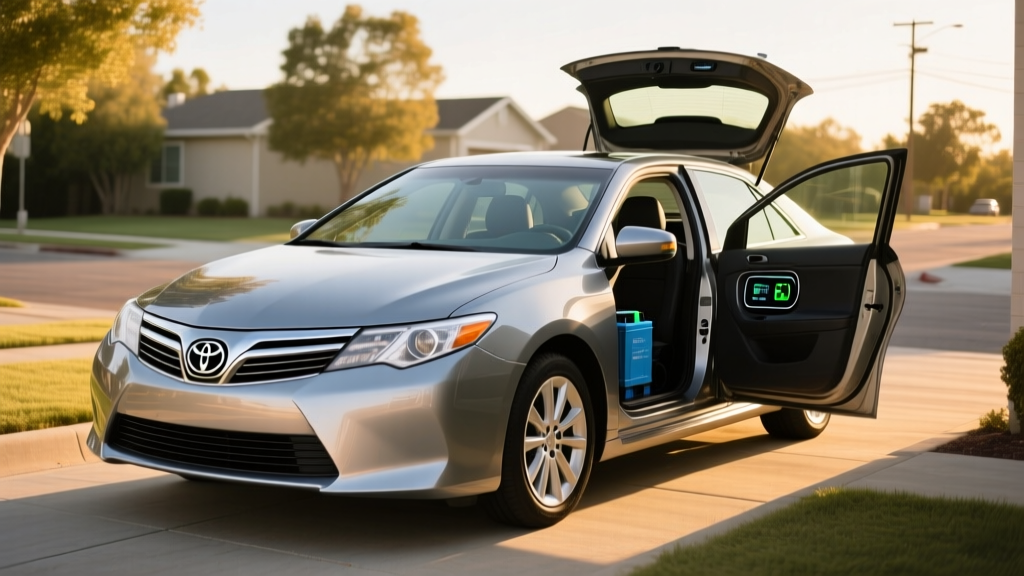
The 2011 Toyota Camry Hybrid sedan occupies a specific niche in the used-car market: it's one of the last midsize hybrid sedans from the pre-lithium era, offering proven nickel-metal hydride (NiMH) battery reliability at bargain prices. If you're cross-shopping this against newer hybrids, plug-in hybrids, or full EVs, you need the exact numbers on fuel economy, battery longevity, and what ownership actually looks like 15 years after production.
This guide breaks down the EPA figures, real-world MPG data, battery replacement economics, and how the 2011 Camry Hybrid stacks up against modern alternatives for buyers who want efficiency without plug-in complexity.
HEV vs PHEV: Where the 2011 Camry Hybrid Fits
The 2011 Toyota Camry Hybrid is a conventional hybrid electric vehicle (HEV), not a plug-in hybrid. This distinction matters because it defines how you fuel it, what incentives apply, and what driving experience to expect.
Conventional Hybrid (HEV) — 2011 Camry Hybrid
- No plug required. The battery charges entirely through regenerative braking and the gasoline engine.
- No electric-only driving range. The electric motor assists the engine but cannot propel the car alone for meaningful distances.
- No federal tax credit. The §30D credit applies only to plug-in vehicles (PHEVs and BEVs).
- Fueling: Gasoline only, at any station.
Plug-In Hybrid (PHEV) — e.g., Toyota Prius Prime, RAV4 Prime
- Requires plug-in charging (Level 1 or Level 2) to access electric-only range.
- Electric-only range: Typically 25–42 miles on modern PHEVs before the gas engine engages.
- Federal tax credit eligible: Up to $7,500 under IRS §30D, subject to MSRP caps, income limits, and battery-sourcing requirements (check IRS.gov for current rules).
- Fueling: Gasoline + electricity.
The 2011 Camry Hybrid is strictly an HEV. You never plug it in, and there is no electric-only mode beyond brief low-speed assist. If you want plug-in capability from Toyota, you'd need to look at a newer Prius Prime or a RAV4 Prime.
Fuel Economy: EPA Ratings vs Real-World MPG
The EPA rated the 2011 Toyota Camry Hybrid sedan at the following fuel economy figures:
| Metric | EPA Rating |
|---|---|
| City MPG | 31 MPG |
| Highway MPG | 35 MPG |
| Combined MPG | 31 MPG |
Source: fueleconomy.gov
Real-World MPG: What Owners Actually Report
Hybrid fuel economy behaves differently than gas-only cars. The electric motor assist is most effective in stop-and-go city driving, where regenerative braking recovers energy that would otherwise be lost. This means:
- City driving: Many owners report matching or slightly exceeding the EPA city rating of 31 MPG, especially in moderate climates. The hybrid system thrives in traffic.
- Highway driving: At sustained speeds above 65 mph, the gasoline engine does most of the work. Expect 30–34 MPG on flat highways, potentially dropping to 26–28 MPG with heavy loads, steep grades, or cold weather.
- Cold weather penalty: In sub-freezing temperatures, the engine runs more frequently to maintain cabin heat and battery temperature, reducing city MPG by 3–5 MPG. This is a well-documented hybrid behavior, not a defect.
- Battery age effect: A degraded NiMH battery (common on 15-year-old vehicles) can reduce MPG by 2–4 MPG combined. See the battery section below for details.
Realistic combined expectation for a well-maintained 2011 Camry Hybrid: 28–32 MPG depending on driving mix, climate, and battery health.
Powertrain Specs: Engine, Motor, and Combined Output
| Specification | 2011 Camry Hybrid |
|---|---|
| Gasoline Engine | 2.4L inline-4 (2AZ-FXE) |
| Engine Horsepower | 147 HP @ 6,000 RPM |
| Electric Motor | Permanent magnet synchronous |
| Motor Output | 40 HP (30 kW) |
| Net Combined System HP | 187 HP |
| Transmission | eCVT (electronically controlled) |
| Battery Type | Nickel-Metal Hydride (NiMH) |
| Battery Capacity | ~1.6 kWh (nominal) |
| Drivetrain | Front-wheel drive |
| 0–60 MPH | ~8.4 seconds |
The eCVT in this generation is Toyota's proven planetary-gear power-split device — not a belt-driven CVT. It has no belts, cones, or friction surfaces to wear, which is a significant reliability advantage. The 2AZ-FXE engine is an Atkinson-cycle variant, sacrificing some low-RPM torque for greater thermal efficiency.
Note: The 2011 model year was the last for this 2.4L hybrid powertrain. The 2012 Camry Hybrid switched to a 2.5L engine (2AR-FXE) with improved efficiency (EPA 40/38/39 MPG), so if fuel economy is your top priority and budget allows, the 2012+ generation is meaningfully better.
Battery Longevity, Warranty, and Replacement Cost
Original Battery Warranty
Toyota originally warranted the 2011 Camry Hybrid battery for 8 years / 100,000 miles (10 years / 150,000 miles in CARB states including California, New York, Massachusetts, and others that adopted California emissions standards). As of 2026, this factory warranty has expired on all 2011 vehicles.
How Long Do These NiMH Batteries Last?
NiMH batteries in Toyota hybrids have a well-documented track record. Data from fleet operators, owner surveys, and independent shops shows:
- Typical lifespan: 12–18 years or 150,000–220,000 miles before significant capacity loss.
- Degradation pattern: NiMH cells tend to fail individually rather than as a full pack. A single weak cell can trigger a hybrid system warning light and reduce MPG.
- Signs of degradation: Reduced MPG (2–4 MPG drop), more frequent engine cycling, hybrid system warning light, reduced regenerative braking feel.
Battery Replacement Options and Costs
| Option | Cost Range | Warranty | Notes |
|---|---|---|---|
| New OEM Toyota Battery | $3,000–$4,200 (installed) | 3 years / unlimited miles | Dealer-installed; most expensive but guaranteed fit and performance |
| Refurbished / Reconditioned Pack | $1,200–$2,200 (installed) | 1–3 years (varies by shop) | Individual cells replaced and rebalanced; widely available from hybrid specialists |
| Used Salvage Pack | $500–$1,200 (parts only) | None or 30–90 days | From a wrecked Camry; mileage/age unknown — risky |
| Individual Cell Replacement | $400–$900 (installed) | Varies | Only the failed cell(s) replaced; cost-effective if only 1–2 cells are bad |
For a 2011 vehicle, most owners choose the refurbished pack or individual cell replacement route. Independent hybrid specialists (shops that focus on Prius, Camry, and other Toyota hybrids) can diagnose individual cell voltage and replace only what's needed. This is a mature aftermarket with reliable options.
Key insight: Before purchasing a used 2011 Camry Hybrid, request a hybrid battery health check. Many shops can read individual cell voltages via OBD-II scanner. A healthy pack should show cell voltages within 0.2V of each other. A spread greater than 0.3V suggests imminent failure.
Pricing: What You'll Pay in the Used Market
The 2011 Toyota Camry Hybrid sedan was originally priced at approximately $27,050 MSRP (base, before destination). In the 2026 used-car market, prices vary significantly by mileage, condition, and battery health:
| Condition | Mileage Range | Typical Price (2026) |
|---|---|---|
| Excellent (battery healthy, low miles) | 80,000–120,000 | $6,500–$8,500 |
| Good (battery OK, average wear) | 120,000–170,000 | $4,500–$6,500 |
| Fair (battery may need service) | 170,000–220,000+ | $2,800–$4,500 |
Tax Credit Eligibility
The 2011 Toyota Camry Hybrid does not qualify for the federal §30D clean vehicle tax credit. That credit applies only to plug-in electric vehicles (BEVs and PHEVs) meeting specific battery-sourcing, MSRP, and buyer income requirements. Conventional hybrids (HEVs) are excluded.
Some states offer modest incentives for used hybrid purchases or hybrid battery replacements, but these vary widely by jurisdiction. Check your state's energy office or department of environmental quality for current programs.
Hybrid vs PHEV vs EV: Which Powertrain Fits Your Situation?
Choose the 2011 Camry Hybrid (HEV) If:
- You cannot charge at home (apartment, street parking, no garage).
- Your budget is under $8,000 for a vehicle.
- You drive a mix of city and highway and want 28–32 MPG without behavioral changes.
- You want Toyota reliability with widely available parts and hybrid-literate mechanics.
- You don't want to think about charging, range, or plug-in logistics.
Choose a Used PHEV (e.g., 2017+ Prius Prime, 2019+ RAV4 Prime) If:
- You can install a Level 2 charger at home and your daily commute is under 25–40 miles.
- You want to drive most days on electricity but need gas flexibility for road trips.
- You qualify for the used-EV tax credit (up to $4,000 under IRC §25E for vehicles under $25,000 from a dealer).
- Your budget is $15,000–$30,000.
Choose a Used Full EV (e.g., Chevrolet Bolt, Nissan Leaf, Tesla Model 3) If:
- You have reliable home charging (Level 2 strongly recommended).
- Your daily driving is predictable and within the vehicle's real-world range.
- You want to eliminate gasoline entirely and minimize maintenance (no oil changes, no spark plugs, minimal brake wear from regen).
- Your budget is $12,000–$25,000 for a used EV with a healthy battery.
Reliability and Safety Record
The 2011 Camry Hybrid benefits from one of the strongest reliability reputations in the automotive industry. The 2AZ-FXE engine and Toyota Hybrid Synergy Drive system have been in continuous production since 2004 (Prius), with millions of units on the road globally.
Known Issues to Check Before Buying
- Hybrid battery degradation: The primary concern at this age. Budget $1,200–$2,200 for a refurbished pack if the original battery hasn't been replaced.
- Brake actuator: Some 2007–2011 Camry Hybrids experienced premature brake actuator wear. Check for any ABS or brake warning lights during a test drive.
- Water pump: The electric water pump was subject to a recall on some 2007–2011 models. Verify the recall was performed (NHTSA recall 13V-490). Check NHTSA.gov with the specific VIN.
- 12V auxiliary battery: Like all hybrids, the Camry has a conventional 12V battery that powers electronics. It typically lasts 4–6 years and costs $150–$250 to replace. A dead 12V battery will prevent the car from starting even if the hybrid battery is healthy.
Safety Ratings
The 2011 Camry earned a 5-star overall rating from NHTSA (National Highway Traffic Safety Administration) under the testing protocol of that era, with strong frontal and side-impact scores. Standard safety equipment included front, side, and curtain airbags, stability control, and anti-lock brakes. It does not have modern ADAS features like automatic emergency braking or lane-keeping assist — those became standard on Camry models years later.
Ownership Costs: 5-Year Projection
Here's a realistic 5-year cost estimate for a 2011 Camry Hybrid driven 12,000 miles per year, assuming 30 MPG combined and $3.40/gallon gasoline (2026 national average):
| Cost Category | 5-Year Estimate |
|---|---|
| Fuel (12,000 mi/yr × 5 yrs ÷ 30 MPG × $3.40/gal) | $6,800 |
| Insurance (avg. $1,100/yr for older sedan) | $5,500 |
| Maintenance (oil, filters, brakes, tires) | $2,500–$3,500 |
| Hybrid battery replacement (if needed) | $1,200–$2,200 |
| Registration and taxes | $600–$1,200 |
| Total 5-Year Operating Cost | $16,600–$19,200 |
For comparison, a similar-age gas-only 2011 Camry (EPA ~25 MPG combined) would cost approximately $8,160 in fuel over the same period — roughly $1,360 more in fuel alone. The hybrid premium pays for itself in fuel savings within the used-car ownership window, even factoring in a potential battery replacement.
Pros and Cons at a Glance
Pros
- Proven hybrid system with massive parts availability and mechanic familiarity
- 28–32 MPG real-world combined — strong for a midsize sedan without plugging in
- Comfortable ride quality, spacious cabin, large trunk (10.6 cu ft)
- No charging infrastructure needed — fuel anywhere
- Low purchase price in the current used market ($3,000–$8,500)
- eCVT transmission has no wear-prone belt or friction components
Cons
- Hybrid battery likely at or past end of original lifespan — replacement may be needed
- No electric-only driving capability; this is not a PHEV
- Lacks modern safety tech (no AEB, no lane-keep, no blind-spot monitoring)
- No federal tax credit eligibility
- Significantly lower MPG than 2012+ Camry Hybrid (EPA 39 combined) or current models
- Interior materials and infotainment dated by 2026 standards
Frequently Asked Questions
How many MPG does the 2011 Toyota Camry Hybrid get?
The EPA rates it at 31 city / 35 highway / 31 combined MPG. In real-world driving, expect 28–32 MPG combined depending on your driving mix, climate, and battery condition. City driving often yields the best results due to regenerative braking and electric motor assist at low speeds.
Does the 2011 Camry Hybrid need to be plugged in?
No. This is a conventional hybrid (HEV), not a plug-in hybrid (PHEV). The battery charges entirely through regenerative braking and the gasoline engine. You fuel it exclusively with gasoline at any gas station.
Is the hybrid battery reliable, and what does replacement cost?
Toyota's NiMH hybrid batteries typically last 12–18 years or 150,000–220,000 miles. At this vehicle's age, the original battery may be degraded or already replaced. A refurbished replacement pack costs $1,200–$2,200 installed at a hybrid specialist. Individual cell replacement can cost as little as $400–$900 if only one or two cells have failed. The original 8-year/100,000-mile warranty has expired.
Does the 2011 Camry Hybrid qualify for any tax credit?
No. The federal §30D clean vehicle credit applies only to plug-in vehicles (BEVs and PHEVs). Conventional hybrids are not eligible. Some states may offer small incentives for used hybrid purchases, but these vary by jurisdiction.
How does this compare to a newer Camry Hybrid?
The 2012 Camry Hybrid (redesigned) achieved EPA 40/38/39 MPG — a significant 25% improvement over the 2011 model. Current-generation Camry Hybrids (2025+) are rated at up to 52 MPG combined. If fuel economy is your primary concern and budget allows, a 2012+ model offers meaningfully better efficiency. The 2011 model's advantage is its lower purchase price.
Should I buy a 2011 Camry Hybrid or a used full EV?
If you cannot charge at home, the Camry Hybrid is the practical choice — no infrastructure required. If you have home charging (Level 2) and your daily driving is under 150 miles, a used EV like the Chevrolet Bolt EUV or Tesla Model 3 offers lower per-mile energy costs (electricity is typically $0.04–$0.06/mile vs $0.11–$0.14/mile for gasoline) and near-zero drivetrain maintenance. The EV route requires a higher upfront investment in charging equipment ($500–$2,000 for a Level 2 home setup).