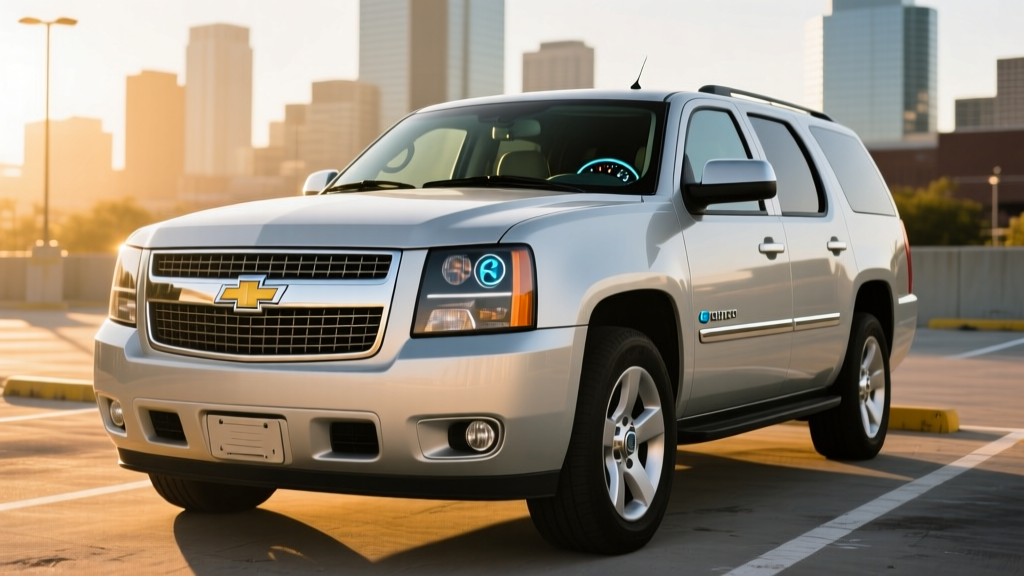
The 2010 Chevrolet Tahoe Hybrid was an ambitious vehicle for its time — a full-size, body-on-frame SUV that paired GM's 6.0-liter V8 with a two-mode hybrid system to deliver fuel economy numbers that seemed impossible for a 5,800-pound truck. Over a decade later, it remains a curiosity in the used SUV market. If you're researching the 2010 Tahoe Hybrid as a potential budget tow rig, family hauler, or fuel-sipping workhorse, this guide breaks down exactly what you're getting: EPA MPG figures, real-world efficiency expectations, the hybrid battery's longevity, replacement costs, and how it compares to modern alternatives in 2026.
2010 Tahoe Hybrid Key Specifications
| Spec | Value |
|---|---|
| Powertrain | 6.0L V8 + Two-Mode Hybrid System |
| Combined Horsepower | 379 hp |
| EPA City MPG | 21 mpg |
| EPA Highway MPG | 22 mpg |
| EPA Combined MPG | 21 mpg |
| Hybrid Battery | 1.8 kWh Nickel-Metal Hydride (NiMH) |
| Towing Capacity | 5,800 lbs (2WD) |
| Drivetrain | RWD or 4WD (Two-Mode) |
| Original MSRP | ~$53,100 (base) |
| Used Price Range (2026) | $6,000 – $12,000 |
HEV vs PHEV: Where the 2010 Tahoe Hybrid Fits
The 2010 Tahoe Hybrid is a conventional hybrid electric vehicle (HEV), not a plug-in hybrid (PHEV). This distinction matters enormously if you're cross-shopping electrified SUVs.
Conventional Hybrid (HEV) — 2010 Tahoe Hybrid
- No plug required. The battery charges exclusively through regenerative braking and the gasoline engine.
- No electric-only range. The electric motors assist the V8 but cannot propel the vehicle independently for meaningful distances.
- Fuel economy gains are modest on a heavy vehicle — roughly 3-5 mpg better than the non-hybrid Tahoe of the same era.
- No federal tax credit eligibility for used HEV purchases under current IRS §30D rules.
Plug-In Hybrid (PHEV) — Modern Equivalent
- Requires plug-in charging to access electric-only range (typically 20-45 miles on 2026 PHEVs).
- Larger battery (15-30 kWh) enables genuine EV-mode commuting.
- May qualify for federal or state incentives depending on battery sourcing and buyer income.
- Example: The 2026 Jeep Wrangler 4xe offers ~22 miles electric-only and 49 MPGe combined — a very different ownership experience.
The Tahoe Hybrid's 1.8 kWh NiMH battery pack is far too small for plug-in operation. It exists to enable regenerative braking capture, electric assist during acceleration, and brief engine-off coasting — not for EV-mode driving.
Fuel Economy: EPA Numbers vs Real-World MPG
According to fueleconomy.gov, the 2010 Tahoe Hybrid achieves:
| Driving Condition | EPA MPG | Real-World Expectation |
|---|---|---|
| City | 21 mpg | 18-22 mpg (hybrids can exceed EPA in stop-and-go) |
| Highway | 22 mpg | 19-21 mpg (aerodynamic drag dominates at speed) |
| Combined | 21 mpg | 18-20 mpg (mixed driving, typical owner) |
For context, the non-hybrid 2010 Tahoe with the 5.3L V8 achieved 15 city / 21 highway / 17 combined. The hybrid's advantage is most pronounced in city driving, where the Two-Mode system's regenerative braking and engine shut-off at stops provide genuine efficiency gains. On the highway, the hybrid's weight penalty (roughly 350 lbs of hybrid hardware) partially offsets its advantages.
Real-world caveat: Owner forums and aggregated fuel logs (Fuelly data) consistently show the 2010 Tahoe Hybrid averaging 17-19 mpg in mixed driving. Heavy towing, aggressive acceleration, and cold weather will push figures toward 14-16 mpg. If you're buying this vehicle expecting Prius-like efficiency, recalibrate: this is a heavy body-on-frame SUV that achieves mid-teens to low-20s — impressive for its class, modest by modern electrified standards.
The Two-Mode Hybrid Powertrain Explained
GM's Two-Mode hybrid system was an engineering marvel of its era, co-developed with BMW and Mercedes-Benz (the same architecture appeared in the BMW X6 ActiveHybrid and Mercedes ML 450 Hybrid). Here's how it works:
- Mode 1 (low speed): Operates as a continuously variable transmission (CVT). The electric motors handle low-speed propulsion and engine starts, enabling seamless stop-start and regenerative braking.
- Mode 2 (high speed/towing): Locks into fixed gear ratios for highway cruising and heavy-load scenarios, bypassing the CVT's efficiency losses at sustained speed.
- The 6.0L V8 features Active Fuel Management (cylinder deactivation), dropping to four cylinders under light loads to save fuel.
- Combined output: 379 horsepower — competitive with the 5.3L V8 non-hybrid (320 hp) and approaching the 6.2L V8 (380 hp).
The system is sophisticated — perhaps too sophisticated. The transmission contains two electric motor-generators, three planetary gearsets, and multiple clutches. When it works, it's seamless. When it fails, repair costs are significant.
Battery Reliability, Lifespan, and Replacement Cost
2010 Tahoe Hybrid Battery Warranty (Original)
- Hybrid battery warranty: 8 years / 100,000 miles (all 50 states)
- Hybrid component warranty: 8 years / 100,000 miles
- Current status: All factory warranties expired by 2018 at the latest
The 1.8 kWh NiMH battery pack in the 2010 Tahoe Hybrid has a mixed reliability record. Nickel-metal hydride chemistry is inherently more stable and longer-lasting than early lithium-ion packs, but age is now the dominant factor. These battery packs were designed for a 10-15 year service life, and most 2010 examples are now 15-16 years old.
Battery replacement cost: A refurbished or remanufactured NiMH hybrid battery for the 2010 Tahoe Hybrid typically runs $2,500 – $4,500 installed from independent hybrid specialists. A new OEM battery from GM (if still available through parts channels) can exceed $5,000. Individual cell replacement is possible for skilled DIYers at roughly $800-$1,200 in parts, but requires high-voltage safety knowledge.
What to check before buying:
- Hybrid battery state of charge health (a scan tool can read this via OBD-II)
- Whether the battery has been previously replaced (ask for receipts)
- Dashboard hybrid system warnings or "Service Hybrid System" messages
- Whether the vehicle still achieves its rated MPG (a significant drop suggests cell degradation)
The Two-Mode transmission is the bigger concern. While the NiMH battery is relatively straightforward to replace, the hybrid transmission itself is a far more expensive failure point. Rebuilds or replacements run $6,000-$9,000, and qualified technicians are increasingly rare. Pre-purchase inspection by a GM hybrid-certified mechanic is strongly recommended.
Tax Credit Eligibility: What You Can (and Can't) Claim
The 2010 Tahoe Hybrid does not qualify for the federal §30D new clean vehicle credit — that credit applies only to new vehicle purchases. For used electrified vehicles, the IRS offers the Used Clean Vehicle Credit (up to $4,000 or 30% of sale price, whichever is less), but eligibility requires:
- The vehicle must be at least two model years old (the 2010 qualifies)
- Sale price must be $25,000 or less (most 2010 Tahoe Hybrids qualify)
- Buyer income caps: $75,000 single / $112,500 head of household / $150,000 joint
- The vehicle must be purchased from a licensed dealer (private-party sales excluded)
- The credit can only be claimed once per VIN
Practical reality: Because the 2010 Tahoe Hybrid is a conventional HEV (not a PHEV or BEV), it does qualify as a "clean vehicle" under the used credit rules — the IRS definition includes hybrid electric vehicles. However, the credit is non-refundable, meaning you need sufficient tax liability to claim it. Consult a tax professional to confirm your eligibility before relying on this credit in your purchase decision.
Who Should Buy the 2010 Tahoe Hybrid in 2026?
Reasons to Buy
- You need a body-on-frame SUV with towing capability and slightly better fuel economy than a gas-only Tahoe
- Budget is under $12,000 and you want a full-size SUV
- You primarily drive in city/stop-and-go conditions where the hybrid system shines
- You have access to a GM hybrid-certified mechanic for maintenance
Reasons to Skip
- You want modern safety tech (no automatic emergency braking, no lane-keep assist)
- Long-term reliability is a priority — hybrid system repair costs can exceed vehicle value
- You want plug-in electric driving or eligibility for significant tax incentives
- You drive mostly highway miles where the hybrid advantage is minimal
Hybrid vs PHEV vs EV — Which Fits You?
Choose the 2010 Tahoe Hybrid (used HEV) if: You need a budget full-size SUV with modest efficiency gains and don't want to plug in. Accept that repair risk on a 15-year-old hybrid system is real.
Choose a modern PHEV (e.g., Toyota RAV4 Prime, Jeep Wrangler 4xe) if: You want 25-40 miles of electric-only commuting with gas-engine backup for road trips, and you have home charging access.
Choose a full EV (e.g., Rivian R1S, Tesla Model X) if: You want zero tailpipe emissions, minimal maintenance, and have reliable charging access. Upfront cost is higher, but total cost of ownership over 5 years can be lower.
Frequently Asked Questions
How many MPG does the 2010 Tahoe Hybrid get?
The EPA rates the 2010 Tahoe Hybrid at 21 city / 22 highway / 21 combined mpg. Real-world owners typically report 17-19 mpg in mixed driving, with city driving occasionally reaching 20-22 mpg thanks to regenerative braking.
Does the 2010 Tahoe Hybrid need to be plugged in?
No. The 2010 Tahoe Hybrid is a conventional hybrid (HEV), not a plug-in hybrid (PHEV). Its 1.8 kWh battery charges exclusively through regenerative braking and the gasoline engine. There is no plug and no electric-only driving range.
Is the 2010 Tahoe Hybrid reliable?
The conventional V8 and chassis components are generally robust. The hybrid-specific components — particularly the Two-Mode transmission and NiMH battery pack — are the primary reliability concerns on a vehicle now 15+ years old. Hybrid battery replacement runs $2,500-$4,500; transmission replacement can exceed $6,000. A pre-purchase inspection by a qualified hybrid technician is essential.
What is the battery replacement cost for the 2010 Tahoe Hybrid?
Expect to pay $2,500-$4,500 for a refurbished NiMH hybrid battery installed by an independent specialist. OEM new batteries may cost over $5,000 if still available. DIY cell-level replacement is possible for $800-$1,200 in parts but requires high-voltage safety training.
Does the 2010 Tahoe Hybrid qualify for any tax credit?
It does not qualify for the new vehicle §30D credit. It may qualify for the Used Clean Vehicle Credit (up to $4,000) if purchased from a licensed dealer for under $25,000, subject to buyer income limits. Confirm eligibility with a tax professional and consult the IRS used vehicle credit page.
How does the 2010 Tahoe Hybrid compare to a modern hybrid SUV?
A 2026 Toyota Grand Highlander Hybrid achieves 36 combined mpg with far more power, modern safety tech, and a full factory warranty — but starts around $42,000. The 2010 Tahoe Hybrid costs a fraction of that upfront but carries significant repair risk and delivers roughly half the fuel economy. The right choice depends on your budget, risk tolerance, and how long you plan to keep the vehicle.