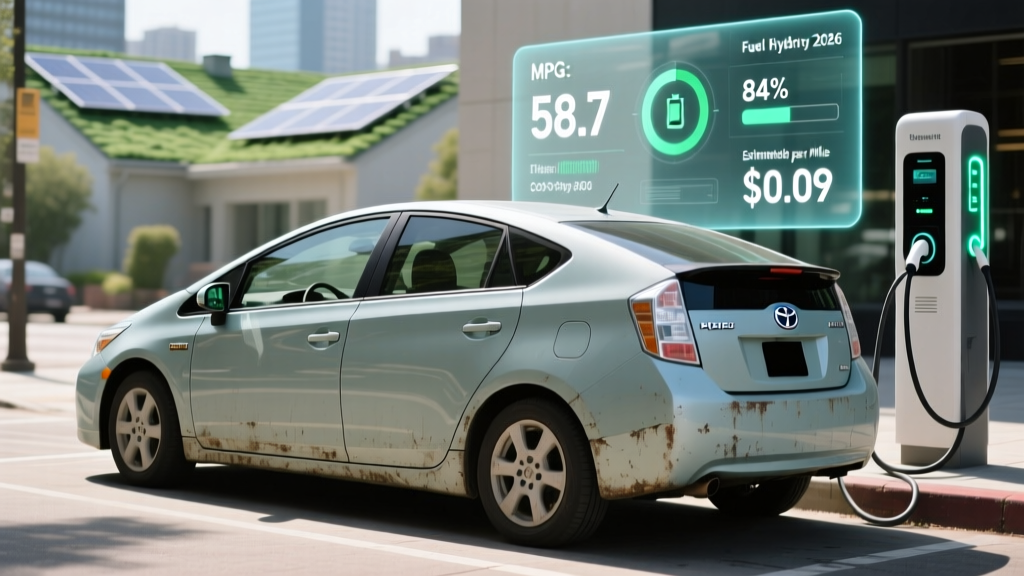
The third-generation Toyota Prius (model years 2010–2015) remains one of the most recognizable hybrid vehicles on American roads. More than a decade after its debut, the 2010 Prius hybrid continues to attract budget-conscious buyers looking for proven fuel efficiency without the complexity of plug-in charging. With used examples routinely selling between $4,000 and $8,000 in 2026, it represents one of the cheapest entries into hybrid ownership available today. But does a 16-year-old hybrid still deliver on its efficiency promises, and what happens when the high-voltage battery reaches end of life?
This guide covers the 2010 Prius as a conventional hybrid electric vehicle (HEV) — meaning it generates all its electricity internally and never needs to be plugged in. We'll also clarify how it differs from modern plug-in hybrids (PHEVs) and full battery-electric vehicles (BEVs) so you can decide which electrified powertrain actually fits your driving pattern.
HEV vs. PHEV vs. EV: Where Does the 2010 Prius Fit?
| Attribute | 2010 Prius (HEV) | Modern PHEV (e.g., 2026 Prius Prime) | Full EV (e.g., 2026 Tesla Model 3) |
|---|---|---|---|
| Plug-in required? | No — self-charging | Yes — plug for EV range | Yes — plug for all driving |
| Electric-only range | ~1 mi at low speed | 35–44 mi (EPA) | 250–360 mi (EPA) |
| Total range | ~500 mi | ~550–600 mi combined | 250–360 mi |
| Fuel/energy source | Gasoline only | Gasoline + grid electricity | Grid electricity only |
| Home charging install | None needed | Level 2 recommended (~$500–$1,500) | Level 2 essential (~$500–$2,000) |
| Federal tax credit (new) | None (credit expired 2010) | Up to $3,750 (§30D, subject to sourcing rules) | Up to $7,500 (§30D, subject to sourcing/income rules) |
| Used vehicle credit | Up to $4,000 (§25E, income caps apply) | Up to $4,000 (§25E) | Up to $4,000 (§25E) |
The 2010 Prius is a conventional hybrid (HEV). It uses regenerative braking and its gasoline engine to keep a small nickel-metal hydride (NiMH) battery charged. You never plug it in. This makes it ideal for buyers without access to home or workplace charging — apartments, street parking, or rentals where installing a Level 2 charger isn't feasible.
A plug-in hybrid (PHEV) like the current-generation Toyota Prius Prime adds a larger lithium-ion battery (13.6 kWh usable) that delivers 44 miles of electric-only driving before the gas engine takes over. PHEVs require regular plug-in charging to realize their efficiency advantage; driven without charging, they perform similarly to — or slightly worse than — a conventional hybrid due to the extra battery weight.
A battery-electric vehicle (BEV) eliminates gasoline entirely. BEVs demand reliable charging access and suit drivers who can charge at home overnight. They offer the lowest per-mile energy cost but require a higher upfront investment and planning for road trips.
Fuel Economy: EPA Ratings and Real-World MPG
The 2010 Prius was EPA-rated at a combined 50 MPG — a benchmark that stood for years. Here's the official breakdown per fueleconomy.gov:
| Driving Cycle | EPA Rating | Real-World Expectation (2026) |
|---|---|---|
| City | 51 MPG | 48–55 MPG (hybrids excel in stop-and-go) |
| Highway | 48 MPG | 42–47 MPG (aerodynamic drag + smaller engine working harder) |
| Combined | 50 MPG | 45–50 MPG |
Hybrids like the 2010 Prius often exceed EPA city estimates in real-world driving because regenerative braking recovers energy during frequent stops. Highway driving is the weak point — the 1.8-liter Atkinson-cycle engine operates less efficiently at sustained high speeds, and aerodynamic drag rises with the square of velocity. Expect 42–47 MPG on a 70 mph interstate run.
Several factors will push real-world MPG below the sticker number in a 2010 model:
- Battery degradation: A weakened NiMH battery forces the engine to run more often, reducing electric-only assist. Expect a 3–8 MPG penalty on a battery with significant capacity loss.
- Cold weather: Below 40°F, the engine runs continuously to heat the cabin and warm the catalytic converter. Winter city MPG can drop to 38–42.
- Tire pressure and alignment: Low rolling-resistance tires at incorrect pressure degrade efficiency noticeably on a vehicle this light (3,042 lbs curb weight).
- Age-related mechanical wear: Sticky brake calipers, old transmission fluid, and clogged air filters all erode MPG over 15+ years of service.
Powertrain Specifications and Performance
| Specification | 2010 Toyota Prius (Third Generation) |
|---|---|
| Engine | 1.8L 4-cylinder Atkinson-cycle (98 hp, 105 lb-ft) |
| Electric motor | Permanent-magnet synchronous (80 hp / 60 kW) |
| Combined net horsepower | 134 hp |
| Transmission | Planetary eCVT (no traditional gears or belts) |
| Hybrid battery | 1.3 kWh NiMH (201.6V nominal, 28 modules) |
| 0–60 mph | 9.8 seconds |
| Curb weight | 3,042 lbs |
| Fuel tank | 11.9 gallons |
| Total range (est.) | ~500 miles |
| EPA combined | 50 MPG |
| CO₂ emissions | 178 g/mile |
The third-generation Prius introduced the 1.8-liter engine (up from 1.5L in the second generation), which improved highway drivability and reduced the engine strain that plagued earlier models at sustained speeds. The eCVT is not a conventional continuously variable transmission with a steel belt — it uses a planetary gearset that blends engine and motor power with no friction components to wear. This design is a major reason the Prius powertrain routinely exceeds 200,000 miles with basic maintenance.
Hybrid Battery Lifespan, Warranty, and Replacement Cost
Original warranty (when new): 8 years / 100,000 miles (10 years / 150,000 miles in CARB states including California, New York, Massachusetts, and others adopting California emissions standards).
In 2026: All 2010 Prius hybrid batteries are out of factory warranty. Replacement is an out-of-pocket expense.
The NiMH battery pack in the 2010 Prius contains 28 individual modules. Failure typically presents as one or two weak modules dragging down the entire pack, triggering the "Red Triangle of Death" (master warning light) and diagnostic codes P0A80 or P0A7F. The battery doesn't usually fail catastrophically — it degrades gradually, reducing electric assist and fuel economy before eventually triggering a check-engine light.
Replacement cost breakdown (2026 market rates):
| Option | Cost Range | Warranty | Notes |
|---|---|---|---|
| New OEM Toyota battery | $2,000–$2,500 (parts + labor) | 3 yr / 36,000 mi | Best longevity; dealer-installed |
| Refurbished/remanufactured pack | $1,000–$1,500 | 1–3 yr varies | Replaced weak modules; quality varies by vendor |
| Individual module replacement | $300–$600 | 30–90 days typical | DIY-friendly; temporary fix; other modules may fail soon |
| Aftermarket new battery (e.g., Green Bean) | $1,200–$1,800 | Limited lifetime (some vendors) | Improved NiMH or upgraded chemistry; check reviews |
For a used 2010 Prius purchased at $5,000–$7,000, a $1,500–$2,500 battery replacement represents 20–50% of the vehicle's value. This is the single most important cost to model before buying. A pre-purchase hybrid battery health check (available at most Toyota dealerships and independent hybrid specialists) will read the battery's internal resistance and voltage delta across modules — this test takes 15 minutes and can save thousands.
Reliability Data and Long-Term Ownership
The third-generation Prius holds one of the strongest reliability records in the Toyota lineup, which is significant given Toyota's reputation. Based on long-term owner surveys and repair databases:
- Powertrain longevity: The 1.8L 2ZR-FXE engine and planetary eCVT regularly exceed 250,000 miles with routine oil changes (every 5,000–10,000 miles with 0W-20 synthetic). Taxi fleets in major US cities have documented 400,000+ mile examples.
- Common failure points: The EGR (exhaust gas recirculation) valve and cooler can clog with carbon deposits around 100,000–150,000 miles, causing rough idle and head gasket stress. Cleaning or replacing the EGR system ($200–$500) is widely considered preventive maintenance on this generation.
- Brake actuator: The regenerative braking system uses an electro-hydraulic brake actuator that can fail at high mileage (150,000+ mi). Replacement runs $1,200–$1,800 at a dealer. Listen for unusual buzzing from the brake pump at startup.
- Inverter coolant pump: An electric pump circulates coolant through the hybrid inverter. Failure can overheat and destroy the inverter ($2,000+ replacement). Check for coolant flow in the inverter reservoir with the car in READY mode.
- Oil consumption: Some 2010–2014 1.8L Prius engines consume oil at higher rates due to piston ring design. Check oil level every 1,000 miles until you establish your engine's consumption pattern.
The NHTSA recorded a small number of recalls for the 2010 Prius, including a software update for the ABS braking system and an inspection of the steering intermediate shaft. Verify any used example has had recall work completed — dealerships perform these free of charge regardless of vehicle age.
Pricing, Tax Credits, and Total Cost of Ownership
The 2010 Prius originally started at $22,800 MSRP. In 2026's used market:
| Condition / Mileage | Typical Price Range (2026) |
|---|---|
| 150,000–200,000 mi, fair condition | $3,500–$5,500 |
| 100,000–150,000 mi, good condition | $5,500–$8,000 |
| Under 100,000 mi, excellent condition | $8,000–$12,000 |
Tax credit eligibility: The original federal hybrid tax credit for the Toyota Prius phased out completely in 2010 after Toyota reached the 600,000-unit cap. No new-vehicle credit applies. However, if you purchase a used 2010 Prius from a dealer in 2026, you may qualify for the §25E Used Clean Vehicle Credit — up to $4,000 or 30% of the sale price (whichever is less). Key requirements per the IRS:
- Vehicle sale price must be $25,000 or less (easily met)
- Buyer income caps: $75,000 single / $112,500 head of household / $150,000 joint filers
- Vehicle must be purchased from a licensed dealer (private-party sales don't qualify)
- The vehicle must be a qualified clean vehicle — the 2010 Prius qualifies as a hybrid
- Credit is non-refundable (you must have tax liability to claim it)
- You can only claim this credit once every three years
On a $6,000 used Prius, the maximum §25E credit would be $1,800 (30% of sale price), effectively reducing your net cost to $4,200. Consult a tax professional to confirm eligibility.
Pros
- Proven 50 MPG combined — real-world often matches or beats EPA in city driving
- No plug-in charging needed — works for apartment dwellers and street parkers
- Extremely low purchase price ($4,000–$8,000 typical)
- Planetary eCVT is virtually bulletproof at high mileage
- Massive aftermarket and DIY community for repairs and parts
- Low insurance premiums (averages $80–$120/month depending on state)
Cons
- Hybrid battery replacement ($1,000–$2,500) is likely needed if original pack
- No electric-only driving range — gasoline is always required
- 9.8-second 0–60 time limits highway merging confidence
- Outdated infotainment — no Apple CarPlay, Android Auto, or backup camera on base trims
- EGR system requires proactive maintenance to prevent head gasket damage
- Safety tech is minimal — no automatic emergency braking, lane-keeping, or blind-spot monitoring
Who Should Buy the 2010 Prius Hybrid?
Choose the 2010 Prius if:
- You drive 15,000+ miles per year, mostly in city or suburban stop-and-go traffic
- You cannot install a home charger (apartment, condo, street parking)
- Your total vehicle budget is under $8,000 and you want the lowest fuel cost at that price point
- You want a commuter appliance with the cheapest cost-per-mile of any non-plug-in vehicle
- You're comfortable budgeting $1,500–$2,500 for a potential battery replacement within 2–3 years
Look at a PHEV (like a used Prius Prime) if:
- You have home or workplace Level 2 charging access
- Your daily commute is under 25 miles round-trip (a PHEV covers this on electricity alone)
- You want to reduce gasoline consumption by 60–80% on typical driving days
Look at a full EV if:
- You have reliable home charging and a daily commute under 200 miles
- You want to eliminate gasoline costs and oil changes entirely
- You're willing to spend $25,000+ (new or used) for modern safety tech and infotainment
Frequently Asked Questions
How many MPG does the 2010 Prius hybrid get?
The EPA rates the 2010 Prius at 51 city / 48 highway / 50 combined MPG. In real-world driving, most owners report 45–50 MPG combined, with city driving sometimes exceeding the EPA estimate thanks to regenerative braking. Highway-only driving at 75 mph typically yields 42–45 MPG. Cold weather (below 40°F) can drop city MPG to 38–42.
Does the 2010 Prius need to be plugged in?
No. The 2010 Prius is a conventional hybrid (HEV), not a plug-in hybrid (PHEV). It charges its 1.3 kWh NiMH battery through regenerative braking and the gasoline engine. You will never see a charge port on this vehicle. If you want electric-only driving range, look at the Prius Prime (PHEV), which was introduced in later model years.
Is the 2010 Prius reliable, and what does a battery replacement cost?
The 2010 Prius has excellent long-term reliability, with the planetary eCVT and 1.8L engine routinely exceeding 200,000–250,000 miles. The main concern is the NiMH hybrid battery, which typically lasts 150,000–200,000 miles or 12–18 years. At 16 years old, many original batteries are near end of life. Replacement costs $1,000–$1,500 for a refurbished pack or $2,000–$2,500 for a new OEM battery. The EGR system and brake actuator are secondary items to inspect at high mileage.
Does the 2010 Prius qualify for any tax credit?
The original new-vehicle hybrid tax credit for the Prius expired in 2010. However, buying a used 2010 Prius from a licensed dealer in 2026 may qualify you for the §25E Used Clean Vehicle Credit — up to $4,000 or 30% of the sale price (whichever is less). Income caps apply ($75,000 single / $150,000 joint), the sale price must be under $25,000, and the credit is non-refundable. Check current IRS guidelines and consult a tax professional before filing.
How does the 2010 Prius compare to a modern hybrid or EV for daily commuting?
For pure fuel cost, the 2010 Prius at 50 MPG costs roughly $0.07 per mile to fuel at $3.50/gallon. A modern PHEV driven mostly on electricity can achieve $0.03–$0.04 per mile, and a full EV on residential electricity averages $0.04–$0.05 per mile. However, the 2010 Prius wins on total upfront cost: at $5,000–$7,000 purchase price with no charging infrastructure needed, the break-even point against a $30,000+ EV takes years of driving to reach. If your priority is the lowest possible entry price into efficient transportation, the 2010 Prius remains hard to beat.
What should I check before buying a used 2010 Prius?
Request a hybrid battery health report (voltage delta and internal resistance across all 28 modules) from a Toyota dealer or hybrid specialist. Verify all recall campaigns are completed via the VIN at the NHTSA website. Check for EGR system service history — clogged EGR coolers are the leading cause of head gasket failure on this generation. Inspect the inverter coolant reservoir for flow when the car is in READY mode. Finally, confirm the brake actuator isn't producing excessive pump cycling noise, which signals impending failure.