The 2010 Honda Insight was Honda's second attempt at a dedicated hybrid — a compact liftback designed to undercut the Toyota Prius on price while delivering competitive fuel economy. Over 15 years later, it has developed a well-documented set of issues that prospective used buyers need to understand before handing over cash. This guide breaks down every major 2010 Honda Insight hybrid problem, from IMA battery degradation to CVT concerns, and tells you exactly what to budget for repairs in 2026.
What Is the 2010 Honda Insight? HEV Basics
The 2010 Insight is a conventional hybrid electric vehicle (HEV), not a plug-in hybrid. It uses Honda's Integrated Motor Assist (IMA) system — a parallel hybrid architecture where a small electric motor sandwiched between the gasoline engine and transmission provides supplemental torque. The battery recharges through regenerative braking and the engine; you never plug it in.
HEV vs PHEV: Why It Matters Here
HEV (this car): No plug, small battery (~0.6 kWh), electric motor assists the engine. Cannot drive on electric power alone at meaningful speeds. No federal tax credit.
PHEV (e.g., Toyota Prius Prime): Plugs in, larger battery (~13.6 kWh), can drive 25–44 miles on electricity alone before the engine kicks in. May qualify for up to $3,750–$7,500 federal credit under current IRS §30D rules if purchased new.
BEV (e.g., Chevrolet Bolt EV): Fully electric, no gasoline engine. Eligible for up to $7,500 federal credit (new) or $4,000 (used) subject to income, MSRP, and sourcing requirements.
2010 Honda Insight Fuel Economy: EPA vs Real World
The Insight's main selling point was — and remains — its fuel efficiency. Here is the official EPA data from fueleconomy.gov:
| Driving Cycle | EPA MPG | Real-World Expectation |
|---|---|---|
| City | 40 MPG | 38–45 MPG (hybrids often beat EPA in stop-and-go) |
| Highway | 43 MPG | 36–41 MPG (small engine works hard at sustained speed) |
| Combined | 41 MPG | 37–42 MPG |
Real-world caveat: Owners consistently report that the Insight exceeds its EPA city estimate in warm-weather urban driving — sometimes hitting 48–50 MPG on flat terrain. However, highway fuel economy tends to fall short, especially above 70 mph or in cold weather. Winter driving with the heater running can drop combined MPG to the low 30s. The 1.3L engine lacks the displacement to cruise efficiently at high speeds, which is the fundamental trade-off of Honda's IMA system versus Toyota's more powerful Hybrid Synergy Drive.
The #1 Problem: IMA Battery Failure
The single most common and costly 2010 Honda Insight hybrid problem is Integrated Motor Assist (IMA) battery degradation and failure. The Insight uses a nickel-metal hydride (NiMH) battery pack rated at approximately 0.6 kWh (usable). After 15 years, nearly every original battery has degraded significantly.
Symptoms of IMA Battery Failure
- IMA warning light illuminates on the dashboard
- Reduced regenerative braking — the car coasts instead of slowing when you lift off the throttle
- Loss of electric motor assist — the 1.3L engine works alone, dropping MPG by 5–10 miles per gallon
- Check engine light with codes P0A7F (hybrid battery pack deterioration) or P0A80 (battery module voltage imbalance)
- State of Charge (SoC) gauge stuck at low levels or fluctuating erratically
- In severe cases, the car may enter a "limp mode" with reduced power
IMA Battery Replacement Cost in 2026
| Option | Cost Range | Warranty | Notes |
|---|---|---|---|
| New OEM Honda battery | $2,000–$2,800 installed | 3 years/36,000 miles | Available but increasingly scarce; Honda has reduced production of IMA packs |
| Aftermarket/refurbished NiMH | $1,000–$1,800 installed | 1–3 years varies by vendor | Common choice for older Insights; quality varies significantly by supplier |
| Individual cell replacement (DIY) | $200–$500 parts only | None | Requires electrical knowledge; replaces only the weak sub-cells within the pack |
| Used salvage battery | $300–$700 installed | 30–90 days typical | High risk — you inherit someone else's degradation curve |
Key insight: Unlike modern lithium-ion packs in current hybrids and EVs, the Insight's NiMH battery degrades more predictably but also more aggressively in hot climates. Owners in Arizona, Texas, and Southern California report IMA failures as early as 60,000–80,000 miles. Cooler-climate batteries sometimes reach 120,000+ miles before significant degradation.
Other Common 2010 Honda Insight Problems
CVT Transmission Issues
The Insight uses a continuously variable transmission (CVT) rather than a traditional geared automatic. While Honda's CVT in the Insight is generally more reliable than the problematic CVTs in some Nissan models of the same era, owners report:
- Transmission shudder or judder during light acceleration at 20–40 mph — often caused by degraded CVT fluid. A drain-and-fill with Honda HCF-2 fluid ($150–$250 at a shop) usually resolves this.
- Whining or humming noise from the transmission at highway speeds — may indicate bearing wear at higher mileage (120,000+ miles).
- The CVT is not serviceable in the traditional sense; there is no filter to replace, only fluid.
Excessive Oil Consumption
The 1.3L i-VTEC engine (LDA3) in some 2010 Insights consumes oil at a rate Honda considers "normal" but owners find excessive — up to 1 quart per 1,000 miles in some cases. This is linked to:
- Low-tension piston rings designed for reduced friction (and thus better MPG)
- Stop-start system operation causing oil drain-down and increased ring wear
- Owners who neglect to check oil between changes risk engine damage. Check the dipstick every 2–3 fuel fill-ups.
12V Battery Drain
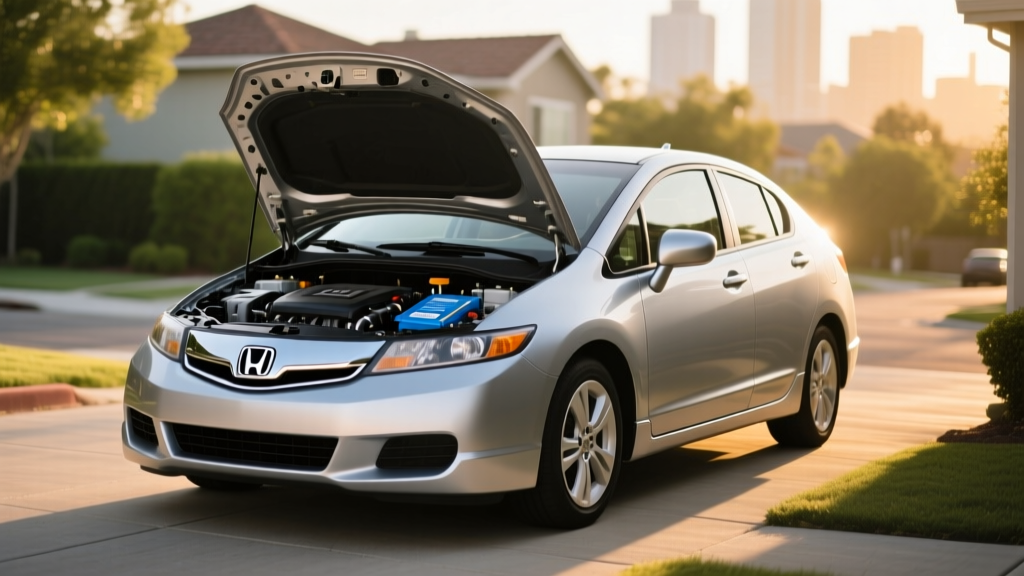
Like all hybrids, the Insight has a conventional 12V lead-acid battery that powers the electronics, lights, and computers. The IMA system's DC-DC converter charges it, but if the IMA battery is degraded, the 12V battery can drain unexpectedly, leaving the car unable to start even though the high-voltage pack has charge. A failing 12V battery is often misdiagnosed as an IMA problem. Replacement: $150–$220 for an AGM-type Group 151R battery.
Brake Actuator and ABS Modulator
The Insight uses regenerative braking blended with friction brakes. Some owners report:
- A grinding or groaning noise from the brake system at low speeds — this can be normal regen-blend behavior, but persistent noise warrants inspection.
- ABS modulator failure at high mileage (130,000+ miles), with replacement costing $800–$1,400.
Air Conditioning Compressor
The Insight's A/C compressor is electrically driven (not belt-driven) to allow operation when the engine is stopped. These compressors can fail at 100,000–140,000 miles, with replacement running $900–$1,500 including refrigerant recharge.
Powertrain Specifications
| Specification | Value |
|---|---|
| Engine | 1.3L i-VTEC inline-4 (LDA3) |
| Engine horsepower | 88 HP @ 5,800 RPM |
| Electric motor output | 13 HP (10 kW) |
| Combined system output | 98 HP @ 5,800 RPM |
| Combined torque | 123 lb-ft @ 1,000–1,500 RPM |
| Transmission | Continuously Variable (CVT) |
| IMA battery type | Nickel-Metal Hydride (NiMH) |
| IMA battery capacity | ~0.6 kWh (nominal) |
| 0–60 mph | ~10.5 seconds (estimated) |
| Curb weight | 2,734 lbs |
| Drivetrain | Front-wheel drive |
The IMA system's 13 HP electric motor is modest by modern standards. For comparison, the 2026 Toyota Prius hybrid pairs a 2.0L engine with a 83 HP motor for a combined 196 HP. The Insight was designed for efficiency, not performance — merging onto highways requires planning.
Reliability Verdict and Battery Warranty Status
Original Hybrid Battery Warranty
Honda originally covered the 2010 Insight's IMA battery for 8 years/80,000 miles (10 years/150,000 miles in California Air Resources Board states: CA, CT, ME, MA, NJ, NY, OR, RI, VT, WA). As of 2026, all factory battery warranties have expired. Any battery replacement is now an out-of-pocket expense.
Overall, the 2010 Insight rates as moderately reliable for its age. The IMA battery is the known wear item, but the rest of the powertrain — the 1.3L engine, CVT, and electronics — are generally durable if maintained. The car has fewer complex systems than a modern PHEV or EV, which means fewer things to break but also less advanced safety and convenience technology.
According to NHTSA data at nhtsa.gov, the 2010 Insight had relatively few recalls — primarily related to airbag inflators (the Takata recall, which should be completed on any surviving example). Always verify recall status by entering the VIN at nhtsa.gov/recalls before purchasing.
Pricing and Tax Credit Eligibility in 2026
The 2010 Honda Insight is long out of production. Used market pricing in 2026:
| Condition | Mileage Range | Approximate Price |
|---|---|---|
| Excellent (IMA battery replaced recently) | 80,000–110,000 | $5,000–$7,000 |
| Good (original or aging IMA battery) | 110,000–150,000 | $3,000–$5,000 |
| Fair (needs IMA battery + minor issues) | 130,000–180,000 | $1,500–$3,000 |
Federal tax credit: The 2010 Insight does not qualify for any current federal tax credit. The IRS §30D new-vehicle credit applies only to new plug-in vehicles (PHEVs and BEVs). The used clean vehicle credit (up to $4,000 under IRC §25E) requires the vehicle to be a plug-in EV or fuel cell vehicle with a battery of at least 7 kWh — the Insight's 0.6 kWh NiMH pack does not qualify. There is no federal incentive for buying a conventional HEV, new or used.
State incentives: A handful of states offer rebates or HOV lane access for hybrids, but most have shifted incentives toward plug-in vehicles. Check your state's energy or DMV website for current programs.
Who Should Buy a 2010 Honda Insight — and Who Shouldn't
Pros
- Excellent real-world city MPG (40–48 in warm urban driving)
- Low purchase price on the used market
- Honda build quality in chassis, interior, and electronics
- Hatchback cargo versatility (15.9 cu ft behind rear seats)
- Simple powertrain — most independent mechanics can service it
- No plug-in requirement — works for apartment dwellers without charging access
Cons
- IMA battery replacement is nearly inevitable ($1,000–$2,800)
- Underpowered — 98 HP combined makes highway merging stressful
- Highway MPG disappoints relative to EPA sticker
- Dated interior with hard plastics and limited tech
- No modern ADAS features (no automatic emergency braking, lane-keeping, etc.)
- Excessive oil consumption in some engines
- All factory warranties expired
Choose the 2010 Insight If:
- You need a cheap, efficient city commuter and don't have access to plug-in charging
- You're comfortable budgeting $1,500–$2,500 for an IMA battery replacement
- You prioritize fuel economy over performance and technology
- You want a simple hybrid without the complexity of a PHEV or EV
Look Elsewhere If:
- You do mostly highway driving — a used Toyota Prius (48–50 MPG combined) or a modern turbocharged gas car may serve you better
- You want plug-in electric range — consider a used Chevrolet Volt (35–53 miles electric) or Toyota Prius Prime
- You need modern safety features — a 2018+ vehicle with automatic emergency braking is significantly safer
- You're not willing to risk an IMA battery repair bill on a $4,000 car
Frequently Asked Questions
How many MPG does the 2010 Honda Insight actually get?
The EPA rates it at 40 city / 43 highway / 41 combined. In real-world driving, expect 38–48 MPG in the city (hybrids excel in stop-and-go), 36–41 MPG on the highway, and 37–42 MPG combined. Cold weather and high speeds reduce these figures. A degraded IMA battery will drop MPG by 5–10 miles per gallon until replaced.
Is the 2010 Honda Insight a plug-in hybrid?
No. The 2010 Insight is a conventional hybrid (HEV). It charges its small NiMH battery through regenerative braking and the gasoline engine. You never plug it in. If you want plug-in electric driving, look at PHEVs like the Toyota Prius Prime, Ford Escape PHEV, or a used Chevrolet Volt.
How much does it cost to replace the IMA battery?
Expect $1,000–$1,800 for an aftermarket refurbished NiMH pack installed, or $2,000–$2,800 for a new OEM Honda battery (if available). DIY cell-level repair is possible for $200–$500 in parts but requires electrical skill. Given the car's low resale value, the battery replacement cost is the single biggest financial risk of ownership.
Is the 2010 Honda Insight reliable overall?
Moderately reliable. The IMA battery is the primary failure point and is essentially a wear item at this age. The 1.3L engine, CVT, and electronics are generally durable with proper maintenance. Oil consumption should be monitored. The car's simplicity is an advantage — there are fewer high-voltage components than in a modern PHEV or BEV, and most mechanical work can be done by any competent shop.
Does the 2010 Insight qualify for any tax credit?
No. The federal new-vehicle credit (§30D) and used-vehicle credit (§25E) both require plug-in capability and a minimum battery capacity of 4 kWh (new) or 7 kWh (used). The Insight's 0.6 kWh NiMH battery does not qualify. It is treated as a conventional gasoline vehicle for tax purposes.
How does the Insight compare to a 2010 Toyota Prius?
The 2010 Prius (third generation) offers 50 MPG combined, 134 HP, a more spacious interior, and a more robust hybrid system (Toyota's Hybrid Synergy Drive). The Prius is more expensive on the used market ($6,000–$9,000 in good condition) but delivers better performance, better highway MPG, and a larger battery with a stronger track record. The Insight's only advantage is a lower purchase price.
Can I drive the Insight if the IMA battery is dead?
Technically yes — the car can operate on the gasoline engine alone with a failed IMA battery, but you will lose regenerative braking, electric assist, and 5–10 MPG. The IMA warning light will remain illuminated, and in some states this will cause an emissions inspection failure. Prolonged driving with a failed IMA battery can also strain the 12V charging system.
For authoritative fuel economy data, see the EPA's fueleconomy.gov listing for the 2010 Honda Insight. For recall and safety information, check your VIN at nhtsa.gov/recalls.