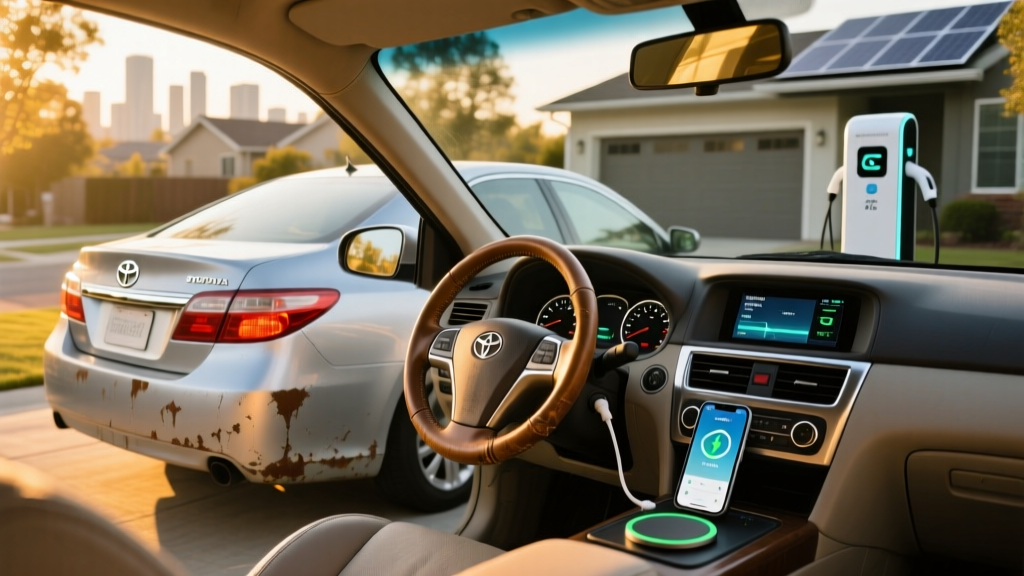
The 2009 Toyota Camry Hybrid was one of the first mainstream midsize sedans to prove that hybrid technology could deliver meaningful fuel savings without sacrificing everyday comfort. More than a decade and a half later, budget-conscious drivers are still searching for 2009 hybrid camry mpg data to figure out whether this aging hybrid is a smart used buy or a ticking time bomb for battery replacement costs.
We've compiled the official EPA figures, real-world owner data, battery longevity expectations, and a clear comparison against modern hybrids, plug-in hybrids, and full EVs to help you decide. Let's get into the numbers.
2009 Camry Hybrid MPG: Official EPA Ratings
The 2009 Toyota Camry Hybrid uses a conventional hybrid (HEV) powertrain — meaning it does not plug in. It charges its small battery entirely through regenerative braking and the gasoline engine. Here are the official EPA fuel economy figures as published on fueleconomy.gov:
| Metric | Value |
|---|---|
| City MPG | 33 MPG |
| Highway MPG | 34 MPG |
| Combined MPG | 34 MPG |
| Annual Fuel Cost (est.) | ~$1,550 (15,000 mi/yr at $3.30/gal) |
| Fuel Tank Capacity | 17.2 gallons |
| Total Driving Range | ~585 miles |
One notable quirk of the 2009 model year: Toyota rated this car at 33 city / 34 highway under the EPA's revised testing methodology that began in 2008. Earlier 2007–2008 Camry Hybrids carried inflated stickers of 40/38 MPG under the old, less rigorous testing cycle. The 2009 numbers are the ones that reflect actual driving conditions more honestly.
Real-World MPG: What Owners Actually Report
EPA stickers are a starting point, not a guarantee. For the 2009 Camry Hybrid, real-world data from owner communities and fuel-tracking platforms like Fuelly tells a more nuanced story:
- Average real-world combined: 30–34 MPG across thousands of fill-ups
- City-heavy driving: 32–36 MPG — hybrids excel in stop-and-go traffic where regenerative braking recaptures energy and the electric motor handles low-speed propulsion
- Highway-heavy driving (75+ mph): 28–32 MPG — the 2.4L four-cylinder engine works harder at sustained high speeds, and aerodynamic drag erodes efficiency
- Cold weather (below 30°F): 26–30 MPG — the engine runs more frequently to provide cabin heat and maintain battery temperature, reducing electric-only operation
Powertrain: What Moves the 2009 Camry Hybrid
The 2009 Camry Hybrid pairs Toyota's well-proven Hybrid Synergy Drive system with a conventional four-cylinder engine. Here's the full powertrain breakdown:
| Component | Specification |
|---|---|
| Gasoline Engine | 2.4L inline-4 (2AZ-FXE), Atkinson cycle |
| Engine Horsepower | 147 HP @ 6,000 RPM |
| Electric Motor | Permanent magnet synchronous, 40 HP |
| Net Combined Horsepower | 192 HP |
| Transmission | eCVT (electronically controlled continuously variable) |
| Drivetrain | Front-wheel drive |
| Hybrid Battery | Nickel-metal hydride (NiMH), ~1.6 kWh (not plug-in) |
| 0–60 MPH | ~8.4 seconds |
The Atkinson-cycle engine sacrifices some low-end torque for greater thermal efficiency, and the electric motor fills in the torque gap during acceleration. The eCVT is not a belt-driven CVT like you'd find in a Nissan — it's a planetary gearset that seamlessly blends power from the engine and motor. This design has proven remarkably durable, with very few reported transmission failures.
HEV vs PHEV vs EV: Where Does the 2009 Camry Hybrid Fit?
If you're shopping for an electrified vehicle in 2026, it's critical to understand the three categories. The 2009 Camry Hybrid is a conventional hybrid (HEV), not a plug-in.
| Feature | HEV (e.g., 2009 Camry Hybrid) | PHEV (e.g., 2026 RAV4 Prime) | BEV (e.g., 2026 Tesla Model 3) |
|---|---|---|---|
| Plugs In? | No | Yes | Yes |
| Electric-Only Range | None (motor assists only) | 25–45 miles typical | 250–400+ miles |
| Battery Size | ~1.6 kWh (NiMH) | 13–20 kWh (Li-ion) | 50–100 kWh (Li-ion/LFP) |
| Gasoline Engine? | Yes | Yes | No |
| Home Charging Needed? | No | Recommended (Level 2) | Essential (Level 2) |
| Federal Tax Credit (§30D) | Not eligible | Up to $7,500 (if eligible) | Up to $7,500 (if eligible) |
| Typical Combined MPG / MPGe | 30–35 MPG | 35–42 MPG + 80–100 MPGe | 100–140 MPGe |
Battery Lifespan, Warranty, and Replacement Cost
The single biggest concern for any used hybrid buyer is the high-voltage battery. Here's what you need to know about the 2009 Camry Hybrid's NiMH pack:
How Long Do These Batteries Actually Last?
Toyota's NiMH hybrid batteries have an outstanding longevity track record. Based on owner reports, mechanic surveys, and taxi fleet data:
- Typical lifespan: 150,000–200,000+ miles before significant degradation
- Failure mode: Gradual capacity loss rather than sudden failure — you'll notice reduced MPG (dropping from 33 to 25–28 combined) as the battery weakens
- Age-related risk: A 2009 model is now 17 years old. Even with moderate mileage, calendar aging degrades NiMH cells. Budget for a potential replacement.
Battery Replacement Costs in 2026
| Option | Cost Range | Notes |
|---|---|---|
| New OEM Toyota Battery | $3,000–$4,000 | Full new pack from dealer; best longevity |
| Remanufactured Battery | $1,500–$2,500 | Rebuilt with tested cells; 1–3 year warranty typical |
| Used/Salvage Battery | $500–$1,200 | From a wrecked Camry; condition is a gamble |
| Individual Cell Replacement | $300–$800 | Replace only failed modules; requires a skilled hybrid tech |
Given that a clean 2009 Camry Hybrid sells for roughly $4,000–$7,000 in 2026 depending on mileage and condition, a full OEM battery replacement can represent 40–80% of the car's value. A remanufactured pack or cell-level repair is usually the economically rational choice.
Tax Credits and Incentives: What Applies in 2026?
Here's the straightforward answer: the 2009 Toyota Camry Hybrid does not qualify for any federal tax credit under current IRS §30D rules.
- The §30D Clean Vehicle Credit applies only to new plug-in electric vehicles (PHEVs and BEVs) with sufficient battery capacity.
- Conventional hybrids (HEVs) like the Camry Hybrid have never qualified for the federal credit.
- The used EV credit (§25E, up to $4,000) also requires a plug-in vehicle — it does not apply to conventional hybrids.
- Toyota's hybrid tax credits for the original 2006–2010 Camry Hybrid buyers were phased out by Toyota reaching the 250,000-unit manufacturer cap back in 2007.
Some states offer registration fee reductions or HOV lane access for hybrids, but these programs have largely sunset or transitioned to plug-in vehicles. Check your state's DMV or energy office for any remaining perks. For current federal rules, always reference IRS.gov §30D guidance.
Who Should Buy the 2009 Camry Hybrid in 2026?
- You want a cheap, fuel-efficient daily driver under $7,000
- You drive mostly in the city (where hybrids shine at 33+ MPG)
- You have no access to home or workplace charging
- You want Toyota reliability with lower fuel costs vs. a gas Camry
- You drive under 15,000 miles/year and want to minimize fuel spend
- The hybrid battery shows signs of degradation (check for warning lights, reduced MPG)
- You want electric-only driving or plug-in capability
- You drive mostly highway miles (a modern turbo gas car or diesel may match the MPG)
- You want modern safety tech (AEB, lane-keep, blind-spot monitoring — not available on this generation)
- A battery replacement would exceed your budget for the car
How It Compares: 2009 Camry Hybrid vs. Modern Alternatives
| Vehicle | Type | Combined MPG/MPGe | Price (2026) | Federal Credit |
|---|---|---|---|---|
| 2009 Camry Hybrid | HEV | 34 MPG | $4,000–$7,000 (used) | None |
| 2026 Toyota Camry Hybrid | HEV | 52 MPG | ~$30,000 new | None |
| 2026 Toyota Prius | HEV | 57 MPG | ~$29,500 new | None |
| 2026 Toyota Prius Prime | PHEV | 52 MPG + 127 MPGe | ~$34,000 new | Up to $7,500* |
| 2026 Hyundai Elantra Hybrid | HEV | 54 MPG | ~$28,000 new | None |
*§30D credit eligibility depends on MSRP caps, buyer income limits, battery sourcing requirements, and point-of-sale transfer rules. Verify on IRS.gov before purchasing.
The 2009 Camry Hybrid's 34 MPG was impressive for its era, but modern hybrids have moved the goalposts dramatically. The current-generation Camry Hybrid achieves 52 MPG combined — a 53% improvement — while the Prius pushes 57 MPG. If you can stretch to a newer used hybrid (2018+ Camry or Prius), the fuel savings alone can justify the higher purchase price within 2–3 years of typical driving.
Frequently Asked Questions
How many MPG does the 2009 Toyota Camry Hybrid get?
The EPA rates it at 33 city / 34 highway / 34 combined MPG. In real-world driving, most owners average 30–34 MPG combined, with city-heavy routes pushing toward 36 MPG and highway-heavy trips dropping to 28–32 MPG.
Does the 2009 Camry Hybrid need to be plugged in?
No. It is a conventional hybrid (HEV), not a plug-in hybrid (PHEV). The battery charges entirely through regenerative braking and the gasoline engine. You fuel it like any other car at a gas station.
How long does the 2009 Camry Hybrid battery last?
Toyota's NiMH batteries typically last 150,000–200,000+ miles. At 17 years old, calendar aging is a factor regardless of mileage. Budget $1,500–$2,500 for a remanufactured replacement if the original battery hasn't been replaced.
Is the 2009 Camry Hybrid reliable?
Yes. The 2AZ-FXE engine and Toyota's Hybrid Synergy Drive are among the most proven and reliable powertrains ever built. The eCVT transmission has no belts or clutches to wear out. Major concerns are limited to the hybrid battery (age-related degradation) and standard 17-year-old wear items (suspension, brakes, electronics).
Hybrid vs PHEV vs EV — which should I choose?
Choose the 2009 Camry Hybrid (HEV) if you want a low-cost, no-plug-needed commuter that saves fuel in city driving. Choose a PHEV (like a used Prius Prime or RAV4 Prime) if you have home charging and want 25–45 miles of electric-only driving for daily commutes with gas-engine backup for road trips. Choose a full EV (BEV) if you want zero gasoline, have reliable home Level 2 charging, and want the lowest per-mile fuel cost — but expect a higher purchase price.
Does the 2009 Camry Hybrid qualify for any tax credit?
No. Conventional hybrids are not eligible for the federal §30D Clean Vehicle Credit or the §25E used EV credit. These credits apply only to plug-in vehicles (PHEVs and BEVs). Some states may offer minor perks, but most hybrid incentive programs have ended.
Sources: EPA fuel economy data via fueleconomy.gov, IRS Clean Vehicle Credit rules via irs.gov, Toyota Camry Hybrid specifications from manufacturer archives.