Quick Verdict: A Pioneer That Still Has Tricks
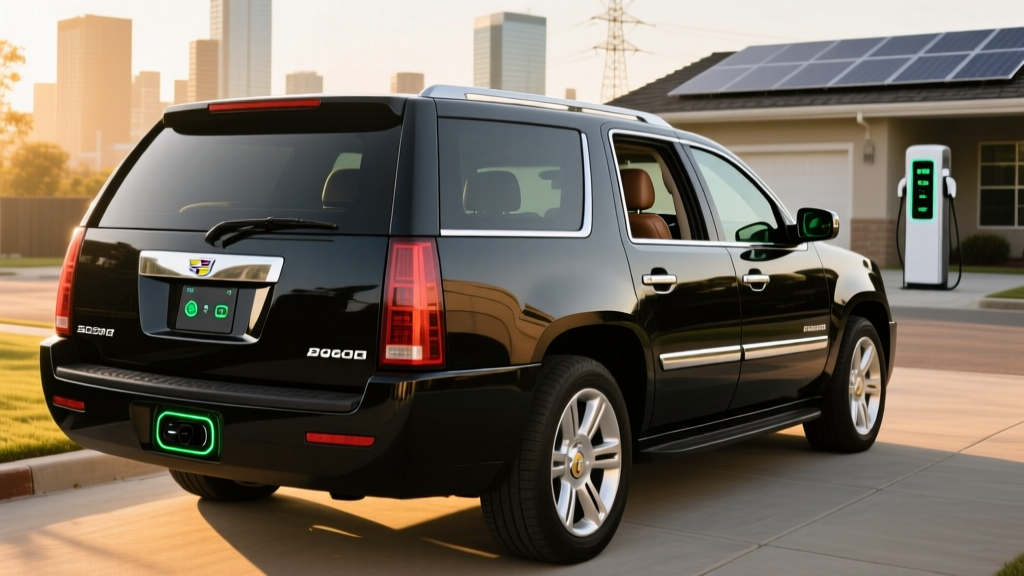
The 2009 Cadillac Escalade Hybrid was one of the first full-size luxury SUVs to pair a V8 with an electric assist system. Built on GM's two-mode hybrid architecture, it delivered meaningful fuel savings over its gas-only sibling without sacrificing the towing capacity or presence Escalade buyers demanded. In 2026, this SUV lives exclusively on the used market — but for buyers seeking a large, capable hybrid without the premium of a new electrified SUV, it remains a compelling, if aging, option.
This guide covers the exact EPA figures, the real-world MPG you should expect from a 17-year-old hybrid system, battery longevity and replacement costs, and how the 2009 Escalade Hybrid stacks up against modern alternatives.
HEV vs PHEV: Where the 2009 Escalade Hybrid Fits
This is a conventional hybrid (HEV), not a plug-in hybrid (PHEV). The 2009 Escalade Hybrid cannot be plugged in. It has no electric-only driving range. Its nickel-metal hydride (NiMH) battery recharges exclusively through regenerative braking and engine-driven generation. You fuel it like any other SUV — with gasoline — and the hybrid system works invisibly to reduce consumption.
Understanding this distinction matters because many shoppers searching for an "Escalade hybrid" assume plug-in capability. The Escalade did not receive a PHEV variant during its second-generation run (2007–2014). If plug-in electric range is a priority, you'll need to look at modern PHEV SUVs like the Jeep Grand Cherokee 4xe or the BMW X5 xDrive50e.
Fuel Economy: EPA Numbers and Real-World MPG
The headline number for the 2009 Escalade Hybrid was substantial for its era: a 50% improvement in city driving over the standard V8 Escalade. Here's the official EPA breakdown:
| Metric | 2009 Escalade Hybrid (2WD) | 2009 Escalade Hybrid (4WD) | 2009 Escalade Gas (2WD) |
|---|---|---|---|
| City MPG | 21 | 20 | 12 |
| Highway MPG | 22 | 21 | 19 |
| Combined MPG | 21 | 20 | 14 |
Source: EPA Fuel Economy
Real-World MPG: What to Expect in 2026
The two-mode hybrid system excels in stop-and-go traffic, where electric assist and regenerative braking do the most work. In city driving, many owners reported meeting or even slightly exceeding the EPA city rating when the vehicle was new — a common trait of conventional hybrids, since regenerative braking recovers energy that gas-only vehicles waste as heat.
However, a 2009 model in 2026 comes with caveats:
- Battery degradation: After 17 years, the NiMH battery pack will have lost capacity. This reduces the electric assist available during acceleration and low-speed driving, pushing the engine to work harder. Expect city MPG to drop to 17–19 if the battery hasn't been replaced or reconditioned.
- Highway driving: The two-mode system offers less benefit at sustained highway speeds. Expect 19–21 MPG on the highway for 2WD models — close to the EPA sticker, since highway efficiency relies more on the 6.0L V8's cylinder deactivation (Active Fuel Management) than on electric assist.
- Towing: When towing near the 5,800-lb capacity, fuel economy drops sharply to 12–14 MPG regardless of hybrid status.
Bottom line: In mixed driving with a healthy battery, plan for 18–20 MPG combined. That's still a meaningful improvement over the gas V8's 14 MPG combined — roughly 28–40% better in real-world use.
Powertrain: The Two-Mode Hybrid System Explained
| Specification | Detail |
|---|---|
| Engine | 6.0L V8 (Vortec) with Active Fuel Management (cylinder deactivation) |
| Engine Power | 332 hp @ 5,100 rpm |
| Electric Motors | Two 60-kW motors integrated into the 2-mode CVT transmission |
| Combined System Output | 379 hp |
| Transmission | Electrically Variable Transmission (EVT) — 2-mode CVT |
| Battery Type | Nickel-Metal Hydride (NiMH), ~1.8 kWh (not usable for plug-in) |
| Drivetrain | 2WD or 4WD (4WD uses a modified transfer case) |
| Towing Capacity | 5,800 lbs (2WD) / 5,600 lbs (4WD) |
| 0–60 mph | ~7.8 seconds |
| Curb Weight | ~5,840 lbs (2WD) |
The two-mode system, co-developed by GM, BMW, and Chrysler (then DaimlerChrysler), was sophisticated for its time. At low speeds, the vehicle could move on electric power alone for very short distances (under 1 mile, under 25 mph) — not enough to qualify as a PHEV, but enough to smooth out stop-and-go traffic and reduce fuel consumption at idle. At higher speeds, the system blended engine and electric power, and the cylinder deactivation shut down four of eight cylinders during light-load cruising.
The result was a full-size, body-on-frame SUV that could achieve 20+ MPG — a number that seemed remarkable in 2009 and still holds up respectably for a vehicle of this size.
Hybrid Battery: Lifespan, Degradation, and Replacement Cost
Original Warranty: GM covered the hybrid-specific components (battery pack, EVT transmission, hybrid control module) for 8 years / 100,000 miles on the 2009 Escalade Hybrid. This warranty has long expired for all examples.
Battery Chemistry: Nickel-Metal Hydride (NiMH) — a proven, durable chemistry that degrades more gracefully than early lithium-ion packs. NiMH batteries typically lose 20–30% of original capacity over 15–20 years rather than failing catastrophically.
Replacement Cost (2026): A remanufactured NiMH battery pack for the 2009 Escalade Hybrid runs $2,500–$4,000 installed at a hybrid-specialist shop. A new OEM pack from GM (if still available) would exceed $5,000. Many owners opt for individual cell replacement or reconditioning services at $1,200–$2,000.
Is the Hybrid System Reliable?
The two-mode EVT transmission and NiMH battery have proven more durable than early critics expected. The most common hybrid-specific failures on high-mileage examples include:
- NiMH battery cell imbalance: Individual cells degrade unevenly, triggering a "Service Hybrid System" warning. Reconditioning or cell-level replacement often resolves this without a full pack swap.
- Inverter coolant pump: The hybrid system's dedicated coolant pump can fail, typically between 100,000–150,000 miles. Replacement runs $400–$700.
- Regenerative braking sensor issues: Wheel speed and brake-position sensors occasionally cause regen to disengage, reducing fuel economy until repaired.
The 6.0L V8 itself is a proven GM workhorse (the Vortec LFA variant), though Active Fuel Management has a known history of lifter failure on high-mileage examples — an issue unrelated to the hybrid system but worth monitoring. Overall, a well-maintained 2009 Escalade Hybrid with a healthy battery is no more risky than its gas-only counterpart, and the hybrid components are generally robust past 150,000 miles.
Pricing, Tax Credits, and Used Market Value
The 2009 Escalade Hybrid originally carried an MSRP of approximately $71,000–$75,000 depending on 2WD/4WD and options — a $4,000–$5,000 premium over the gas V8 model.
In the 2026 used market, examples typically trade in the $8,000–$16,000 range depending on mileage, condition, and battery health. Low-mileage, well-maintained examples with documented battery service command the upper end.
Tax Credit Eligibility
The 2009 Escalade Hybrid does not qualify for any current federal tax credit. Under current IRS §30D rules, only new plug-in electric vehicles (BEVs and PHEVs with at least 7 kWh of battery capacity and plug-in capability) are eligible. Conventional hybrids like this Escalade have never qualified for the §30D credit. There is also no federal used-EV credit (§25E) available because the vehicle is not a plug-in.
Some states historically offered hybrid purchase incentives, but most have expired or shifted exclusively to plug-in vehicles. Check your state's current energy office or Alternative Fuels Data Center for any remaining programs.
Who Should Buy the 2009 Escalade Hybrid vs. Alternatives
Pros
- 30–40% better city MPG than the gas V8 Escalade
- Full-size SUV with 5,800-lb towing capacity
- Luxury features: leather, Bose audio, navigation, power running boards
- NiMH battery is durable and relatively affordable to replace
- Low used-market entry price ($8K–$16K)
Cons
- No electric-only range — not a PHEV
- Highway MPG only marginally better than the gas model
- 17-year-old technology — no modern ADAS or infotainment
- Heavy curb weight (~5,840 lbs) means high tire and brake wear
- No federal tax credit eligibility
- Insurance costs can be elevated for older luxury SUVs
Decision Framework: Hybrid vs PHEV vs EV
Choose the 2009 Escalade Hybrid if: You need a large, body-on-frame luxury SUV with real towing capacity, want better fuel economy than a gas V8, don't have access to plug-in charging, and are comfortable with a used vehicle that's outside its original warranty.
Choose a modern PHEV (e.g., Jeep Grand Cherokee 4xe, BMW X5 xDrive50e) if: You want 25–40 miles of electric-only range for daily commuting, can charge at home, and prefer a newer vehicle with modern safety tech and warranty coverage.
Choose a full EV (e.g., Rivian R1S, Tesla Model X, Cadillac Escalade IQ) if: You want zero tailpipe emissions, have reliable home charging, prioritize low running costs, and have the budget for a new or late-model electric SUV. Note that no full-electric Escalade equivalent existed as of early 2026 — the Cadillac Escalade IQ is the brand's electric flagship but at a significantly higher price point.
Ownership Costs: What to Budget in 2026
Buying a 17-year-old luxury SUV — hybrid or not — requires realistic maintenance budgeting. Here's what to plan for annually:
- Fuel: At 19 MPG combined and $3.40/gallon (2026 national average), driving 12,000 miles/year costs roughly $2,147/year. That's ~$670 less annually than the gas-only Escalade at 14 MPG combined.
- Insurance: Expect $1,400–$2,200/year for a used luxury SUV, varying significantly by state, driving record, and coverage level.
- Maintenance: Budget $1,500–$2,500/year for an out-of-warranty Escalade. Hybrid-specific items (inverter coolant, brake actuator) add to standard V8 maintenance.
- Battery reserve: Set aside $2,500–$4,000 for eventual NiMH battery replacement if the pack hasn't been serviced.
Total annual operating cost (fuel + insurance + maintenance): approximately $5,000–$6,800 — competitive with the gas Escalade once you factor in fuel savings, but higher than a modern compact PHEV or EV.
Frequently Asked Questions
How many MPG does the 2009 Escalade Hybrid actually get?
The EPA rates the 2WD model at 21 city / 22 highway / 21 combined. The 4WD model is rated at 20/21/20. In real-world 2026 driving with a 17-year-old battery, expect 17–19 city and 19–21 highway — still a significant improvement over the gas model's 14 MPG combined.
Can the 2009 Escalade Hybrid drive on electric power alone?
Only at very low speeds (under ~25 mph) and for very short distances (under a mile). This is a conventional hybrid, not a plug-in. There is no meaningful electric-only range — the system uses electric assist to improve efficiency, not to replace gasoline driving.
Is the hybrid battery expensive to replace?
A remanufactured NiMH battery pack costs $2,500–$4,000 installed. Cell-level reconditioning can cost as little as $1,200–$2,000. This is less expensive than replacing a modern lithium-ion EV battery pack, which can exceed $10,000–$20,000.
Does the 2009 Escalade Hybrid qualify for any tax credit?
No. Federal tax credits under IRS §30D apply only to new plug-in electric vehicles. Conventional hybrids have never qualified for the federal EV credit. The used-EV credit (§25E) also requires plug-in capability, which this vehicle lacks.
Is the 2009 Escalade Hybrid reliable?
The two-mode hybrid system and NiMH battery have proven durable, often reaching 150,000+ miles without major hybrid-component failure. The primary risks are age-related battery degradation, inverter coolant pump wear, and the standard V8 maintenance items (Active Fuel Management lifters, transmission service). A pre-purchase inspection by a hybrid-experienced technician is strongly recommended.
How does this compare to the new Cadillac Escalade IQ?
The Cadillac Escalade IQ is a fully electric luxury SUV with an EPA-estimated range exceeding 400 miles, but it starts above $130,000. The 2009 Hybrid serves an entirely different buyer — someone seeking a used luxury SUV under $16,000 with better fuel economy than a gas V8, not a cutting-edge electric flagship.