Quick Verdict: A 17-Year-Old Luxury Hybrid That Still Intrigues
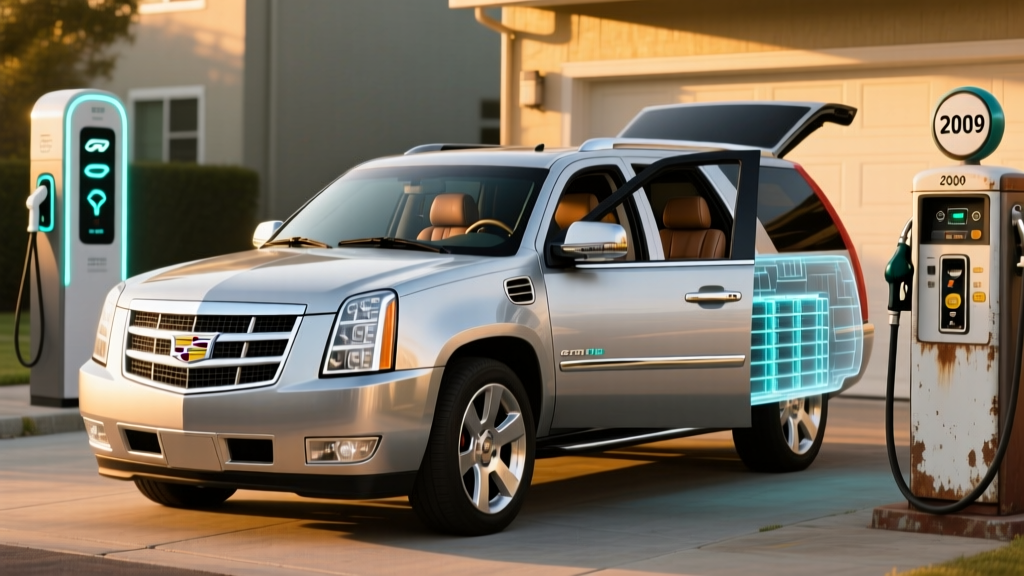
The 2009 Cadillac Escalade Hybrid SUV occupies an unusual niche in 2026. It was GM's flagship attempt to make a 5,800-pound, body-on-frame luxury SUV sip less fuel using a two-mode hybrid system co-developed with BMW and Mercedes-Benz. With EPA ratings of 20 MPG city, 21 MPG highway, and 20 MPG combined, it delivered roughly a 30% fuel-economy improvement over its gas-only sibling — a meaningful gain for a three-row luxury hauler that still offered 332 combined horsepower and a 5,800-pound towing capacity.
But this is a conventional hybrid (HEV), not a plug-in hybrid (PHEV). You never plug it in. The 1.8 kWh nickel-metal hydride (NiMH) battery recharges exclusively through regenerative braking and the 6.0L V8 engine. There is no electric-only driving mode of any meaningful distance. If you're shopping for a PHEV with 30+ miles of EV range, this isn't it. If you want a used luxury SUV with modest fuel savings and don't want to deal with charging infrastructure, it warrants a closer look — with major caveats about age and battery replacement cost.
HEV vs PHEV: What the 2009 Escalade Hybrid Actually Is
Before diving into specs, the distinction matters because buyers often confuse hybrid types:
| Feature | 2009 Escalade Hybrid (HEV) | Typical PHEV (e.g., 2026 RAV4 Prime) | Full EV (BEV) |
|---|---|---|---|
| Plug-in charging | No — never plugs in | Yes — Level 1/2 AC | Yes — Level 1/2/DC |
| Electric-only range | ~0 miles (motor assists only) | 35-45 miles | 250-400+ miles |
| Battery size | 1.8 kWh (NiMH) | 14-20 kWh (NMC/LFP) | 60-100+ kWh |
| Gas engine | 6.0L V8 (always available) | 4-cyl (backup) | None |
| Fuel required | Gasoline (premium recommended) | Gasoline + electricity | Electricity only |
| Federal tax credit (new) | None | Up to $7,500 (§30D) | Up to $7,500 (§30D) |
The 2009 Escalade Hybrid uses GM's Two-Mode Hybrid system, which pairs two electric motors inside the transmission housing with the 6.0L Vortec V8. In low-speed city driving, the system can shut off the engine at stops and briefly propel the SUV on electric power alone at very low speeds (under ~25 mph, for short distances). But this isn't a usable EV mode — it's an efficiency assist. The engine fires up the moment you need real acceleration or climb a hill.
Fuel Economy: EPA Ratings and Real-World MPG
| Driving Condition | EPA Estimate | Real-World Expectation |
|---|---|---|
| City | 20 MPG | 18-21 MPG (hybrid system helps in stop-and-go) |
| Highway | 21 MPG | 19-22 MPG (aero drag hurts at 70+ mph) |
| Combined | 20 MPG | 18-20 MPG |
For context, the gas-only 2009 Escalade with the 6.2L V8 was rated at 12 city / 19 highway / 15 combined. The hybrid's 33% combined improvement is substantial, but 20 MPG combined still means frequent fill-ups with a 26-gallon tank and premium fuel costs. At $4.00/gallon premium and 12,000 miles/year, expect roughly $2,400 in annual fuel costs — about $900/year less than the gas model.
According to fueleconomy.gov, the 2009 Escalade Hybrid's 20 MPG combined places it among the most efficient body-on-frame SUVs of its era, but far behind modern crossovers. A 2026 Toyota Highlander Hybrid achieves 36 MPG combined for comparison.
Powertrain Specs: The Two-Mode Hybrid System
| Specification | 2009 Cadillac Escalade Hybrid |
|---|---|
| Engine | 6.0L Vortec V8 (VVT, Active Fuel Management) |
| Engine HP | 332 hp @ 5,100 rpm (gas only) |
| Electric Motors | Two 60 kW AC motors (inside 2-mode EVT) |
| Combined System HP | 332 hp (net) |
| Combined Torque | 367 lb-ft |
| Transmission | Electrically Variable Transmission (EVT), 2 modes + 4 fixed gears |
| Hybrid Battery | 1.8 kWh NiMH (300V nominal) |
| Drivetrain | RWD or AWD (AWD standard on Hybrid trim) |
| 0-60 mph | ~8.0 seconds (estimated) |
| Towing Capacity | 5,800 lbs (properly equipped) |
| Curb Weight | ~5,841 lbs |
The two-mode system is mechanically sophisticated. Mode 1 handles low-speed driving where one electric motor can propel the vehicle while the other manages the engine's connection. Mode 2 engages at highway speeds, where the system operates more like a conventional powertrain with electric assist. The Active Fuel Management system can also shut off four of the eight cylinders under light load, further saving fuel during steady-state cruising.
This complexity is a double-edged sword: it works well when functional, but repairs on a 17-year-old two-mode hybrid transmission are neither cheap nor straightforward. Few independent shops have the diagnostic tools for GM's EVT system.
Battery Lifespan, Warranty, and Replacement Cost
Original warranty: GM covered the hybrid battery and related components for 8 years / 100,000 miles (10 years / 150,000 miles in CARB states). For a 2009 model, all factory warranty coverage expired no later than 2019.
Battery chemistry: Nickel-metal hydride (NiMH) — proven, durable, but heavier and lower energy density than modern lithium-ion.
Expected lifespan: NiMH packs in GM two-mode hybrids typically last 150,000-200,000 miles before significant capacity loss. Many 2007-2013 Tahoe/Escalade Hybrids have reached 200K+ miles on original packs.
Battery Replacement Cost in 2026
If the hybrid battery fails out of warranty, owners face a difficult economic decision:
- OEM replacement (dealer): $3,500-$5,500 for the battery pack, plus $800-$1,500 labor
- Aftermarket/remanufactured pack: $1,800-$3,000 (available from hybrid battery specialists like Green Bean Battery or Exclusive Battery)
- Individual cell replacement: $600-$1,200 if only a few cells are weak (requires a shop with NiMH cell-level diagnostics)
- Junkyard pull: $500-$1,200 for a used pack with unknown remaining life — risky
Given that a 2009 Escalade Hybrid in average condition has a 2026 market value of roughly $6,000-$10,000 (depending on mileage and condition), a $5,000+ dealer battery replacement can total the vehicle economically. The aftermarket route at $2,000-$3,000 is more rational but still represents 25-40% of the vehicle's value.
Reliability Track Record
The GM two-mode hybrid system has proven reasonably reliable, but not trouble-free. Common issues reported on owner forums and NHTSA complaint databases include:
- Hybrid battery cooling fan failure: The battery has its own dedicated cooling system. Fan motor failures cause the battery to overheat and trigger reduced-power limp mode.
- Inverter coolant pump failure: Similar to the cooling fan — if the inverter overheats, the hybrid system shuts down.
- Transmission mode solenoid issues: The EVT uses multiple solenoids to manage mode transitions. Failures cause harsh shifts or loss of hybrid functionality.
- 12V auxiliary battery drain: The hybrid system draws from the 12V battery when parked; parasitic drain can kill a weak 12V battery faster than in conventional vehicles.
The V8 engine and conventional drivetrain components (transfer case, axles) carry the same reliability profile as the gas Escalade — generally stout but thirsty if the hybrid system fails and the vehicle reverts to gas-only operation (which drops MPG to roughly 14-15 combined).
Pricing, Tax Credits, and Used Market Value
The 2009 Escalade Hybrid carried an original MSRP of approximately $71,915 (base, with AWD standard on the Hybrid trim). That was roughly $9,000 more than the gas-only Escalade Luxury trim.
In 2026, used market pricing looks very different:
- Fair condition (150K+ miles): $4,500-$6,500
- Good condition (100K-140K miles): $6,500-$9,000
- Excellent condition (under 100K miles): $9,000-$12,000
Tax Credit Eligibility
The 2009 Escalade Hybrid does not qualify for any federal tax credit in 2026. Under current IRS §30D rules, the federal clean vehicle credit applies only to new plug-in electric vehicles (PHEVs and BEVs) with sufficient battery capacity and meeting critical mineral/battery sourcing requirements. Conventional hybrids (HEVs) have never qualified for §30D. Additionally, the IRS clean vehicle credit has MSRP caps, buyer income limits, and battery component sourcing rules that only apply to new vehicle purchases.
The now-expired used EV credit (§25E, up to $4,000 for used plug-in vehicles) also does not apply — it requires a plug-in vehicle with at least 4 kWh of battery capacity, and the Escalade Hybrid's 1.8 kWh NiMH pack falls short. No state-level hybrid incentives currently target 17-year-old conventional hybrids.
Who Should Consider This Hybrid — and Who Shouldn't
Pros
- 30% better fuel economy than gas Escalade (20 vs 15 MPG combined)
- Full three-row seating and 5,800-lb towing retained
- No plug-in charging required — works with existing gas infrastructure
- NiMH battery has proven durable to 150K-200K+ miles
- Luxury features (leather, Bose audio, navigation, power third row) standard
- Low used purchase price ($6K-$10K) vs new luxury SUVs
Cons
- 20 MPG combined is poor by 2026 standards (modern hybrids achieve 35-50 MPG)
- Complex two-mode transmission is expensive to repair if it fails
- All factory warranty coverage expired years ago
- No EV-only driving mode; no plug-in capability
- Premium fuel required increases operating cost
- Outdated infotainment and safety technology (no AEB, no lane-keeping)
- Heavy curb weight (5,841 lbs) accelerates tire and brake wear
Choose the 2009 Escalade Hybrid If:
- You need a three-row, body-on-frame SUV with towing capability on a tight budget
- You drive mostly city/suburban miles where the hybrid system provides the most benefit
- You have access to a mechanic familiar with GM's two-mode hybrid system
- You want to avoid the complexity of plug-in charging entirely
Look Elsewhere If:
- Fuel economy is your top priority (a 2026 Toyota Sienna Hybrid gets 36 MPG combined and seats eight)
- You want EV-only commuting (consider a used PHEV like a 2019-2022 Chrysler Pacifica Hybrid with 32 miles EV range)
- You can't absorb a potential $2,000-$5,000 hybrid battery or transmission repair
- Modern safety features (automatic emergency braking, blind-spot monitoring) are important
Hybrid vs PHEV vs EV: Which Fits Your Needs in 2026?
The 2009 Escalade Hybrid represents one end of the electrification spectrum. Here's how it compares to modern alternatives:
| Vehicle Type | Example (2026) | Combined MPG / MPGe | EV Range | Plug-In? | Est. Annual Fuel Cost |
|---|---|---|---|---|---|
| Conventional HEV | 2009 Escalade Hybrid | 20 MPG | 0 mi | No | ~$2,400 |
| Conventional HEV | 2026 Highlander Hybrid | 36 MPG | 0 mi | No | ~$1,330 |
| PHEV | 2026 Grand Cherokee 4xe | 56 MPGe / 23 MPG gas | 25 mi | Yes | ~$1,100-$1,800 |
| BEV | 2026 Rivian R1S | 69 MPGe (2.5 mi/kWh) | 352 mi | Yes | ~$600-$900 |
If you can charge at home and your daily commute is under 35 miles, a modern PHEV lets you drive almost entirely on electricity while keeping a gas engine for road trips. A full EV eliminates fuel costs further but requires charging infrastructure and a higher upfront investment. The 2009 Escalade Hybrid's value proposition is strictly about used-vehicle affordability with modest fuel savings — not about embracing electrification.
Frequently Asked Questions
How many MPG does the 2009 Cadillac Escalade Hybrid get?
The EPA rates the 2009 Escalade Hybrid at 20 MPG city, 21 MPG highway, and 20 MPG combined. Real-world results typically range from 18-21 MPG depending on driving style, terrain, and whether the hybrid system is fully functional. This represents a roughly 30% improvement over the gas-only model's 15 MPG combined.
Can the 2009 Escalade Hybrid drive on electric power only?
Not in any practical sense. The two-mode hybrid system can propel the SUV at very low speeds (under ~25 mph) for brief distances using electric motors, but the 1.8 kWh NiMH battery doesn't store enough energy for meaningful EV-only driving. The engine starts automatically when you accelerate or reach higher speeds. This is a conventional hybrid — it never plugs in.
Is the 2009 Escalade Hybrid reliable?
The GM two-mode hybrid system has a moderate reliability record. The NiMH battery pack is durable (many last 150,000-200,000 miles), but the complex EVT transmission and hybrid-specific cooling components (battery fan, inverter coolant pump) can fail and are expensive to repair. The underlying V8 engine and chassis components are proven but the vehicle's age means all rubber, seals, and electronics are subject to wear. Budget $1,000-$2,000/year for maintenance and potential hybrid-system repairs.
What does it cost to replace the hybrid battery?
A dealer-installed OEM replacement runs $3,500-$5,500 for the battery plus $800-$1,500 in labor. Aftermarket remanufactured packs are available for $1,800-$3,000 installed. Individual cell replacement (if only a few cells are weak) costs $600-$1,200. Given the vehicle's $6,000-$10,000 used value, battery replacement is a significant economic decision.
Does the 2009 Escalade Hybrid qualify for any tax credit?
No. Under current IRS §30D rules, the federal clean vehicle credit applies only to new plug-in electric vehicles (PHEVs and BEVs). Conventional hybrids have never qualified. The used EV credit (§25E) also doesn't apply because it requires plug-in capability and at least 4 kWh of battery capacity. No state incentives target 17-year-old conventional hybrids.
Should I buy a 2009 Escalade Hybrid or a newer hybrid SUV?
If your budget allows, a newer hybrid (2018+ Toyota Highlander Hybrid, 2020+ Ford Explorer Hybrid) offers significantly better fuel economy (28-36 MPG combined), modern safety features, remaining warranty coverage, and more readily available parts. The 2009 Escalade Hybrid makes sense only if you specifically need its body-on-frame towing capability, three-row luxury, and very low purchase price — and you're prepared for the risk of hybrid-system repair costs.
Does the hybrid system affect towing capacity?
The 2009 Escalade Hybrid retains a 5,800-pound towing rating when properly equipped, which is slightly less than the gas model's 7,800-pound maximum. The hybrid system's additional weight (~300 lbs for the battery and motors) and the EVT transmission's torque characteristics reduce the maximum tow rating. If heavy towing is your primary use case, the gas model actually has the advantage.