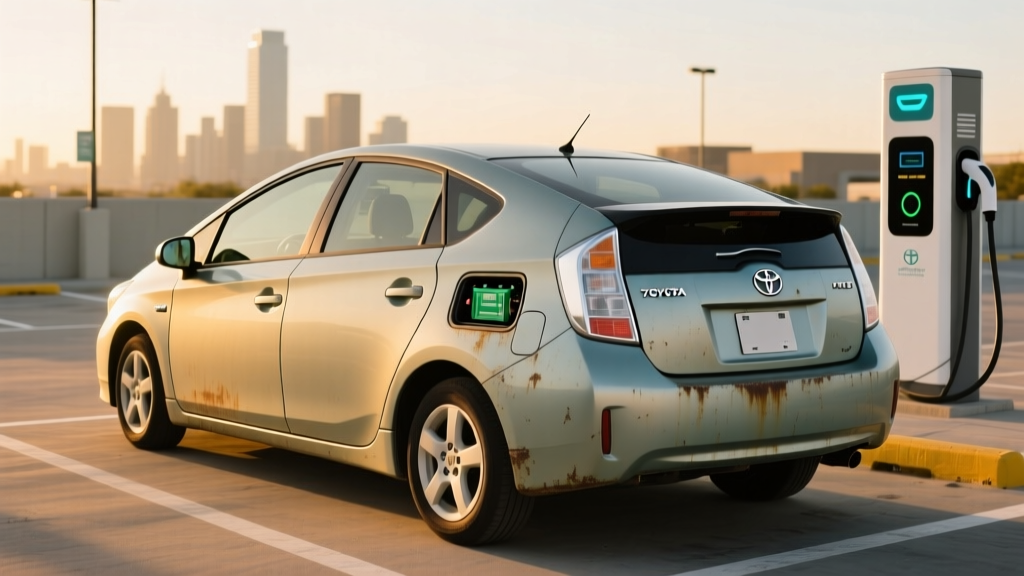
The second-generation Toyota Prius (model years 2004–2009) remains one of the most recognizable hybrids on the road. With over 15 years of real-world data behind it, the 2008 model year sits at a crossroads: cheap to acquire on the used market, but old enough that specific failure points are well-documented. If you're researching 2008 Toyota Prius hybrid problems before buying or maintaining one, this guide covers every major issue, the real cost of ownership, and whether this aging HEV still makes sense compared to modern hybrids and EVs.
The 2008 Prius is a conventional hybrid (HEV) — it cannot plug in. It charges its small nickel-metal hydride (NiMH) battery through regenerative braking and the gasoline engine. A plug-in hybrid (PHEV) like the later Prius Prime offers 25+ miles of electric-only range and requires external charging. This article focuses entirely on the 2008 HEV model.
Fuel Economy: EPA Ratings vs Real-World MPG
The 2008 Toyota Prius carries EPA ratings that still hold up remarkably well against modern non-hybrid vehicles. According to fueleconomy.gov, the official figures are:
| Metric | MPG |
|---|---|
| City | 48 |
| Highway | 45 |
| Combined | 46 |
Real-World MPG: What Owners Actually See
The Prius is one of the few vehicles where real-world city driving can exceed the EPA estimate. The hybrid system's reliance on electric-only propulsion at low speeds means stop-and-go traffic actually favors efficiency. Most owners report 42–50 MPG in mixed driving. Highway-only trips at 75+ MPH typically drop to 38–42 MPG because the Prius's aerodynamic advantage diminishes at higher speeds and the 1.5L engine works harder.
In cold weather (below 30°F), expect a 5–10% MPG reduction. The engine runs more frequently to maintain cabin heat and battery temperature, reducing electric-only operation. This is normal hybrid behavior and not indicative of a problem.
Common 2008 Toyota Prius Hybrid Problems
After nearly two decades on the road, the failure patterns of the 2008 Prius are well-established. Here are the documented issues ranked by frequency and severity:
1. Hybrid Battery Degradation and Failure
The most searched and most feared issue. The 2008 Prius uses a 1.3 kWh (nominal) NiMH battery pack consisting of 28 modules. By design, only about 0.6–0.8 kWh is usable — Toyota buffers the state of charge to protect longevity.
Typical lifespan: 120,000–180,000 miles or 12–18 years in moderate climates. Heat is the primary degradation accelerant; Prius batteries in Arizona and Texas tend to fail earlier than those in cooler regions.
Symptoms of failure: Reduced MPG (dropping to 30–35), the battery fan running constantly (loud whirring from the rear), state-of-charge gauge fluctuating wildly, and ultimately a "Check Hybrid System" warning with diagnostic codes P0A80 or P3000-series.
Replacement cost in 2026:
- New OEM battery (Toyota dealer): $2,200–$3,000 installed
- Refurbished/reconditioned battery: $800–$1,500 installed
- Individual module replacement (rebalancing): $300–$600 at a hybrid specialist
- Aftermarket new battery (e.g., Dorman, Project Lithium): $1,500–$2,500
For a vehicle with a current market value of $3,000–$6,000, a full OEM battery replacement is often uneconomical. Refurbished packs or module-level repairs are the pragmatic choice.
2. Inverter Coolant Pump Failure
The 2008 Prius has a separate electric coolant pump for the inverter/converter assembly. This pump circulates coolant to keep power electronics within operating temperature. When it fails (often silently), the inverter can overheat, potentially leading to a $2,000–$4,000 inverter replacement.
Prevention: Check for turbulence in the inverter coolant reservoir (under the hood, passenger side) when the car is ON and READY. If the fluid surface is still, the pump may be dead. Toyota issued a recall (campaign 13V133000) for certain 2004–2009 Prius inverter coolant pumps — verify whether your VIN was serviced.
3. Combination Meter (Dashboard) Failure
A widespread issue where the instrument cluster goes dark or the speedometer, odometer, and fuel gauge stop working intermittently. The root cause is solder joint failure on the circuit board due to thermal cycling.
Repair cost: $200–$500 for a rebuilt unit or professional solder rework. This is an inconvenience rather than a safety-critical failure, but it does prevent you from monitoring speed and fuel level reliably.
4. Steering Intermediate Shaft Clunk
Many 2004–2009 Prius owners report a clunking or knocking sensation when turning the steering wheel at low speeds. The telescoping intermediate shaft develops play. Toyota issued a Technical Service Bulletin (TSB) for this, and replacement shafts are available for $150–$300 plus labor.
5. Catalytic Converter Theft
The Prius's catalytic converter contains higher concentrations of precious metals than most gas vehicles, making it a frequent theft target. Replacement costs $1,200–$2,000 for an OEM unit. Aftermarket catalytic converter shields ($150–$300 installed) are strongly recommended for any 2008 Prius parked outdoors.
6. Head Gasket Failure (High Mileage)
Above 180,000 miles, the 1.5L 1NZ-FXE engine becomes susceptible to head gasket failure, often preceded by coolant loss and overheating. This is largely a function of age and mileage rather than a design flaw, but it's a terminal repair for most vehicles in this value range ($1,500–$2,500).
Powertrain Specifications and Battery Details
| Specification | Value |
|---|---|
| Engine | 1.5L 4-cylinder Atkinson cycle (1NZ-FXE) |
| Engine HP | 76 hp @ 5,000 rpm |
| Electric Motor | Permanent magnet synchronous, 67 hp (50 kW) |
| Combined Net HP | 110 hp |
| Transmission | eCVT (planetary gearset, no belt) |
| Battery Type | NiMH (Nickel-Metal Hydride) |
| Battery Capacity | 1.3 kWh nominal (~0.7 kWh usable) |
| Battery Voltage | 201.6V (nominal) |
| 0–60 MPH | ~10.4 seconds |
| Drivetrain | FWD |
| Plug-In Charging | No (HEV — self-charging only) |
Hybrid Battery Warranty and Longevity
Toyota's original hybrid battery warranty for the 2008 Prius was 8 years / 100,000 miles (10 years / 150,000 miles in California Air Resources Board states: CA, CT, MA, ME, NJ, NY, OR, RI, VT, WA). As of 2026, all original factory coverage has expired for this model year. Any battery replacement will be at owner expense unless an extended aftermarket warranty was purchased.
Real-world battery longevity data: Fleet and taxi use demonstrated that 200,000+ mile battery life was achievable with regular use (daily driving keeps NiMH cells balanced). Vehicles that sat unused for extended periods actually experienced more battery degradation than daily drivers. If you're buying a 2008 Prius today, a vehicle with 140,000 miles and a recently replaced battery is often a better value than one with 90,000 original miles and the original pack.
HEV vs PHEV vs EV: Where Does the 2008 Prius Fit?
| Factor | 2008 Prius (HEV) | 2025 Prius Prime (PHEV) | 2025 Hyundai Ioniq 5 (BEV) |
|---|---|---|---|
| Combined MPG / MPGe | 46 MPG | 127 MPGe (EV) / 52 MPG (hybrid) | 114 MPGe |
| Electric-Only Range | N/A | 44 miles | 303 miles |
| Plugs In? | No | Yes (Level 1/2, no DCFC) | Yes (Level 1/2 + DCFC) |
| Used Price / New MSRP | $3,000–$6,000 | ~$33,445 MSRP | ~$42,600 MSRP |
| Federal Tax Credit | None | Up to $3,750 (§30D)* | Up to $7,500 (§30D)* |
| Fuel Cost per Mile (est.) | ~$0.08 | ~$0.04–$0.07 | ~$0.04–$0.06 |
| Home Charging Needed? | No | Recommended | Essential |
* Federal tax credit eligibility under IRS §30D depends on buyer income limits, MSRP caps, and battery component/mineral sourcing requirements. Consult irs.gov or a tax professional before purchasing.
Who Should Still Buy a 2008 Prius?
Choose the 2008 Prius HEV if:
- Your budget is under $6,000 and you need maximum MPG without plugging in
- You lack home or workplace charging access (apartment, street parking)
- You want a proven, simple hybrid with abundant aftermarket parts and independent mechanic knowledge
- You drive 10,000–15,000 miles/year in city-heavy conditions where hybrid efficiency peaks
Choose a modern PHEV (like the 2025 Prius Prime) if:
- You can charge at home (Level 2, 240V) and have a commute under 40 miles
- You want to drive mostly electric daily while retaining gas flexibility for road trips
- You qualify for the federal PHEV tax credit and want modern safety features (AEB, lane-keeping)
Choose a full EV if:
- You have reliable home charging and your daily driving is under 250 miles
- You want to eliminate oil changes, spark plugs, and exhaust system maintenance entirely
- You want the lowest per-mile fuel cost and qualify for the full $7,500 federal credit
Pricing and Ownership Costs in 2026
The 2008 Toyota Prius trades hands in 2026 at roughly $3,000–$6,000 depending on mileage, condition, battery health, and regional demand. California and Pacific Northwest markets command premiums due to sustained hybrid demand.
Estimated Annual Ownership Costs
- Fuel: ~$900–$1,200/year (12,000 miles at $3.20/gallon, 46 MPG)
- Insurance: ~$700–$1,100/year (varies by state, driver, coverage level)
- Maintenance: ~$400–$700/year (oil changes, brake pads, tires — brakes last longer due to regen)
- Battery reserve: Budget $1,000–$2,000 over a 3–5 year ownership period for potential hybrid battery work
Total estimated annual cost: $2,000–$4,000 including fuel, insurance, and maintenance — competitive with any vehicle on the road, provided the hybrid battery holds.
Tax Credit Eligibility for the 2008 Prius
The 2008 Toyota Prius does not qualify for any current federal tax credit. The IRS §30D Clean Vehicle Credit applies only to new vehicles purchased new, and the original hybrid vehicle credit that applied to the Prius was phased out for Toyota in 2007 after the manufacturer reached 60,000 qualifying units.
If you purchase a used 2008 Prius from a dealer, you also do not qualify for the Used Clean Vehicle Credit (§25E) because that credit applies only to used EVs and PHEVs with a battery capacity of at least 7 kWh — the 2008 Prius's 1.3 kWh NiMH pack falls far below this threshold.
Is the 2008 Prius Still Reliable in 2026?
The honest assessment: the 2008 Prius is a reliable vehicle for its age, which means it requires more attention and maintenance budget than a newer car. The hybrid system itself — the planetary eCVT, the motor/generators, the inverter — is remarkably durable and often outlasts conventional automatic transmissions. The engine is low-stress (Atkinson cycle, low RPM operation) and can exceed 250,000 miles with basic oil maintenance.
The risks are age-related: rubber components, electronics, coolant system parts, and the hybrid battery. A well-maintained 2008 Prius with a recent battery replacement and verified inverter coolant pump can deliver years of 46 MPG service. A neglected example with the original battery at 160,000 miles is a financial liability.
- 46 MPG combined — still top-tier for non-plug-in vehicles
- No charging infrastructure needed
- Extremely well-documented repair procedures; any hybrid-capable shop can service it
- Low annual fuel cost (~$1,000/year)
- Proven eCVT durability (no belt, no clutch packs)
- Abundant used parts and salvage inventory
- Hybrid battery replacement likely needed if original ($1,000–$3,000)
- No modern safety features (no AEB, no blind-spot monitoring, no backup camera standard)
- Slow acceleration (10.4 sec 0–60) — highway merging requires planning
- Inverter coolant pump is a known failure point
- Catalytic converter theft target
- No tax credits available
- Interior materials and infotainment are dated by 2026 standards
Frequently Asked Questions
How many MPG does the 2008 Toyota Prius get?
The EPA rates the 2008 Prius at 48 city / 45 highway / 46 combined MPG. Real-world owners typically see 42–50 MPG in mixed driving, with city-heavy routes sometimes exceeding the EPA estimate thanks to frequent electric-only operation at low speeds.
How much does it cost to replace a 2008 Prius hybrid battery?
A new OEM battery from a Toyota dealer costs $2,200–$3,000 installed. Refurbished batteries run $800–$1,500, and individual module replacement (rebalancing a few failed cells) costs $300–$600 at a hybrid specialist. Given the car's $3,000–$6,000 market value, most owners opt for refurbished or module-level repairs.
Does the 2008 Prius qualify for any tax credit?
No. The original hybrid tax credit for Toyota was phased out in 2007, and the current used-vehicle credit (§25E) requires a minimum 7 kWh battery — the 2008 Prius has only 1.3 kWh. No federal incentives apply to this vehicle in 2026.
Is the 2008 Prius a conventional hybrid or plug-in?
It is a conventional hybrid (HEV). You never plug it in. The battery charges via regenerative braking and the gasoline engine. The plug-in Prius (later called Prius Prime) debuted for the 2012 model year and offers electric-only range — that is a fundamentally different vehicle.
What is the most expensive problem a 2008 Prius can have?
Inverter failure is the single most expensive repair at $2,000–$4,000, though it's less common than battery degradation. Head gasket failure at high mileage ($1,500–$2,500) and hybrid battery replacement ($800–$3,000) round out the top three. Regular inverter coolant pump inspection and replacement ($150–$300 preventive) can help avoid the inverter failure scenario.
How long can a 2008 Prius last?
With proper maintenance and hybrid battery care, 250,000–300,000 miles is achievable. Many Prius taxis exceeded 300,000 miles on the original powertrain. The limiting factor is usually economic: at some point, repair costs exceed the vehicle's market value, making replacement more rational than repair.
Should I buy a 2008 Prius or save for a newer hybrid?
If your budget is strictly under $6,000 and you need reliable, high-MPG transportation without charging access, a well-inspected 2008 Prius with a fresh battery is a sound choice. If you can stretch to $12,000–$18,000, a 2016+ (fourth-generation) Prius offers significantly better safety features, a more refined ride, and a lighter lithium-ion battery with better longevity characteristics.