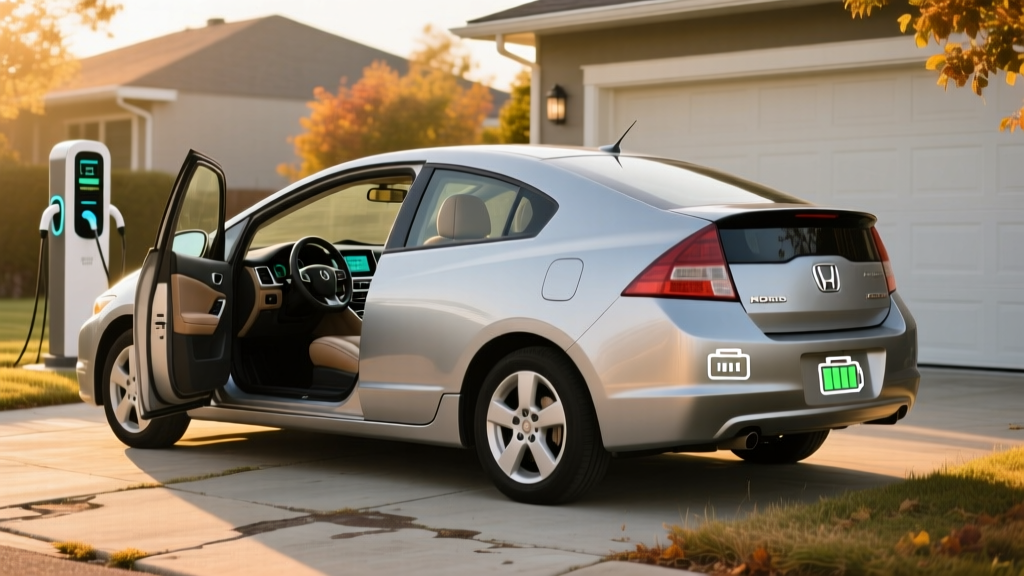
The 2008 Honda Insight was Honda's first-generation dedicated hybrid — a small, lightweight two-seater built around the original Integrated Motor Assist (IMA) system. Discontinued after the 2006 model year in the U.S. and not officially sold as a 2008 model, the Insight returned for the 2010 model year as a completely redesigned five-passenger hatchback. If you're researching a Honda Insight hybrid 2008 model, you're likely looking at either a late-registered first-gen (2000–2006) or the more common second-generation Insight (2010–2014) that Honda marketed as its affordable hybrid alternative to the Toyota Prius.
This guide covers the second-generation Honda Insight (2010–2014 model years, which is what most buyers encounter when searching for a 2008-era Insight), along with notes on the original first-gen where relevant. We'll break down EPA fuel economy, real-world MPG, IMA battery health, replacement costs, and whether this aging hybrid still earns a spot in your driveway in 2026.
2008 Honda Insight Hybrid: What Model Are You Actually Looking At?
Honda's Insight timeline is confusing, so let's clarify before diving into specs:
- First-generation Insight (2000–2006): Two-seat, ultra-lightweight hatchback with a 1.0L three-cylinder engine and early IMA system. EPA-rated at an extraordinary 57 city / 56 highway / 56 combined MPG (manual transmission). Extremely rare on the used market.
- Second-generation Insight (2010–2014): Five-passenger hatchback with a 1.3L four-cylinder and updated IMA. This is the model most buyers find when searching for a budget Honda hybrid from the late-2000s era. EPA-rated at 40 city / 43 highway / 41 combined MPG.
- Third-generation Insight (2019–2022): A completely different vehicle — a sleek sedan based on the Civic platform with a two-motor hybrid system. Not relevant to a 2008 search.
There was no official 2007 or 2008 model year Insight sold in the United States. If a listing says "2008 Honda Insight," verify the actual model year on the VIN — it may be a mislabeled 2006 first-gen or a 2010 second-gen.
Fuel Economy: EPA Ratings vs Real-World MPG
For the second-generation Insight (2010–2014), here are the official EPA figures from fueleconomy.gov:
| Metric | Value |
|---|---|
| City MPG | 40 |
| Highway MPG | 43 |
| Combined MPG | 41 |
| Fuel Tank Capacity | 10.6 gallons |
| Total Range | ~435 miles |
| Annual Fuel Cost (EPA est.) | ~$1,250 (at 2025 gas prices) |
Real-world MPG reality check: The Insight's IMA system provides mild hybrid assist — the electric motor adds torque during acceleration but cannot propel the car on electric power alone. In real-world driving, owners typically report 38–44 MPG combined, depending on driving style and conditions. The Insight tends to slightly exceed its EPA highway rating on flat terrain at moderate speeds (55–65 mph), but city MPG can dip to 35–37 if you drive aggressively or in stop-and-go traffic without sufficient regenerative braking opportunities. Cold weather reduces MPG by roughly 5–10%, consistent with most hybrids as the engine runs more frequently to maintain cabin heat and battery temperature.
For comparison, the first-generation Insight (2000–2006) achieved 56 combined MPG — still one of the highest EPA ratings of any gasoline vehicle ever sold in the U.S. But finding a well-preserved example in 2026 is a collector's challenge, not a practical commuter strategy.
Powertrain and Hybrid System: How IMA Works
The second-generation Insight uses Honda's Integrated Motor Assist (IMA), a parallel hybrid system that differs significantly from Toyota's Hybrid Synergy Drive and from modern series-parallel or plug-in hybrid architectures.
| Component | Specification |
|---|---|
| Gasoline Engine | 1.3L SOHC i-VTEC inline-4 |
| Engine Output | 88 hp @ 5,800 rpm / 88 lb-ft torque |
| Electric Motor (IMA) | 10 kW (13 hp) / 58 lb-ft torque |
| Combined Net Output | 98 hp @ 5,800 rpm |
| Transmission | CVT (continuously variable) |
| Hybrid Battery | 0.6 kWh Nickel-Metal Hydride (NiMH) |
| Drive Wheels | Front |
| 0–60 mph | ~10.5 seconds |
| Curb Weight | ~2,730 lbs |
The IMA motor is sandwiched between the engine and CVT, providing torque fill during acceleration and regenerative braking during deceleration. The Insight can shut off the engine at stops (idle stop) and restart it seamlessly, but it cannot drive on electric power alone — unlike the Toyota Prius, which can creep at low speeds on battery only.
The Honda Insight (all generations) is a conventional hybrid (HEV), not a plug-in hybrid (PHEV). You never plug it in. The small NiMH battery recharges exclusively through regenerative braking and engine power. If you're looking for electric-only driving range or home charging capability, you need a PHEV like the Toyota Prius Prime or a full BEV — the Insight offers neither.
HEV vs PHEV vs EV: Which Powertrain Fits You?
Shopping for an older budget hybrid like the Insight means you're likely prioritizing low upfront cost and strong fuel economy. Here's how the three electrified powertrain types compare for a budget-conscious buyer in 2026:
| Factor | HEV (e.g., Insight) | PHEV (e.g., Prius Prime) | BEV (e.g., Bolt EV) |
|---|---|---|---|
| Plug-in Required? | No | Yes (Level 1 or 2) | Yes (Level 2 recommended) |
| Electric-Only Range | 0 miles | 25–45 miles | 200–350+ miles |
| Total Range | 400–500 miles | 400–600 miles | 200–350 miles |
| Fuel Cost per Mile | ~$0.09 | ~$0.04–0.09 | ~$0.03–0.05 |
| Used Price (2026) | $4,000–$8,000 | $15,000–$25,000 | $12,000–$22,000 |
| Federal Tax Credit | None | Up to $7,500 (new only) | Up to $7,500 (new); up to $4,000 used) |
| Maintenance Complexity | Low | Moderate | Low (no engine) |
Choose the Insight (HEV) if: You need the lowest possible purchase price, have no access to plug-in charging, drive moderate daily distances, and want proven hybrid reliability with no range anxiety.
Choose a PHEV if: You have home charging access, want 25–45 miles of electric-only commuting, and still need gasoline range for road trips.
Choose a BEV if: You have reliable home or workplace charging, want the lowest per-mile fuel cost, and your daily driving stays within 200+ miles.
IMA Battery Health, Lifespan, and Replacement Cost
The single biggest concern for any used hybrid buyer is battery health. The second-generation Insight's 0.6 kWh NiMH IMA battery is small by modern standards, but its degradation pattern is well-documented after nearly two decades of real-world use.
Honda originally warranted the IMA battery for 8 years / 80,000 miles (10 years / 150,000 miles in California and CARB-adopting states). For a 2010–2014 Insight in 2026, factory warranty coverage has expired on all examples. Battery health now depends entirely on age, mileage, climate exposure, and driving patterns.
Expected lifespan: NiMH IMA batteries typically last 120,000–180,000 miles or 12–18 years before significant capacity loss triggers an IMA warning light. Many first- and second-gen Insights have exceeded 200,000 miles on the original battery, but capacity degradation of 20–30% is normal at that age. You'll notice reduced regenerative braking, weaker acceleration assist, and slightly lower MPG — but the car remains drivable.
Replacement cost (2026):
- Refurbished/remanufactured IMA battery: $800–$1,500 (parts only, installed by independent hybrid shops)
- New OEM Honda IMA battery: $2,000–$3,000 (dealer-installed, though Honda may discontinue new units for this generation)
- DIY grid-level cell replacement: $200–$400 in NiMH sub-cells for owners comfortable with high-voltage work (not recommended without proper training)
Before purchasing any used Insight, request an OBD-II scan for IMA battery state of health — specifically checking for background charge/discharge cycle counts, individual cell voltage variance, and any stored IMA-related diagnostic trouble codes (DTCs). A healthy IMA battery should show cell voltage variance under 0.2V across all modules.
Reliability, Common Issues, and Ownership Costs
The second-generation Insight is generally reliable, but several known issues affect long-term ownership cost:
Common Problems
- IMA battery degradation: The most frequent and expensive issue. Expect a replacement at 150,000+ miles if the original battery is still installed.
- 12V auxiliary battery drain: The Insight's small 12V battery can drain if the car sits unused for 2+ weeks, as the IMA system draws parasitic current. A dead 12V battery prevents the car from starting entirely — even with a healthy IMA pack.
- CVT shudder: Some owners report transmission shudder at low speeds, typically resolved with a CVT fluid drain-and-fill using Honda HMMF fluid.
- A/C compressor clutch: Electric A/C compressor failures are documented but not epidemic. Replacement runs $800–$1,200.
- EGR valve clogging: Can cause rough idle and check-engine lights around 100,000+ miles. Cleaning or replacement costs $150–$350.
Estimated Annual Ownership Costs (2026)
| Category | Estimated Cost |
|---|---|
| Fuel (12,000 mi/yr @ $3.20/gal) | ~$935 |
| Insurance (national avg.) | ~$900–$1,200 |
| Maintenance (oil, tires, brakes) | ~$400–$600 |
| Repairs (amortized IMA + misc.) | ~$300–$500 |
| Total Annual Cost | ~$2,535–$3,235 |
For context, a comparable 2012 Honda Civic (non-hybrid, ~30 MPG combined) would cost roughly $1,280/year in fuel alone — the Insight saves about $345/year in fuel but carries higher potential repair costs from the aging hybrid system.
Tax Credits and Incentives: Does the Insight Qualify?
For used Honda Insight models purchased in 2026, no federal tax credits apply. Here's the breakdown:
- Federal §30D New EV/PHEV Credit ($7,500): Applies only to new plug-in vehicles. The Insight is a conventional HEV and was never eligible, even when new. Per IRS guidelines, conventional hybrids do not qualify.
- Federal Used Clean Vehicle Credit (up to $4,000): Available for used BEVs and PHEVs priced under $25,000. The Insight, as a conventional HEV, is not eligible.
- Original hybrid tax credit (expired): When new, the second-gen Insight qualified for a modest $1,450 federal Alternative Motor Vehicle Credit (IRC §30B), which phased out in 2010. This credit no longer applies to any purchase.
- State incentives: Most state-level hybrid incentives have expired or shifted to PHEVs and BEVs. Check your state's energy office or AFDC state incentive database for any remaining local programs — though none currently target conventional HEVs.
Bottom line: budget for the full purchase price with no tax credit offset. The Insight's value proposition rests entirely on low fuel costs and a cheap entry price.
Who Should Buy a 2008-Era Honda Insight in 2026?
Buy It If:
- You need a sub-$6,000 commuter car with strong MPG
- You have no access to plug-in charging
- Your commute is under 40 miles daily
- You value low annual fuel costs (~$935/year)
- You're comfortable budgeting $1,000–$2,000 for an eventual IMA battery replacement
Skip It If:
- You need back-seat space or cargo room (it's compact)
- You want modern safety tech (no AEB, no lane-keep, basic airbags only)
- You drive over 20,000 miles/year (a newer, more efficient hybrid may pencil out better)
- You want electric-only driving capability
- The IMA battery shows warning lights or high cell variance on pre-purchase scan
The Insight makes sense as a budget commuter for someone who understands the IMA battery risk and prices it into their purchase. If you can find a well-maintained 2012–2014 model under 100,000 miles with documented IMA health, it remains one of the cheapest ways to achieve 40+ MPG without plugging in.
Frequently Asked Questions
How many MPG does the 2008-era Honda Insight hybrid get?
The second-generation Honda Insight (2010–2014) is EPA-rated at 40 city / 43 highway / 41 combined MPG. Real-world owners report 38–44 MPG combined, with highway driving at moderate speeds often exceeding the EPA estimate. The rare first-generation Insight (2000–2006) achieved 56 combined MPG.
Can the Honda Insight drive on electric power alone?
No. The Insight uses Honda's IMA parallel hybrid system, which cannot propel the vehicle without the gasoline engine running. The electric motor only provides assist during acceleration and regenerative braking. It is a conventional hybrid (HEV), not a plug-in hybrid (PHEV), and never needs to be plugged in.
How much does it cost to replace the IMA battery?
A refurbished IMA battery for the second-gen Insight costs $800–$1,500 installed at an independent hybrid shop. A new OEM battery from a Honda dealer runs $2,000–$3,000, though availability may be limited in 2026 as Honda phases out parts for this generation. Most IMA batteries last 120,000–180,000 miles.
Is the Honda Insight hybrid reliable?
The Insight is generally reliable with proper maintenance. The primary risk is IMA battery degradation due to age — nearly all surviving examples are now 12+ years old and may need a battery replacement within the ownership period. Other known issues include 12V battery drain during storage and occasional CVT shudder. Overall repair costs remain moderate compared to non-hybrid vehicles of the same era.
Does the Honda Insight qualify for any tax credit in 2026?
No. The Insight is a conventional hybrid (HEV), not a plug-in vehicle. It does not qualify for the federal §30D new clean vehicle credit, the used clean vehicle credit, or most state EV/PHEV incentives. The original $1,450 hybrid credit (IRC §30B) that applied when the car was new expired over a decade ago.
How does the Insight compare to a Toyota Prius of the same era?
The 2010–2014 Insight gets slightly lower MPG than the third-gen Prius (50 combined vs. 41 combined), offers less interior space, and uses a simpler IMA system rather than Toyota's more robust series-parallel Hybrid Synergy Drive. The Prius also has a stronger track record for battery longevity and can drive short distances on electric power alone. However, the Insight typically costs $2,000–$4,000 less on the used market, making it a viable budget alternative if MPG isn't your only priority.