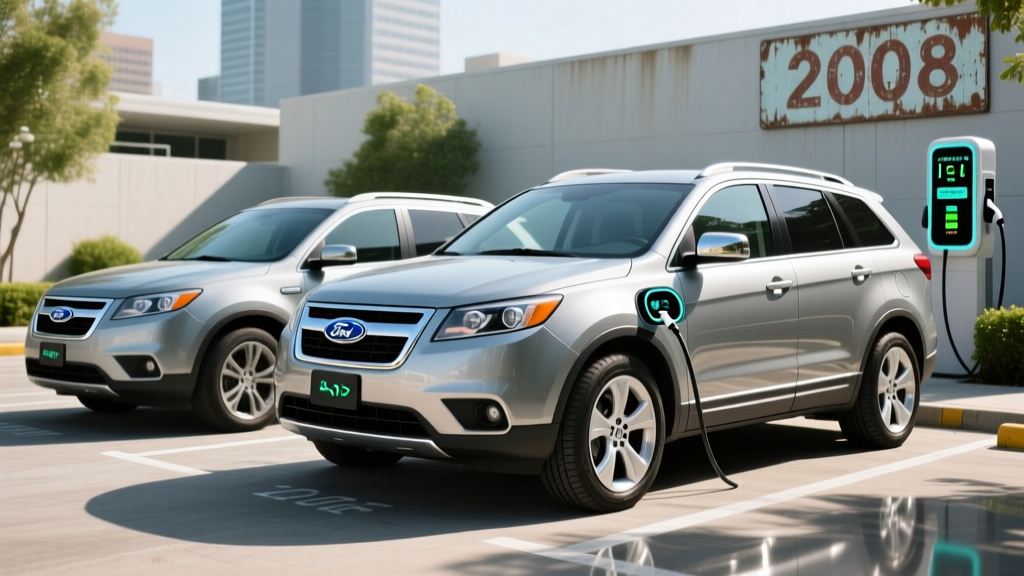
The 2008 Ford Escape Hybrid was one of the first mainstream hybrid SUVs available in the United States, arriving years before electrification became an industry-wide mandate. Nearly two decades later, buyers researching a ford hybrid 2008 model are typically evaluating a used vehicle — either as a budget-friendly commuter, a first hybrid experience, or a benchmark for how far hybrid technology has come. This guide breaks down the 2008 Escape Hybrid's powertrain, real-world fuel economy, battery longevity expectations, and how it stacks up against modern hybrid, PHEV, and full EV alternatives in 2026.
What Ford Hybrids Were Available in 2008?
For the 2008 model year, Ford offered exactly one hybrid vehicle in the U.S. market: the Ford Escape Hybrid. It was a conventional hybrid (HEV), meaning it charged its battery solely through regenerative braking and the gasoline engine — no plug required. Ford did not sell a plug-in hybrid (PHEV) in 2008. The Mercury Mariner Hybrid, a mechanically identical twin, was also available through Mercury dealers but shared the same powertrain.
HEV vs PHEV: What 2008 Buyers Need to Know
| Feature | 2008 Ford Escape Hybrid (HEV) | Modern PHEV (e.g., 2026 Ford Escape PHEV) |
|---|---|---|
| Plugs in to charge? | No — charges via engine and regen | Yes — Level 1 or Level 2 AC charging |
| Electric-only driving | Very limited (~1-2 mi at low speed) | 30-40 miles EPA electric-only |
| Battery size | ~1.3 kWh NiMH | ~14.4 kWh lithium-ion (usable) |
| Federal tax credit | None (expired long ago) | Up to $3,750 under §30D (varies by sourcing) |
| Gas engine required | Yes — always | Only after battery depletes |
The 2008 Escape Hybrid is a conventional HEV. You never plug it in. It operates like a gas car that uses an electric motor to assist and recover energy during braking.
2008 Ford Escape Hybrid Powertrain and Specifications
The 2008 Escape Hybrid paired a 2.3-liter Atkinson-cycle four-cylinder engine with an electric motor and a planetary gearset — a power-split architecture licensed from Toyota's hybrid synergy drive patents of that era. This was a full hybrid system, meaning the vehicle could move on electric power alone at very low speeds (typically under 25 mph for short distances), but it was never designed for meaningful electric-only range.
| Specification | 2008 Ford Escape Hybrid FWD | 2008 Ford Escape Hybrid AWD |
|---|---|---|
| Engine | 2.3L Atkinson-cycle I4 | 2.3L Atkinson-cycle I4 |
| Engine horsepower | 133 hp | 133 hp |
| Electric motor | Permanent-magnet AC synchronous | Permanent-magnet AC synchronous |
| Combined system horsepower | 155 hp | 155 hp |
| Transmission | CVT (power-split device) | CVT (power-split device) |
| Battery type | Nickel-metal hydride (NiMH) | Nickel-metal hydride (NiMH) |
| Battery capacity | ~1.3 kWh | ~1.3 kWh |
| Drivetrain | Front-wheel drive | All-wheel drive |
| 0-60 mph (est.) | ~10.5 seconds | ~11.0 seconds |
| Curb weight | ~3,780 lbs | ~3,930 lbs |
The AWD model used a second, smaller electric motor on the rear axle rather than a mechanical driveshaft. This "eAWD" system provided torque to the rear wheels when slip was detected, without the weight and friction losses of a traditional AWD drivetrain.
Fuel Economy: EPA Ratings and Real-World MPG
This is the question every used-hybrid buyer asks first. The 2008 Escape Hybrid's EPA ratings varied by drivetrain:
| Configuration | City MPG | Highway MPG | Combined MPG |
|---|---|---|---|
| FWD | 34 | 30 | 32 |
| AWD | 29 | 27 | 28 |
Source: EPA / fueleconomy.gov
Real-World MPG vs EPA Estimates
Conventional hybrids like the 2008 Escape Hybrid often exceed their EPA city rating in stop-and-go driving because regenerative braking recovers energy that a gas car wastes as heat. However, highway driving is where the Escape Hybrid's aerodynamics and relatively heavy curb weight work against it.
Owner-reported data and long-term testing from the era suggest:
- City driving (FWD): 30-36 MPG, depending on traffic density and driving style. Heavy stop-and-go can push toward the high end.
- Highway driving (FWD): 27-31 MPG at 65-70 mph. The boxy SUV shape and 3,780-lb weight limit efficiency at speed.
- Mixed driving (FWD): 28-33 MPG is typical for owners who split city and highway miles.
- AWD penalty: Expect 2-4 MPG lower across the board. The rear motor and added weight reduce efficiency.
In 2026, a well-maintained 2008 Escape Hybrid with a healthy battery should still deliver close to these figures. If you're seeing significantly lower MPG — say, 22-24 MPG combined — that's a strong indicator of battery degradation, which we address below.
Battery Lifespan, Warranty, and Replacement Cost
The 2008 Escape Hybrid's NiMH battery pack was a proven technology by that time, borrowed conceptually from the Toyota Prius playbook. NiMH cells degrade more gracefully than early lithium-ion packs, but after 16-18 years of service, age is a factor regardless of mileage.
Original Battery Warranty (Now Expired)
Ford originally warranted the Escape Hybrid battery for 8 years / 100,000 miles (in CARB states, 10 years / 150,000 miles). For a 2008 model, all factory battery warranties expired no later than 2018. Any battery replacement in 2026 is an out-of-pocket expense.
What to Expect from an 18-Year-Old NiMH Battery
NiMH batteries don't fail catastrophically the way a dead 12V battery does. Instead, they lose capacity gradually — meaning the electric motor assists less, the gas engine runs more, and MPG drops. Signs of a degraded hybrid battery in the 2008 Escape include:
- Noticeable drop in fuel economy (3-8 MPG below EPA ratings)
- The engine running more frequently at stops or low speeds
- Reduced regenerative braking feel
- Dashboard warning messages related to the hybrid system
Battery Replacement Options and Cost (2026)
| Option | Estimated Cost | Notes |
|---|---|---|
| New OEM battery (Ford dealer) | $3,500 - $5,000 | May be difficult to source for a 2008 model; check dealer parts availability |
| Remanufactured battery pack | $1,500 - $2,800 | Most common choice for older hybrids; quality varies by supplier |
| Individual cell replacement | $500 - $1,200 | Specialist shops can replace only failed cells; requires diagnostic expertise |
| Used/salvage battery | $400 - $900 | Lowest cost but highest risk — unknown remaining lifespan |
For a vehicle with a current market value of $3,000-$6,000 (depending on condition and mileage), a full OEM battery replacement is rarely economical. Most owners opt for remanufactured packs or cell-level repair at a hybrid specialist shop.
Is the 2008 Ford Escape Hybrid Reliable?
The 2008 Escape Hybrid earned a reputation for above-average reliability within the Ford lineup of its era. The hybrid powertrain components — particularly the planetary gearset and electric motors — have fewer wear items than a conventional automatic transmission. There's no torque converter, no clutch packs, and no traditional brake wear (regen handles much of the deceleration).
Common trouble areas reported by owners and mechanics include:
- Hybrid battery degradation — the most significant and expensive issue as the vehicle ages
- Brake actuator assembly — the electrohydraulic brake system is unique to the hybrid and costly to replace (~$1,200-$1,800)
- 12V auxiliary battery — like any car, this requires periodic replacement; a dead 12V battery can prevent the hybrid system from starting
- EVAP system codes — common to many Ford vehicles of this era, not hybrid-specific
- Power steering — the electric power steering system is generally reliable but can be expensive if the pump fails
The conventional (non-hybrid) components — suspension, interior, HVAC — share parts with the standard Escape and are widely supported by aftermarket suppliers. Body and chassis rust is the primary concern for vehicles in the Rust Belt.
Tax Credits and Incentives: What Applies in 2026?
The 2008 Ford Escape Hybrid originally qualified for a federal tax credit under the Energy Policy Act of 2005 — up to $2,600 for early purchasers. However, this credit was subject to a manufacturer phase-out cap (Ford hit 60,000 qualifying vehicles in 2006), and the credit was fully eliminated for Ford hybrids by mid-2007 for most buyers. Even if it hadn't phased out, the original credit applied only to the first purchaser of a new vehicle.
For a used 2008 Escape Hybrid purchase in 2026:
- Federal §30D new-vehicle credit: Does not apply — this vehicle is not new.
- Federal §25E used-EV credit: Does not apply — this is a conventional hybrid (HEV), not a plug-in electric vehicle. The §25E credit (up to $4,000) is available only for used BEVs and PHEVs with a battery capacity of at least 7 kWh, per IRS guidelines.
- State incentives: Most state-level hybrid incentives that existed in 2008 have expired. A handful of states offer registration fee discounts or HOV lane access for hybrids, but eligibility for a 2008 model varies by jurisdiction. Check your state's DMV or energy office for current rules.
The bottom line: expect no federal tax credit and likely no state incentives for purchasing a 2008 Escape Hybrid today.
How the 2008 Escape Hybrid Compares to Modern Alternatives
If you're researching a 2008 Ford hybrid, you're likely weighing it against other options in the $5,000-$15,000 range. Here's how it compares to what's available in 2026:
| Vehicle | Type | Combined MPG / MPGe | Electric-Only Range | Approx. Used Price (2026) |
|---|---|---|---|---|
| 2008 Ford Escape Hybrid | HEV | 32 MPG (FWD) | ~1-2 mi (low speed) | $3,000 - $6,000 |
| 2017-2019 Toyota Prius | HEV | 52-56 MPG | ~1 mi (low speed) | $12,000 - $18,000 |
| 2017-2019 Chevrolet Volt | PHEV | 42 MPG / 106 MPGe | 53 miles (EPA) | $10,000 - $16,000 |
| 2026 Ford Escape Hybrid | HEV | 39-41 MPG | N/A | $33,000+ (new MSRP) |
| 2026 Ford Escape PHEV | PHEV | 40 MPG / 105 MPGe | 37 miles (EPA) | $39,000+ (new MSRP) |
The 2008 Escape Hybrid's 32 MPG combined was impressive for an SUV in 2008, but modern hybrids like the Toyota Prius and the current-generation Escape Hybrid deliver 40-56 MPG with more power, better technology, and remaining factory warranties.
Pros: 2008 Ford Escape Hybrid
- Low purchase price in the used market
- No plug required — works like a gas car
- SUV cargo versatility (68.2 cu ft max)
- AWD available with eAWD system
- Proven hybrid architecture with strong low-speed efficiency
- Towing rated up to 1,000 lbs
Cons: 2008 Ford Escape Hybrid
- 18-year-old battery likely degraded or replaced
- No federal tax credit or modern incentives
- Highway MPG underwhelming (30 EPA, often less real-world)
- Dated interior and safety technology
- Brake actuator replacement is expensive
- No DC fast charging (not applicable to HEV)
- Parts availability for hybrid-specific components may decline
Who Should Buy a 2008 Ford Escape Hybrid — And Who Shouldn't?
Choose the 2008 Escape Hybrid If:
- You need a cheap, no-plug hybrid for city-heavy commuting under $6,000
- You live in a mild climate and drive mostly under 40 mph in stop-and-go traffic (where the hybrid system shines)
- You want AWD in a hybrid without paying modern prices
- You're mechanically inclined and can source remanufactured hybrid components
Look Elsewhere If:
- Your commute is mostly highway — a modern diesel or a 45+ MPG compact hybrid will save more fuel
- You want plug-in electric driving — consider a used Chevrolet Volt or Toyota Prius Prime
- You rely on advanced safety features (AEB, lane-keeping, blind-spot monitoring) — none were available on the 2008 Escape
- You can stretch your budget to $12,000-$18,000 — a 2017+ Prius offers dramatically better MPG, warranty, and safety
Frequently Asked Questions
How many MPG does the 2008 Ford Escape Hybrid get?
The EPA rates the FWD model at 34 city / 30 highway / 32 combined MPG. The AWD model is rated at 29 city / 27 highway / 28 combined. In real-world driving, city-heavy commuters may see 30-36 MPG, while highway-dominant drivers typically see 27-31 MPG (FWD). Battery condition significantly affects these numbers on a vehicle of this age.
Can I plug in the 2008 Ford Escape Hybrid to charge it?
No. The 2008 Escape Hybrid is a conventional hybrid (HEV), not a plug-in hybrid (PHEV). It has no charging port. The battery charges exclusively through regenerative braking and the gasoline engine. If you want a Ford hybrid you can plug in, you'd need a 2013 or later Ford Fusion Energi, C-Max Energi, or a current-generation Escape PHEV.
How far can the 2008 Escape Hybrid drive on electric power alone?
Effectively only 1-2 miles at speeds under 25 mph under ideal conditions. This is not a meaningful electric-only range — it's designed for creeping through parking lots or stoplights, not for commuting without gas. If electric-only driving is a priority, a PHEV like the Chevrolet Volt (53 miles EPA electric) or a full BEV is the right choice.
Is the 2008 Ford Escape Hybrid reliable, and what does a battery replacement cost?
The hybrid powertrain is generally reliable, but at 16-18 years old, battery degradation is the primary concern. A remanufactured NiMH battery pack costs $1,500-$2,800 installed. The brake actuator is another known expensive failure point ($1,200-$1,800). Non-hybrid components are widely supported. Overall reliability depends heavily on maintenance history and whether the hybrid battery has been replaced.
Does the 2008 Ford Escape Hybrid qualify for any tax credit in 2026?
No. The original federal hybrid tax credit for the Escape Hybrid phased out in 2007, and even if it hadn't, it applied only to original purchasers of new vehicles. The current federal §30D new-vehicle credit and §25E used-vehicle credit both require plug-in capability (BEV or PHEV) with a minimum battery capacity. The 2008 Escape Hybrid, as a conventional HEV with a ~1.3 kWh NiMH battery, does not qualify for any federal tax incentive. Check your state's energy office for any remaining local incentives, though most have expired.
How does the 2008 Escape Hybrid compare to the 2026 Ford Escape Hybrid?
The 2026 Ford Escape Hybrid uses a 2.5L Atkinson-cycle I4 with a more powerful electric motor for 210 combined horsepower and EPA ratings of 39-41 MPG combined — roughly 25% better fuel economy with significantly more power. It also includes modern safety technology (automatic emergency braking, lane-keeping, adaptive cruise) that the 2008 model lacks. New pricing starts around $33,000, so the value proposition depends entirely on your budget.
Is it worth buying a 2008 Escape Hybrid in 2026?
It can be — if the price is right ($3,000-$5,000), the hybrid battery has been recently replaced or tests healthy, and your driving is primarily city-oriented. It's a functional, no-fuss hybrid SUV for budget buyers. But if you can spend $10,000-$15,000, a 2017+ Prius, a used Chevrolet Volt (PHEV), or a 2016+ Ford Fusion Hybrid will deliver meaningfully better fuel economy, safety, and remaining component life. The 2008 Escape Hybrid is a stepping stone, not a destination, in today's used-EV market.