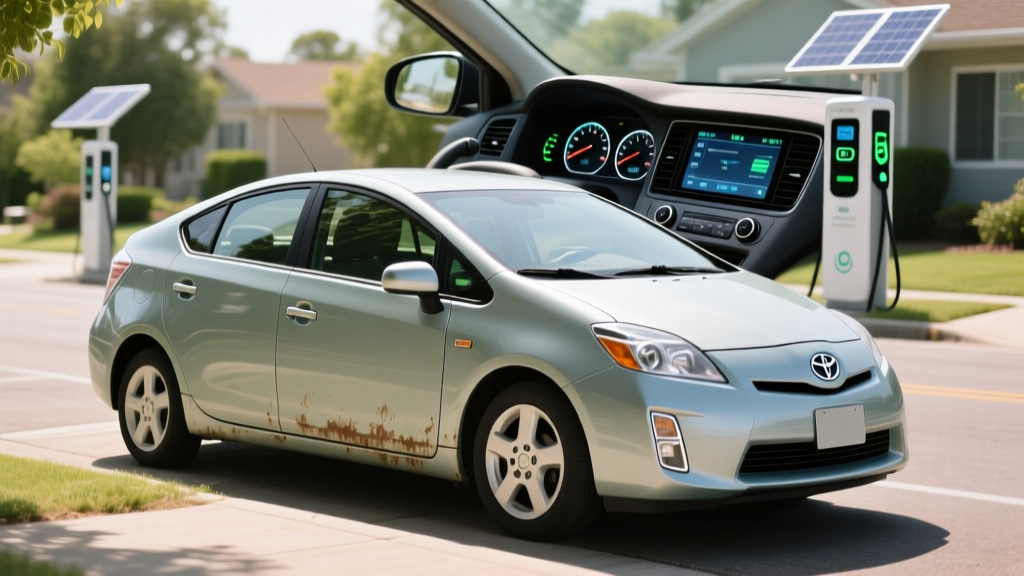
The 2007 Toyota Prius occupies a unique space in the used-car market in 2026. As a second-generation (XW20) hybrid, it helped define what a gasoline-electric hybrid could be for everyday drivers. With nearly two decades of real-world data on its powertrain, battery longevity, and maintenance costs, the 2007 Prius hybrid is one of the most thoroughly documented vehicles on the road. This guide breaks down exactly what you can expect if you're considering buying or keeping one today.
Understanding the 2007 Prius: Conventional Hybrid (HEV), Not a PHEV
Before diving into specs, it's critical to understand what the 2007 Prius is — and what it isn't. This is a conventional hybrid electric vehicle (HEV), sometimes called a "self-charging hybrid." It does not plug in. It has no electric-only driving range to speak of, and it cannot be charged from a wall outlet or public charger.
HEV vs. PHEV vs. BEV: Where the 2007 Prius Fits
| Feature | 2007 Prius (HEV) | Modern PHEV (e.g., Prius Prime) | Full EV (BEV) |
|---|---|---|---|
| Plugs in to charge? | No | Yes | Yes |
| Electric-only range | ~1 mile at low speed | 25–44 miles (2025–2026 models) | 200–400+ miles |
| Battery size | 1.3 kWh (NiMH) | 13.6 kWh (Li-ion) | 50–100+ kWh |
| Gasoline engine? | Yes (primary) | Yes (backup + highway) | No |
| Regenerative braking | Yes | Yes | Yes |
| Federal tax credit (new) | Expired (was $3,150) | Up to $7,500 (§30D, if eligible) | Up to $7,500 (§30D, if eligible) |
The 2007 Prius uses Toyota's Hybrid Synergy Drive (HSD) system, which seamlessly blends a 1.5-liter gasoline engine with two electric motor-generators through a planetary gearset (e-CVT). The battery recharges through regenerative braking and engine power — you simply drive it like a normal car and it manages the energy flow automatically.
Fuel Economy: EPA Ratings vs. Real-World MPG
The 2007 Prius was rated by the EPA at 48 MPG city / 45 MPG highway / 46 MPG combined under the revised testing methodology that the EPA adopted for 2008+ model years (retroactively applied to earlier models on fueleconomy.gov). Under the older testing cycle displayed on the original window sticker, the numbers were higher — 60 city / 51 highway — but those figures were not representative of real-world driving.
| Metric | 2007 Prius (Revised EPA) | Real-World Expectation |
|---|---|---|
| City MPG | 48 | 44–50 (hybrids excel in stop-and-go) |
| Highway MPG | 45 | 40–46 (less regen benefit at steady speed) |
| Combined MPG | 46 | 42–48 |
| Annual fuel cost (15k mi/yr, $3.40/gal) | ~$1,109 | |
Real-world note: Hybrids like the Prius typically exceed their EPA city estimate in gentle urban driving because regenerative braking recovers energy that conventional cars waste as heat. However, aggressive acceleration, extreme cold, and sustained highway speeds above 70 mph will push real-world economy toward the low end of the range. Owners on forums like PriusChat consistently report lifetime averages between 43 and 48 MPG, with some hypermilers achieving low 50s in ideal conditions.
How Many MPG Does the 2007 Prius Hybrid Get?
The EPA rates the 2007 Prius at 46 MPG combined (48 city / 45 highway). In real-world driving, most owners average 42–48 MPG combined, with city driving often yielding the best results thanks to regenerative braking. At current fuel prices (~$3.40/gallon national average in early 2026), that translates to roughly $1,100 per year in fuel for 15,000 miles of driving.
Powertrain Specifications and Performance
The 2007 Prius pairs a 1.5-liter inline-4 Atkinson-cycle gasoline engine with Toyota's second-generation Hybrid Synergy Drive. Here are the hard numbers:
| Specification | 2007 Toyota Prius |
|---|---|
| Engine | 1.5L I4 Atkinson-cycle (1NZ-FXE) |
| Engine horsepower | 76 HP @ 5,000 RPM |
| Electric motor (MG2) | 67 HP (50 kW) |
| Net system horsepower | 110 HP |
| Net system torque | 82 lb-ft (engine) + 295 lb-ft (MG2 peak) |
| Transmission | e-CVT (planetary gearset, no fixed gears) |
| 0–60 mph | ~9.8 seconds |
| Top speed | ~106 mph (electronically limited) |
| Hybrid battery | 1.3 kWh, Nickel-Metal Hydride (NiMH), 201.6V nominal |
| Curb weight | ~2,932 lbs |
| Drive type | Front-wheel drive |
The 110 combined horsepower figure sounds modest, and the ~9.8-second 0–60 time confirms this is not a performance car. However, the electric motor's instant torque (available from 0 RPM) gives the Prius surprisingly responsive off-the-line acceleration in city driving. The e-CVT provides seamless, gear-shift-free acceleration that feels smoother than any conventional automatic, though it produces the characteristic "rubber band" drone under hard acceleration as the engine holds at a fixed RPM while the car catches up.
Hybrid Battery: Lifespan, Degradation, and Replacement Cost
The single biggest concern for any used 2007 Prius buyer is the hybrid battery. This is a 1.3 kWh Nickel-Metal Hydride (NiMH) pack consisting of 28 modules. Unlike modern lithium-ion packs, NiMH chemistry is less energy-dense but has proven remarkably durable in the Prius application.
Original Battery Warranty
When new, Toyota warranted the hybrid battery for 8 years / 100,000 miles (10 years / 150,000 miles in CARB states like California, New York, and Massachusetts). As of 2026, the original factory warranty has expired for all 2007 Prius vehicles. Any remaining coverage would come from an aftermarket replacement battery's warranty.
Battery lifespan data: Real-world evidence from nearly two decades of Prius ownership shows that the original NiMH battery typically lasts 150,000 to 200,000 miles or 12 to 18 years, depending on climate and usage patterns. Heat is the primary enemy — Prius batteries in hot Southern and Southwestern states tend to degrade faster than those in cooler climates. Many 2007 Prius examples on the road in 2026 have already had at least one battery replacement.
| Battery Scenario | Cost Range (2026) | Warranty |
|---|---|---|
| New OEM Toyota battery (dealer) | $2,500–$3,500 installed | 3 years / unlimited miles |
| Refurbished/reconditioned battery | $1,000–$1,800 installed | 1–3 years (varies by shop) |
| Aftermarket new battery (e.g., Dorman, Green Bean) | $1,500–$2,500 installed | 3–5 years (varies) |
| Individual module replacement (DIY/specialist) | $300–$800 | None to 1 year |
Practical advice: When evaluating a used 2007 Prius, ask whether the hybrid battery has been replaced and, if so, when and with what type. A recently replaced OEM battery adds significant value. If the battery is original and the car has over 150,000 miles, budget $1,500–$3,000 for a replacement within the next few years. A hybrid battery health check (available at Toyota dealers and many independent hybrid specialists) can assess remaining capacity and identify weak modules before a complete failure.
Reliability, Maintenance, and Known Issues
The 2007 Prius has a well-earned reputation for reliability. Toyota's hybrid system has proven to be one of the most durable powertrains ever mass-produced. The e-CVT has no conventional clutch packs, bands, or torque converter to wear out — it's a simple planetary gearset with very few moving parts.
Common issues specific to the 2007 (Gen 2) Prius:
- Hybrid battery failure: As discussed, the primary long-term cost. Symptoms include reduced MPG, dashboard warning lights, and the car relying more heavily on the gasoline engine.
- 12V auxiliary battery: The Prius has a small 12V battery (located in the trunk) that powers electronics and boots the hybrid system. These typically last 4–6 years and cost ~$200–$300 to replace. A dead 12V battery will prevent the car from starting, even if the hybrid battery is fully charged.
- Combination meter (dashboard) failure: A known issue on 2004–2009 Prius models where the instrument cluster goes dark or displays incorrect information. Repair or replacement runs $300–$800.
- Steering intermediate shaft: Some Gen 2 Prius models develop a clunking feeling in the steering. Toyota issued a service bulletin; repair involves replacing the intermediate shaft (~$400–$700).
- Water pump (electric): The Prius uses an electric coolant pump for the inverter. Failure can trigger a hybrid system warning. Replacement is ~$300–$500.
- Brake actuator: The regenerative braking system uses an electro-hydraulic actuator that can fail at high mileage. This is one of the more expensive repairs ($1,200–$2,000).
Routine maintenance is minimal compared to a conventional car: oil changes every 5,000 miles (conventional) or 7,500–10,000 miles (synthetic), cabin air filter, engine air filter, and brake fluid. The regenerative braking system significantly extends brake pad life — many Prius owners report original brake pads lasting 80,000–100,000 miles.
2007 Prius Pricing and Tax Credit Status in 2026
The 2007 Prius is only available on the used market. Current pricing in early 2026:
| Condition / Mileage | Typical Price Range |
|---|---|
| Excellent (under 100k mi, new battery) | $7,000–$9,500 |
| Good (100k–150k mi, battery health verified) | $5,000–$7,500 |
| Fair (150k–200k mi, original or aging battery) | $3,500–$5,500 |
| High mileage / needs battery (200k+ mi) | $2,000–$4,000 |
Federal Tax Credit Status
The 2007 Prius originally qualified for a federal tax credit of up to $3,150 under the Energy Policy Act of 2005. However, Toyota hit the 250,000-unit manufacturer cap in 2007, and the credit phased out completely for Toyota hybrids by late 2007/early 2008. No federal tax credit is available for purchasing a used 2007 Prius in 2026.
The current IRS §30D Clean Vehicle Credit (up to $7,500) applies only to new qualifying plug-in EVs and PHEVs meeting battery sourcing, MSRP caps, and buyer income requirements. A 19-year-old conventional hybrid does not qualify under any current federal incentive program.
The Used Clean Vehicle Credit (§25E, up to $4,000 or 30% of sale price) applies only to used plug-in EVs and PHEVs — not conventional HEVs like the 2007 Prius. Again, no credit applies here.
Who Should Buy a 2007 Prius Hybrid in 2026?
Decision Framework: Is the 2007 Prius Right for You?
Choose the 2007 Prius if:
- You need the cheapest possible reliable commuter car with excellent fuel economy
- You drive primarily in city/stop-and-go traffic where hybrid efficiency shines
- You cannot install a home charger and don't want to rely on public charging
- You want minimal maintenance costs and proven long-term durability
- Your budget is under $8,000 and you want maximum miles per dollar
Choose a modern PHEV (e.g., 2025–2026 Prius Prime) if:
- You want electric-only commuting (44 miles EV range) with a gas engine backup
- You have home charging access and a short commute
- You want modern safety features (automatic emergency braking, lane-keeping, adaptive cruise)
- You may qualify for the $7,500 federal tax credit under §30D
Choose a full EV (BEV) if:
- You want zero tailpipe emissions and the lowest per-mile fuel cost
- You have reliable home Level 2 charging
- Your daily driving is under 250 miles and you rarely take long road trips
- You want to eliminate oil changes, spark plugs, and exhaust maintenance entirely
Pros
- 46 MPG combined — still competitive with many 2026 hybrids
- Proven, well-documented powertrain with massive owner community
- Very low annual maintenance costs
- No charging infrastructure needed — just add gas
- Strong cargo versatility (hatchback with 14.4 cu ft trunk + folding rear seats)
- Extremely low purchase price on the used market
Cons
- No modern safety tech (no AEB, no blind-spot monitoring, no backup camera standard)
- Hybrid battery replacement is a $1,500–$3,500 eventual cost
- Dated interior with basic infotainment (no Bluetooth audio, no USB, no smartphone integration)
- Slow acceleration (~9.8 sec 0–60) — struggles with highway merging under load
- No federal or state tax credits available
- 12V auxiliary battery can strand you if neglected
Frequently Asked Questions
How many MPG does the 2007 Prius hybrid get?
The EPA rates the 2007 Toyota Prius at 48 city / 45 highway / 46 MPG combined under the revised testing methodology. Real-world owners typically see 42–48 MPG combined, with city driving often yielding the best results due to regenerative braking. At 15,000 miles per year and $3.40/gallon, expect roughly $1,100 in annual fuel costs.
Does the 2007 Prius plug in?
No. The 2007 Prius is a conventional hybrid (HEV), not a plug-in hybrid (PHEV). It charges its own 1.3 kWh battery through regenerative braking and the gasoline engine. You never need to — and cannot — plug it in. If you want a Prius that plugs in and offers electric-only driving, look at the Prius Plug-in (2012–2015) or Prius Prime (2017–present).
Is the 2007 Prius reliable and what does a battery replacement cost?
Yes, the 2007 Prius is widely regarded as one of the most reliable vehicles Toyota has ever built. The hybrid system has minimal wear components. The main long-term cost is the hybrid battery: a replacement runs $1,500–$3,500 depending on whether you choose OEM, aftermarket, or refurbished. Original batteries typically last 150,000–200,000 miles or 12–18 years. Many 2007 examples in 2026 have already had at least one battery swap.
Does the 2007 Prius qualify for any tax credit?
No. The original federal hybrid tax credit for the Prius (up to $3,150) phased out in 2007–2008 after Toyota reached the 250,000-unit cap. Under current 2026 IRS rules, the §30D Clean Vehicle Credit and the §25E Used Clean Vehicle Credit apply only to plug-in vehicles (PHEVs and BEVs), not conventional hybrids. No federal tax credit is available for purchasing a 2007 Prius.
Hybrid vs. PHEV vs. EV — which should I choose?
A conventional hybrid like the 2007 Prius is ideal if you want maximum fuel efficiency with zero lifestyle change — no plugging in, no range planning, no charging apps. A PHEV (like the current Prius Prime) adds 25–44 miles of electric-only range for short commutes but requires home charging to realize its benefit. A full EV (BEV) offers the lowest operating cost and zero tailpipe emissions but requires reliable charging access and a higher upfront investment. For a budget buyer in 2026 who simply needs cheap, reliable transportation, the 2007 Prius HEV remains hard to beat on cost per mile.
What should I check before buying a used 2007 Prius?
Prioritize three things: (1) hybrid battery health — get a diagnostic scan at a Toyota dealer or hybrid specialist; (2) maintenance history — especially oil changes and inverter coolant service; (3) the 12V auxiliary battery age. Also check for the combination meter issue (instrument cluster going dark) and test the regenerative braking feel. A pre-purchase inspection by a hybrid-experienced mechanic is worth the $100–$200 investment.
Sources: EPA Fuel Economy — 2007 Toyota Prius, IRS Clean Vehicle Credits, Toyota Motor Corporation specifications.