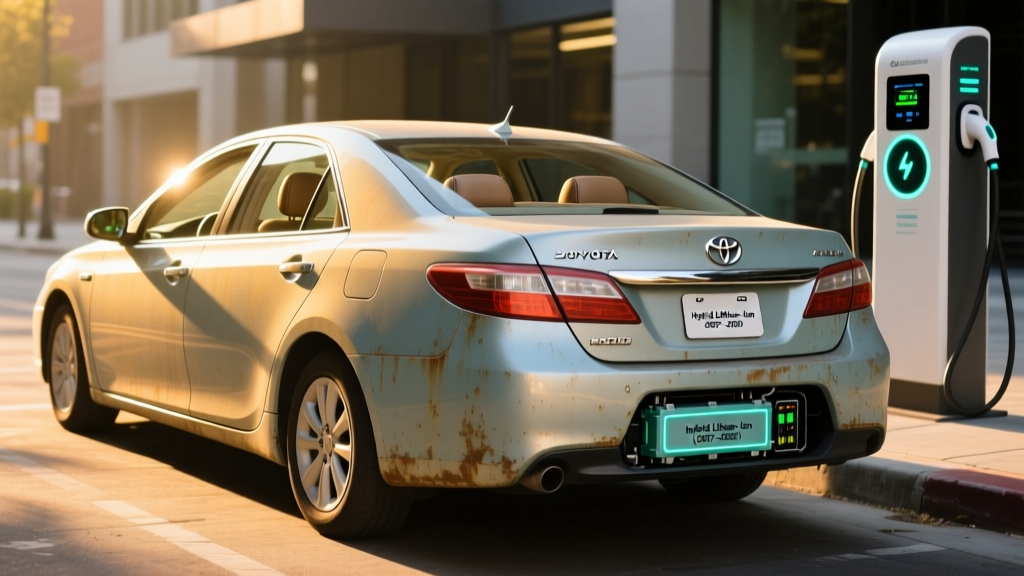
The 2007 Toyota Camry Hybrid sedan occupies a specific niche in 2026: a proven, affordable entry point into hybrid ownership on the used market. As one of Toyota's earliest mainstream hybrid sedans, it pairs a 2.4-liter four-cylinder engine with an electric motor in a conventional hybrid (HEV) configuration — no plug required. With nearly two decades of real-world data behind it, buyers can now evaluate this car on actual longevity, not marketing promises.
This guide covers everything a used-car shopper needs to know about the 2007 Camry Hybrid: EPA fuel economy versus real-world MPG, battery health expectations, replacement costs, and whether this aging hybrid still makes financial sense compared to modern HEVs, PHEVs, and full EVs.
Understanding the 2007 Camry Hybrid: HEV, Not PHEV
The 2007 Toyota Camry Hybrid is a conventional hybrid electric vehicle (HEV). This is a critical distinction that buyers sometimes miss. Unlike a plug-in hybrid (PHEV) such as the modern Toyota Prius Prime or RAV4 Prime, the Camry Hybrid has no charging port and no meaningful electric-only range. It recovers energy through regenerative braking and uses a small battery buffer to assist the gasoline engine during acceleration and low-speed driving.
HEV vs PHEV — What's the Difference?
| Feature | HEV (2007 Camry Hybrid) | PHEV (e.g., 2026 Prius Prime) |
|---|---|---|
| Plug-in charging? | No — never plugs in | Yes — Level 1 or Level 2 |
| Electric-only range | ~1 mile at very low speed | 25–45 miles typical |
| Battery capacity | 1.5 kWh (NiMH) | 13–18 kWh (Li-ion) |
| Federal tax credit | No | Up to $7,500 (§30D, new only) |
| Fuel required | Gasoline only | Gasoline + electricity |
The 2007 Camry Hybrid generates all its electrical energy internally. You fuel it like any gas car and never think about charging.
Fuel Economy: EPA Ratings and Real-World MPG
The 2007 Camry Hybrid's headline feature was — and remains — its fuel efficiency. According to fueleconomy.gov, the EPA rates the 2007 Camry Hybrid at:
| Cycle | MPG |
|---|---|
| City | 33 MPG |
| Highway | 34 MPG |
| Combined | 34 MPG |
Real-World MPG: What Owners Actually Report
Hybrid fuel economy behaves differently than gas-only cars. The 2007 Camry Hybrid's Atkinson-cycle 2.4L engine and electric motor assist shine in stop-and-go city traffic, where regenerative braking constantly recharges the NiMH battery. In real-world ownership, most drivers report 30–36 MPG combined, with city driving often yielding slightly better results than highway cruising.
On sustained highway trips at 70–75 mph, expect the electric motor's contribution to diminish and fuel economy to settle around 30–32 MPG. Cold weather reduces battery efficiency and increases engine warm-up time, dropping winter city MPG to approximately 28–30 MPG in freezing climates.
For a 2007 model with nearly 20 years of potential wear, actual MPG depends heavily on battery health. A degraded hybrid battery reduces the motor's assist capability, forcing the gasoline engine to work harder and dropping fuel economy by 2–5 MPG.
Powertrain Specs: Engine, Motor, and Combined Output
| Specification | 2007 Camry Hybrid |
|---|---|
| Gasoline engine | 2.4L 4-cylinder Atkinson cycle, 147 hp |
| Electric motor | Permanent magnet AC synchronous, 40 hp |
| Net combined horsepower | 192 hp |
| Transmission | eCVT (electronically controlled CVT) |
| Hybrid battery | 1.5 kWh NiMH (nickel-metal hydride) |
| Drivetrain | Front-wheel drive |
| 0–60 mph | ~8.6 seconds |
| Curb weight | ~3,680 lbs |
| Fuel tank | 17.2 gallons |
| Total range (est.) | ~585 miles |
Toyota's Hybrid Synergy Drive system in this generation seamlessly blends engine and motor power through an eCVT — a planetary gearset, not a belt-driven CVT. This design is mechanically simple and has proven extraordinarily durable, with few reported transmission failures even at high mileage.
Battery Longevity, Warranty, and Replacement Cost
The single biggest concern for any used hybrid buyer is battery health. The 2007 Camry Hybrid uses a nickel-metal hydride (NiMH) battery pack — older chemistry than the lithium-ion packs in modern hybrids, but one with a well-documented track record.
Original Battery Warranty
When new, Toyota covered the 2007 Camry Hybrid's battery under its Hybrid System Warranty: 8 years / 100,000 miles (10 years / 150,000 miles in California and states adopting CARB emissions standards). This warranty has long since expired for virtually all examples on the road in 2026.
Real-World Battery Lifespan
NiMH batteries in the Camry Hybrid have demonstrated remarkable longevity. Data from owner communities and repair shops indicates:
- 150,000–200,000 miles before significant degradation is common
- Many original batteries have exceeded 200,000 miles with gradual capacity loss
- Calendar age matters: even low-mileage examples from 2007 are now 19 years old, and NiMH chemistry degrades with time regardless of use
- Hot climates accelerate degradation faster than cool climates
Battery Replacement Cost in 2026
If the hybrid battery in a 2007 Camry Hybrid fails or degrades significantly, replacement options include:
- New OEM Toyota battery: $2,500–$3,500 installed (often uneconomical for a car of this value)
- Remanufactured/reconditioned battery: $1,000–$1,800 installed — the most common choice for this model year
- Individual module replacement: $300–$600 at a specialist hybrid shop (replacing only failed cells within the pack)
- Used/salvage battery: $400–$800 installed — risky given the age of any 2007-era pack
For a vehicle with a typical 2026 used value of $4,000–$7,000 depending on mileage and condition, a full OEM battery replacement can consume 40–80% of the car's value. Remanufactured packs or module-level repairs are the practical path.
Does the 2007 Camry Hybrid Qualify for Any Tax Credit?
No. The 2007 Toyota Camry Hybrid does not qualify for any federal tax credit in 2026. Here's why:
- The IRS §30D Clean Vehicle Credit applies only to new qualifying plug-in EVs and fuel cell vehicles — not conventional hybrids, and not used vehicles (with one narrow exception below).
- The Used Clean Vehicle Credit (§25E, up to $4,000) applies only to used plug-in EVs and fuel cell vehicles — conventional HEVs like the Camry Hybrid are excluded.
- When new in 2007, the Camry Hybrid did qualify for a federal tax credit of up to $2,600 under the older Energy Policy Act provisions, but Toyota's credit phase-out cap was reached in 2007–2008, and that program is long closed.
No state incentives currently target 19-year-old conventional hybrids either. The 2007 Camry Hybrid's value proposition rests entirely on its low purchase price and fuel savings — not government incentives.
Reliability and Ownership Costs
Toyota's third-generation Hybrid Synergy Drive, used in the 2007 Camry Hybrid, is among the most proven hybrid powertrains ever built. The eCVT transmission has no belts or clutches to wear, and the 2.4L 2AZ-FXE engine is a detuned Atkinson-cycle variant known for longevity when maintained.
Key reliability considerations for a 2007 example in 2026:
- Hybrid battery: The primary risk (detailed above). Budget $1,000–$1,800 for a reconditioned replacement if not recently done.
- Inverter/coolant pump: The hybrid inverter coolant pump was subject to a recall on some model years. Verify recall completion. Inverter replacement runs $1,500–$2,500 if it fails.
- Brakes: Regenerative braking reduces wear on friction brakes significantly. Rotors and pads often last 80,000+ miles.
- 12V auxiliary battery: Like any car, the standard 12V battery needs replacement every 4–5 years. The Camry Hybrid uses a group 35 or auxiliary-size battery in the trunk.
- Standard maintenance: Oil changes, coolant flushes, and transmission fluid service follow conventional Toyota intervals. Nothing exotic.
Insurance costs for a 2007 Camry Hybrid are low — typically $800–$1,200/year depending on driver profile and state, given the vehicle's age and value.
Who Should Buy This Hybrid vs. a Modern EV or PHEV?
Pros
- Low used purchase price ($4K–$7K)
- Proven, simple hybrid system — no plug, no range anxiety
- 34 MPG combined saves ~$600–$900/year vs. a 22-MPG gas sedan
- Smooth, quiet low-speed electric assist
- Strong reliability record for powertrain
- Low insurance and registration costs
Cons
- 19 years old — general age-related wear (suspension, interior, electronics)
- Hybrid battery replacement likely needed if not already done
- No tax credit or incentive eligibility
- NiMH battery less efficient than modern Li-ion hybrids
- Lacks modern safety tech (no AEB, lane-keep, blind-spot monitoring)
- Outdated infotainment (no Apple CarPlay/Android Auto, basic audio)
Decision Framework
Choose the 2007 Camry Hybrid if: You need a budget-friendly commuter, drive 10,000–15,000 miles/year mostly in city traffic, can absorb a potential $1,000–$1,800 battery repair, and want hybrid fuel savings without the upfront cost of a new vehicle.
Choose a modern used PHEV (2018+ Prius Prime) if: You have home charging access, want 25+ miles of electric-only range for short commutes, and can spend $15,000–$22,000 on a newer used vehicle with modern safety features.
Choose a used full EV (2019+ Nissan Leaf, Chevy Bolt) if: You have reliable home Level 2 charging, your daily commute is under 150 miles, and you want zero gasoline costs and minimal drivetrain maintenance.
Skip the hybrid entirely if: You drive mostly highway miles at high speed (where hybrid advantage shrinks), or if a battery replacement would make the total cost exceed that of a newer conventional gas car.
Frequently Asked Questions
How many MPG does the 2007 Toyota Camry Hybrid get?
The EPA rates it at 33 MPG city, 34 MPG highway, and 34 MPG combined. Real-world owners typically see 30–36 MPG combined depending on driving mix, climate, and battery health. City driving often yields the best results thanks to regenerative braking.
Does the 2007 Camry Hybrid need to be plugged in?
No. It is a conventional hybrid (HEV), not a plug-in hybrid. It charges its 1.5 kWh NiMH battery internally through regenerative braking and engine-driven generation. You never plug it in.
How much does it cost to replace the hybrid battery?
A remanufactured battery pack costs $1,000–$1,800 installed. A new OEM Toyota battery runs $2,500–$3,500. Module-level repair at a hybrid specialist can cost as little as $300–$600 if only a few cells have failed. Given the car's used value, remanufactured or module repair is the most cost-effective path.
Is the 2007 Camry Hybrid reliable?
Yes, with caveats. The Hybrid Synergy Drive powertrain and eCVT are among the most reliable hybrid systems ever produced. The main risk is age-related hybrid battery degradation — nearly all 2007 examples will need battery attention if they haven't already. Standard maintenance items (suspension, brakes, cooling system) follow typical Toyota patterns.
Does it qualify for any federal or state tax credit?
No. The IRS §30D credit and the Used Clean Vehicle Credit (§25E) apply only to plug-in electric vehicles and fuel cell vehicles. Conventional hybrids like the 2007 Camry Hybrid are not eligible for any current federal incentive. No state programs target this vehicle either.
How does the 2007 Camry Hybrid compare to a modern hybrid?
A 2026 Toyota Camry Hybrid achieves 51 MPG combined with a more efficient lithium-ion battery, 208 combined horsepower, and modern safety technology (AEB, lane tracing, adaptive cruise). However, a new Camry Hybrid starts around $30,000. The 2007 model costs roughly one-fifth the price while delivering about two-thirds of the fuel economy — a compelling trade-off for budget-conscious buyers.
What should I check before buying a used 2007 Camry Hybrid?
Request a hybrid battery health check (a dealer or hybrid specialist can read the battery's state of health via OBD-II). Verify the inverter coolant pump recall was completed. Check for maintenance records, particularly coolant flushes on the hybrid system. Test-drive in EV mode at low speed — if the engine kicks in immediately or the battery gauge drops rapidly, the pack may need service.
Sources: EPA fuel economy data from fueleconomy.gov; IRS Clean Vehicle Credit rules from irs.gov; NHTSA recall data from nhtsa.gov.