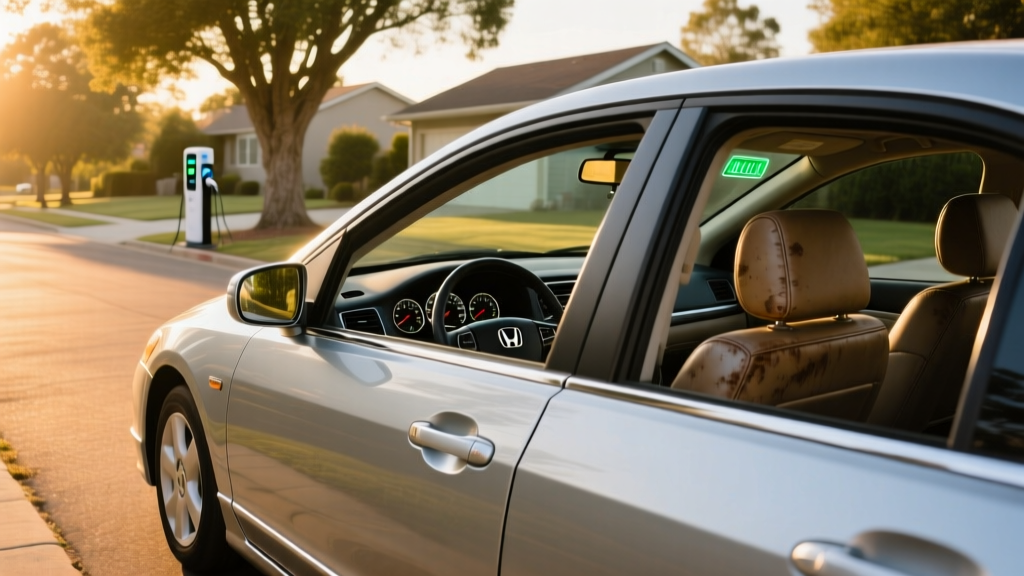
The 2007 Honda Civic Hybrid was one of the first mainstream compact sedans to pair a gasoline engine with an electric motor for everyday fuel savings. Nearly two decades later, buyers researching the 2007 Honda Civic Hybrid mileage are typically looking at used examples priced well under $5,000 — and the central question is whether this early hybrid powertrain still delivers meaningful economy or whether age and battery degradation have eroded its original advantage.
This guide covers the EPA fuel-economy numbers, what owners actually see at the pump, the IMA (Integrated Motor Assist) battery's expected lifespan and replacement cost, and how this pioneering HEV compares to modern hybrids, plug-in hybrids, and full EVs available in 2026.
2007 Honda Civic Hybrid MPG: EPA Ratings vs Real-World Results
The 2007 Civic Hybrid is a conventional hybrid (HEV), not a plug-in. It charges its small battery pack exclusively through regenerative braking and the gasoline engine — there is no plug, no electric-only driving range, and no external charging required.
| Metric | EPA Rating | Real-World Expectation |
|---|---|---|
| City MPG | 49 MPG | 40–48 MPG (depends on battery health) |
| Highway MPG | 51 MPG | 42–50 MPG |
| Combined MPG | 50 MPG | 41–49 MPG |
| Fuel Tank Capacity | 12.4 gallons | — |
| Total Driving Range | ~620 miles | ~500–610 miles |
According to fueleconomy.gov, the 2007 Civic Hybrid with the CVT transmission earned a combined 50 MPG — an exceptional figure even by 2026 standards. However, real-world mileage in a 19-year-old vehicle hinges almost entirely on the condition of the IMA battery.
How the IMA Hybrid Powertrain Works
Honda's Integrated Motor Assist system in the 2007 Civic is fundamentally different from the series-parallel hybrid systems Toyota used in the Prius. The IMA places a thin electric motor sandwiched between the engine and transmission. This motor assists the gasoline engine during acceleration and captures energy during braking, but it cannot propel the car on electric power alone at meaningful speeds.
| Specification | Value |
|---|---|
| Engine | 1.3L inline-4 (i-DSI, 8-valve) |
| Engine Horsepower | 93 hp @ 6,000 rpm |
| Electric Motor Output | 20 hp (15 kW) |
| Combined System Output | 110 hp @ 6,000 rpm |
| Combined Torque | 123 lb-ft @ 1,000–2,500 rpm |
| Transmission | CVT (continuously variable) |
| Drivetrain | Front-wheel drive |
| IMA Battery Type | Nickel-Metal Hydride (NiMH) |
| IMA Battery Capacity | ~0.6 kWh (nominal) |
| 0–60 mph | ~10.5 seconds |
| Curb Weight | ~2,850 lbs |
The 1.3L i-DSI engine uses dual spark plugs per cylinder for more complete combustion, a design Honda favored for efficiency over raw output. The 20-hp electric motor fills in the torque gap at low RPMs, which is where small-displacement engines are weakest. The result is adequate city acceleration and genuinely impressive fuel economy — when the battery is healthy.
HEV vs PHEV vs EV: Where Does the 2007 Civic Hybrid Fit?
Understanding the distinction between hybrid types is essential when shopping in 2026. The 2007 Civic Hybrid is a conventional HEV. Here is how it compares to modern alternatives:
Conventional HEV
(2007 Civic Hybrid)
- No plug required
- Gas engine + small electric motor
- 0 miles electric-only
- 40–50 MPG combined
- Lower purchase price (used)
- No tax credits available
Plug-in Hybrid (PHEV)
(e.g., 2026 Toyota Prius Prime)
- Plugs in to charge
- Larger battery (13.6 kWh)
- ~44 miles electric-only
- 52 MPG combined (hybrid mode)
- Higher new price (~$33,000+)
- May qualify for §30D credit
Full EV (BEV)
(e.g., 2026 Hyundai Ioniq 6)
- Plugs in to charge
- Large traction battery (77.4 kWh)
- ~342 miles total range
- 140 MPGe combined
- Higher new price (~$38,000+)
- $7,500 credit (if eligible)
If you can charge at home and drive under 40 miles daily, a modern PHEV gives you electric commuting with gas-engine road-trip flexibility. If you have no home charging access and want minimal upfront cost, a used HEV like the 2007 Civic Hybrid still has a role — provided the battery is in good shape.
IMA Battery Lifespan, Degradation, and Replacement Cost
This is the single most important factor in buying a 2007 Civic Hybrid today. The NiMH IMA battery was designed for longevity, but after 19 years, even the best-maintained original pack will have significant capacity loss.
Original Battery Warranty & Expected Lifespan
- Original Honda warranty: 10 years / 150,000 miles (in CARB states), 8 years / 80,000 miles (non-CARB states)
- Expected original battery life: 10–15 years with gradual capacity loss
- Current status (2026): All original batteries are beyond warranty; most surviving examples have been replaced at least once
| Option | Cost Range | Expected Life | Notes |
|---|---|---|---|
| OEM Honda replacement | $2,000–$3,000 (parts + labor) | 8–12 years | Best reliability; dealer-installed |
| Aftermarket/remanufactured | $1,200–$2,000 | 5–8 years | Varying quality; check warranty terms |
| Used/salvage yard battery | $300–$700 | 2–5 years (unpredictable) | Risky; unknown degradation state |
| Individual cell rebuild (DIY) | $150–$400 (parts) | Varies widely | Requires technical skill; safety risk |
When evaluating a used 2007 Civic Hybrid, ask for documentation of any IMA battery replacement. A car with a documented OEM replacement within the last 3–5 years is a far better buy than one riding on a 19-year-old original pack. Warning signs of a failing IMA battery include the IMA warning light on the dash, reduced fuel economy, and the battery-charge indicator never reaching full or dropping rapidly.
Reliability Track Record and Common Issues
The 2007 Civic Hybrid's conventional powertrain (engine, CVT) is generally durable. The eighth-generation Civic platform is known for reaching 200,000+ miles with basic maintenance. However, the hybrid-specific components introduce failure points that non-hybrid Civics do not have.
Common issues reported by owners and tracked by NHTSA:
- IMA battery failure: The most frequent and expensive issue. Without replacement, the car still drives but loses most of its fuel-economy advantage.
- IMA motor stator failure: Less common but documented; can trigger the IMA warning light and reduce power.
- 12V auxiliary battery drain: The IMA system's DC-DC converter charges the 12V battery; if the IMA battery is weak, the 12V may also suffer.
- CVT shudder: Some owners report hesitation or vibration at low speeds; often resolved with a CVT fluid change using Honda HMMF fluid.
- Engine mounts: Standard wear item, but the added weight and torque pulses of the IMA system can accelerate deterioration.
Pros
- Excellent fuel economy (40–50 MPG) when battery is healthy
- No plug or charging infrastructure needed
- Low purchase price on the used market ($2,000–$5,000)
- Honda reliability for engine and chassis components
- Proven, simple hybrid system with no complex planetary gearset
- Lightweight and easy to park (compact sedan)
Cons
- IMA battery replacement likely needed ($1,200–$3,000)
- No electric-only driving capability whatsoever
- Modest 110 hp — slow by modern standards
- No eligibility for any federal or state EV/PHEV tax credits
- Outdated safety tech (no AEB, lane-keep, or blind-spot monitoring)
- NiMH battery chemistry is dated; heavier and less energy-dense than modern lithium-ion
Tax Credits and Incentives: Does the 2007 Civic Hybrid Qualify?
No. The 2007 Honda Civic Hybrid does not qualify for any current federal tax credit.
Under the current IRS §30D Clean Vehicle Credit, only new plug-in electric vehicles (BEVs and PHEVs) with qualifying battery sourcing and MSRP/income limits are eligible for up to $7,500. Conventional hybrids like the Civic Hybrid have never qualified for the current credit structure, and the original hybrid-vehicle tax credit that existed in 2006–2007 (up to $2,100) was phased out for Honda vehicles after they hit the 60,000-unit manufacturer cap.
The used clean-vehicle credit (§25E, up to $4,000) also applies only to used BEVs and PHEVs — not conventional HEVs. There is no federal financial incentive to purchase a 2007 Civic Hybrid in 2026.
Should You Buy a 2007 Civic Hybrid in 2026?
Who Should Choose the 2007 Civic Hybrid
- Choose this car if: You need a cheap, no-plug commuter that sips fuel; you have a trusted mechanic who can assess IMA battery health before purchase; you drive 10,000–15,000 miles/year and want to minimize fuel cost without buying new.
- Choose a modern PHEV instead if: You can install a Level 2 charger at home, drive under 40 miles daily, and want electric-only commuting with the security of a gas engine for longer trips. A used 2018+ Prius Prime or new Prius Prime offers far more technology and efficiency.
- Choose a full EV instead if: You have reliable home charging, want zero tailpipe emissions, and can take advantage of the $7,500 federal credit on a new BEV. Vehicles like the Chevy Equinox EV or Hyundai Ioniq 5 offer 300+ miles of range.
- Choose a standard gas Civic instead if: You want simplicity with no hybrid-battery risk. A 2007–2011 Civic LX (non-hybrid) gets 30–36 MPG combined and avoids IMA replacement costs entirely.
Frequently Asked Questions
How many MPG does the 2007 Honda Civic Hybrid get?
The EPA rates the 2007 Civic Hybrid (CVT) at 49 city / 51 highway / 50 combined MPG. In real-world driving with a healthy IMA battery, owners typically see 41–49 MPG combined. With a degraded battery, expect 35–40 MPG.
Does the 2007 Civic Hybrid need to be plugged in?
No. This is a conventional hybrid (HEV). The IMA battery charges itself through regenerative braking and the gasoline engine. There is no plug, no charging port, and no electric-only driving mode.
How much does it cost to replace the IMA battery?
An OEM Honda IMA battery replacement runs $2,000–$3,000 including labor at a dealership. Aftermarket remanufactured batteries cost $1,200–$2,000 installed. Salvage-yard units are cheaper ($300–$700) but carry unknown remaining life.
Is the 2007 Civic Hybrid reliable?
The engine, transmission, and chassis are durable Honda components. The primary reliability concern is the IMA battery, which is beyond its original warranty life at this point. If the battery has been replaced recently with an OEM unit, the car can be a reliable daily driver. Without a recent battery replacement, budget $1,500–$3,000 for a new one.
Does the 2007 Honda Civic Hybrid qualify for any tax credit?
No. Federal clean-vehicle credits (§30D for new, §25E for used) apply only to plug-in vehicles (BEVs and PHEVs). Conventional hybrids are not eligible. The original hybrid tax credit from 2006–2007 was phased out for Honda over a decade ago.
How far can the 2007 Civic Hybrid drive on a full tank?
With a 12.4-gallon fuel tank and 50 MPG combined (EPA), the theoretical maximum range is approximately 620 miles. Real-world range with a healthy battery is roughly 500–610 miles between fill-ups.
Can I still get parts for the 2007 Civic Hybrid?
Mechanical parts (brakes, suspension, engine components) remain widely available since the Civic platform shared many parts with non-hybrid models. IMA-specific components (battery pack, IMA motor, DC-DC converter) are available through Honda dealers and aftermarket suppliers, though availability may narrow over time.
The 2007 Honda Civic Hybrid remains a practical, fuel-efficient used car — but only if you go in with eyes open about the IMA battery. At $2,000–$5,000 on the used market, it can still deliver 45+ MPG and low running costs, making it one of the cheapest ways to drive a high-MPG vehicle in 2026. Just factor a potential battery replacement into your purchase budget, and have the IMA system inspected before you buy.