Quick Verdict: The 2007 Escape Hybrid at a Glance
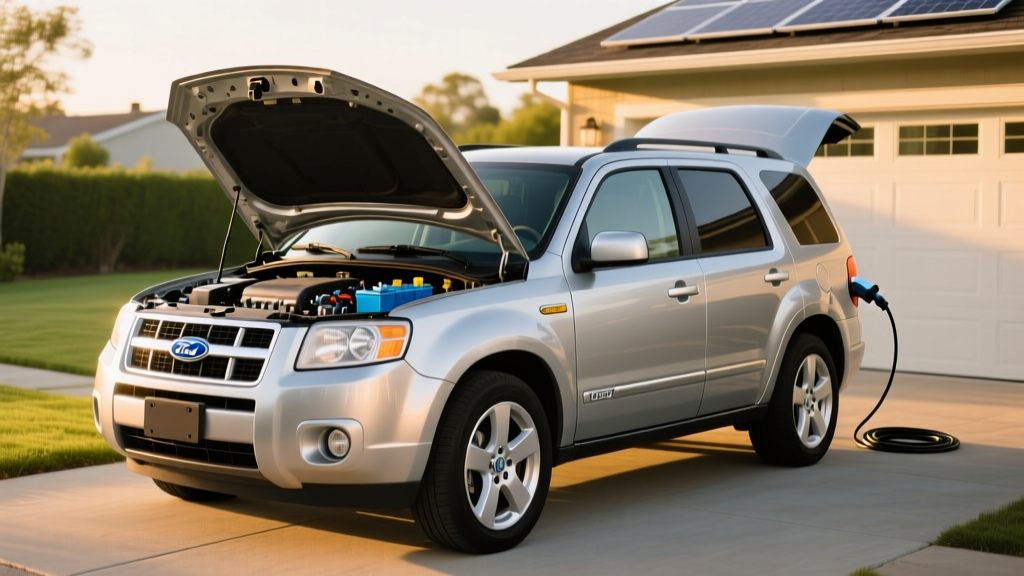
The 2007 Ford Escape Hybrid was one of the first mainstream hybrid SUVs on the road — a front-wheel-drive or all-wheel-drive compact that paired a 2.3-liter Atkinson-cycle four-cylinder with an electric motor and a modest nickel-metal-hydride (NiMH) battery. Nearly two decades later, it remains a fixture on the used market for buyers who want SUV utility without the fuel bill of a conventional gas model. With an EPA-rated 34 MPG city and 30 MPG highway (FWD), the Escape Hybrid still posts competitive numbers against some modern non-hybrid crossovers.
But buying a 19-year-old hybrid in 2026 comes with specific concerns — primarily battery health, parts availability, and whether the fuel savings justify the maintenance risk. This guide covers the exact specs, real-world MPG expectations, battery replacement economics, and a clear-eyed look at who should (and shouldn't) consider this vehicle today.
| Spec | FWD | AWD (4WD) |
|---|---|---|
| EPA City MPG | 34 | 33 |
| EPA Highway MPG | 30 | 29 |
| EPA Combined MPG | 32 | 31 |
| Engine | 2.3L Atkinson-cycle I4 | |
| Combined System HP | 155 hp | |
| Electric Motor | Permanent-magnet AC synchronous, integrated in eCVT | |
| Transmission | eCVT (planetary gearset) | |
| Hybrid Battery | NiMH, ~1.8 kWh (nominal), 330V | |
| 0–60 mph | ~10.5 seconds (est.) | |
| Cargo Volume | 29.2 cu ft (rear seats up) / 67.2 cu ft (folded) | |
| Towing Capacity | 1,000 lbs | 1,000 lbs |
| Original MSRP (2007) | ~$26,970 (base Hybrid) | |
| Typical Used Price (2026) | $3,500–$7,500 depending on miles/condition | |
How Many MPG Does the 2007 Escape Hybrid Actually Get?
The EPA rates the front-wheel-drive 2007 Escape Hybrid at 34 city / 30 highway / 32 combined MPG. The all-wheel-drive version drops slightly to 33/29/31 MPG. These figures come from fueleconomy.gov, the official DOE/EPA source.
| Drivetrain | City | Highway | Combined | Annual Fuel Cost* |
|---|---|---|---|---|
| FWD | 34 MPG | 30 MPG | 32 MPG | ~$1,550 |
| AWD | 33 MPG | 29 MPG | 31 MPG | ~$1,600 |
*Based on 15,000 miles/year, 55% city driving, $3.30/gallon regular unleaded. Your cost varies with local fuel prices and driving mix.
Real-World MPG vs. EPA Sticker
Hybrids like the Escape tend to exceed their EPA city rating in stop-and-go traffic because regenerative braking recovers energy that a gas car wastes as heat. Owners on forums and fuel-tracking sites like Fuelly commonly report 33–36 MPG in mixed suburban driving with the FWD model.
However, highway-heavy commutes tell a different story. At sustained 70–75 mph speeds, the electric motor contributes less and the 2.3L engine does most of the work — expect 27–29 MPG on the highway in real-world conditions, slightly below the EPA estimate. Cold weather further reduces efficiency: winter MPG can drop 10–15% as the engine runs more frequently to provide cabin heat and maintain battery temperature.
For a buyer in 2026, the realistic expectation is 29–33 MPG combined for the FWD model depending on your driving mix, climate, and the vehicle's mechanical condition. That's still a meaningful improvement over the conventional 2007 Escape 4-cylinder, which was rated at 22 city / 27 highway / 24 combined.
Hybrid vs. Plug-In Hybrid vs. Full EV: Where Does the Escape Fit?
The 2007 Ford Escape Hybrid is a conventional hybrid (HEV) — it is not a plug-in hybrid (PHEV) and it is not a battery electric vehicle (BEV). Understanding this distinction is essential before buying.
| Feature | HEV (this Escape) | PHEV (e.g., Escape PHEV) | BEV (e.g., Mustang Mach-E) |
|---|---|---|---|
| Plugs in? | No | Yes | Yes |
| Electric-only range | ~0.5–1 mile at low speed | 25–40 miles typical | 230–320+ miles |
| Battery size | ~1.8 kWh (NiMH) | 14–20 kWh (Li-ion) | 70–100+ kWh (Li-ion) |
| Gas engine? | Yes — primary power | Yes — backup + highway | No |
| Home charging needed? | No | Recommended (Level 2) | Required |
| Federal tax credit | None | Up to $7,500 (§30D, new only) | Up to $7,500 (§30D, new only) |
The 2007 Escape Hybrid generates all its electricity internally through regenerative braking and the gasoline engine. You never plug it in. The small NiMH battery assists during acceleration and enables brief electric-only movement at very low speeds (parking lots, traffic crawls), but it cannot drive on electricity alone for meaningful distances.
Who Should Choose This HEV vs. a PHEV or EV?
Choose the 2007 Escape Hybrid (HEV) if: You want better fuel economy than a gas SUV with zero change to your routine — no plug, no charging app, no range planning. You drive 10,000–15,000 miles/year mostly in mixed city/suburban conditions. You're on a tight used-car budget (under $8,000).
Consider a PHEV instead if: You have access to home or workplace Level 2 charging, your daily commute is under 35 miles round-trip, and you want to drive mostly on electricity while keeping a gas engine for road trips. A newer Ford Escape PHEV (2020+) offers 37 miles of electric-only range.
Consider a full BEV if: You have reliable home charging, want to eliminate gasoline entirely, and your budget allows a newer vehicle. The used EV market offers options like the Chevrolet Bolt EUV or Nissan Leaf at competitive prices.
Powertrain Deep Dive: Engine, Motor, and eCVT
The 2007 Escape Hybrid uses Ford's second-generation hybrid system, co-developed with Toyota-derived planetary gearset technology. Here's how the components break down:
- Gasoline engine: 2.3-liter Atkinson-cycle inline-4, producing 133 hp and 129 lb-ft of torque on its own. The Atkinson cycle delays intake valve closing, sacrificing low-RPM torque for greater thermal efficiency — ideal for a hybrid where the electric motor fills in the low-end gap.
- Electric motor: A permanent-magnet AC synchronous motor/generator integrated into the transaxle, contributing additional torque during acceleration and acting as a generator during regenerative braking.
- Combined system output: 155 horsepower. The engine and motor don't simply add together — the planetary eCVT blends their power through a torque-splitting arrangement.
- Transmission: Electronically controlled continuously variable transmission (eCVT). Unlike a belt-driven CVT, this uses a planetary gearset with no fixed gear ratios — it's mechanically robust and has proven very reliable in long-term use.
The AWD version adds a rear-mounted electric motor that drives the rear wheels when traction is needed, eliminating the mechanical driveshaft found in conventional AWD systems. This "eAWD" approach is more efficient but adds roughly 150 lbs and reduces fuel economy by about 1 MPG across the board.
Battery Health, Warranty, and Replacement Cost in 2026
The hybrid battery is the single biggest concern for anyone buying a 2007 Escape Hybrid today. Here's what you need to know.
Battery Warranty (Original)
Ford warranted the 2007 Escape Hybrid's NiMH battery pack for 8 years or 100,000 miles (10 years / 150,000 miles in California-emission states). That factory warranty has expired for all examples of this model year. Any battery failure in 2026 is the owner's responsibility.
Battery Chemistry and Lifespan
The Escape Hybrid uses a nickel-metal-hydride (NiMH) battery pack rated at approximately 1.8 kWh (nominal) and 330 volts. NiMH chemistry is less energy-dense than modern lithium-ion but has a well-documented longevity profile. Toyota's Prius, which used similar NiMH packs, routinely reached 150,000–200,000 miles on the original battery.
For the Escape Hybrid, real-world data suggests the NiMH pack typically lasts 120,000–180,000 miles before capacity degradation becomes noticeable (reduced electric assist, slightly lower MPG). Many examples are now beyond this range, so battery condition should be the primary inspection item when buying.
Replacement Cost
If the hybrid battery fails or degrades significantly, you have three options:
- OEM replacement from Ford: ~$3,000–$4,500 for the battery pack alone, plus $500–$1,000 labor. Total: roughly $3,500–$5,500 at a dealership. Availability may be limited for a 2007 model.
- Aftermarket/remanufactured pack: Companies like Green Bean Battery and Dorman offer remanufactured NiMH packs for $1,500–$2,500 including installation at partner shops. These often come with a limited lifetime warranty.
- Individual cell replacement: A hybrid-specialist shop can test and replace only the failed cells within the pack for $500–$1,200. This is a short-term fix — if one cell group has failed, others may follow.
Given that a clean 2007 Escape Hybrid sells for $3,500–$7,500 in 2026, a full OEM battery replacement can approach or exceed the vehicle's value. A remanufactured pack is the more economically rational choice if the rest of the vehicle is in good shape.
How to Check Battery Health Before Buying
Ask a hybrid-experienced mechanic to perform a battery load test and check the State of Health (SoH) via OBD-II scan tool. Key metrics:
- Internal resistance (should be low and even across modules)
- Voltage delta between cell groups (a spread greater than 0.2V under load signals weak cells)
- Regenerative braking functionality (should charge the battery at a healthy rate on deceleration)
Pricing, Tax Credits, and Total Cost of Ownership
The 2007 Escape Hybrid originally carried an MSRP of approximately $26,970 for the FWD base model — a significant premium over the conventional gas Escape at the time. In 2026, used examples trade between $3,500 and $7,500 depending on mileage, condition, battery health, and drivetrain (AWD commands a small premium).
Federal and State Tax Credits
The 2007 Escape Hybrid does not qualify for any current federal tax credit. The IRS §30D Clean Vehicle Credit applies only to new qualifying plug-in electric vehicles (BEVs and PHEVs) with specific battery-sourcing, MSRP, and buyer-income requirements. Conventional hybrids (HEVs) have never qualified for §30D, and the older Hybrid Vehicle Tax Credit that existed in the mid-2000s was exhausted for Ford hybrids by 2009 and has since been repealed. For current credit rules, see the IRS Clean Vehicle Credits page.
Some states offered their own hybrid incentives in the 2000s, but these have long expired. No state currently offers a tax credit for purchasing a used conventional hybrid.
Estimated Annual Operating Costs
| Expense | Estimated Cost |
|---|---|
| Fuel (32 MPG combined, $3.30/gal) | ~$1,550 |
| Insurance (national avg., older SUV) | ~$900–$1,200 |
| Maintenance (oil, filters, brakes, tires) | ~$600–$900 |
| Estimated total annual operating cost | ~$3,050–$3,650 |
For comparison, the conventional 2007 Escape 4-cylinder (24 MPG combined) would cost roughly $2,060/year in fuel alone — about $510 more per year. Over five years, the hybrid saves approximately $2,500 in fuel, which helps offset the higher purchase price of a well-maintained example or a potential battery replacement.
Reliability and Common Issues Beyond the Battery
The 2007 Escape Hybrid's powertrain — particularly the eCVT transaxle and the planetary gearset — has proven remarkably durable. The eCVT lacks the friction belts or clutch packs that fail in conventional automatics, and many examples have exceeded 200,000 miles with only routine fluid changes.
Common non-hybrid issues to watch for:
- Electric power steering (EPS): The Escape Hybrid uses an electric steering rack. Failures are not uncommon above 100,000 miles and replacement runs $800–$1,400.
- A/C compressor: The hybrid uses an electrically driven A/C compressor (not belt-driven). Replacement is more expensive than a conventional compressor — budget $1,000–$1,500.
- Brake actuator: The regenerative braking system uses a special brake actuator. If it fails, the brake pedal feel changes and a warning light illuminates. Replacement is $800–$1,200.
- Rust: Like most Ford products of this era, check the rear wheel arches, rocker panels, and subframe for corrosion, especially in salt-belt states.
- 12V battery: The conventional 12-volt battery powers the vehicle's computers and must be in good condition for the hybrid system to boot. A dead 12V battery will prevent the car from starting — even if the high-voltage hybrid battery is fully charged.
Overall, the Escape Hybrid's reliability record is solid for its age, but buyers should budget $1,500–$3,000 in the first year for deferred maintenance and age-related repairs — a standard expectation for any 19-year-old vehicle.
Pros
- 34/30 MPG EPA still competitive with modern non-hybrid crossovers
- No plug-in required — zero lifestyle change from a gas car
- eCVT planetary gearset is mechanically robust
- Low used-car entry price ($3,500–$7,500)
- Real cargo space (29.2 cu ft) unlike many hybrid sedans
- Regenerative braking extends brake pad life significantly
Cons
- NiMH battery likely near or past its service life
- No federal or state tax credits available
- Modest 155 hp — acceleration is leisurely (10.5s to 60 mph)
- Dated interior, infotainment, and safety tech by 2026 standards
- Limited towing (1,000 lbs)
- Parts availability declining for hybrid-specific components
- No DC fast charging or plug-in capability
Is the 2007 Escape Hybrid Still Worth It in 2026?
The 2007 Ford Escape Hybrid makes sense for a narrow but real buyer profile: someone who needs a compact SUV, wants better fuel economy without plugging in, and is comfortable with the maintenance realities of a nearly 20-year-old vehicle. The fuel savings over a conventional Escape are meaningful — roughly $500/year — but the battery replacement risk is the deciding financial variable.
If you find an example with under 120,000 miles and a recently replaced or tested-healthy hybrid battery, it can be a thrifty daily driver. If the battery is original and untested, factor a $1,500–$2,500 remanufactured replacement into your purchase budget.
For buyers with a larger budget ($15,000+), a newer hybrid like the 2018+ Toyota RAV4 Hybrid (40 MPG combined) or a 2020+ Ford Escape Hybrid offers dramatically better efficiency, modern safety features, and remaining factory warranty. For those with home charging access, a used BEV like the Chevrolet Bolt EUV eliminates fuel costs almost entirely.
Frequently Asked Questions
How many MPG does the 2007 Ford Escape Hybrid get?
The EPA rates the FWD model at 34 city / 30 highway / 32 combined MPG. The AWD model gets 33/29/31 MPG. In real-world driving, expect 29–33 MPG combined depending on your driving mix and climate.
Does the 2007 Escape Hybrid need to be plugged in?
No. This is a conventional hybrid (HEV), not a plug-in hybrid. It charges its own battery through regenerative braking and the gasoline engine. You fuel it like any other gas vehicle.
How far can the 2007 Escape Hybrid drive on electric only?
Effectively zero meaningful distance. The hybrid system can move the vehicle at very low speeds (under ~25 mph) for roughly half a mile on battery alone in ideal conditions, but this is not a practical electric-driving mode. It exists for smooth stop-and-go traffic operation, not for zero-emission commuting. If you want electric-only range, you need a PHEV or BEV.
Is the 2007 Escape Hybrid reliable?
The hybrid powertrain (eCVT, motor, planetary gearset) is mechanically robust. The main reliability risk is the aging NiMH battery pack, which is now beyond its typical 120,000–180,000-mile service life. Non-hybrid components like the electric power steering, A/C compressor, and brake actuator can also be costly when they fail. Budget for age-related repairs.
What does it cost to replace the hybrid battery?
An OEM replacement runs $3,500–$5,500 installed at a dealer. A remanufactured aftermarket pack costs $1,500–$2,500 installed. Individual cell repair is $500–$1,200 but may be temporary.
Does the 2007 Escape Hybrid qualify for a tax credit?
No. The federal §30D Clean Vehicle Credit applies only to new plug-in electric vehicles (BEVs and PHEVs) meeting specific battery-sourcing and MSRP requirements. Conventional hybrids have never qualified for this credit. The older hybrid tax credit that existed in the 2000s was exhausted and has been repealed. See IRS.gov for current rules.
How does the 2007 Escape Hybrid compare to a modern hybrid SUV?
A 2025 Toyota RAV4 Hybrid achieves 41 city / 38 highway / 39 combined MPG — roughly 20% more efficient than the 2007 Escape Hybrid. Modern hybrids also feature lithium-ion batteries with better energy density, updated safety technology (automatic emergency braking, lane keeping), and current factory warranties. The cost gap is significant, however: a new RAV4 Hybrid starts around $33,000 vs. $3,500–$7,500 for a used Escape Hybrid.
Can the 2007 Escape Hybrid tow?
Yes, but minimally. Ford rated it for 1,000 lbs of towing capacity — enough for a small utility trailer or a couple of dirt bikes, but not a boat or camper. If towing is a priority, look at a conventional V6 Escape or a modern hybrid SUV with higher ratings.