Quick Verdict: The 2007 Civic Hybrid in 2026
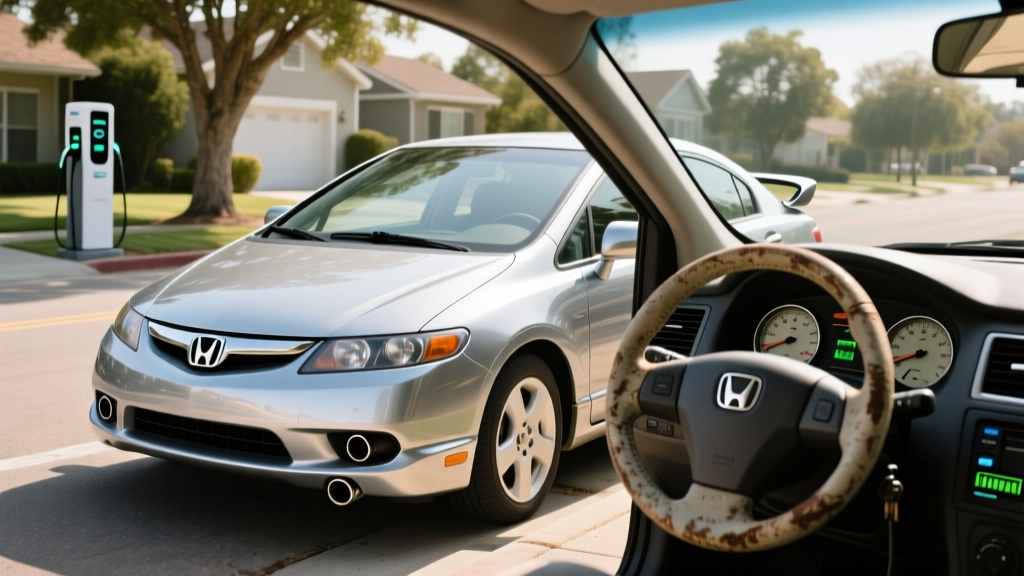
The 2007 Honda Civic Hybrid is a conventional hybrid electric vehicle (HEV) — not a plug-in — that pairs a 1.3-liter gasoline engine with a small electric assist motor. Nearly two decades after its debut, it remains one of the most fuel-efficient used cars available on the secondary market. With an EPA-estimated 49 MPG combined, low running costs, and Honda's reputation for mechanical durability, the 2007 Civic Hybrid still appeals to budget-conscious commuters who want hybrid efficiency without the complexity or price of a modern PHEV or full EV.
But ownership in 2026 comes with a critical caveat: the Integrated Motor Assist (IMA) battery is now 18-19 years old. If it hasn't been replaced, buyers should budget $1,500–$3,000 for a new or refurbished pack. This guide covers everything you need to know before purchasing or continuing to own one.
2007 Civic Hybrid: Key Specifications at a Glance
| Specification | Value |
|---|---|
| Vehicle Type | Conventional Hybrid (HEV) — no plug-in required |
| Powertrain | 1.3L i-VTEC 4-cylinder + IMA electric motor |
| Combined Horsepower | 110 hp @ 6,000 rpm |
| Combined Torque | 123 lb-ft @ 1,000–2,500 rpm |
| Transmission | CVT (Continuously Variable Transmission) |
| EPA Fuel Economy (City / Hwy / Combined) | 49 / 51 / 49 MPG* |
| Fuel Tank Capacity | 12.4 gallons |
| Total Driving Range | ~607 miles (EPA combined) |
| IMA Battery Type | Nickel-Metal Hydride (NiMH), ~0.6 kWh |
| Drivetrain | Front-wheel drive |
| 0–60 mph | ~10.5 seconds |
| Original MSRP (2007) | $22,600 |
| Current Used Price Range (2026) | $2,500–$5,500 depending on mileage and condition |
*EPA figures revised under older testing methodology. Real-world results may differ — see section below.
Fuel Economy: EPA Ratings vs. Real-World MPG
The 2007 Civic Hybrid carries EPA estimates of 49 MPG city, 51 MPG highway, and 49 MPG combined, according to fueleconomy.gov. These numbers were competitive when the car launched and remain impressive among used vehicles today.
Real-World MPG Expectations
Hybrids often exceed their EPA city ratings in stop-and-go driving, where regenerative braking and electric motor assist do the most work. However, the 2007 Civic Hybrid's EPA numbers were based on pre-2008 testing cycles that tended to overstate real-world results. Under the revised EPA methodology applied retroactively, real-world expectations are closer to:
- City driving: 42–48 MPG (regenerative braking maximizes electric assist)
- Highway driving: 45–52 MPG (lean-burn mode engages at steady speeds)
- Combined mixed driving: 42–47 MPG
- Cold weather (below 35°F): 36–42 MPG (engine runs more often for cabin heat; battery efficiency drops)
Owner forums and long-term reports consistently show that well-maintained examples with healthy IMA batteries achieve 43–46 MPG in mixed daily commuting. Drivers who accelerate gently and maintain steady highway speeds report figures touching 50 MPG on flat routes.
HEV vs. PHEV vs. Full EV: Where Does the 2007 Civic Hybrid Fit?
The 2007 Civic Hybrid is a conventional hybrid (HEV). It cannot be plugged in. The small NiMH battery recharges solely through regenerative braking and the gasoline engine. This is fundamentally different from a plug-in hybrid (PHEV) or a battery electric vehicle (BEV).
| Feature | 2007 Civic Hybrid (HEV) | Modern PHEV (e.g., 2026 Toyota Prius Prime) | Full EV (e.g., 2026 Tesla Model 3) |
|---|---|---|---|
| Plug-in Charging | No — self-charging via regen | Yes — Level 1/2, some DC fast | Yes — Level 1/2/DC fast |
| Electric-Only Range | None (motor assists only) | ~40–45 miles | ~300–360 miles |
| Combined MPG / MPGe | 49 MPG (gasoline) | 52 MPG gas + 127 MPGe electric | 132 MPGe |
| Battery Size | ~0.6 kWh (NiMH) | ~13.6 kWh (Li-ion) | ~60–75 kWh (Li-ion/LFP) |
| Fuel Cost per Mile | ~$0.07 (at $3.40/gal) | ~$0.04 electric / $0.07 gas | ~$0.04 (at $0.14/kWh) |
| Tailpipe Emissions | Low (not zero) | Low (zero in EV mode) | Zero at tailpipe |
| Used Price Range (2026) | $2,500–$5,500 | $28,000–$38,000 new | $25,000–$45,000 new |
Who Should Choose the 2007 Civic Hybrid?
Choose the 2007 Civic Hybrid (HEV) if:
- You need the cheapest possible fuel-efficient commuter car
- You lack access to home or workplace charging (no plug needed)
- You want proven mechanical simplicity with no charging logistics
- Your budget is under $6,000 total including potential battery replacement
Choose a modern PHEV or EV if:
- You have Level 2 charging access and want electric-only daily commuting
- You want current safety technology (AEB, blind-spot monitoring, lane-keeping)
- You want to eliminate or drastically reduce gasoline use
- You qualify for the §30D federal tax credit on a new or used electrified vehicle
Powertrain Deep Dive: How the IMA System Works
Honda's Integrated Motor Assist (IMA) system in the 2007 Civic Hybrid is fundamentally different from the full-hybrid systems used by Toyota. The IMA places a thin electric motor between the 1.3-liter i-VTEC engine and the CVT transmission. This motor assists the gasoline engine during acceleration and captures energy during braking, but it cannot propel the car on electric power alone at meaningful speeds.
Key powertrain specs:
- Engine: 1.3L SOHC i-VTEC inline-4, 95 hp @ 6,000 rpm
- IMA Motor: Permanent-magnet electric motor, 15 hp / 58 lb-ft assist
- Combined Output: 110 hp, 123 lb-ft torque
- Idle Stop: Engine shuts off at stops; IMA motor restarts it instantly
- Lean-Burn: Under light highway loads, the engine runs in a fuel-efficient lean air-fuel ratio mode
- Regen Braking: IMA motor acts as a generator under deceleration, recharging the NiMH pack
The IMA system is simpler and lighter than Toyota's Hybrid Synergy Drive (used in the Prius), but it provides less electric-only capability. The trade-off is reduced complexity, which generally translates to fewer failure points — aside from the IMA battery itself.
IMA Battery Lifespan, Replacement Cost, and Warranty
The single biggest ownership concern for any 2007 Civic Hybrid buyer is the IMA battery. This ~0.6 kWh nickel-metal hydride (NiMH) pack was warrantied by Honda for 8 years / 80,000 miles (10 years / 150,000 miles in CARB states including California, New York, Massachusetts, and others that adopted California emissions standards).
Battery Warranty & Lifespan Summary
- Original Honda Warranty: 8 yr / 80,000 mi (10 yr / 150,000 mi in CARB states)
- Current Status (2026): All 2007 models are well past original warranty expiration
- Typical NiMH Lifespan: 10–15 years / 120,000–180,000 miles before significant degradation
- Replacement Cost (OEM new): $2,000–$3,000 installed at a Honda dealer
- Replacement Cost (aftermarket/refurbished): $1,000–$1,800 installed at an independent hybrid shop
- DIY Refurbished Pack: $600–$1,000 for the battery alone
Signs of IMA Battery Failure
Watch for these indicators when evaluating a used 2007 Civic Hybrid:
- IMA warning light on the dashboard — indicates battery or system fault
- Reduced fuel economy — a degraded battery provides less assist, forcing the engine to work harder (expect 5–10 MPG loss)
- Recalibration events — the battery gauge drops suddenly and the engine revs high to recharge it (occasional recalibrations are normal; frequent ones signal degradation)
- Idle stop not engaging — the system disables auto-stop when battery SoC is low
Is Battery Replacement Worth It?
If the car is otherwise clean with under 160,000 miles, a $1,500–$2,500 battery replacement can extend the vehicle's useful life by another 5–8 years. At 45+ MPG, the fuel savings versus a comparable non-hybrid (say, a 2007 Civic EX at ~30 MPG combined) save roughly $400–$600 per year at 12,000 miles annually and $3.40/gallon gasoline. The battery replacement pays for itself in 3–5 years of typical driving.
Reliability, Safety, and Common Issues
The eighth-generation Civic platform (2006–2011) is widely regarded as mechanically robust. The 1.3L engine and CVT transmission are generally durable with regular maintenance. However, several model-year-specific issues are worth noting:
Common Problems Beyond the IMA Battery
- CVT shudder: Some owners report hesitation or vibration during low-speed acceleration. Often resolved with a CVT fluid drain-and-fill using Honda HMMF fluid.
- Engine block cracking: A known issue affecting some 2006–2009 Civic Hybrid engines, particularly in cold climates. Honda extended the engine block warranty to 10 years for affected VINs — check with a dealer to confirm coverage status.
- 12V battery drain: The auxiliary 12V battery can drain if the car sits for extended periods, as the IMA system draws a small parasitic load.
- Motor mount wear: The front engine mount is a known wear item around 100,000–130,000 miles ($150–$300 replacement).
Safety Ratings
The 2007 Civic earned strong safety scores for its era. The NHTSA awarded it 5 stars for frontal crash protection (driver and passenger) and 4 stars for side impact. Standard safety equipment includes front airbags, side-curtain airbags, ABS, and electronic brake distribution. However, it lacks modern active safety features like automatic emergency braking, lane-departure warning, or blind-spot monitoring — technologies now standard on most 2026 vehicles.
Does the 2007 Civic Hybrid Qualify for Any Tax Credit?
No. The 2007 Honda Civic Hybrid does not qualify for the current §30D federal clean vehicle tax credit. There are several reasons:
- The §30D credit for new vehicles applies only to new plug-in EVs and PHEVs with battery packs of at least 7 kWh — the Civic Hybrid's 0.6 kWh NiMH pack doesn't qualify.
- The used EV credit (§25E, up to $4,000) applies only to used plug-in EVs and fuel-cell vehicles, not conventional hybrids.
- Honda's hybrid tax credit eligibility expired in 2008 when the manufacturer hit the original credit phase-out cap.
If you're shopping for a used hybrid and want tax incentives, consider a used PHEV like the Toyota Prius Prime, Chevrolet Volt, or Honda Clarity Plug-In Hybrid, which may qualify for the §25E used clean vehicle credit (up to $4,000 or 30% of sale price, whichever is lower) subject to income caps and dealer reporting requirements.
Ownership Costs: 2007 Civic Hybrid vs. Alternatives
Here's how annual running costs compare for the 2007 Civic Hybrid against a similarly-aged non-hybrid Civic and a modern used EV, assuming 12,000 miles per year:
| Cost Factor | 2007 Civic Hybrid (45 MPG real) | 2007 Civic Gas (30 MPG) | Used EV (e.g., 2020 Bolt) |
|---|---|---|---|
| Annual Fuel/Energy | $907 (gas @ $3.40/gal) | $1,360 (gas @ $3.40/gal) | $504 (electric @ $0.14/kWh) |
| Annual Insurance (est.) | $900–$1,100 | $850–$1,050 | $1,000–$1,300 |
| Maintenance (annual avg) | $400–$600 | $350–$500 | $200–$350 |
| Total Annual Running Cost | ~$2,200–$2,600 | ~$2,560–$2,910 | ~$1,700–$2,150 |
The hybrid saves roughly $350–$450 per year in fuel versus the gas Civic. Over five years, that's $1,750–$2,250 — enough to cover a battery replacement if needed.
Pros, Cons, and Final Assessment
Pros
- Excellent real-world fuel economy (42–48 MPG combined)
- No plug-in charging required — ideal for apartment dwellers
- Low purchase price on the used market ($2,500–$5,500)
- Proven Honda mechanical reliability (engine, CVT)
- Simple hybrid system with fewer components than full hybrids
- Strong NHTSA crash ratings for its model year
Cons
- IMA battery likely needs replacement if original ($1,500–$3,000)
- No electric-only driving capability
- Lacks modern safety tech (AEB, lane-keep, blind-spot monitoring)
- No tax credit eligibility (federal or most state)
- CVT can feel sluggish; 0–60 in ~10.5 seconds
- Known engine block cracking issue on some VINs
- Outdated infotainment — no Bluetooth audio, no backup camera standard
Frequently Asked Questions
How many MPG does the 2007 Honda Civic Hybrid actually get?
The EPA rates it at 49 city / 51 highway / 49 combined under original testing. Real-world driving in 2026 typically yields 42–48 MPG combined depending on driving style, terrain, climate, and IMA battery health. City driving with frequent stops tends to produce the best results thanks to regenerative braking.
Does the 2007 Civic Hybrid need to be plugged in?
No. The 2007 Civic Hybrid is a conventional hybrid (HEV), not a plug-in hybrid (PHEV). The small IMA battery recharges entirely through regenerative braking and the gasoline engine. You fuel it like any other car at a gas station.
How much does it cost to replace the IMA battery?
An OEM Honda replacement IMA battery costs $2,000–$3,000 installed at a dealership. Aftermarket or refurbished packs range from $1,000–$1,800 installed at independent hybrid specialists. DIY refurbished packs can be found for $600–$1,000.
Is the 2007 Civic Hybrid reliable?
Mechanically, the 1.3L engine and CVT are durable with proper maintenance. The main reliability risk is IMA battery degradation, which is expected on a vehicle of this age. The engine block cracking issue affects some VINs — check with a Honda dealer before purchasing. Overall, it's considered one of the more reliable early hybrids if the battery is addressed.
How does the 2007 Civic Hybrid compare to a 2007 Toyota Prius?
The 2007 Prius offers similar EPA fuel economy (~46 MPG combined under revised methodology), more interior cargo space (hatchback), and a more capable full-hybrid system that can drive short distances on electric power alone at low speeds. The Civic Hybrid has a more conventional driving feel, a traditional trunk, and slightly better highway manners. The Prius's larger NiMH battery is also expensive to replace ($2,000–$3,500).
Can I still get hybrid tax credits for buying a used Civic Hybrid?
No. The current §30D federal tax credit applies only to new plug-in vehicles (EVs and PHEVs). The §25E used clean vehicle credit also requires a plug-in vehicle. Conventional hybrids like the Civic Hybrid are not eligible for any current federal tax incentive.
Should I buy a 2007 Civic Hybrid or a newer used EV?
It depends on your budget and charging access. If you can spend $12,000–$20,000 and have home Level 2 charging, a used EV like a 2019–2021 Chevrolet Bolt or Nissan Leaf will deliver lower per-mile energy costs, zero tailpipe emissions, and a smoother, quieter drive. If your budget is under $6,000 and you lack reliable charging access, the 2007 Civic Hybrid remains a practical, high-MPG choice — just budget for a potential battery replacement.