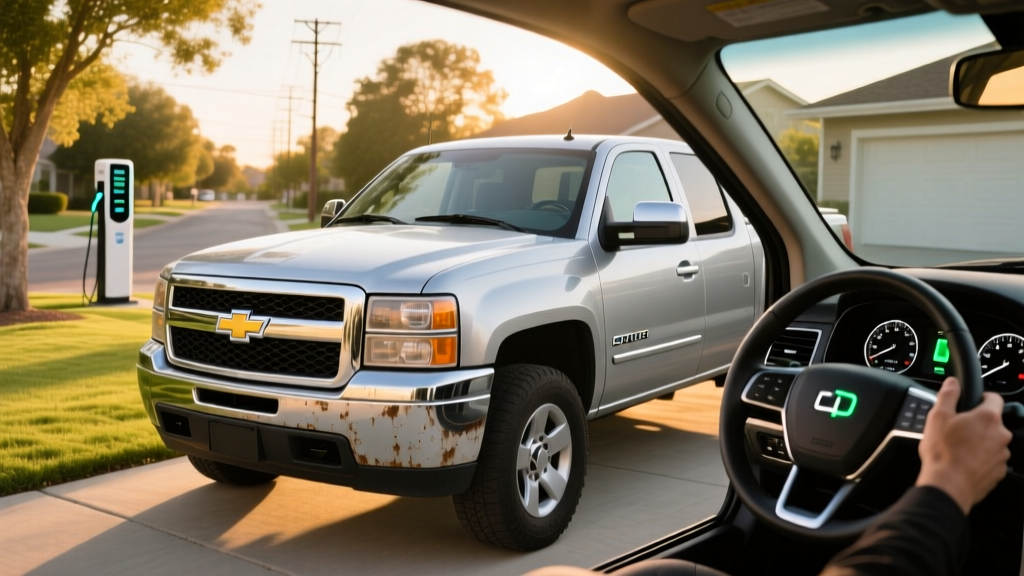
The 2006 Chevrolet Silverado Hybrid: America's First Full-Size Hybrid Truck
Long before the Ford F-150 PowerBoost or the Silverado 1500 Hybrid that Chevy teased and ultimately canceled, General Motors took a genuine swing at electrifying the full-size pickup segment. The 2006 Chevrolet Silverado Hybrid was the result — a mild-hybrid system paired with the venerable 5.3L Vortec V8, sold in very limited numbers to commercial fleets and a handful of retail buyers in select markets. If you're searching for a 2006 Silverado Hybrid today — whether as a used-truck prospect, a curiosity, or a baseline for understanding how far hybrid trucks have come — this guide covers the exact specifications, real-world fuel economy, battery longevity concerns, and ownership economics two decades later.
Let's be direct: this was not a Prius competitor. The 2006 Silverado Hybrid used GM's early "mild hybrid" architecture, which provided modest fuel-economy gains and a unique stationary power-export feature. Understanding exactly what this system did — and didn't do — is essential before evaluating one on the used market in 2026.
HEV vs. PHEV: Where the 2006 Silverado Hybrid Falls
The 2006 Silverado Hybrid is a conventional hybrid electric vehicle (HEV) — not a plug-in hybrid (PHEV). This distinction matters enormously, especially when researching tax credits or charging requirements.
| Feature | HEV (2006 Silverado Hybrid) | PHEV (e.g., Modern Plug-In Truck/SUV) |
|---|---|---|
| Plug-in charging required? | No — charges via regenerative braking & engine | Yes — requires Level 1 or Level 2 outlet |
| Electric-only driving | No (electric motor assists only at low speeds / idle) | Yes — typically 20–50 miles on battery alone |
| Battery size | ~1.5 kWh (NiMH pack) | 12–30+ kWh (lithium-ion) |
| Federal tax credit (§30D) | Not eligible (credit expired for this vehicle years ago; §30D requires plug-in capability) | Up to $7,500 if current-year §30D rules met |
| Typical MPG improvement over gas | 10–20% | 50–100%+ when factoring electric miles |
The Silverado's mild-hybrid system was never designed to propel the truck on electric power alone at meaningful speeds. Instead, it provided auto stop/start, regenerative braking, slight torque assist during acceleration, and — its headline party trick — stationary power export via four 120V/20A AC outlets in the bed, capable of supplying up to 2,400 watts of continuous power for job-site tools or tailgating.
Fuel Economy: EPA MPG and Real-World Expectations
The EPA rated the 2006 Silverado Hybrid 1500 at 18 city / 21 highway / 19 combined MPG (2WD configuration). The four-wheel-drive variant dropped slightly to 17 city / 19 highway / 18 combined MPG. For context, the conventional 2006 Silverado 1500 with the same 5.3L V8 and 4-speed automatic returned roughly 14 city / 19 highway / 16 combined MPG in 2WD form.
| Configuration | City MPG | Highway MPG | Combined MPG |
|---|---|---|---|
| 2006 Silverado Hybrid 2WD | 18 | 21 | 19 |
| 2006 Silverado Hybrid 4WD | 17 | 19 | 18 |
| 2006 Silverado 5.3L Gas 2WD (baseline) | 14 | 19 | 16 |
Source: fueleconomy.gov
The hybrid's advantage came primarily in city driving, where the auto stop/start system and regenerative braking recaptured energy that a conventional truck would waste at idle and during braking. The roughly 3-MPG combined improvement (2WD) translated to approximately a 16–19% fuel-economy gain over the gas-only equivalent — meaningful for a full-size truck of that era, but modest by modern hybrid standards.
Real-World MPG vs. EPA Sticker
Owners on fueleconomy.gov's "My MPG" tracker report real-world averages clustering between 16 and 19 MPG combined, with city-heavy drivers occasionally touching 20 MPG and highway-dominant drivers sometimes falling below the EPA highway estimate. This is consistent with mild-hybrid behavior: the system's benefits are concentrated in stop-and-go driving, and the added weight of the battery pack (~150 lbs) slightly offsets the gains on sustained highway cruising. A 20-year-old truck with worn suspension, underinflated tires, or a dirty air filter will trend toward the lower end.
Powertrain Specifications: 5.3L V8 Meets Mild Hybrid
| Specification | 2006 Silverado Hybrid 1500 |
|---|---|
| Engine | 5.3L Vortec V8 (Gen III, LMG flex-fuel) |
| Engine horsepower | 295 HP @ 5,200 RPM |
| Engine torque | 335 lb-ft @ 4,000 RPM |
| Electric motor | Starter-generator (integrated), ~14 kW peak assist |
| Combined system output | ~295 HP (motor assists but does not add peak HP independently) |
| Transmission | 4-speed automatic (4L60-E) |
| Hybrid battery | Nickel-metal hydride (NiMH), ~1.5 kWh, 42V system |
| Drivetrain | RWD (2WD) or 4WD |
| 0–60 mph | ~8.5 seconds (estimated) |
| Towing capacity | ~7,700 lbs (properly equipped, 2WD) |
| Power export | 4 × 120V/20A bed outlets, 2,400W continuous |
The electric motor in this system functioned primarily as a starter-generator. It enabled the engine to shut off at stops (a rarity for trucks in 2006), provided minor torque fill during initial acceleration, and recaptured kinetic energy during deceleration. It could not drive the wheels independently — this was not a "strong" or "full" hybrid like the later two-mode system GM introduced in the 2008 Tahoe Hybrid, nor anything resembling a modern PHEV.
Hybrid Battery: Lifespan, Warranty, and Replacement Cost
Original warranty: GM covered the hybrid battery pack for 8 years / 100,000 miles (extended to 10 years / 150,000 miles in California and states adopting CARB emissions standards). That factory coverage has expired for every surviving 2006 Silverado Hybrid.
Battery chemistry: Nickel-metal hydride (NiMH) — not lithium-ion. NiMH packs are chemically more tolerant of heat and overcharge than early lithium cells, but they suffer from higher self-discharge rates and lower energy density.
How Long Does the Battery Last?
NiMH packs of this generation typically lasted 120,000–180,000 miles before significant capacity loss, though calendar age is also a factor. At 20 years old, any 2006 Silverado Hybrid still on the road has almost certainly had its original battery replaced — or is in immediate need of one. NiMH cells degrade with time regardless of mileage due to electrolyte breakdown and internal resistance growth.
Battery Replacement Cost
Replacement options for the 2006 Silverado Hybrid NiMH pack:
- Remanufactured pack: $1,200–$2,200 (parts only) from hybrid-battery specialists. Availability is limited due to low production volumes.
- Used/salvage pack: $400–$900, but carries significant risk given the age of any donor battery.
- Labor: $300–$600 at an independent shop; the pack is located under the rear seat and is moderately accessible.
- Total out-of-pocket: Expect $1,500–$2,800 for a complete replacement with a remanufactured unit.
This is less expensive than a modern high-voltage lithium pack replacement (which can run $5,000–$20,000), but the scarcity of 2006 Silverado Hybrid-specific NiMH modules is a growing concern. Fewer trucks were sold (estimates suggest under 5,000 units total), and the aftermarket supply chain for this specific pack has thinned considerably.
Pricing, Tax Credits, and 2026 Used-Market Value
The 2006 Silverado Hybrid originally carried an MSRP of approximately $32,000–$38,000 depending on configuration — a meaningful premium over the gas-only Silverado 1500 of the era. It was sold primarily through commercial fleet channels in California and a handful of other markets.
Federal Tax Credit Status
The 2006 Silverado Hybrid originally qualified for a modest federal hybrid tax credit under the Energy Policy Act of 2005 — typically $250–$650 depending on the phase-out schedule and buyer's tax liability. That credit program has long since expired. Under current IRS §30D rules, the vehicle does not qualify for the Clean Vehicle Credit because:
- §30D applies only to new plug-in electric vehicles (BEVs and PHEVs with ≥7 kWh battery capacity)
- The Silverado Hybrid is a conventional HEV, not a plug-in vehicle
- The vehicle is not new, and the used-EV credit (§25E) also requires plug-in capability
Bottom line: zero federal tax credit availability for this vehicle in 2026. State-level incentives for conventional hybrids have also largely disappeared, as programs have shifted to prioritize zero-emission vehicles.
2026 Used-Market Value
Surviving 2006 Silverado Hybrids are uncommon. When they appear, pricing tracks closely with comparable non-hybrid 2006 Silverado 1500s in similar condition:
- Fair/poor condition: $2,500–$4,500
- Good condition (150K+ miles): $4,500–$7,000
- Excellent/low-mileage: $7,000–$10,000 (rare)
The hybrid badge does not command a meaningful premium on the used market. In fact, some buyers discount for the potential battery-replacement liability. The power-export feature is the only unique selling point that occasionally attracts contractor buyers.
Reliability and Ownership Considerations
The 5.3L Vortec V8 (LMG/LM7 family) is one of GM's most durable engines, routinely reaching 250,000+ miles with basic maintenance. The 4L60-E automatic transmission is well-understood by any GM-truck mechanic. The hybrid-specific components — the starter-generator, the 42V battery pack, and the power-export inverter — add complexity but are relatively simple compared to modern high-voltage systems.
Key reliability considerations for a 20-year-old example:
- Hybrid system faults: If the 42V battery fails, the truck can still operate in a limp mode using the conventional 12V starter, but auto stop/start and regen braking will be disabled.
- Parts availability: Hybrid-specific components (inverter, battery modules, bed power outlets) are increasingly difficult to source. Standard Silverado mechanical parts remain abundant and inexpensive.
- Rust: As with all GMT800-platform trucks, frame and body-panel corrosion is the primary structural concern in salt-belt states.
- Insurance: Standard classic/high-mileage truck rates. No hybrid-specific surcharge, but also no green-vehicle discount.
Who Should Consider the 2006 Silverado Hybrid?
Pros
- Bulletproof 5.3L V8 with well-known maintenance needs
- Modest city MPG improvement over gas equivalent (~19 vs. ~16 combined)
- Unique 2,400W bed power export for job-site use
- Auto stop/start was ahead of its time for a full-size truck
- Cheap to buy in 2026 ($3K–$7K typical)
Cons
- Hybrid battery likely needs replacement (or already has)
- Only a 4-speed automatic — outdated by 2026 standards
- Very low production volume = scarce hybrid-specific parts
- No tax credit, no EV incentives
- Real-world MPG gains are modest (~3 MPG combined)
- Not a plug-in — no electric-only driving
Decision Framework
Consider the 2006 Silverado Hybrid if: You need a cheap, proven V8 work truck and the bed power-export feature has genuine utility for your contracting or tailgating needs. You're comfortable sourcing hybrid parts from a thinning supply chain and budgeting for a battery replacement.
Choose a conventional 2006 Silverado gas model instead if: You want maximum parts availability, the simplest possible maintenance, and don't need the power-export outlets. The MPG difference is small enough that fuel savings alone won't justify the hybrid complexity.
Look at a modern PHEV or BEV truck if: You want substantial electric-only range (the Ford F-150 Lightning, Rivian R1T, or upcoming Silverado EV), qualify for the current §30D federal tax credit (up to $7,500 for qualifying new EVs/PHEVs meeting MSRP caps, income limits, and battery-sourcing requirements), and want modern safety tech and infotainment.
2006 Silverado Hybrid FAQ
How many MPG does the 2006 Silverado Hybrid get?
The EPA rates the 2WD model at 18 city / 21 highway / 19 combined MPG. The 4WD model rates 17/19/18 MPG. Real-world owners typically report 16–19 MPG combined depending on driving mix and vehicle condition.
Can the 2006 Silverado Hybrid drive on electric power alone?
No. This is a mild hybrid (HEV), not a plug-in hybrid (PHEV). The electric motor assists the gasoline engine and enables auto stop/start, but it cannot propel the truck independently. There is no electric-only range.
Does the 2006 Silverado Hybrid qualify for any tax credit in 2026?
No. The original federal hybrid credit ($250–$650) expired long ago. Current IRS §30D and §25E credits require plug-in electric vehicles (BEVs or PHEVs with ≥7 kWh batteries). The Silverado Hybrid is a conventional HEV and does not qualify for any current federal incentive.
What does it cost to replace the hybrid battery?
Expect $1,500–$2,800 for a remanufactured NiMH pack including labor. Availability is limited due to the truck's very low production volume. A used/salvage pack costs $400–$900 but carries significant age-related risk.
Is the 2006 Silverado Hybrid reliable?
The underlying 5.3L V8 and 4-speed automatic are proven, durable GM components. The hybrid-specific parts (battery, inverter, starter-generator) add moderate complexity but are lower-voltage and simpler than modern hybrid systems. The main risk in 2026 is parts scarcity for hybrid-unique components and the near-certainty of battery replacement due to 20-year calendar age.
What was the bed power-export feature?
The truck included four 120V/20A AC outlets in the bed, powered by the hybrid battery system, capable of delivering up to 2,400 watts continuously. This was designed for running power tools at job sites or appliances while tailgating — a genuinely innovative feature for 2006 that predated modern truck power-export systems like Ford's Pro Power Onboard by 15 years.
How does this compare to modern hybrid trucks?
The 2006 Silverado Hybrid's 19 MPG combined is substantially below modern competitors. The 2026 Ford F-150 PowerBoost hybrid achieves approximately 25 MPG combined, and plug-in options like the F-150 Lightning (BEV) eliminate fuel use entirely for daily driving. The 2006 model's value is primarily as an inexpensive used truck with a unique power-export feature, not as a fuel-economy leader.