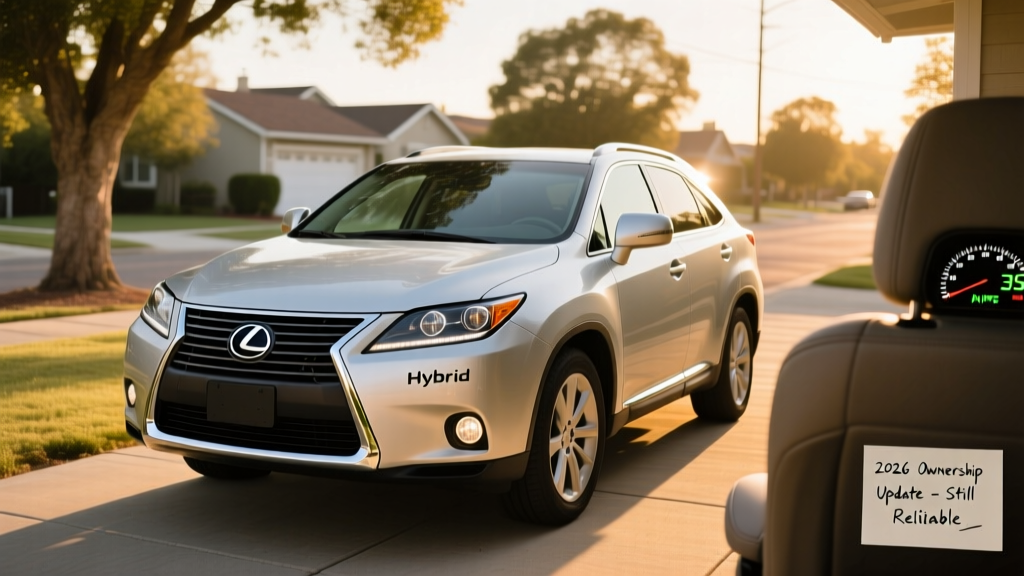
The 2006 Lexus RX 400h was the first luxury hybrid SUV sold in the United States, pairing a 3.3-liter V6 with Toyota's Hybrid Synergy Drive. Nearly two decades later, used examples still change hands, and buyers consistently search for one thing: what kind of fuel economy does it actually deliver today? Below, we break down the official EPA numbers, real-world MPG data from long-term owners, hybrid-battery longevity expectations, and whether this early HEV is still a smart buy in 2026.
2006 Lexus RX 400h Hybrid MPG: Official EPA Numbers
The EPA rated the 2006 RX 400h at 31 MPG city / 27 MPG highway / 28 MPG combined for the front-wheel-drive variant, and 31/25/27 for the all-wheel-drive model. For a mid-size luxury SUV in 2006 — when most competitors returned 16–19 MPG combined — those figures were exceptional.
| Drivetrain | City MPG | Highway MPG | Combined MPG | Annual Fuel Cost* |
|---|---|---|---|---|
| FWD | 31 | 27 | 28 | ~$2,250 |
| AWD (eFour) | 31 | 25 | 27 | ~$2,330 |
*Based on 15,000 miles/year at $3.50/gallon regular unleaded; adjust for local fuel prices.
Note that the city MPG is higher than the highway number — a hallmark of Toyota's series-parallel hybrid system. At low speeds, the electric motor does most of the work, and regenerative braking recovers energy in stop-and-go traffic. Highway driving relies more heavily on the gasoline engine, which is a 3.3L V6 not known for high thermal efficiency by modern standards.
Real-World MPG: What Owners Actually Report
EPA stickers are a starting point, but real-world fuel economy depends on driving style, climate, and vehicle condition. For a 20-year-old hybrid, battery health is a significant variable.
Aggregated owner data from Fuelly and Edmunds forums shows the following patterns:
- City-dominant driving (healthy battery): 27–30 MPG — close to or slightly below EPA city, since regenerative braking still provides a major advantage over gas-only SUVs.
- Highway-dominant driving: 23–26 MPG — below the EPA highway rating, because the RX 400h's aerodynamics and weight (4,500+ lbs) work against it at sustained speed.
- Mixed driving, average conditions: 24–27 MPG combined.
- Degraded hybrid battery: 20–23 MPG combined. When the NiMH battery can no longer hold a meaningful charge, the system defaults to engine-dominant operation, eliminating the electric assist advantage.
Key insight: The single biggest factor in real-world 2006 RX 400h MPG today is hybrid battery state of health (SoH). A fresh or well-maintained battery delivers near-EPA numbers; a degraded one drops fuel economy by 15–25%. Always check battery health before purchasing.
Powertrain & Performance Specifications
The 2006 RX 400h uses Toyota's Hybrid Synergy Drive, combining a gasoline engine with two motor-generators and a nickel-metal hydride (NiMH) battery pack. It is a conventional hybrid (HEV), meaning it charges its own battery through regenerative braking and engine operation — it does not plug in.
| Specification | Value |
|---|---|
| Engine | 3.3L V6 (3MZ-FE), 211 hp @ 5,600 rpm |
| Front Electric Motor | 123 kW (165 hp) |
| Rear Electric Motor (AWD only) | 50 kW (67 hp) |
| Net System Horsepower | 270 hp (combined peak) |
| Hybrid Battery | NiMH, ~6.5 kWh (gross), ~1.4 kWh usable |
| Transmission | eCVT (planetary gearset, no fixed gears) |
| 0–60 mph | 7.3 seconds (FWD), 7.4 seconds (AWD) |
| Curb Weight | 4,500–4,610 lbs |
| Towing Capacity | 3,500 lbs |
The 270 net system horsepower made the RX 400h quicker than most V6 luxury SUVs of its era. The eCVT provides seamless acceleration without shift shock, though it lacks the direct feel of a geared transmission.
HEV vs PHEV vs EV: Where the RX 400h Fits
Understanding the difference between hybrid types is critical, especially when shopping the used market where terminology is sometimes misused.
| Feature | HEV (RX 400h) | PHEV (e.g., 2026 RAV4 Prime) | BEV (e.g., 2026 RZ 450e) |
|---|---|---|---|
| Plugs in? | No | Yes | Yes |
| Electric-only range | <1 mile at low speed | 35–42 miles | 220–300+ miles |
| Battery size | ~6.5 kWh (NiMH) | ~18 kWh (Li-ion) | 70–95 kWh (Li-ion) |
| Gasoline engine? | Yes | Yes | No |
| Tailpipe emissions | Yes (reduced) | Yes (when engine runs) | None |
| Federal tax credit (new) | None | Up to $7,500 (§30D) | Up to $7,500 (§30D) |
| Home charging required? | No | Recommended | Essential |
The 2006 RX 400h is an HEV. It has no plug, no electric-only driving range to speak of (the system may creep short distances on electric power at very low speeds, but this is measured in feet, not miles), and no eligibility for any current federal tax credit. It is self-charging through regenerative braking and engine-driven generation.
Hybrid Battery Longevity & Replacement Cost
This is the number-one concern for any used-hybrid buyer, and it should be. The RX 400h's NiMH battery pack was robust for its era, but after 18–20 years, most original packs have degraded significantly or been replaced.
Original warranty: Lexus covered the hybrid battery for 8 years / 100,000 miles (10 years / 150,000 miles in CARB states including California, New York, Massachusetts, and others that adopted California emissions standards). This warranty has long since expired on all 2006 models.
Real-world battery lifespan data from owner communities shows:
- Original battery, no replacement: Many packs lasted 120,000–180,000 miles before showing significant degradation (reduced MPG, more frequent engine cycling, dashboard warnings). Some have exceeded 200,000 miles in mild climates.
- Primary failure modes: Cell imbalance (individual modules degrade at different rates), heat damage (hot climates accelerate degradation), and age-related capacity loss regardless of mileage.
- Symptoms of a failing battery: Noticeable MPG drop (20% or more), the gasoline engine running constantly, reduced acceleration, and eventually a check-engine or hybrid-system warning light.
Battery Replacement Options & Costs
| Option | Parts Cost | Labor | Total Range | Warranty |
|---|---|---|---|---|
| New OEM Lexus battery | $3,500–$4,500 | $500–$800 | $4,000–$5,300 | 3 yr / 36,000 mi |
| Refurbished/remanufactured | $1,500–$2,500 | $500–$800 | $2,000–$3,300 | 1–3 yr (varies) |
| Used salvage battery | $500–$1,200 | $500–$800 | $1,000–$2,000 | None / 30 days |
| Individual cell/module replacement | $200–$600 | $800–$1,500 | $1,000–$2,100 | Varies by shop |
Independent hybrid-specialist shops have become more common, and many offer refurbished packs with 1–3 year warranties. For a vehicle with a current market value of $4,000–$8,000 (depending on mileage and condition), a $4,000+ OEM replacement is hard to justify — which is why refurbished packs are the most popular choice among RX 400h owners today.
2006 RX 400h Used Market Pricing & Tax Credit Status
As of early 2026, the 2006 Lexus RX 400h trades in the used market at approximately:
- Under 100,000 miles, excellent condition: $7,000–$9,000
- 100,000–150,000 miles, good condition: $5,000–$7,500
- Over 150,000 miles or needing battery work: $3,000–$5,000
Tax Credit Eligibility
The 2006 RX 400h does not qualify for any federal tax credit in 2026. The IRS §30D new clean vehicle credit applies only to new PHEVs and BEVs meeting battery-sourcing, MSRP, and buyer-income requirements. The used-EV credit (§25E, up to $4,000) covers used BEVs and PHEVs under $25,000, but conventional hybrids (HEVs) are excluded from both programs. No state currently offers incentives for purchasing a used HEV either.
When the RX 400h was new, it did qualify for a federal tax deduction (not a credit) under the Energy Policy Act of 2005, but that provision expired long ago and applied only to original purchasers.
Reliability & Known Issues Beyond the Battery
The RX 400h shares its platform with the highly regarded third-generation Toyota Highlander Hybrid and Lexus ES 330. The underlying 3MZ-FE V6 and hybrid transaxle are known for durability, but several non-battery issues surface at high mileage:
- Hybrid inverter coolant pump: Can fail between 100,000–150,000 miles. Replacement runs $400–$700. Failure can overheat the inverter, a much costlier repair.
- Brake actuator assembly: The electro-hydraulic brake system is specific to the hybrid and can develop leaks or valve-body issues at 120,000+ miles. Repair cost: $1,200–$2,000.
- Electric power steering: Early rack-and-pinion units can develop noise or stiffness; replacement is $800–$1,400.
- Air conditioning compressor: The electric A/C compressor is hybrid-specific and expensive ($1,000–$1,800 to replace).
- Standard wear items: Suspension bushings, struts, and engine mounts wear as expected on any 20-year-old vehicle.
Overall, the RX 400h has an above-average reliability reputation for its age, but maintenance costs rise sharply past 150,000 miles — especially for hybrid-specific components. A pre-purchase inspection by a technician experienced with Toyota/Lexus hybrid systems is strongly recommended.
Who Should Buy the 2006 RX 400h in 2026?
Pros
- Strong city MPG (28–31) for a luxury SUV of any era
- Smooth, quiet ride with Lexus build quality
- 270 hp provides confident acceleration
- No plug-in charging needed — works like a regular car
- AWD available without significant MPG penalty in city driving
- Low purchase price on the used market
Cons
- Highway MPG (23–26 real-world) trails modern hybrids
- Hybrid battery replacement likely needed; adds $2,000–$5,000
- Hybrid-specific parts (brake actuator, inverter pump) are expensive
- No federal or state tax credits available
- Outdated infotainment; no Apple CarPlay/Android Auto
- Safety tech is basic by 2026 standards (no AEB, no lane-keeping)
Choose the 2006 RX 400h if: You want a cheap, comfortable daily driver with strong city fuel economy, you don't have access to home charging (ruling out PHEVs and BEVs), and you can budget $2,000–$3,000 for a hybrid-battery contingency. It remains a solid budget hybrid SUV for urban commuters.
Look at a newer PHEV or BEV if: You can charge at home, you want modern safety features (automatic emergency braking, blind-spot monitoring), you want eligibility for federal or state incentives, or you want to avoid the risk of aging hybrid-battery repairs. The 2026 Toyota RAV4 Hybrid ($32,000+) or RAV4 Prime PHEV ($44,000+ before credits) deliver far better overall efficiency with full warranties.
Choose a conventional gas SUV if: You drive mostly highway miles (where the RX 400h's advantage shrinks), you want lower maintenance complexity, or you plan to keep the vehicle for a short period and don't want to absorb hybrid-repair risk.
Frequently Asked Questions
How many MPG does the 2006 Lexus RX 400h get in 2026?
The EPA rated it at 31 city / 27 highway / 28 combined (FWD). Real-world results from 20-year-old examples typically fall between 24–28 MPG combined with a healthy battery, and 20–23 MPG if the hybrid battery is degraded. City driving yields the best results thanks to regenerative braking.
Does the 2006 RX 400h need to be plugged in?
No. The 2006 RX 400h is a conventional hybrid (HEV), not a plug-in hybrid. Its small NiMH battery charges itself through regenerative braking and the gasoline engine. You fuel it exactly like a regular car — just add gasoline.
How far can it drive on electric power alone?
Effectively zero miles in any practical sense. The hybrid system may propel the vehicle on electric power for a few hundred feet at very low speeds (under 25 mph), such as creeping through a parking lot. This is not usable electric-only range — it's a brief assist mode. For meaningful electric-only driving (30+ miles), you would need a PHEV like the current RAV4 Prime or a full BEV.
Is the 2006 RX 400h reliable?
The powertrain (V6 engine + hybrid transaxle) is generally reliable and can exceed 200,000 miles with proper maintenance. The main risk areas are the hybrid battery (likely needing replacement at this age), the hybrid inverter coolant pump, and the electro-hydraulic brake actuator. Budget $2,000–$3,000 for hybrid-system contingencies in your first year of ownership.
How much does a replacement hybrid battery cost?
A new OEM battery costs $4,000–$5,300 installed. Refurbished packs run $2,000–$3,300 installed, and individual cell-module replacements (at a hybrid specialist) can be as low as $1,000–$2,100. Most owners opt for refurbished packs given the vehicle's current market value.
Does the 2006 RX 400h qualify for any tax credit?
No. The IRS §30D new-vehicle credit and §25E used-vehicle credit apply only to plug-in vehicles (PHEVs and BEVs). Conventional hybrids (HEVs) that don't plug in are not eligible for any federal tax credit in 2026. The RX 400h's original federal tax deduction expired over a decade ago.
How does the RX 400h compare to a modern hybrid like the 2026 RAV4 Hybrid?
The 2026 RAV4 Hybrid achieves an EPA-rated 41 MPG combined — roughly 50% more efficient than the RX 400h. It also offers modern safety features (Toyota Safety Sense 3.0 with AEB and lane-keeping), current infotainment with wireless CarPlay, and a full 10-year/150,000-mile hybrid battery warranty. The trade-off is price: a new RAV4 Hybrid starts around $32,000 vs. $4,000–$8,000 for a used RX 400h.
Sources: EPA fuel economy data from fueleconomy.gov; IRS tax credit rules from irs.gov; IIHS historical safety ratings from iihs.org.