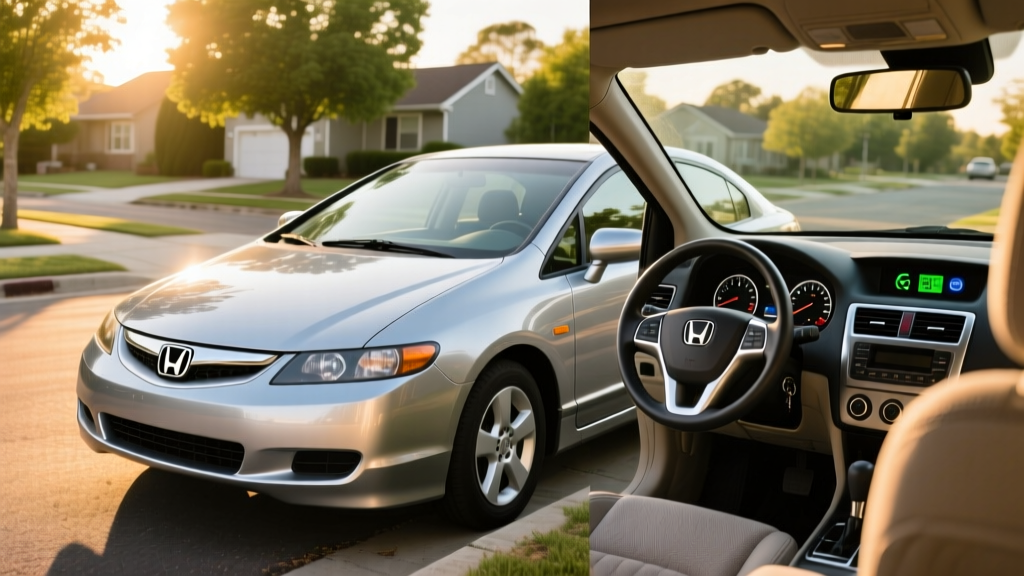
The 2006 Honda Civic Hybrid: A Pioneer That Still Runs
Two decades after it first rolled off the assembly line, the 2006 Honda Civic Hybrid remains one of the most recognizable early mainstream hybrids on American roads. Honda's second-generation Civic Hybrid used the company's Integrated Motor Assist (IMA) system — a fundamentally different approach from Toyota's Hybrid Synergy Drive — and delivered exceptional fuel economy for its era. But in 2026, with modern PHEVs and BEVs dominating the conversation, does a 20-year-old hybrid still hold up as a practical, economical daily driver? We break down the real-world data, battery longevity, and ownership economics to help you decide.
The 2006 Civic Hybrid is a conventional hybrid (HEV), not a plug-in hybrid (PHEV). It cannot be plugged in and has no electric-only driving mode. The battery recharges solely through regenerative braking and the gasoline engine. Modern PHEVs (like the 2026 Toyota RAV4 Prime or Honda Clarity Plug-In) offer 25–45 miles of electric-only range before the gas engine engages. If you want plug-in capability, you'll need to look at newer vehicles.
Fuel Economy: EPA Ratings vs Real-World MPG
The 2006 Civic Hybrid was rated by the EPA at an impressive 49 MPG city / 51 MPG highway / 50 MPG combined when equipped with the CVT automatic transmission (the 5-speed manual variant was rated slightly lower at 46/51/48). These figures placed it among the most efficient vehicles available that year, trailing only the Toyota Prius.
| Transmission | City MPG | Highway MPG | Combined MPG |
|---|---|---|---|
| CVT Automatic | 49 | 51 | 50 |
| 5-Speed Manual | 46 | 51 | 48 |
Source: fueleconomy.gov — 2006 Honda Civic Hybrid
Real-World MPG: What Owners Actually Report
EPA estimates from the mid-2000s used a different testing methodology than today's standards, and real-world results for the 2006 Civic Hybrid varied widely. Owner-reported data on forums and fuel-tracking sites like Fuelly consistently shows an average of 40–45 MPG combined in mixed driving, with some drivers achieving the EPA-rated 50 MPG under ideal conditions (moderate temperatures, flat terrain, light traffic) and others seeing dips into the mid-30s during aggressive highway driving or extreme cold.
The IMA system's lean-burn capability on the highway helped achieve its strong highway rating, but city driving with frequent stops taxed the relatively small battery pack more heavily than Toyota's larger full-hybrid system. Expect roughly 42–46 MPG in typical suburban commuting, and plan for 35–40 MPG if your route is predominantly high-speed interstate driving.
With a 13.2-gallon fuel tank and real-world combined MPG of ~43, expect roughly 565–580 miles per tank in mixed driving. Highway-heavy routes may reduce that to ~470 miles; careful city driving can push it past 600.
Powertrain Specs: The IMA System Explained
The 2006 Civic Hybrid paired a 1.3-liter i-DSI inline-4 gasoline engine with a thin electric motor sandwiched between the engine and transmission. This was Honda's Integrated Motor Assist (IMA), a "mild hybrid" architecture that differs significantly from Toyota's full-hybrid system.
| Specification | Detail |
|---|---|
| Gasoline Engine | 1.3L i-DSI inline-4, 8-valve SOHC |
| Engine Power | 85 hp @ 6,000 rpm |
| Engine Torque | 87 lb-ft @ 3,300 rpm |
| Electric Motor | 15 kW (20 hp) permanent-magnet, integrated into flywheel |
| Combined System Output | 93 hp @ 5,750 rpm / 123 lb-ft @ 1,000–2,500 rpm |
| Hybrid Battery | 158V NiMH (Nickel-Metal Hydride), ~0.65 kWh usable |
| Transmission | CVT (standard) or 5-speed manual |
| Drivetrain | Front-wheel drive |
| 0–60 mph | ~11.5 seconds (CVT) |
| Curb Weight | ~2,723 lbs |
The IMA system could not propel the car on electric power alone — unlike the Toyota Prius's full-hybrid system, which could crawl at low speeds on battery. Instead, the IMA motor provided assist during acceleration, smoothed out the idle-stop system, and captured energy during deceleration via regenerative braking. The result was a simpler, lighter system (the Civic Hybrid weighed roughly 150 lbs less than a contemporary Prius) but with less electric-only flexibility.
Battery Lifespan, Degradation & Replacement Cost
The 2006 Civic Hybrid's NiMH battery pack is the single biggest ownership variable for a 20-year-old hybrid. Unlike modern lithium-ion packs, NiMH chemistry degrades more predictably but is also more susceptible to capacity loss from prolonged heat exposure and deep cycling.
Honda originally covered the IMA battery with an 8-year / 80,000-mile warranty (extended to 10 years / 150,000 miles in California and other CARB states). As of 2026, every 2006 Civic Hybrid is well beyond its original warranty coverage. Any battery replacement will be an out-of-pocket expense unless covered by an extended aftermarket warranty.
How Long Does the IMA Battery Last?
Original IMA batteries in the 2006 Civic Hybrid typically lasted 100,000–150,000 miles before significant capacity loss triggered the IMA warning light. Many owners reported needing a replacement between years 8 and 14 of ownership. Climate plays a major role: vehicles in hot Southern states (Arizona, Texas, Florida) experienced faster degradation than those in temperate Pacific Northwest or Northeast climates.
Battery Replacement Options & Costs
| Option | Cost Range | Notes |
|---|---|---|
| OEM Honda New Battery | $2,500–$3,500 | Dealer-installed; may be discontinued or backordered for this model year |
| Aftermarket Remanufactured | $1,200–$2,000 | Reconditioned cells with 1–3 year warranty; most common choice for older vehicles |
| Used/Salvage Battery | $400–$800 | Pulled from wrecked/low-mileage Civic; unknown remaining lifespan, high risk |
| Individual Cell Replacement (DIY) | $150–$400 | Replacing only failed NiMH sticks; requires high-voltage safety knowledge; not recommended for non-technical owners |
For a vehicle with a 2026 market value of roughly $2,500–$5,000 depending on mileage and condition, a full OEM battery replacement at $3,000+ is often economically questionable. Most practical owners opt for a remanufactured pack at $1,500–$1,800 installed, which restores most of the hybrid system's functionality for another 80,000–100,000 miles.
Reliability & Common Issues Beyond the Battery
The 2006 Civic Hybrid's conventional mechanical components — suspension, brakes, steering — share much with the standard eighth-generation Civic and are generally robust with proper maintenance. However, several model-specific issues are worth flagging:
- IMA Battery Failure: As discussed, the primary reliability concern. The IMA warning light and Check Engine light (typically code P0A7F or P1447) signal degraded battery capacity.
- CVT Transmission: The continuously variable transmission is generally reliable but requires regular fluid changes (Honda HMMF fluid, every 30,000–60,000 miles). Neglected CVTs can develop shudder or slip at higher mileages.
- 12V Battery Drain: The IMA system relies on the 12V auxiliary battery to boot up. A weak 12V battery can prevent the hybrid system from starting, even if the IMA pack is healthy.
- Motor Mount Degradation: The active engine mount that dampens vibration from the idle-stop system can fail around 100,000–130,000 miles, causing noticeable vibration at stops. Replacement runs $300–$500.
- Brake Actuator: The regenerative braking system uses a specialized brake actuator. Failure is uncommon but expensive ($800–$1,200) when it occurs.
Overall, the 2006 Civic Hybrid scores well on long-term reliability when the IMA battery is addressed proactively. The 1.3L engine itself is under-stressed and can easily surpass 200,000 miles with standard maintenance.
Tax Credits & Purchase Economics in 2026
The 2006 Civic Hybrid originally qualified for a federal Alternative Motor Vehicle Credit (up to $2,100), but this credit phased out for Honda after the manufacturer hit its 60,000-unit cap. As of 2026:
- No federal tax credit is available for purchasing a used 2006 Civic Hybrid. The IRS §30D New Clean Vehicle Credit applies only to new vehicles meeting current battery-sourcing and MSRP-cap requirements. The Used Clean Vehicle Credit (up to $4,000 or 30% of sale price, whichever is less) requires the vehicle to be at least two model years old and to have a battery capacity of at least 7 kWh — the 2006 Civic Hybrid's ~0.65 kWh NiMH pack does not meet this threshold.
- No state incentives are typically available for conventional HEVs of this age, as most state programs now target PHEVs and BEVs.
- Purchase price in the used market ranges from roughly $2,000–$3,500 (high mileage, possible battery issues) to $4,000–$5,500 (lower mileage, documented maintenance, healthy IMA battery).
At current national gas prices (~$3.10–$3.50/gallon in early 2026), the fuel savings versus a comparable non-hybrid 2006 Civic (rated ~30 MPG combined) amount to roughly $500–$700 per year assuming 12,000 miles driven annually. Over five years, that's $2,500–$3,500 in fuel savings — enough to offset the purchase price and one battery replacement.
Who Should Buy the 2006 Civic Hybrid vs a Modern EV or PHEV?
✓ Buy This If…
- You need a budget daily driver under $5,000 with excellent fuel economy
- You have no access to home or workplace charging (no plug needed)
- Your commute is city/suburban where hybrid efficiency shines
- You want proven, simple mechanics any shop can service
- You drive under 15,000 miles/year and want low operating costs
✗ Skip This If…
- You want electric-only driving or plug-in capability
- You need modern safety features (AEB, lane-keep, blind-spot — none available on this generation)
- Your commute is predominantly highway at 75+ mph (hybrid advantage diminishes)
- You want warranty coverage on the hybrid battery
- You're concerned about finding OEM replacement parts for a 20-year-old hybrid system
Hybrid vs PHEV vs Full EV — Quick Decision Framework
| Factor | HEV (2006 Civic Hybrid) | PHEV (e.g., 2026 RAV4 Prime) | BEV (e.g., 2026 Tesla Model Y) |
|---|---|---|---|
| Needs Plug-In Charging? | No | Optional (best with home L2) | Yes (required) |
| Electric-Only Range | 0 miles | 35–45 miles | 250–330 miles |
| Typical Purchase Price (2026) | $2,500–$5,500 | $38,000–$50,000 | $35,000–$55,000 |
| Federal Tax Credit Eligible? | No | Up to $7,500* | Up to $7,500* |
| Annual Fuel/Energy Cost | ~$850–$1,050 | ~$500–$800 | ~$450–$700 |
| Best For | Budget buyers, no charging access | Short commutes + road trips | Home charging + low running costs |
* Federal §30D credit subject to MSRP caps ($55,000 cars / $80,000 SUVs), buyer income limits ($150K single / $300K joint), and battery critical-mineral sourcing requirements. Verify current eligibility at IRS.gov.
2006 Civic Hybrid: Final Verdict for 2026 Buyers
The 2006 Honda Civic Hybrid occupies a specific niche in 2026: it's one of the cheapest ways to achieve 40+ MPG without plugging in. For budget-conscious commuters who lack charging infrastructure, it remains a rational choice — provided you budget for an IMA battery replacement and accept the absence of modern safety technology.
If your budget extends to $15,000+, a newer used hybrid (2016+ Prius, 2018+ Honda Insight, or 2020+ Corolla Hybrid) will offer better reliability, modern safety features, and a battery with more remaining life. If you can invest $30,000+ and have home charging access, a modern PHEV or BEV will deliver dramatically lower operating costs, available tax credits, and far better safety ratings.
But at $3,000–$4,500 with a healthy battery? The 2006 Civic Hybrid still does exactly what it was designed to do: sip fuel and keep running.
Frequently Asked Questions
How many MPG does the 2006 Civic Hybrid get in real driving?
Most owners report 40–45 MPG combined in real-world mixed driving, versus the EPA rating of 50 MPG combined (CVT). City driving tends to yield 43–48 MPG; sustained highway driving at 70+ mph may drop to 36–42 MPG. Cold weather and aggressive acceleration further reduce efficiency.
Is the 2006 Civic Hybrid reliable?
The conventional mechanical components (engine, suspension, brakes) are reliable with standard maintenance. The primary reliability concern is the IMA hybrid battery, which typically requires replacement between 100,000–150,000 miles. The CVT transmission is durable if fluid is changed regularly. Overall, it's a solid vehicle if you plan for the battery replacement.
How much does it cost to replace the hybrid battery?
A remanufactured IMA battery pack costs $1,200–$2,000 installed. A new OEM Honda battery runs $2,500–$3,500 but may be difficult to source for a 2006 model year. DIY cell-level repair is possible for $150–$400 in parts but requires high-voltage safety knowledge.
Does the 2006 Civic Hybrid qualify for any tax credit?
No. The original federal hybrid credit for this model phased out in 2007 after Honda hit its cap. The current Used Clean Vehicle Credit (§25E) requires a minimum 7 kWh battery capacity, which the Civic Hybrid's ~0.65 kWh NiMH pack does not meet. No state incentives are typically available for conventional HEVs of this age.
Can the 2006 Civic Hybrid drive on electric power alone?
No. The IMA system is a "mild hybrid" — the electric motor assists the gasoline engine but cannot propel the vehicle independently. The car always runs on gasoline, with the electric motor providing supplemental torque during acceleration and capturing energy during braking.
Is it worth buying a 2006 Civic Hybrid in 2026?
It depends on your budget and needs. If you need reliable transportation under $5,000 with strong fuel economy and no charging requirement, yes — it's one of the best options at this price point. If you can spend more, newer hybrids and PHEVs offer better safety, technology, and lower long-term battery risk. Always verify the IMA battery health (via an OBD-II scan tool checking battery voltage and state of health) before purchasing.